






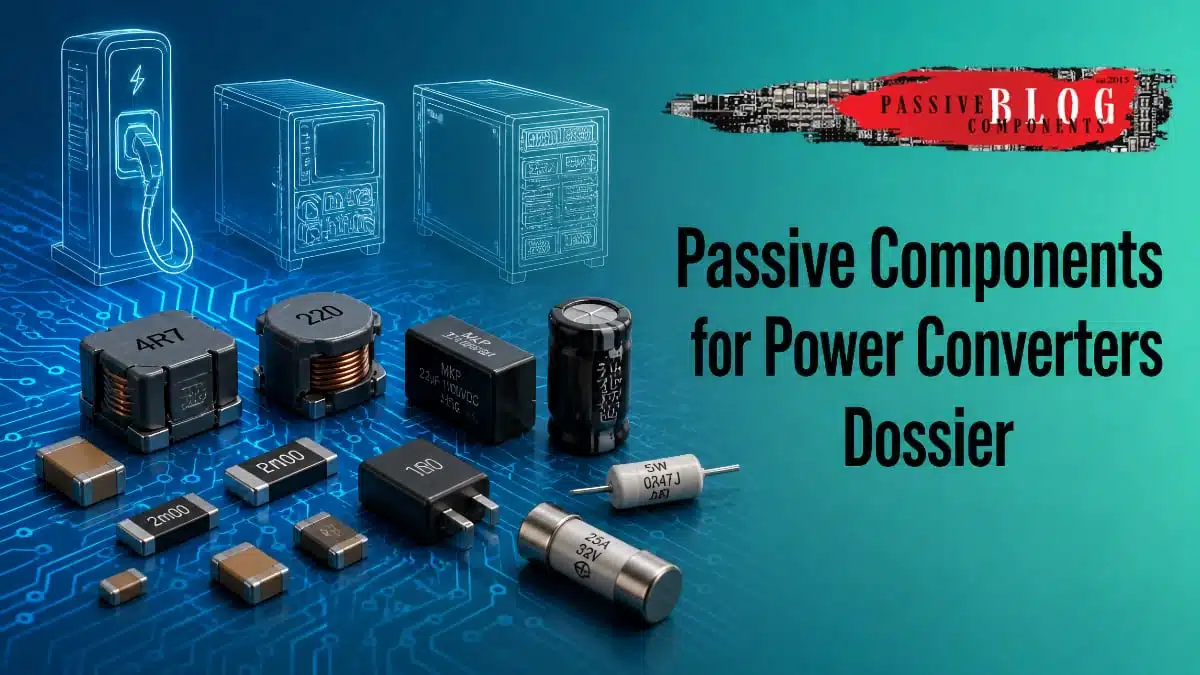
Passive Components Blog has released the Passive Components for Power Converters Dossier, a 63‑page, application‑driven analysis of how passive components shape modern power converter design between June 2025 and June 2026.
From AI data‑center racks and 800 V EV traction inverters to PV string inverters, industrial drives and high‑density USB‑C adapters, this dossier explains how capacitors, magnetics, resistors, EMI filters and protection devices have moved from “catalogue afterthoughts” to first‑order constraints on efficiency, power density, reliability and compliance.
What the dossier covers
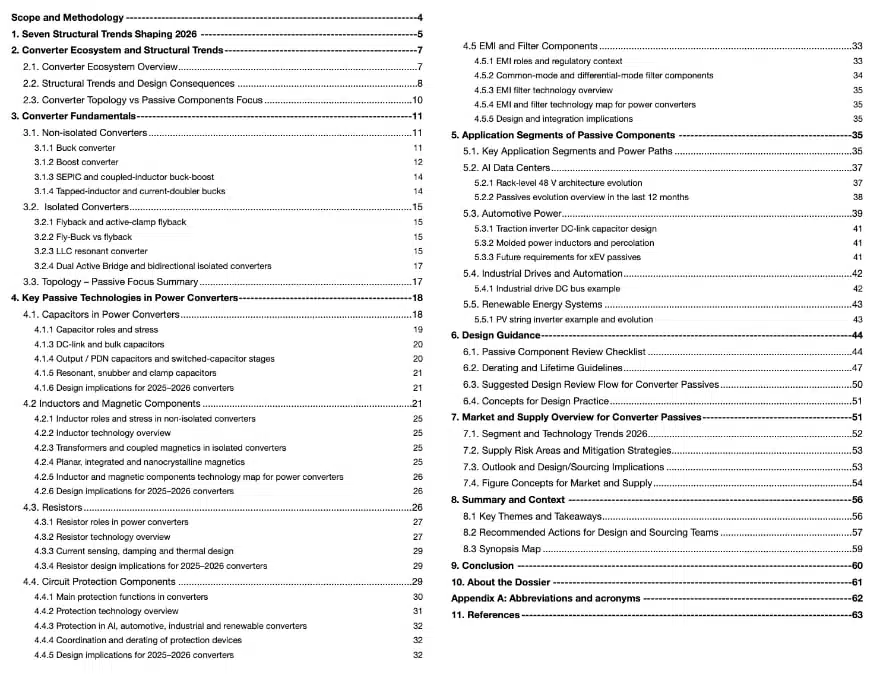
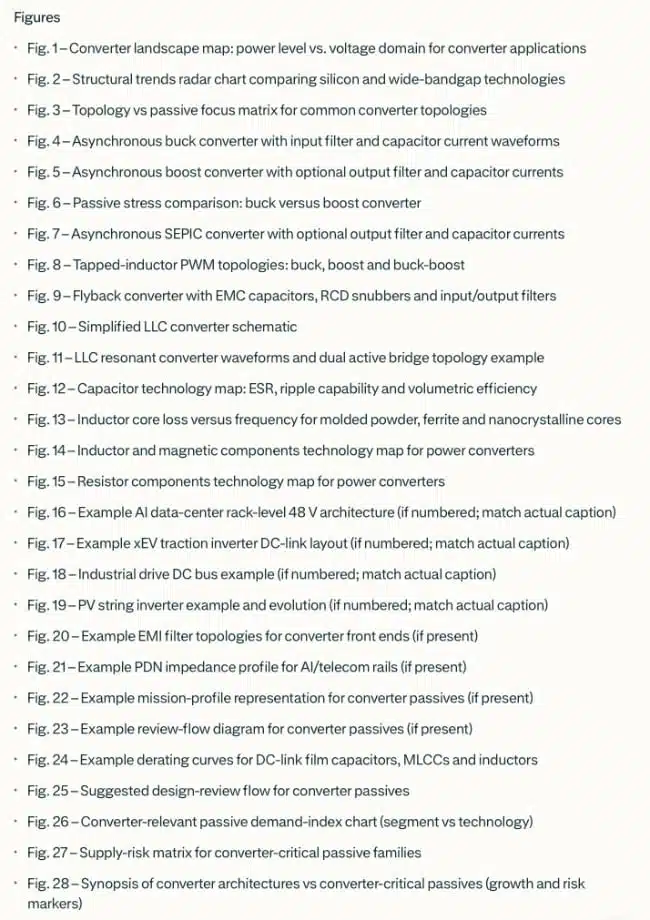
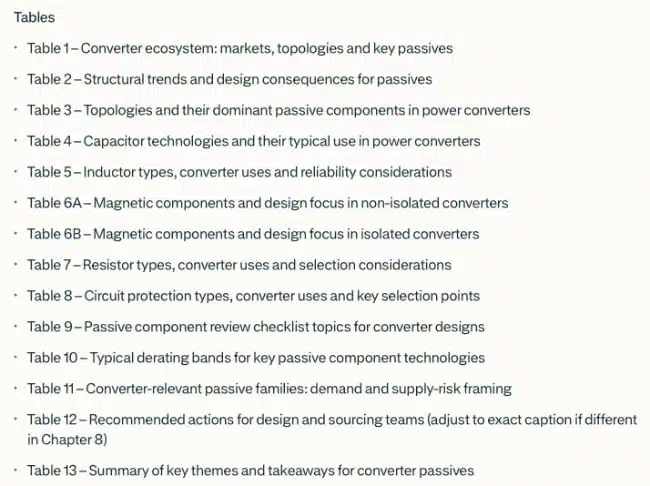
The Passive Components for Power Converters Dossier is a comprehensive annual report focused on converter‑critical passive components across the main power‑electronics ecosystems of 2026. It combines topology fundamentals, component‑technology deep dives, application chapters and design/sourcing guidance into one reference you can use all year. Structured into eleven chapters plus an abbreviations appendix, the dossier covers:
Seven structural trends shaping 2026 converters
How dynamic impedance engineering, wide‑bandgap devices, planar/integrated magnetics, polymer and film DC‑link capacitors, molded‑inductor reliability, and bidirectional/switch‑capacitor architectures are changing passive‑component requirements and failure modes.
Converter ecosystem & topology fundamentals
A landscape view that maps AI data centers, automotive, industrial, renewable, telecom and consumer adapters into power/voltage clusters, followed by a compact review of the main non‑isolated and isolated converter topologies and their dominant passive “hot spots”.
Key passive technologies in real converters
Application‑centric chapters for capacitors, inductors and magnetics, resistors, circuit‑protection components and EMI/filter parts. Each family is covered in terms of roles, stress mechanisms, technology options, derating rules, failure modes and 2025–2026 shifts in design practice.
Application‑segment chapters for converter passives
Dedicated sections describe how passives are actually deployed and stressed in:
- AI data‑center racks and 48 V bus architectures
- Automotive xEV power paths (OBC, DC/DC, traction inverters, 48 V rails)
- Industrial drives and factory automation
- PV and storage/renewable energy systems
- High‑volume adapters and chargers
Design‑engineer guidance and checklists
A practical review checklist for converter passives, derating and lifetime guidelines by component family, and a suggested design‑review flow that ties mission profiles, hotspot temperatures and vendor life models back to concrete DC‑link, magnetics, EMI and protection choices.
Market and supply‑side view for converter passives
A qualitative 2025–2026 view of segment and technology trends, demand concentration and supply‑risk areas specific to converter‑relevant passives, plus an outlook on how these shifts affect design and sourcing decisions through the 2026 design cycle.
Key questions the dossier answers
- Which converter topologies and voltage/power domains are driving the most demanding requirements for DC‑link capacitors, output/PDN networks, magnetics, EMI filters and protection chains in 2026?
- How do GaN/SiC transitions and higher switching frequencies redistribute loss, thermal and EMI constraints from semiconductors into magnetics, DC‑link capacitors and layout‑sensitive passives?
- Where do polymer, hybrid aluminum, film and MLCC technologies each make the most sense in DC‑link, output, resonant, snubber and switched‑capacitor roles?
- What are the emerging reliability concerns (e.g. molded‑inductor percolation, high‑hotspot operation of film DC‑link banks) and how should derating and qualification be adapted?
- For AI racks, xEV powertrains, industrial drives, PV strings and adapters, which passive families actually set efficiency, lifetime and EMC limits – and which can remain catalogue choices?
- How can design and sourcing teams use a shared checklist and review flow to make converter‑passive decisions traceable to mission profiles, thermal margins and supply risk?
Who should read it
- Power‑electronics design engineers architecting ACDC front ends, DC/DC stages and board‑level power for AI servers, EVs, industrial drives, PV/storage systems, telecom rectifiers and high‑density adapters who need converter‑specific passive guidance rather than generic component datasheets.
- Component engineers and technology managers owning approved‑component lists and reliability rules for DC‑link and output capacitors, inductors and magnetics, EMI filters, sensing/damping resistors and protection components in 2026‑era platforms.
- Sourcing and category managers managing risk, qualification and supplier strategies for converter‑relevant passives, and needing a concise, application‑aware view of which capacitor, magnetic, resistor, EMI and protection families are becoming structurally critical vs. commodity.
- Product and platform owners planning new power‑conversion platforms and wanting to understand how topology, bus voltages and mission profiles implicitly lock in certain passive‑component families and supply exposures.
Why it stands apart
Unlike generic “power electronics” or component‑level reports, this dossier is converter‑centric and application‑led:
- It starts from real power paths (PFC + LLC, OBC/DC‑link, 48 V bus + multiphase POL, PV string + DC/DC, etc.) and maps exactly which passive families become first‑order constraints in each case.
- It combines topology fundamentals, component‑technology maps, application chapters and design checklists in one volume, so engineers and sourcing teams can work from the same set of visuals and terminology.
- It treats passives not as isolated parts, but as an ecosystem: DC‑link banks, output/PDN networks, magnetics, EMI filters, current‑sense and damping resistors, and protection chains are always discussed in context of mission profile, control strategy and packaging.
- A dedicated design‑guidance chapter and worked examples (e.g. a 3 kW ACDC front end) show how to turn “good practice” statements on derating and lifetime into concrete design and review actions.
The result is a compact, high‑density reference that can be read in an afternoon and used throughout the year for architecture, design and sourcing decisions around passives in power converters.
Availability
The Passive Components for Power Components Technology Dossier is available now at 699 EUR exclusively from passive-components.eu as a paid download.
To learn more about other available dossiers and purchase your copy, visit the Technology Dossiers page on the passive-components.eu blog.