









In this article, Dr. Vladimir Azbel presents a virtual anode thermal model that allows engineers to evaluate how far a tantalum anode design can be minimized while preserving safe forming conditions and reducing the risk of local overheating, stress accumulation, and subsequent DCL instability.
Modern tantalum capacitors are under constant pressure to shrink in size while maintaining or even increasing capacitance and operating voltage. Design miniaturization, however, is not just a question of reducing anode size or pellet mass. It directly affects the local structure of the porous anode, especially the geometry of interparticle necks, and with that the structural and thermal safety margin of the component.
Why miniaturization is not just about size
Miniaturization typically involves using higher-CVg powders and adjusting pressing density, anode mass, sintering regime, and forming voltage. At the same time, it unavoidably modifies:
- The geometry of interparticle necks
- The local heat flow paths
- The mechanical connection between tantalum particles
Interparticle necks are critical zones where current flow, heat flow, and mechanical connection all intersect. As the geometrical reserve of these necks decreases, there is increasing risk of:
- Local overheating
- Increased mechanical stresses
- Higher defectivity of the oxide film and interface zone
Interparticle necks are one of the most critical zones of the anode. Current flow, heat flow, and the mechanical connection between tantalum particles all pass through them. During formation, an anodic Ta₂O₅ oxide film grows on the tantalum surface, and this growth does not occur in free volume, but inside a real porous structure constrained by the sizes of the necks, pores, and contact zones.
Therefore, during design miniaturization, it is important to evaluate not only whether the required capacitance is achieved, but also how closely the growing oxide film approaches the geometrical limitations of the interparticle neck. The smaller the geometrical reserve, the higher the sensitivity of the anode to forming conditions, electrolyte conductivity, forming current, and local overheating.
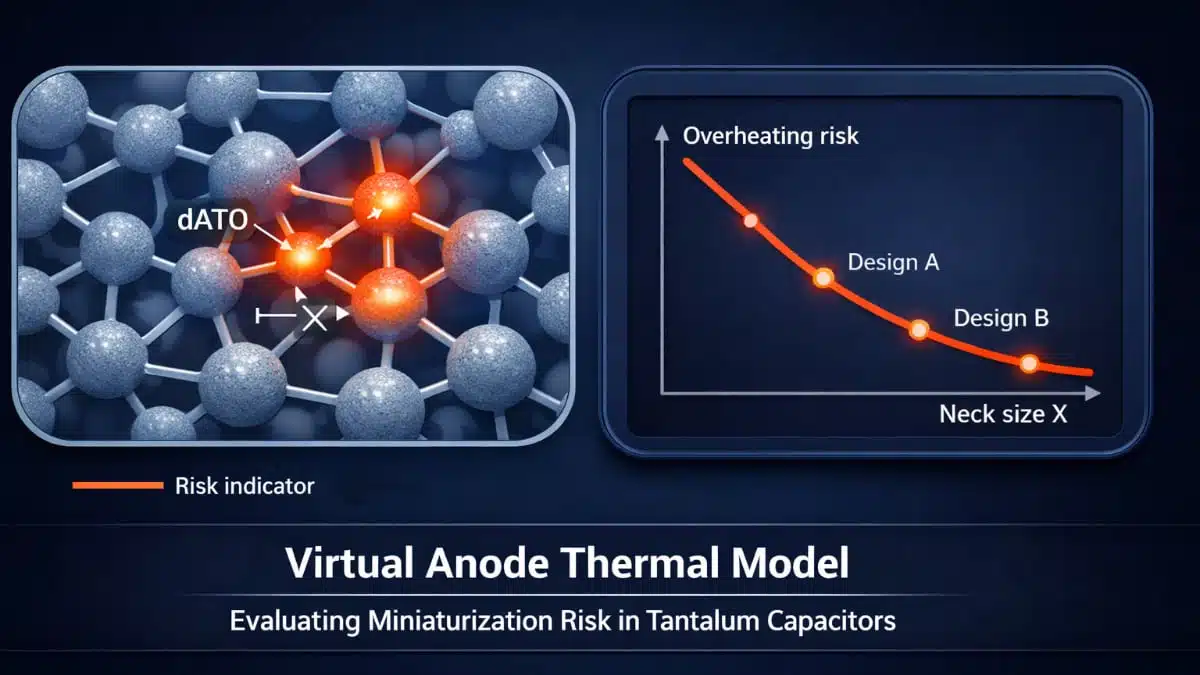
For a visual analysis of this effect, a dimensionless parameter was added to the virtual anode thermal model:
ψ = dATO / X
where dATO is the thickness of the amorphous Ta₂O₅ film, and X is the characteristic size of the metallic neck.
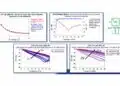
The quantities dATO and X are included in the model parameter Δ, which is used as an indicator of local overheating risk. At the same time, ψ = dATO / X is used as a visual geometrical indicator of their ratio. It shows how closely the thickness of the growing anodic oxide film approaches the characteristic size of the interparticle neck and allows a visual assessment of how changes in neck geometry, under the same forming conditions, affect the value of Δ.
In this sense, the parameter ψ can be considered an indirect indicator of the increasing risk of stress accumulation and possible stress relaxation as forming voltage increases. The more strongly the oxide film occupies the available geometrical scale of the neck, the higher the probability of local growth of mechanical stresses in the Ta / Ta₂O₅ / interface-zone system.
This is especially important for minimized designs. Such a design may maintain the required capacitance and formally meet the electrical requirements, while still having a smaller structural and thermal reserve in the interparticle neck region. In this case, even a small change in electrolyte conductivity or forming current can significantly affect the local thermal balance and the stability of the oxide film.
The virtual model makes it possible to analyze these factors together.
Key idea of the virtual anode thermal model
The virtual model links together:
- Geometry of the porous structure
- Interparticle neck size
- Anodic TaO oxide-film thickness
- Electrolyte conductivity
- Forming current and forming voltage
The model introduces a dimensionless parameter that combines oxide-film thickness and neck size as an indicator of local overheating risk. In parallel, a geometrical indicator based on the ratio of oxide-film thickness to neck size provides a clear visual sense of how closely the growing oxide approaches the geometric limits of the neck.
This makes it possible to see not only whether the required capacitance is achieved, but also how much structural and thermal reserve remains in the interparticle-neck region under given forming conditions.
An engineering decision-support tool, not a predictor
A central point of the article is that the model is not intended to give absolute numerical predictions of overheating or DCL degradation. Instead, its purpose is comparative engineering analysis:
- To evaluate how structural and thermal safety margin changes when geometry or process parameters are varied
- To compare alternative miniaturization and forming recipes
- To identify when the design is approaching a critical reduction in structural/thermal reserve
In other words, the model is a decision-support indicator that helps engineers choose more robust technological paths rather than search for a single “correct” number.
Practical questions the model can answer
By combining structural, thermal, and process parameters in one framework, the virtual anode thermal model helps address practical questions such as:
- How far can we minimize anode geometry without crossing a dangerous threshold for local overheating?
- Is it more effective to reduce risk by lowering forming current, changing electrolyte conductivity, adjusting forming-voltage steps, or preserving larger neck geometry?
- How do changes in powder characteristics, sintering, or pressing translate into structural and thermal reserve at the neck level?
A minimized design may formally satisfy electrical requirements (capacitance, DCL, etc.) while having a significantly smaller structural and thermal reserve. The model helps identify such borderline designs early in development.
Model availability
The Excel-based Virtual Anode Thermal Model used in this work is available as an engineering tool for comparative and visual analysis. It allows users to:
- Visualize how changes in anode geometry and forming conditions affect local overheating risk
- Combine structural and process parameters in a single analysis framework
- Support design and process decisions for safer miniaturization