







Passive Components Blog
No Result
View All Result
  • Home
  • NewsFilter
    • All
    • Aerospace & Defence
    • Antenna
    • Applications
    • Automotive
    • Capacitors
    • Circuit Protection Devices
    • electro-mechanical news
    • Filters
    • Fuses
    • Inductors
    • Industrial
    • Integrated Passives
    • inter-connect news
    • Market & Supply Chain
    • Market Insights
    • Medical
    • Modelling and Simulation
    • New Materials & Supply
    • New Technologies
    • Non-linear Passives
    • Oscillators
    • Passive Sensors News
    • Resistors
    • RF & Microwave
    • Telecommunication
    • Weekly Digest

    Using a Virtual Anode Thermal Model to Evaluate Miniaturization Risk in Tantalum Capacitors

    Bourns Introduced High-Current Coupled Inductor for 48 V Hybrid and IBC Converters

    Würth Elektronik Expands Nanocrystalline Cable Cores for Broadband EMI Suppression

    High‑Speed Supercapacitor Balancing for AI Data Center Power Systems

    Bourns Introduced Automotive TVS Diodes for Compact ESD Protection

    EMC‑Compliant PCB and Connector Design Guidelines

    Practical Value of Structural Diagnostics for Tantalum Capacitor Anodes

    Hall-Effect Sensing for Harsh Environments: TT Electronics Selected in NASA’s Dragonfly Fan

    Bourns Releases Automotive Gate Driver Transformer for Isolated Power

    Trending Tags

    • Ripple Current
    • RF
    • Leakage Current
    • Tantalum vs Ceramic
    • Snubber
    • Low ESR
    • Feedthrough
    • Derating
    • Dielectric Constant
    • New Products
    • Market Reports
  • VideoFilter
    • All
    • Antenna videos
    • Capacitor videos
    • Circuit Protection Video
    • Filter videos
    • Fuse videos
    • Inductor videos
    • Inter-Connect Video
    • Non-linear passives videos
    • Oscillator videos
    • Passive sensors videos
    • Resistor videos

    EMC‑Compliant PCB and Connector Design Guidelines

    Why Isolated DC/DC Power Supplies Fail Late, Würth Elektronik Podcast

    Designing 800 V DC EMC Filters: Calculation, Simulation and Measurement

    Current Sense Transformer Datasheet and Design‑in Guide

    Designing a USB Type‑C Flyback Planar Transformer with Frenetic’s Planar Tool

    Magnetics Design in High‑Frequency GaN Converters

    Qi2 Wireless Charging: Inductors, Capacitors and EMC Filters

    Two‑capacitor paradox explained for engineers

    Capacitances of Nonlinear MLCCs: What Datasheets Don’t Tell You

    Trending Tags

    • Capacitors explained
    • Inductors explained
    • Resistors explained
    • Filters explained
    • Application Video Guidelines
    • EMC
    • New Products
    • Ripple Current
    • Simulation
    • Tantalum vs Ceramic
  • Knowledge Blog
  • DossiersNew
  • Suppliers
    • Who is Who
  • PCNS
    • PCNS 2025
    • PCNS 2023
    • PCNS 2021
    • PCNS 2019
    • PCNS 2017
  • Events
  • Home
  • NewsFilter
    • All
    • Aerospace & Defence
    • Antenna
    • Applications
    • Automotive
    • Capacitors
    • Circuit Protection Devices
    • electro-mechanical news
    • Filters
    • Fuses
    • Inductors
    • Industrial
    • Integrated Passives
    • inter-connect news
    • Market & Supply Chain
    • Market Insights
    • Medical
    • Modelling and Simulation
    • New Materials & Supply
    • New Technologies
    • Non-linear Passives
    • Oscillators
    • Passive Sensors News
    • Resistors
    • RF & Microwave
    • Telecommunication
    • Weekly Digest

    Using a Virtual Anode Thermal Model to Evaluate Miniaturization Risk in Tantalum Capacitors

    Bourns Introduced High-Current Coupled Inductor for 48 V Hybrid and IBC Converters

    Würth Elektronik Expands Nanocrystalline Cable Cores for Broadband EMI Suppression

    High‑Speed Supercapacitor Balancing for AI Data Center Power Systems

    Bourns Introduced Automotive TVS Diodes for Compact ESD Protection

    EMC‑Compliant PCB and Connector Design Guidelines

    Practical Value of Structural Diagnostics for Tantalum Capacitor Anodes

    Hall-Effect Sensing for Harsh Environments: TT Electronics Selected in NASA’s Dragonfly Fan

    Bourns Releases Automotive Gate Driver Transformer for Isolated Power

    Trending Tags

    • Ripple Current
    • RF
    • Leakage Current
    • Tantalum vs Ceramic
    • Snubber
    • Low ESR
    • Feedthrough
    • Derating
    • Dielectric Constant
    • New Products
    • Market Reports
  • VideoFilter
    • All
    • Antenna videos
    • Capacitor videos
    • Circuit Protection Video
    • Filter videos
    • Fuse videos
    • Inductor videos
    • Inter-Connect Video
    • Non-linear passives videos
    • Oscillator videos
    • Passive sensors videos
    • Resistor videos

    EMC‑Compliant PCB and Connector Design Guidelines

    Why Isolated DC/DC Power Supplies Fail Late, Würth Elektronik Podcast

    Designing 800 V DC EMC Filters: Calculation, Simulation and Measurement

    Current Sense Transformer Datasheet and Design‑in Guide

    Designing a USB Type‑C Flyback Planar Transformer with Frenetic’s Planar Tool

    Magnetics Design in High‑Frequency GaN Converters

    Qi2 Wireless Charging: Inductors, Capacitors and EMC Filters

    Two‑capacitor paradox explained for engineers

    Capacitances of Nonlinear MLCCs: What Datasheets Don’t Tell You

    Trending Tags

    • Capacitors explained
    • Inductors explained
    • Resistors explained
    • Filters explained
    • Application Video Guidelines
    • EMC
    • New Products
    • Ripple Current
    • Simulation
    • Tantalum vs Ceramic
  • Knowledge Blog
  • DossiersNew
  • Suppliers
    • Who is Who
  • PCNS
    • PCNS 2025
    • PCNS 2023
    • PCNS 2021
    • PCNS 2019
    • PCNS 2017
  • Events
No Result
View All Result
Passive Components Blog
No Result
View All Result

Using a Virtual Anode Thermal Model to Evaluate Miniaturization Risk in Tantalum Capacitors

24.6.2026
Reading Time: 6 mins read
A A

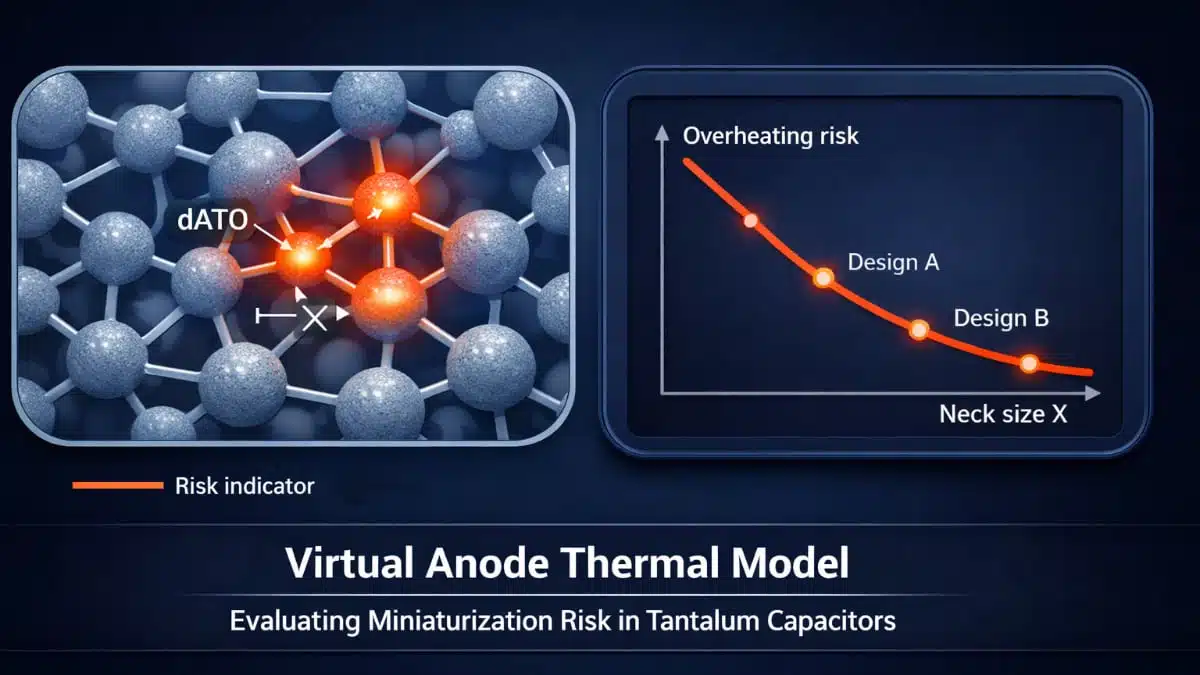
In this article, Dr. Vladimir Azbel presents a virtual anode thermal model that allows engineers to evaluate how far a tantalum anode design can be minimized while preserving safe forming conditions and reducing the risk of local overheating, stress accumulation, and subsequent DCL instability.

Modern tantalum capacitors are under constant pressure to shrink in size while maintaining or even increasing capacitance and operating voltage. Design miniaturization, however, is not just a question of reducing anode size or pellet mass. It directly affects the local structure of the porous anode, especially the geometry of interparticle necks, and with that the structural and thermal safety margin of the component.

RelatedPosts

Practical Value of Structural Diagnostics for Tantalum Capacitor Anodes

Mechanical SSC Testing as a Structural Diagnostic Tool for Tantalum Capacitor Anodes

Using Stress–Strain Curves to Diagnose Tantalum Powders for Capacitors

Why miniaturization is not just about size

Miniaturization typically involves using higher-CVg powders and adjusting pressing density, anode mass, sintering regime, and forming voltage. At the same time, it unavoidably modifies:

  • The geometry of interparticle necks
  • The local heat flow paths
  • The mechanical connection between tantalum particles

Interparticle necks are critical zones where current flow, heat flow, and mechanical connection all intersect. As the geometrical reserve of these necks decreases, there is increasing risk of:

  • Local overheating
  • Increased mechanical stresses
  • Higher defectivity of the oxide film and interface zone

Interparticle necks are one of the most critical zones of the anode. Current flow, heat flow, and the mechanical connection between tantalum particles all pass through them. During formation, an anodic Ta₂O₅ oxide film grows on the tantalum surface, and this growth does not occur in free volume, but inside a real porous structure constrained by the sizes of the necks, pores, and contact zones.

Therefore, during design miniaturization, it is important to evaluate not only whether the required capacitance is achieved, but also how closely the growing oxide film approaches the geometrical limitations of the interparticle neck. The smaller the geometrical reserve, the higher the sensitivity of the anode to forming conditions, electrolyte conductivity, forming current, and local overheating.

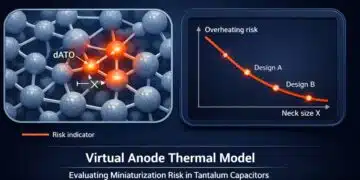
For a visual analysis of this effect, a dimensionless parameter was added to the virtual anode thermal model:

ψ = dATO / X

where dATO is the thickness of the amorphous Ta₂O₅ film, and X is the characteristic size of the metallic neck.

The quantities dATO and X are included in the model parameter Δ, which is used as an indicator of local overheating risk. At the same time, ψ = dATO / X is used as a visual geometrical indicator of their ratio. It shows how closely the thickness of the growing anodic oxide film approaches the characteristic size of the interparticle neck and allows a visual assessment of how changes in neck geometry, under the same forming conditions, affect the value of Δ.

In this sense, the parameter ψ can be considered an indirect indicator of the increasing risk of stress accumulation and possible stress relaxation as forming voltage increases. The more strongly the oxide film occupies the available geometrical scale of the neck, the higher the probability of local growth of mechanical stresses in the Ta / Ta₂O₅ / interface-zone system.

This is especially important for minimized designs. Such a design may maintain the required capacitance and formally meet the electrical requirements, while still having a smaller structural and thermal reserve in the interparticle neck region. In this case, even a small change in electrolyte conductivity or forming current can significantly affect the local thermal balance and the stability of the oxide film.

The virtual model makes it possible to analyze these factors together.

Key idea of the virtual anode thermal model

The virtual model links together:

  • Geometry of the porous structure
  • Interparticle neck size
  • Anodic TaO oxide-film thickness
  • Electrolyte conductivity
  • Forming current and forming voltage

The model introduces a dimensionless parameter that combines oxide-film thickness and neck size as an indicator of local overheating risk. In parallel, a geometrical indicator based on the ratio of oxide-film thickness to neck size provides a clear visual sense of how closely the growing oxide approaches the geometric limits of the neck.

This makes it possible to see not only whether the required capacitance is achieved, but also how much structural and thermal reserve remains in the interparticle-neck region under given forming conditions.

An engineering decision-support tool, not a predictor

A central point of the article is that the model is not intended to give absolute numerical predictions of overheating or DCL degradation. Instead, its purpose is comparative engineering analysis:

  • To evaluate how structural and thermal safety margin changes when geometry or process parameters are varied
  • To compare alternative miniaturization and forming recipes
  • To identify when the design is approaching a critical reduction in structural/thermal reserve

In other words, the model is a decision-support indicator that helps engineers choose more robust technological paths rather than search for a single “correct” number.

Practical questions the model can answer

By combining structural, thermal, and process parameters in one framework, the virtual anode thermal model helps address practical questions such as:

  • How far can we minimize anode geometry without crossing a dangerous threshold for local overheating?
  • Is it more effective to reduce risk by lowering forming current, changing electrolyte conductivity, adjusting forming-voltage steps, or preserving larger neck geometry?
  • How do changes in powder characteristics, sintering, or pressing translate into structural and thermal reserve at the neck level?

A minimized design may formally satisfy electrical requirements (capacitance, DCL, etc.) while having a significantly smaller structural and thermal reserve. The model helps identify such borderline designs early in development.

Model availability

The Excel-based Virtual Anode Thermal Model used in this work is available as an engineering tool for comparative and visual analysis. It allows users to:

  • Visualize how changes in anode geometry and forming conditions affect local overheating risk
  • Combine structural and process parameters in a single analysis framework
  • Support design and process decisions for safer miniaturization

Virtual Anode Thermal Model

https://doi.org/10.5281/zenodo.19482660

Related

Recent Posts

High‑Speed Supercapacitor Balancing for AI Data Center Power Systems

23.6.2026
37

Practical Value of Structural Diagnostics for Tantalum Capacitor Anodes

22.6.2026
22

Knowles Expands High‑Q Ceramic Core Inductors for RF designs

19.6.2026
22

TrendForce: CSP in‑house AI ASIC Boom Reshapes Capacitor Demand

18.6.2026
107

Samsung Introduces Automotive 1206 100uF X7T MLCC for Power Rails in ADAS and SoCs

17.6.2026
32

YMIN Hybrid Aluminum Capacitors for Automotive LiDAR Power Rails

17.6.2026
30

Samsung Presents Ultra‑Thin Silicon Capacitors for AI and Server PDN

17.6.2026
68

YAGEO Introduces 310VAC SMD Y2 Safety MP Capacitors for Compact EMI Filtering

16.6.2026
34

DMASS: European Components Distribution Returns To Growth In Q1 2026

16.6.2026
58

Upcoming Events

Jun 30
17:00 - 18:00 CEST

PSMA Capacitor Committee Webinar: High Voltage Pulse Capacitors

Jul 14
16:00 - 17:00 CEST

EMC Design Essentials: Mastering Varistors and Common Mode Chokes

Jul 21
16:00 - 17:00 CEST

Safety by design: X and Y Interference suppression capacitors for power line filters

View Calendar

Popular Posts

  • Boost Converter Design and Calculation

    0 shares
    Share 0 Tweet 0
  • Buck Converter Design and Calculation

    0 shares
    Share 0 Tweet 0
  • LLC Resonant Converter Design and Calculation

    0 shares
    Share 0 Tweet 0
  • Flyback Converter Design and Calculation

    0 shares
    Share 0 Tweet 0
  • MLCC and Ceramic Capacitors

    0 shares
    Share 0 Tweet 0
  • Earthing Systems and IEC Classification Explained

    0 shares
    Share 0 Tweet 0
  • Nvidia Vera Rubin: Why One AI Rack Needs So Many More MLCC Capacitors

    0 shares
    Share 0 Tweet 0
  • Dual Active Bridge (DAB) Topology

    0 shares
    Share 0 Tweet 0
  • SEPIC Converter Design and Calculation

    0 shares
    Share 0 Tweet 0
  • MLCC Case Sizes Standards Explained

    0 shares
    Share 0 Tweet 0

Newsletter Subscription


Passive Components Blog

© EPCI - Leading Passive Components Educational and Information Site

  • Home
  • Privacy Policy
  • EPCI Membership & Advertisement
  • About

No Result
View All Result
  • Home
  • Knowledge Blog
  • Dossiers
  • PCNS

© EPCI - Leading Passive Components Educational and Information Site

This website uses cookies. By continuing to use this website you are giving consent to cookies being used. Visit our Privacy and Cookie Policy.
Go to mobile version