
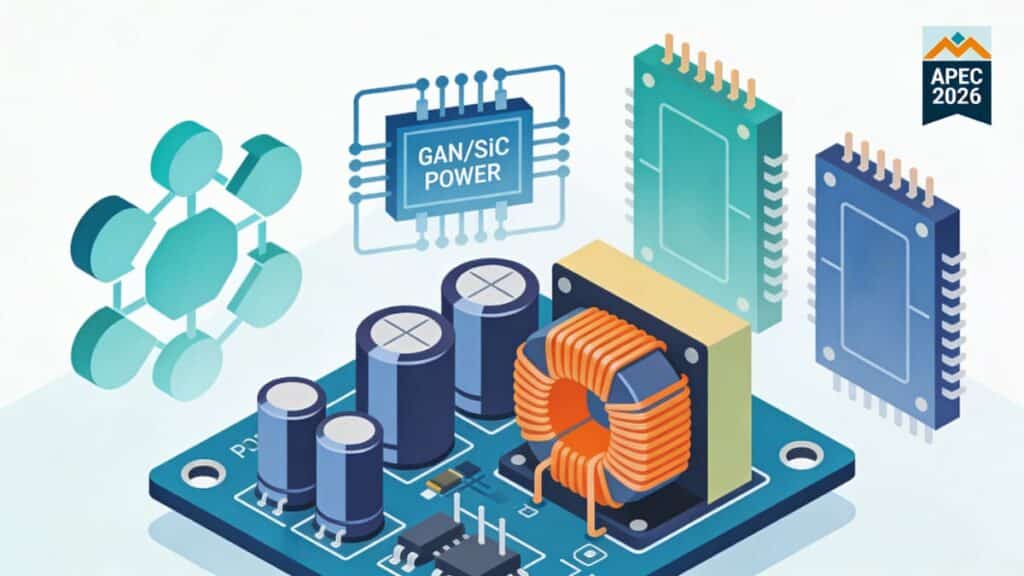
The Applied Power Electronics Conference (APEC) 2026 confirmed how quickly power conversion is evolving across AI data centers, EVs, industrial automation, and robotics.
While most headlines focus on wide‑bandgap semiconductors and new converter topologies, these changes have direct and sometimes disruptive consequences for passive components. This article reviews the main APEC 2026 power‑electronics trends and translates them into concrete implications for capacitors, resistors and inductors / magnetics, as well as for reliability and supply‑chain planning.
APEC 2026: Power electronics themes that drive passives
APEC 2026 reinforced several core themes: relentless pressure for higher efficiency, higher power density, smaller solution size, and simpler design‑in. Device vendors showcased GaN and SiC switches, integrated power stages, and new control ICs targeting AI data centers, EV on‑board chargers, robotics, industrial automation, and high‑end appliances. Bidirectional switch concepts, in particular, were highlighted as a way to enable new topologies such as matrix converters and single‑stage AC‑DC architectures.
For passive components, these system‑level themes translate into:
- Higher switching frequencies, which reduce magnetic size but demand low‑loss cores and lower parasitics.
- Higher bus voltages (400–800 V and beyond) and more bidirectional energy flow, which change stress profiles on capacitors and magnetics.
- Tighter EMI and functional‑safety requirements, pushing more sophisticated filtering, isolation and surge protection components into every design.
Wide‑bandgap and high‑frequency operation: impact on magnetics
GaN and SiC devices on display at APEC 2026 operate at higher switching frequencies and support higher power density than traditional silicon solutions. Semiconductor vendors highlighted flyback and other converter topologies switching up to around 150 kHz to shrink transformer size and meet low standby consumption targets. This frequency increase is moderate compared with RF, but significant enough to impact transformer and inductor design.
For magnetics, the implications include:
- Stronger demand for low‑loss core materials, optimized for tens to hundreds of kilohertz, to keep core losses under control as frequency and flux density rise.
- More planar transformers and integrated magnetics co‑packaged with power devices to minimize loop inductance, improve EMI behavior, and save board space.
- Increased focus on isolation components that combine high working voltages with reinforced insulation, driven by EV, industrial and data‑center safety requirements.
Design engineers will need detailed frequency‑dependent loss data, parasitic models, and clear isolation specs from magnetics vendors to exploit these power‑density gains without compromising efficiency or reliability.
Advanced packaging and copackaged solutions: passives move into the module
Another clear APEC 2026 theme is advanced packaging: power stages, drivers and often magnetics are being brought closer together, or even co‑packaged, to reduce parasitics and simplify design. Program and topic lists for the conference also highlight devices and components as a dedicated technical focus area, reinforcing that packaging is now a major innovation vector for power electronics.
From a passive‑component perspective, this leads to several trends:
- Higher adoption of integrated power modules where critical magnetics and decoupling elements are part of the “black box”, reducing discrete BOM count but raising the importance of module‑level reliability.
- New form factors and mounting concepts for passives, optimized for ultra‑short interconnects, thermal performance and automated assembly into power modules.
- Closer collaboration between semiconductor and passive suppliers, as module designers must co‑optimize magnetic design, capacitive decoupling, creepage/clearance and thermal paths.
For independent passive suppliers, this creates both risk and opportunity: losing some discrete sockets, but gaining value in custom magnetics, high‑performance capacitors and module‑ready subassemblies.
Application drivers: EVs, AI data centers, industry and robotics
The APEC 2026 semiconductor vendors emphasize AI data centers, EVs/e‑mobility, industrial automation, and robotics as primary target applications for new power devices and architectures. Many showcased solutions address 48 V intermediate bus architectures, high‑voltage battery systems, and compact isolated supplies for automotive and industrial control.
These application domains have distinct passive‑component implications:
- EV and e‑mobility: higher‑voltage DC‑link and snubber capacitors, high‑reliability magnetics for traction inverters and on‑board chargers, and robust surge protection (varistors, TVS) that meet automotive EMC and safety standards.
- AI data centers: high‑frequency inductors for multiphase VRMs, bulk capacitors with low ESR and high ripple capability, and dense EMI filters to handle fast transients and high current slew rates.
- Industrial automation and robotics: compact, high‑isolation transformers, DC‑link and buffer capacitors for servo drives, and robust resistors and shunt solutions for accurate current sensing in harsh environments.
In all cases, long lifetime, elevated temperature ratings, and robust surge/overvoltage margins become minimum expectations rather than premium options.
Market outlook: growing demand for advanced passives
Beyond APEC itself, recent market research underscores that passive components are entering a growth phase driven by automotive, telecommunication and consumer‑electronics demand. One 2026 market analysis estimates the passive electronic components market at over 36 billion USD in 2026, rising above 50 billion USD by 2033 with a mid‑single‑digit CAGR. Capacitors are expected to account for more than half of the market value, reflecting their central role in power conversion, filtering and energy storage.
Key demand drivers include:
- Expansion of 5G infrastructure and connected devices, requiring more RF and high‑frequency passives.
- Strong growth in EVs and charging infrastructure, which use large numbers of high‑voltage and high‑reliability capacitors, resistors and magnetics.
- Ongoing miniaturization and higher functional density in consumer electronics, driving demand for compact, high‑CV MLCCs and integrated passive arrays.
At the same time, other analyses warn that passive components could become a supply‑risk hotspot around 2026, as server, GPU, and EV demand rise faster than capacity expansions and as material costs trend upward.
Consequences for specific passive categories
Capacitors
APEC 2026 system trends and market data point to several capacitor directions:
- Higher‑voltage MLCCs and film capacitors for DC‑link, PFC and snubber functions in SiC/GaN‑based designs, balancing size with reliability and surge capability.
- Polymer and hybrid electrolytics for low ESR, high ripple current, and temperature robustness in compact converters and VRM stages.
- Specialized capacitors for 48 V architectures and bidirectional converters, where they must handle frequent cycling, high ripple and potentially new stress profiles in single‑stage topologies.
Designers will need to pay closer attention to derating strategies, ripple current ratings, and lifetime modeling, particularly where capacitors sit close to hot power devices in advanced packaging schemes.
Magnetics and inductors
As switching devices move to higher frequency and advanced topologies, magnetics must match:
- Transformers designed for hundreds of kilohertz, with low core loss, low leakage inductance, and sufficient isolation for automotive and industrial standards.
- Inductors with low DC resistance and carefully controlled saturation behavior to support fast transient response in AI and server power rails.
- Custom and planar magnetics co‑designed for specific modules and packages, where mechanical constraints and thermal interfaces drive the form factor.
Magnetics suppliers that can offer accurate models, digital‑ready design tools and reference designs for new GaN/SiC topologies will be well placed to support these trends.
Resistors and protection devices
While less visible in conference coverage, resistive and protection components also feel the impact:
- High‑power shunt resistors for precise current sensing in EV and industrial drives, with low inductance for high‑frequency performance.
- Surge and overvoltage protection (varistors, TVS, gas arresters) tailored to EV battery systems, fast chargers, and 5G infrastructure, where transient stresses are increasing.
- Integration of resistive elements into modules and sensor assemblies, improving accuracy and reducing parasitic effects in compact systems.
These components support safety, EMC and control accuracy — all essential for the high‑performance power systems emphasized at APEC.
Design‑in strategies for engineers and OEMs
Given the APEC 2026 themes and market context, power‑electronics designers and OEMs should adapt their passive‑component strategies in several ways:
- Engage early with passive suppliers when adopting new GaN/SiC devices or bidirectional topologies, to ensure suitable magnetics, capacitors and protection parts are available and characterized at target frequencies and stresses.
- Revisit derating and lifetime policies, especially for capacitors placed in high‑temperature, high‑ripple locations within dense power modules.
- Plan for supply‑chain robustness by qualifying multiple sources and form factors for critical capacitor and inductor types, anticipating potential constraints in high‑growth segments.
For passive‑component manufacturers, APEC 2026 confirms that value is shifting towards application‑specific, high‑performance parts, custom magnetics, and close co‑development with power‑stage designers.
Conclusion
APEC 2026 underlined that power‑electronics innovation is not only about transistors and controllers: it directly reshapes the landscape for passive components. Higher efficiency, higher power density, and new topologies translate into stricter performance requirements for capacitors, magnetics, resistors and protection devices. At the same time, market studies show robust growth in demand, led by EVs, 5G, AI data centers and industrial automation, but also highlight emerging supply risks for critical passive types.
For engineers, the message is clear: passive components must be treated as strategic design elements co‑optimized with semiconductors and packaging, not as afterthoughts. For passive‑component suppliers, APEC 2026 signals strong opportunities in high‑reliability, high‑frequency, and application‑specific solutions, provided they can keep pace with the rapid evolution of power‑electronics architectures and system‑level expectations.
References
- APEC 2026 showcases advances in power electronics – EDN
- Passive Electronic Components Market Size & Trend, 2026–2033 – Coherent Market Insights
- APEC 2026 coverage – Power Electronics News
- APEC 2026 Topic List / Program Book
- APEC 2026 | TI.com – Texas Instruments
- KYOCERA AVX showcases power‑electronics components at APEC 2026
- Why Passive Components Are Emerging as a 2026 Supply Risk – Fusion Worldwide
- Synopsis of the Global Passive Electronic Components Market Trend – 2026

