
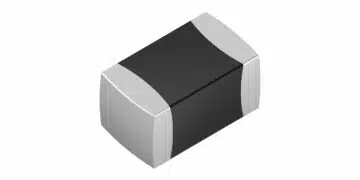


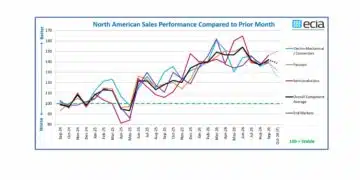



AI server demand is rapidly absorbing high‑end MLCC capacity and manufacturers are considering price increase of the high end MLCC capacitors needed for these applications.
AI server demand: from forecast to capacity stress
The MLCC industry has been discussing the impact of AI servers on capacitor demand for several years, but 2025–2026 is when this demand is visibly stressing available high‑end capacity. Murata has highlighted that AI‑server‑related MLCC demand is on track for a strong double‑digit CAGR toward 2030, driven by the much higher MLCC counts per accelerator board and per rack compared with conventional servers.
An AI accelerator board can easily integrate tens of thousands of MLCCs across point‑of‑load converters, decoupling networks and auxiliary circuits, and a fully populated AI rack multiplies this into the hundreds of thousands of units. This is not just a volume story: data‑center power‑delivery networks favor high‑CV, low‑ESR MLCCs with tight tolerances, which are precisely the segments where effective capacity is hardest to expand quickly.
In recent comments, Murata president Norio Nakajima confirmed that the company has started internal discussions about raising prices for its more advanced MLCCs used in AI servers. Demand from AI data centers is so strong that it is increasingly difficult to match it with existing capacity while also supporting other strategic markets.
At the same time, Murata emphasizes that it is still in the process of gauging the “true demand” profile for AI infrastructure. The company wants better visibility into whether current order momentum is sustainable, or whether there is a risk of a short‑term spike followed by digestion. As of mid‑February 2026, this means that a decision on specific price actions is pending, and there is no formal corporate notice detailing MLCC price revisions.
Spot MLCC prices already moving
Even without an official Murata list‑price change, the broader MLCC market is already showing the typical symptoms of a tightening cycle. Industry reports from Korea and other regions indicate that spot prices for certain MLCC categories have risen by up to roughly 20% in early 2026, led by high‑grade parts for AI, industrial and automotive applications.
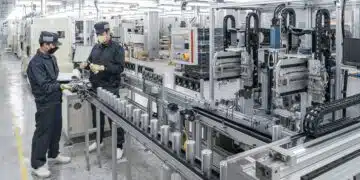
Production line utilization for high‑end MLCCs at leading suppliers is reported to be running at very high levels, effectively close to full for some high‑CV and high‑reliability product segments. At the same time, major manufacturers have remained cautious about adding large new bricks‑and‑mortar capacity after the last boom–bust cycle. The result is a more measured capacity response, where incremental debottlenecking is favored over aggressive greenfield expansions, and where pricing has more room to firm when demand concentrates in specific, higher‑value niches.
The latest AI‑server platforms provide a concrete explanation of why these price discussions are happening now. Moving from general‑purpose servers with around 2 000 MLCCs to training and inference racks with hundreds of thousands of capacitors – and into the million‑parts range for next‑generation Vera Rubin configurations – multiplies MLCC content by orders of magnitude per rack. At the same time, MLCCs are increasingly replacing aluminum polymer capacitors in constrained server footprints, further lifting volumetric demand in exactly those high‑CV, fine‑pitch, high‑reliability grades that are hardest to expand in capacity.
What this means for MLCC users in AI and beyond
For OEMs, Tier‑1s and EMS providers, the combination of doubled inquiries, high utilization and rising spot prices suggests that contractual MLCC pricing for high‑end AI‑server parts is likely to come under upward pressure over the next few quarters. Designs that depend on advanced high‑CV MLCCs for GPU/accelerator power rails, VRMs and board‑level decoupling will be particularly exposed.
From a design‑in and supply‑chain perspective, several measures become advisable:
- Review second‑source options and footprint flexibility for critical MLCC positions in AI and server platforms.
- Engage early with distributors and manufacturers to secure allocations and forecast commitments for data‑center‑grade MLCCs.
- Consider the total cost of ownership of power‑delivery architectures, as incremental improvements in layout or derating can sometimes reduce the absolute MLCC count in hot spots.
For other sectors—automotive, industrial, and consumer—the immediate impact will depend on product mix. Commodity, low‑capacitance MLCCs may remain relatively stable, while high‑CV and special‑construction parts (high temperature, high voltage, high reliability) can see knock‑on effects as capacity is prioritized toward AI‑server demand. The MLCC market is effectively splitting between high‑end segments with structural tightness and more commoditized ranges where pricing remains more competitive.
For the passive components community, AI servers are becoming a key structural driver that interacts with existing trends in automotive electrification and industrial digitalization. Even if Murata ultimately adopts a gradual approach to list‑price adjustments, the signal to the market is clear: high‑end MLCCs for AI infrastructure should be treated as strategic components, with corresponding attention to design, qualification and supply‑chain planning.
From an engineering perspective, the current AI‑driven “MLCC super‑cycle” translates into a higher probability of allocation pressure and selective price moves on advanced MLCC types rather than a uniform, across‑the‑board price hike. Hardware teams working on AI accelerators, high‑density power modules and server motherboards should:
- Plan AVL diversification early across at least two or three tier‑1 MLCC suppliers plus regional alternatives where qualification and application allow, to reduce single‑source exposure on critical case sizes and voltage ratings.
- Design PDNs with realistic second‑source options (slight differences in case size, voltage derating, dielectric or ripple rating) so that last‑minute substitutions remain technically acceptable if the preferred part is constrained.
- Where AI‑rack volume is expected, coordinate long‑term forecasts and, where possible, framework agreements with distributors or OEM procurement to shield key MLCC positions from short‑term spot‑market spikes.
- passive-components
This shifts part of the MLCC risk management into the architecture phase rather than leaving it purely to purchasing after the design is frozen.
Mid‑2026 update – Lead times confirm the tightening cycle.
By mid‑year, additional signals from other MLCC manufacturers support the picture of a structural imbalance in high‑end MLCC supply for AI servers. Holy Stone has warned that demand from AI‑server power subsystems is tightening availability of advanced MLCCs, with lead times now exceeding around 20 weeks and constraints expected to extend into 2027. Taken together with Murata’s internal price discussions and early‑year spot price increases of up to roughly 20% for selected high‑grade MLCC ranges, this suggests that AI‑related MLCCs are entering a multi‑year period of elevated pricing and extended lead times rather than a short‑lived spike.
This strengthens the case for early design collaboration with MLCC suppliers, multi‑sourcing of key values and, where appropriate, evaluation of alternative technologies for non‑critical positions in AI server power trees to preserve flexibility.
References
- Digitimes – “AI server MLCC orders double capacity; Murata considers price increase,” February 18, 2026.
- Bloomberg – “Murata Explores Raising Prices of Key AI Server Component,” February 17, 2026.
- Meyka – “Murata Manufacturing Stock Today, February 18: MLCC Price Hike Talks on AI Boom,” February 17, 2026.
- Investing.com – “Murata raises MLCC growth forecast for AI servers to 30% CAGR,” December 2, 2025.
- Biz Chosun – “AI server boom drives MLCC prices higher as Murata, Samsung split …,” February 7, 2026.
- Market and distributor commentary on MLCC spot price increases and supply tightness, early 2026