




Passive Components Blog
No Result
View All Result
  • Home
  • NewsFilter
    • All
    • Aerospace & Defence
    • Antenna
    • Applications
    • Automotive
    • Capacitors
    • Circuit Protection Devices
    • electro-mechanical news
    • Filters
    • Fuses
    • Inductors
    • Industrial
    • Integrated Passives
    • inter-connect news
    • Market & Supply Chain
    • Market Insights
    • Medical
    • Modelling and Simulation
    • New Materials & Supply
    • New Technologies
    • Non-linear Passives
    • Oscillators
    • Passive Sensors News
    • Resistors
    • RF & Microwave
    • Telecommunication
    • Weekly Digest

    All‑Water Supercapacitor Based on 1‑nm Clay Channels and Nanoconfined Water Electrolyte

    Littelfuse Unveils High‑Current 48V SMD Fuse for AI Data Center Protection

    Modelithics Releases COMPLETE Library v26.2 for Keysight Genesys

    Why Isolated DC/DC Power Supplies Fail Late, Würth Elektronik Podcast

    Wk 23 Electronics Supply Chain Digest

    Power Converter Dossier: Passive Components Design and Selection Guide 2026

    Evans Group Unifies Four High-Rel Capacitor Leaders

    Skeleton Releases Graphene‑Based UPS for AI Data Centers

    Designing 800 V DC EMC Filters: Calculation, Simulation and Measurement

    Trending Tags

    • Ripple Current
    • RF
    • Leakage Current
    • Tantalum vs Ceramic
    • Snubber
    • Low ESR
    • Feedthrough
    • Derating
    • Dielectric Constant
    • New Products
    • Market Reports
  • VideoFilter
    • All
    • Antenna videos
    • Capacitor videos
    • Circuit Protection Video
    • Filter videos
    • Fuse videos
    • Inductor videos
    • Inter-Connect Video
    • Non-linear passives videos
    • Oscillator videos
    • Passive sensors videos
    • Resistor videos

    Why Isolated DC/DC Power Supplies Fail Late, Würth Elektronik Podcast

    Designing 800 V DC EMC Filters: Calculation, Simulation and Measurement

    Current Sense Transformer Datasheet and Design‑in Guide

    Designing a USB Type‑C Flyback Planar Transformer with Frenetic’s Planar Tool

    Magnetics Design in High‑Frequency GaN Converters

    Qi2 Wireless Charging: Inductors, Capacitors and EMC Filters

    Two‑capacitor paradox explained for engineers

    Capacitances of Nonlinear MLCCs: What Datasheets Don’t Tell You

    Tapped Inductor Buck Converter Fundamentals

    Trending Tags

    • Capacitors explained
    • Inductors explained
    • Resistors explained
    • Filters explained
    • Application Video Guidelines
    • EMC
    • New Products
    • Ripple Current
    • Simulation
    • Tantalum vs Ceramic
  • Knowledge Blog
  • DossiersNew
  • Suppliers
    • Who is Who
  • PCNS
    • PCNS 2025
    • PCNS 2023
    • PCNS 2021
    • PCNS 2019
    • PCNS 2017
  • Events
  • Home
  • NewsFilter
    • All
    • Aerospace & Defence
    • Antenna
    • Applications
    • Automotive
    • Capacitors
    • Circuit Protection Devices
    • electro-mechanical news
    • Filters
    • Fuses
    • Inductors
    • Industrial
    • Integrated Passives
    • inter-connect news
    • Market & Supply Chain
    • Market Insights
    • Medical
    • Modelling and Simulation
    • New Materials & Supply
    • New Technologies
    • Non-linear Passives
    • Oscillators
    • Passive Sensors News
    • Resistors
    • RF & Microwave
    • Telecommunication
    • Weekly Digest

    All‑Water Supercapacitor Based on 1‑nm Clay Channels and Nanoconfined Water Electrolyte

    Littelfuse Unveils High‑Current 48V SMD Fuse for AI Data Center Protection

    Modelithics Releases COMPLETE Library v26.2 for Keysight Genesys

    Why Isolated DC/DC Power Supplies Fail Late, Würth Elektronik Podcast

    Wk 23 Electronics Supply Chain Digest

    Power Converter Dossier: Passive Components Design and Selection Guide 2026

    Evans Group Unifies Four High-Rel Capacitor Leaders

    Skeleton Releases Graphene‑Based UPS for AI Data Centers

    Designing 800 V DC EMC Filters: Calculation, Simulation and Measurement

    Trending Tags

    • Ripple Current
    • RF
    • Leakage Current
    • Tantalum vs Ceramic
    • Snubber
    • Low ESR
    • Feedthrough
    • Derating
    • Dielectric Constant
    • New Products
    • Market Reports
  • VideoFilter
    • All
    • Antenna videos
    • Capacitor videos
    • Circuit Protection Video
    • Filter videos
    • Fuse videos
    • Inductor videos
    • Inter-Connect Video
    • Non-linear passives videos
    • Oscillator videos
    • Passive sensors videos
    • Resistor videos

    Why Isolated DC/DC Power Supplies Fail Late, Würth Elektronik Podcast

    Designing 800 V DC EMC Filters: Calculation, Simulation and Measurement

    Current Sense Transformer Datasheet and Design‑in Guide

    Designing a USB Type‑C Flyback Planar Transformer with Frenetic’s Planar Tool

    Magnetics Design in High‑Frequency GaN Converters

    Qi2 Wireless Charging: Inductors, Capacitors and EMC Filters

    Two‑capacitor paradox explained for engineers

    Capacitances of Nonlinear MLCCs: What Datasheets Don’t Tell You

    Tapped Inductor Buck Converter Fundamentals

    Trending Tags

    • Capacitors explained
    • Inductors explained
    • Resistors explained
    • Filters explained
    • Application Video Guidelines
    • EMC
    • New Products
    • Ripple Current
    • Simulation
    • Tantalum vs Ceramic
  • Knowledge Blog
  • DossiersNew
  • Suppliers
    • Who is Who
  • PCNS
    • PCNS 2025
    • PCNS 2023
    • PCNS 2021
    • PCNS 2019
    • PCNS 2017
  • Events
No Result
View All Result
Passive Components Blog
No Result
View All Result

Cornell Dubilier Upgrade its Thinpack Energy Dense Aluminum Electrolytic Capacitors to 5,000 hrs Rated

18.6.2020
Reading Time: 2 mins read
A A

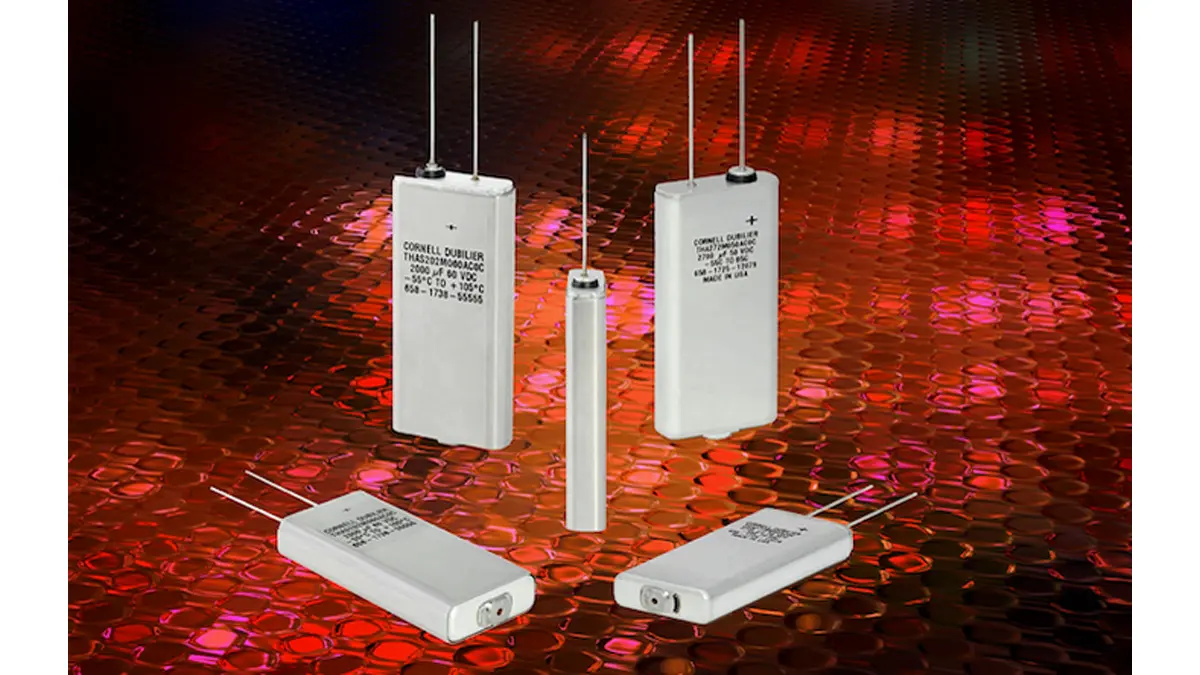
THA and THAS Series Thinpack aluminum electrolytic capacitors deliver the highest-energy density in a low-profile. CDE updates its spec now to 5,000hrs at rated voltage.

First introduced in 2018, Cornell Dubilier Electronics, Inc. (CDE) has made significant design tweaks to their groundbreaking THA and THAS Series Thinpack capacitors. The product updates raise the rated life to 5,000 hours, a 66% increase over the first-generation devices. The key strength of the series is still high energy density. The 85 ºC THA Series Thinpack capacitors are only 8.2mm thick, and 9mm for the 105 ºC THAS Series.  While of similar height to V-chip electrolytics, tantalums, and board-mounted axials, THA and THAS offer much higher bulk-storage capability.  For example, a single THA/THAS capacitor can replace an entire board full of SMT, axial or radial aluminum electrolytic or solid tantalum capacitance arrays.  The upgrade to a 5,000-hour rating expands the potential range of applications to longer life commercial and MIL/Aero devices. All THA/THAS capacitors sold after January 1, 2020, will meet the new performance specifications. Pricing is unchanged.

RelatedPosts

All‑Water Supercapacitor Based on 1‑nm Clay Channels and Nanoconfined Water Electrolyte

Littelfuse Unveils High‑Current 48V SMD Fuse for AI Data Center Protection

Modelithics Releases COMPLETE Library v26.2 for Keysight Genesys

THA/THAS Series capacitors are thinner and more cost-effective than most alternative technologies.  Unlike traditional cylindrical electrolytics, THA/THAS capacitors have sealed, laser-welded aluminum cases to eliminate the need for space-wasting end seal gaskets. Compared to cylindricals, flat THA and THAS capacitors are up to 60% smaller by volume. The design includes a valve to vent hydrogen gas buildups that may otherwise cause pressure-related swelling.  The 105°C rated THAS Series adds a 0.38mm form-fitting stainless-steel sleeve to further prevent swelling at the highest temperatures.

Compared to a bank of SMT or axial aluminum electrolytic capacitors comprising similar total values, THA/THAS capacitors can offer significant cost, weight, and space savings. The benefits include requiring about 70% less board space than alternatives. Even where size or weight reduction is not essential, the smaller part and connection count improves overall circuit reliability (one part vs. many).  The THA is rated at 5,000 hr. life @ 85°C; and the THAS is rated at 5,000 hr. life @ 105°C.  Values range from 140 µF at 450 Vdc to 18,000 µF at 10 Vdc, with 72 capacitance/voltage combinations available for each series. 

Potential applications include any circuits that require high capacitance bulk storage and filtering.  These include: tablets, laptops, instrumentation, commercial-grade LED driver modules, compact power supplies, drones and RPVs, set-top boxes, 1U rack-mounted devices, and other high-performance, low-profile devices.

Highlights

  • THA Thin profile, 8.2 mm thin
  • THAS Thin profile, 9 mm thin
  • Very high energy density
  • THA 5000 hr life @ 85 ºC
  • THAS 5000 hr life @ 105 ºC
  • REACH and RoHS Compliant

Related

Source: Cornell Dubilier

Recent Posts

All‑Water Supercapacitor Based on 1‑nm Clay Channels and Nanoconfined Water Electrolyte

10.6.2026
7

Littelfuse Unveils High‑Current 48V SMD Fuse for AI Data Center Protection

9.6.2026
7

Modelithics Releases COMPLETE Library v26.2 for Keysight Genesys

8.6.2026
9

Power Converter Dossier: Passive Components Design and Selection Guide 2026

5.6.2026
36

Evans Group Unifies Four High-Rel Capacitor Leaders

5.6.2026
26

Skeleton Releases Graphene‑Based UPS for AI Data Centers

5.6.2026
31

TDK Releases DC-link Film Capacitors with Ultra-low Inductance for SiC Power Converters

4.6.2026
46

Murata Introduces World First 2.2uF 100V Soft‑Term MLCC in 0805 Size for Automotive

4.6.2026
35

Murata and Xona Partner on LEO Satellite Navigation for Industrial Applications

3.6.2026
40

Upcoming Events

Jun 16
16:00 - 17:00 CEST

EMC with EMC – EMC‑compliant design with electromechanical connectors

Jul 14
16:00 - 17:00 CEST

EMC Design Essentials: Mastering Varistors and Common Mode Chokes

Jul 21
16:00 - 17:00 CEST

Safety by design: X and Y Interference suppression capacitors for power line filters

View Calendar

Popular Posts

  • Buck Converter Design and Calculation

    0 shares
    Share 0 Tweet 0
  • Boost Converter Design and Calculation

    0 shares
    Share 0 Tweet 0
  • MLCC and Ceramic Capacitors

    0 shares
    Share 0 Tweet 0
  • LLC Resonant Converter Design and Calculation

    0 shares
    Share 0 Tweet 0
  • Flyback Converter Design and Calculation

    0 shares
    Share 0 Tweet 0
  • What Electronics Engineer Needs to Know About Passive Low Pass Filters

    0 shares
    Share 0 Tweet 0
  • Dual Active Bridge (DAB) Topology

    0 shares
    Share 0 Tweet 0
  • SEPIC Converter Design and Calculation

    0 shares
    Share 0 Tweet 0
  • Capacitor Charging and Discharging

    0 shares
    Share 0 Tweet 0
  • Earthing Systems and IEC Classification Explained

    0 shares
    Share 0 Tweet 0

Newsletter Subscription


Passive Components Blog

© EPCI - Leading Passive Components Educational and Information Site

  • Home
  • Privacy Policy
  • EPCI Membership & Advertisement
  • About

No Result
View All Result
  • Home
  • Knowledge Blog
  • Dossiers
  • PCNS

© EPCI - Leading Passive Components Educational and Information Site

This website uses cookies. By continuing to use this website you are giving consent to cookies being used. Visit our Privacy and Cookie Policy.
Go to mobile version