









Passive Components Blog
No Result
View All Result
  • Home
  • NewsFilter
    • All
    • Aerospace & Defence
    • Antenna
    • Applications
    • Automotive
    • Capacitors
    • Circuit Protection Devices
    • electro-mechanical news
    • Filters
    • Fuses
    • Inductors
    • Industrial
    • Integrated Passives
    • inter-connect news
    • Market & Supply Chain
    • Market Insights
    • Medical
    • Modelling and Simulation
    • New Materials & Supply
    • New Technologies
    • Non-linear Passives
    • Oscillators
    • Passive Sensors News
    • Resistors
    • RF & Microwave
    • Telecommunication
    • Weekly Digest

    Modelithics Releases COMPLETE v26.1 for Keysight ADS

    April 2026 Interconnect, Passives and Electromechanical Components Market Insights

    SPICE Simulation of Non-Linear Resistors: Vishay’s Thermistor and PPTC Modelling Ecosystem

    KYOCERA AVX Introduces Traction‑Grade DC Link Film Capacitors

    When More Capacitance Hurts Reliability: The Role of the Metallic Skeleton in Tantalum Anodes

    Why Power Inductors Use a Ferrite Core With an Air Gap

    Wk 16 Electronics Supply Chain Digest

    YAGEO Introduces High‑Current Y2/X1 Film Capacitors for Wide-bandgap Power Systems

    Amphenol Explanded Liquid Cooling Connectors for AI, ESS and EV Systems

    Trending Tags

    • Ripple Current
    • RF
    • Leakage Current
    • Tantalum vs Ceramic
    • Snubber
    • Low ESR
    • Feedthrough
    • Derating
    • Dielectric Constant
    • New Products
    • Market Reports
  • VideoFilter
    • All
    • Antenna videos
    • Capacitor videos
    • Circuit Protection Video
    • Filter videos
    • Fuse videos
    • Inductor videos
    • Inter-Connect Video
    • Non-linear passives videos
    • Oscillator videos
    • Passive sensors videos
    • Resistor videos

    Why Power Inductors Use a Ferrite Core With an Air Gap

    Transformer-Based Power-Line Harvester Magnetic Design

    Thermal Modeling of Magnetics

    Standard vs Planar LLC transformers Comparison for Battery Chargers

    How Modern Tools Model Magnetic Components for Power Electronics

    Advanced Loss Modeling for Planar Magnetics in the Frenetic Planar Tool

    2026 Power Magnetics Design Trends: Flyback, DAB and Planar

    Enabling Software‑Defined Vehicle Architectures: Automotive Ethernet and Zonal Smart Power

    Calculating Resistance Value of a Flyback RC Snubber 

    Trending Tags

    • Capacitors explained
    • Inductors explained
    • Resistors explained
    • Filters explained
    • Application Video Guidelines
    • EMC
    • New Products
    • Ripple Current
    • Simulation
    • Tantalum vs Ceramic
  • Knowledge Blog
  • DossiersNew
  • Suppliers
    • Who is Who
  • PCNS
    • PCNS 2025
    • PCNS 2023
    • PCNS 2021
    • PCNS 2019
    • PCNS 2017
  • Events
  • Home
  • NewsFilter
    • All
    • Aerospace & Defence
    • Antenna
    • Applications
    • Automotive
    • Capacitors
    • Circuit Protection Devices
    • electro-mechanical news
    • Filters
    • Fuses
    • Inductors
    • Industrial
    • Integrated Passives
    • inter-connect news
    • Market & Supply Chain
    • Market Insights
    • Medical
    • Modelling and Simulation
    • New Materials & Supply
    • New Technologies
    • Non-linear Passives
    • Oscillators
    • Passive Sensors News
    • Resistors
    • RF & Microwave
    • Telecommunication
    • Weekly Digest

    Modelithics Releases COMPLETE v26.1 for Keysight ADS

    April 2026 Interconnect, Passives and Electromechanical Components Market Insights

    SPICE Simulation of Non-Linear Resistors: Vishay’s Thermistor and PPTC Modelling Ecosystem

    KYOCERA AVX Introduces Traction‑Grade DC Link Film Capacitors

    When More Capacitance Hurts Reliability: The Role of the Metallic Skeleton in Tantalum Anodes

    Why Power Inductors Use a Ferrite Core With an Air Gap

    Wk 16 Electronics Supply Chain Digest

    YAGEO Introduces High‑Current Y2/X1 Film Capacitors for Wide-bandgap Power Systems

    Amphenol Explanded Liquid Cooling Connectors for AI, ESS and EV Systems

    Trending Tags

    • Ripple Current
    • RF
    • Leakage Current
    • Tantalum vs Ceramic
    • Snubber
    • Low ESR
    • Feedthrough
    • Derating
    • Dielectric Constant
    • New Products
    • Market Reports
  • VideoFilter
    • All
    • Antenna videos
    • Capacitor videos
    • Circuit Protection Video
    • Filter videos
    • Fuse videos
    • Inductor videos
    • Inter-Connect Video
    • Non-linear passives videos
    • Oscillator videos
    • Passive sensors videos
    • Resistor videos

    Why Power Inductors Use a Ferrite Core With an Air Gap

    Transformer-Based Power-Line Harvester Magnetic Design

    Thermal Modeling of Magnetics

    Standard vs Planar LLC transformers Comparison for Battery Chargers

    How Modern Tools Model Magnetic Components for Power Electronics

    Advanced Loss Modeling for Planar Magnetics in the Frenetic Planar Tool

    2026 Power Magnetics Design Trends: Flyback, DAB and Planar

    Enabling Software‑Defined Vehicle Architectures: Automotive Ethernet and Zonal Smart Power

    Calculating Resistance Value of a Flyback RC Snubber 

    Trending Tags

    • Capacitors explained
    • Inductors explained
    • Resistors explained
    • Filters explained
    • Application Video Guidelines
    • EMC
    • New Products
    • Ripple Current
    • Simulation
    • Tantalum vs Ceramic
  • Knowledge Blog
  • DossiersNew
  • Suppliers
    • Who is Who
  • PCNS
    • PCNS 2025
    • PCNS 2023
    • PCNS 2021
    • PCNS 2019
    • PCNS 2017
  • Events
No Result
View All Result
Passive Components Blog
No Result
View All Result

COVID-19 and Ukraine War Impact to Electronics

29.3.2022
Reading Time: 3 mins read
A A

Impact to Electronics of the COVID-19 and Ukraine war on the electronics industry in 2022 is discussed in article published by Semiconductor Intelligence.

The outlook for electronics and semiconductors in 2022 is uncertain. Just as the world was returning to more normal conditions after (hopefully) the worst of the COVID-19 pandemic is over, Russia invaded Ukraine in February.

RelatedPosts

Modelithics Releases COMPLETE v26.1 for Keysight ADS

April 2026 Interconnect, Passives and Electromechanical Components Market Insights

SPICE Simulation of Non-Linear Resistors: Vishay’s Thermistor and PPTC Modelling Ecosystem

The International Monetary Fund (IMF) in a March 15 blog post asserted the Russian invasion of Ukraine will impact the global economy through three channels:

  1. High prices for energy and other commodities will dampen demand.
  2. Trade and supply chains in neighboring countries will be disrupted.
  3. Investor uncertainty will tighten financial conditions.

The IMF’s January 2022 forecast called for World GDP to moderate from the pandemic recovery rate of 5.9% in 2021 to more sustainable rates of 4.4% in 2022 and 3.8% in 2023. In its March 15 blog, the IMF stated it will revise its GDP forecasts downward in its April update. The January forecast had Russia’s GDP growing 2.8% in 2022. After the Ukraine invasion, international sanctions on Russia will certainly drive its economy into recession. The three factors listed above will likely lower the economic outlook for most nations.
The impact on the electronics and semiconductor sectors will be indirect. There is no significant semiconductor or electronics manufacturing in Russia, Ukraine, or neighboring countries. However, lower overall demand in 2022 will reduce electronics demand to some extent.

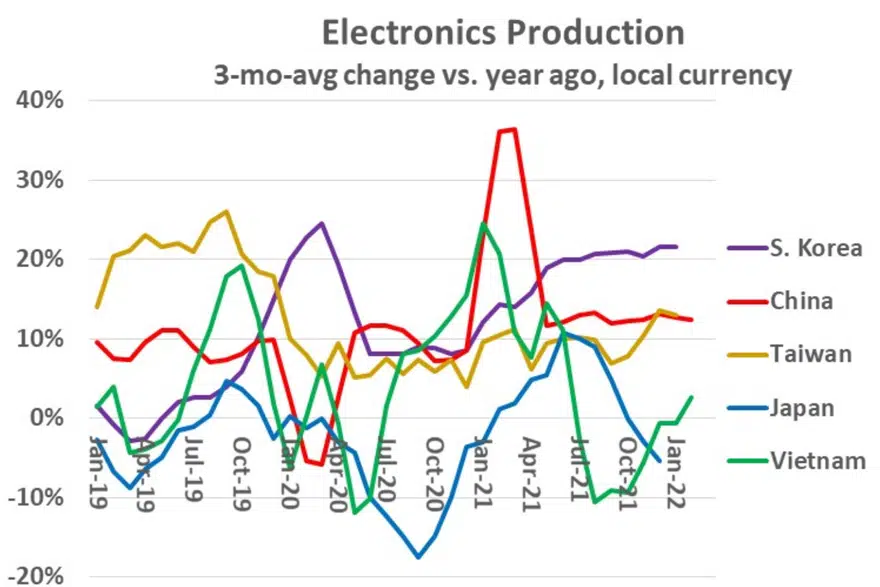
The major electronics producing countries in Asia have mostly returned to normal growth. South Korea, which had a minimal pandemic related slowdown, is the strongest with three-month-average growth over 20% for the last eight months through January 2022. China is back to pre-pandemic growth rates in the 12% to 13% range. Taiwan also did not see a significant pandemic slowdown and is growing 13%. Vietnam electronics production declined in autumn 2021 due to pandemic-related shutdowns, but it returned to growth in February 2022. Japan had production declines at the end of 2021 following pandemic recovery growth of over 10% earlier in the year. Japan is continuing a long-term slowing of electronics production due to shifts to lower-cost Asian countries.
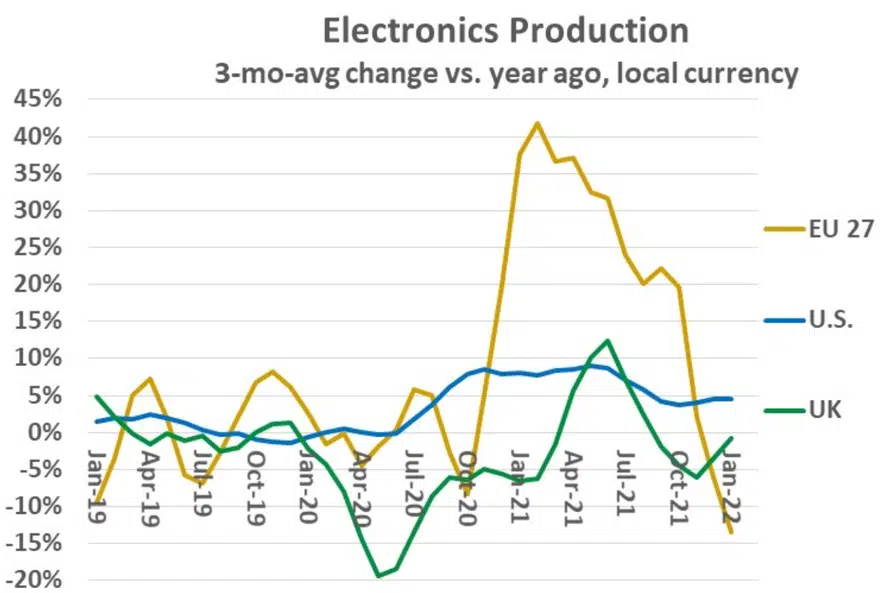
United States electronics production growth has been in the 4% to 5% range for the last five months through January 2022, above the pre-pandemic range of minus 1% to plus 2% in 2019. The 27 countries of the European Union (EU 27) showed a 14% decline in January 2022 after robust growth in the 30% to 40% range in the first half of 2021. In addition to pandemic effects, the EU 27 has benefited from a shift of production from the United Kingdom after Brexit. The UK has experienced flat to declining electronic production of the last three years except for pandemic recovery growth in April through August 2021.

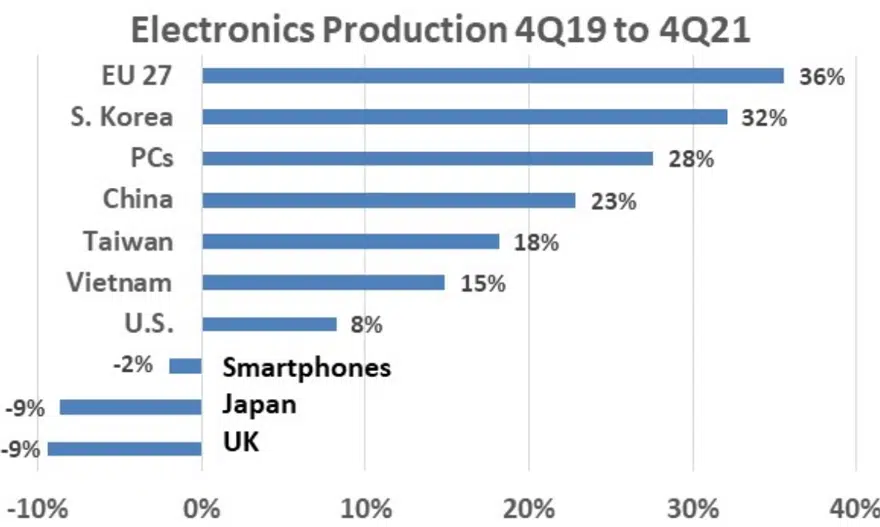
Comparing data from the fourth quarter of 2021, when the world was in pandemic recovery, to the fourth quarter of 2019 (pre-pandemic) shows the trends by country and product. The chart shows the change in electronics production in local currency for 4Q 2021 versus 4Q 2019. The EU 27 and South Korea had growth over 30%. China, Taiwan, and Vietnam had change in the mid-teens to low 20% range. U.S. growth was a moderate 8%. Japan and the UK both had 9% declines as production shifted from Japan to other Asia countries and from the UK to EU countries.

PC unit shipments grew 28% from 4Q 2019 to 4Q 2021 driven by more people working and learning from home during the pandemic. Smartphone unit shipments were basically flat, down 2%.
The electronics industry appears to have largely overcome the pandemic slowdown and is back on track for steady growth. However, the Russia-Ukraine war is causing uncertainty for the global economy. The effect on electronics will likely be noticeable but not significant.
Related

Source: Semiconductor Intelligence

Recent Posts

Modelithics Releases COMPLETE v26.1 for Keysight ADS

23.4.2026
9

April 2026 Interconnect, Passives and Electromechanical Components Market Insights

22.4.2026
38

KYOCERA AVX Introduces Traction‑Grade DC Link Film Capacitors

21.4.2026
38

When More Capacitance Hurts Reliability: The Role of the Metallic Skeleton in Tantalum Anodes

20.4.2026
36

Why Power Inductors Use a Ferrite Core With an Air Gap

20.4.2026
40

YAGEO Introduces High‑Current Y2/X1 Film Capacitors for Wide-bandgap Power Systems

17.4.2026
29

YAGEO Introduces High Rel MLCCs Beyond MIL-Spec Limits

16.4.2026
52

Würth Elektronik Expanded Capacity for Validation and Services in Asia

16.4.2026
17

Samsung Introduces Ultra-High-Voltage 1500 V MLCCs for xEV Powertrains

16.4.2026
26

Upcoming Events

Apr 27
15:00 - 16:00 CEST

Commercial Space Screening Approach for Agile, High-Reliability Payloads

Apr 29
10:00 - 11:00 CDT

SEPIC Design Done Right

Apr 30
10:00 - 11:00 CDT

Programming Embedded Systems

View Calendar

Popular Posts

  • Buck Converter Design and Calculation

    0 shares
    Share 0 Tweet 0
  • Boost Converter Design and Calculation

    0 shares
    Share 0 Tweet 0
  • Flyback Converter Design and Calculation

    0 shares
    Share 0 Tweet 0
  • LLC Resonant Converter Design and Calculation

    0 shares
    Share 0 Tweet 0
  • MLCC and Ceramic Capacitors

    0 shares
    Share 0 Tweet 0
  • Dual Active Bridge (DAB) Topology

    0 shares
    Share 0 Tweet 0
  • Capacitor Charging and Discharging

    0 shares
    Share 0 Tweet 0
  • What Electronics Engineer Needs to Know About Passive Low Pass Filters

    0 shares
    Share 0 Tweet 0
  • Ripple Current and its Effects on the Performance of Capacitors

    3 shares
    Share 3 Tweet 0
  • MLCC Case Sizes Standards Explained

    0 shares
    Share 0 Tweet 0

Newsletter Subscription


Passive Components Blog

© EPCI - Leading Passive Components Educational and Information Site

  • Home
  • Privacy Policy
  • EPCI Membership & Advertisement
  • About

No Result
View All Result
  • Home
  • Knowledge Blog
  • PCNS

© EPCI - Leading Passive Components Educational and Information Site

This website uses cookies. By continuing to use this website you are giving consent to cookies being used. Visit our Privacy and Cookie Policy.
Go to mobile version