






Passive Components Blog
No Result
View All Result
  • Home
  • NewsFilter
    • All
    • Aerospace & Defence
    • Antenna
    • Applications
    • Automotive
    • Capacitors
    • Circuit Protection Devices
    • electro-mechanical news
    • Filters
    • Fuses
    • Inductors
    • Industrial
    • Integrated Passives
    • inter-connect news
    • Market & Supply Chain
    • Market Insights
    • Medical
    • Modelling and Simulation
    • New Materials & Supply
    • New Technologies
    • Non-linear Passives
    • Oscillators
    • Passive Sensors News
    • Resistors
    • RF & Microwave
    • Telecommunication
    • Weekly Digest

    Modelithics Extends Models for Microchip PIN and Varactor Diodes

    Exxelia Offers 1200V Capacitors and Magnetics for 800V Aerospace Platforms

    Wk 28 Electronics Supply Chain Digest

    Bourns Introduces Automotive BMS Signal Transformer with Integrated Common Mode Chokes

    Itelcond Introduces High‑Voltage Aluminium Capacitors for Modern IGBT DC‑links

    Bourns Introduces Automotive Shielded Power Inductors for Compact DC‑DC Converters

    EMC Design Fundamentals: Safe Use of Varistors and Common Mode Chokes in Mains and Data-Line Filters

    Murata Unveils Lead Disc Ceramic Capacitors for Automotive Safety and EMI Suppression

    SCHURTER Releases Intelligent Three‑Terminal Fuses for Safer Li‑ion Battery Systems

    Trending Tags

    • Ripple Current
    • RF
    • Leakage Current
    • Tantalum vs Ceramic
    • Snubber
    • Low ESR
    • Feedthrough
    • Derating
    • Dielectric Constant
    • New Products
    • Market Reports
  • VideoFilter
    • All
    • Antenna videos
    • Capacitor videos
    • Circuit Protection Video
    • Filter videos
    • Fuse videos
    • Inductor videos
    • Inter-Connect Video
    • Non-linear passives videos
    • Oscillator videos
    • Passive sensors videos
    • Resistor videos

    EMC Design Fundamentals: Safe Use of Varistors and Common Mode Chokes in Mains and Data-Line Filters

    Ferrite versus Nanocrystalline Power Inductor Cores: Turns, Gap and Size

    KYOCERA AVX Presents Antenna Integrator Studio Tutorial for Antenna Placement and RF Design

    Power Design Simulation Tools for Faster Inductor Selection and Loss Optimization

    EMC‑Compliant PCB and Connector Design Guidelines

    Why Isolated DC/DC Power Supplies Fail Late, Würth Elektronik Podcast

    Designing 800 V DC EMC Filters: Calculation, Simulation and Measurement

    Current Sense Transformer Datasheet and Design‑in Guide

    Designing a USB Type‑C Flyback Planar Transformer with Frenetic’s Planar Tool

    Trending Tags

    • Capacitors explained
    • Inductors explained
    • Resistors explained
    • Filters explained
    • Application Video Guidelines
    • EMC
    • New Products
    • Ripple Current
    • Simulation
    • Tantalum vs Ceramic
  • Knowledge Blog
  • Dossiers
    • AI Hardware Dossier
    • Power Converter Dossier
    • Automotive Dossier
    • Capacitor Dossier
    • Resistor Dossier
    • Inductor Dossier
    • Circuit Protection Dossier
  • Suppliers
    • Who is Who
  • PCNS
    • PCNS 2025
    • PCNS 2023
    • PCNS 2021
    • PCNS 2019
    • PCNS 2017
  • Events
  • Home
  • NewsFilter
    • All
    • Aerospace & Defence
    • Antenna
    • Applications
    • Automotive
    • Capacitors
    • Circuit Protection Devices
    • electro-mechanical news
    • Filters
    • Fuses
    • Inductors
    • Industrial
    • Integrated Passives
    • inter-connect news
    • Market & Supply Chain
    • Market Insights
    • Medical
    • Modelling and Simulation
    • New Materials & Supply
    • New Technologies
    • Non-linear Passives
    • Oscillators
    • Passive Sensors News
    • Resistors
    • RF & Microwave
    • Telecommunication
    • Weekly Digest

    Modelithics Extends Models for Microchip PIN and Varactor Diodes

    Exxelia Offers 1200V Capacitors and Magnetics for 800V Aerospace Platforms

    Wk 28 Electronics Supply Chain Digest

    Bourns Introduces Automotive BMS Signal Transformer with Integrated Common Mode Chokes

    Itelcond Introduces High‑Voltage Aluminium Capacitors for Modern IGBT DC‑links

    Bourns Introduces Automotive Shielded Power Inductors for Compact DC‑DC Converters

    EMC Design Fundamentals: Safe Use of Varistors and Common Mode Chokes in Mains and Data-Line Filters

    Murata Unveils Lead Disc Ceramic Capacitors for Automotive Safety and EMI Suppression

    SCHURTER Releases Intelligent Three‑Terminal Fuses for Safer Li‑ion Battery Systems

    Trending Tags

    • Ripple Current
    • RF
    • Leakage Current
    • Tantalum vs Ceramic
    • Snubber
    • Low ESR
    • Feedthrough
    • Derating
    • Dielectric Constant
    • New Products
    • Market Reports
  • VideoFilter
    • All
    • Antenna videos
    • Capacitor videos
    • Circuit Protection Video
    • Filter videos
    • Fuse videos
    • Inductor videos
    • Inter-Connect Video
    • Non-linear passives videos
    • Oscillator videos
    • Passive sensors videos
    • Resistor videos

    EMC Design Fundamentals: Safe Use of Varistors and Common Mode Chokes in Mains and Data-Line Filters

    Ferrite versus Nanocrystalline Power Inductor Cores: Turns, Gap and Size

    KYOCERA AVX Presents Antenna Integrator Studio Tutorial for Antenna Placement and RF Design

    Power Design Simulation Tools for Faster Inductor Selection and Loss Optimization

    EMC‑Compliant PCB and Connector Design Guidelines

    Why Isolated DC/DC Power Supplies Fail Late, Würth Elektronik Podcast

    Designing 800 V DC EMC Filters: Calculation, Simulation and Measurement

    Current Sense Transformer Datasheet and Design‑in Guide

    Designing a USB Type‑C Flyback Planar Transformer with Frenetic’s Planar Tool

    Trending Tags

    • Capacitors explained
    • Inductors explained
    • Resistors explained
    • Filters explained
    • Application Video Guidelines
    • EMC
    • New Products
    • Ripple Current
    • Simulation
    • Tantalum vs Ceramic
  • Knowledge Blog
  • Dossiers
    • AI Hardware Dossier
    • Power Converter Dossier
    • Automotive Dossier
    • Capacitor Dossier
    • Resistor Dossier
    • Inductor Dossier
    • Circuit Protection Dossier
  • Suppliers
    • Who is Who
  • PCNS
    • PCNS 2025
    • PCNS 2023
    • PCNS 2021
    • PCNS 2019
    • PCNS 2017
  • Events
No Result
View All Result
Passive Components Blog
No Result
View All Result

Electronic Products announces finalists for the 2018 Product of the Year Awards

16.11.2018
Reading Time: 3 mins read
A A

Source: Electronic Products news

Electronic Products has announced the finalists for the 2018 Product of the Year Awards. These annual awards, now in its 43rdyear, recognizes outstanding products that represent any or all of the following qualities: a significant advancement in a technology or its application, an exceptionally innovative design, a substantial achievement in price/performance, improvements in design performance, and a potential for new product designs/opportunities. EP editors evaluated 100+ products across 10 electronic component categories.

RelatedPosts

Modelithics Extends Models for Microchip PIN and Varactor Diodes

Exxelia Offers 1200V Capacitors and Magnetics for 800V Aerospace Platforms

Wk 28 Electronics Supply Chain Digest

Here are the Passive Components category finalists:

Cornell Dubilier: THA Series Thinpack Aluminum Electrolytic Capacitors
Výsledek obrázku pro Cornell Dubilier THA Series

Cornell Dubilier Electronics, Inc. (CDE) has announced a significant new development in aluminum electrolytic technology. Its 85°C THA Series Thinpack capacitors are only 8.2 mm thick and 9 mm thick for the 105°C THAS Series. This is comparable in height to V-chip electrolytics, tantalums, and board-mounted axials but with much higher bulk-storage capability. A single THA/THAS capacitor can replace an array of SMT, axial or radial aluminum electrolytic, or solid tantalum capacitance arrays. That substitution can allow engineers to design smaller products,with simplified assembly and higher reliability. The THA/THAS Series design is radically new yet based on CDE’s 20+ years of experience with MIL-grade flat electrolytics, said CDE. Re-engineered to be thinner and more cost-effective, it is a good fit for many of today’s high-performance electronics. Unlike traditional cylindrical electrolytics, a THA/THAS capacitor has a sealed, laser-welded aluminum case to eliminate the need for space-wasting end seal gaskets for up to a 60% space reduction.

Littelfuse: PolySwitch setP Series Temperature Indicator1
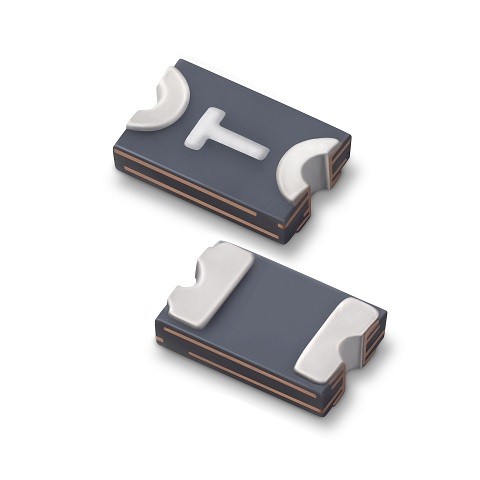
PolySwitch setP Series Temperature Indicator protects USB Type-C and USB Power Delivery charging cables from dangerous overheating faults. Unlike earlier temperature monitoring solutions like placing a PPTC or mini breaker on the power (VBUS) line, the power-independent setP is unique because it is designed to be located on the communication channel, where it senses the temperature increase and then leverages the inherent behaviors of the USB Type-C charging system to alert the charging port to shut down the power flow. Because it is placed on the communication channel rather than the power line, the setP does not contribute to power loss. The compact 0805 (mils) footprint of the setP Temperature Indicator makes it at least 50% smaller than solutions that require placing a device on the power line. Being much smaller allows it to fit more easily inside the connector. The same setP device can be used to protect cables designed for any power level, providing the same reliable protection at the lowest and highest possible levels allowed within USB-C.

TDK: CeraCharge Solid-State Rechargeable Battery (with ceramic)
Výsledek obrázku pro TDK: CeraChargeTDK Corp. developed the first solid-state rechargeable battery in SMD technology, the CeraCharge, which is based on a solid ceramic electrolyte. Depending on requirements, the number of charge/discharge cycles range from several dozens to up to 1,000. With its compact EIA 1812 package (4.5 × 3.2 × 1.1 mm), it offers a capacity of 100 µAh at a rated voltage of 1.4 V. This battery is also capable of delivering currents in the order of several mA for short periods. Thanks to the SMD technology, placement of the battery is easy, and it can be processed using reflow soldering techniques, which, in turn, reduces the production cost of the end product. In contrast to most common technologies, CeraCharge is a solid-state rechargeable battery with no liquid electrolyte. The battery is based on a multilayer technology, similar to MLCCs. This means that a relatively high energy density and smallest volume are combined with the safety and high-volume manufacturing benefits of ceramic multilayer components. In addition, the use of a solid ceramic element as an electrolyte rules out the risk of fire, explosion, or leakage of liquid electrolyte. To increase the capacity and the voltage, any number of individual CeraCharge components can be connected in series and parallel. This opens up a wide range of possible applications — particularly in devices intended for the IoT. These include, for example, real-time clocks, Bluetooth beacons, wearables, or systems for energy harvesting.


Related

Recent Posts

Exxelia Offers 1200V Capacitors and Magnetics for 800V Aerospace Platforms

22.7.2026
21

Bourns Introduces Automotive BMS Signal Transformer with Integrated Common Mode Chokes

17.7.2026
29

Itelcond Introduces High‑Voltage Aluminium Capacitors for Modern IGBT DC‑links

17.7.2026
53

Bourns Introduces Automotive Shielded Power Inductors for Compact DC‑DC Converters

16.7.2026
58

Murata Unveils Lead Disc Ceramic Capacitors for Automotive Safety and EMI Suppression

15.7.2026
63

SCHURTER Releases Intelligent Three‑Terminal Fuses for Safer Li‑ion Battery Systems

14.7.2026
51

Square-Wave Harmonics and RMS Currents in Power Converters

14.7.2026
69

LeanBOM: Practical Cross‑Technology Capacitor Search by Real Working Conditions

14.7.2026
70

In the Age of AI, Every Watt Counts: Implications for Components

13.7.2026
103

Upcoming Events

Jul 28
8:00 - 11:00 CEST

Post Procurement Testing of EEE Components for LEO Space Applications

Jul 29
17:30 - 18:30 CEST

To Ferrite or to Nanocrystalline in Transformer Design

Sep 29
16:00 - 17:00 CEST

Cybersecurity 2026

View Calendar

Popular Posts

  • Boost Converter Design and Calculation

    0 shares
    Share 0 Tweet 0
  • Buck Converter Design and Calculation

    0 shares
    Share 0 Tweet 0
  • YAGEO Announces July 2026 Capacitor Price Increase

    0 shares
    Share 0 Tweet 0
  • Flyback Converter Design and Calculation

    0 shares
    Share 0 Tweet 0
  • LLC Resonant Converter Design and Calculation

    0 shares
    Share 0 Tweet 0
  • MLCC and Ceramic Capacitors

    0 shares
    Share 0 Tweet 0
  • MLCCs in the Age of AI: Q2 2026 Market Tightness

    0 shares
    Share 0 Tweet 0
  • Earthing Systems and IEC Classification Explained

    0 shares
    Share 0 Tweet 0
  • Nvidia Vera Rubin: Why One AI Rack Needs So Many More MLCC Capacitors

    0 shares
    Share 0 Tweet 0
  • Dual Active Bridge (DAB) Topology

    0 shares
    Share 0 Tweet 0

Newsletter Subscription


Passive Components Blog

© EPCI - Leading Passive Components Educational and Information Site

  • Home
  • Privacy Policy
  • EPCI Membership & Advertisement
  • About

No Result
View All Result
  • Home
  • Knowledge Blog
  • Dossiers
  • PCNS

© EPCI - Leading Passive Components Educational and Information Site

This website uses cookies. By continuing to use this website you are giving consent to cookies being used. Visit our Privacy and Cookie Policy.