













Passive Components Blog
No Result
View All Result
  • Home
  • NewsFilter
    • All
    • Aerospace & Defence
    • Antenna
    • Applications
    • Automotive
    • Capacitors
    • Circuit Protection Devices
    • electro-mechanical news
    • Filters
    • Fuses
    • Inductors
    • Industrial
    • Integrated Passives
    • inter-connect news
    • Market & Supply Chain
    • Market Insights
    • Medical
    • Modelling and Simulation
    • New Materials & Supply
    • New Technologies
    • Non-linear Passives
    • Oscillators
    • Passive Sensors News
    • Resistors
    • RF & Microwave
    • Telecommunication
    • Weekly Digest

    Skeleton Technologies Expands in U.S. to Power AI Data Centers

    TDK Releases Stackable µPOL 25A Power Modules

    Wk 6 Electronics Supply Chain Digest

    Smoltek CNF-MIM Capacitors Hit 1,000x Lower Leakage

    DigiKey Expands Line Card with 108K Stock Parts and 364 Suppliers

    Würth Elektronik Announces Partner Program

    Vishay Releases Compact 0806 Low‑DCR Power Inductor

    Murata Opens New Ceramic Capacitor Manufacturing and R&D Center in Japan

    Murata Publishes Power Delivery Guide for AI Servers

    Trending Tags

    • Ripple Current
    • RF
    • Leakage Current
    • Tantalum vs Ceramic
    • Snubber
    • Low ESR
    • Feedthrough
    • Derating
    • Dielectric Constant
    • New Products
    • Market Reports
  • VideoFilter
    • All
    • Antenna videos
    • Capacitor videos
    • Circuit Protection Video
    • Filter videos
    • Fuse videos
    • Inductor videos
    • Inter-Connect Video
    • Non-linear passives videos
    • Oscillator videos
    • Passive sensors videos
    • Resistor videos

    Enabling Software‑Defined Vehicle Architectures: Automotive Ethernet and Zonal Smart Power

    Calculating Resistance Value of a Flyback RC Snubber 

    One‑Pulse Characterization of Nonlinear Power Inductors

    Thermistor Linearization Challenges

    Coaxial Connectors and How to Connect with PCB

    PCB Manufacturing, Test Methods, Quality and Reliability

    Transformer Behavior – Current Transfer and Hidden Feedback

    Choosing the Right Capacitor: The Importance of Accurate Measurements

    RF Inductors: Selection and Design Challenges for High-Frequency Circuits

    Trending Tags

    • Capacitors explained
    • Inductors explained
    • Resistors explained
    • Filters explained
    • Application Video Guidelines
    • EMC
    • New Products
    • Ripple Current
    • Simulation
    • Tantalum vs Ceramic
  • Knowledge Blog
  • DossiersNew
  • Suppliers
    • Who is Who
  • PCNS
    • PCNS 2025
    • PCNS 2023
    • PCNS 2021
    • PCNS 2019
    • PCNS 2017
  • Events
  • Home
  • NewsFilter
    • All
    • Aerospace & Defence
    • Antenna
    • Applications
    • Automotive
    • Capacitors
    • Circuit Protection Devices
    • electro-mechanical news
    • Filters
    • Fuses
    • Inductors
    • Industrial
    • Integrated Passives
    • inter-connect news
    • Market & Supply Chain
    • Market Insights
    • Medical
    • Modelling and Simulation
    • New Materials & Supply
    • New Technologies
    • Non-linear Passives
    • Oscillators
    • Passive Sensors News
    • Resistors
    • RF & Microwave
    • Telecommunication
    • Weekly Digest

    Skeleton Technologies Expands in U.S. to Power AI Data Centers

    TDK Releases Stackable µPOL 25A Power Modules

    Wk 6 Electronics Supply Chain Digest

    Smoltek CNF-MIM Capacitors Hit 1,000x Lower Leakage

    DigiKey Expands Line Card with 108K Stock Parts and 364 Suppliers

    Würth Elektronik Announces Partner Program

    Vishay Releases Compact 0806 Low‑DCR Power Inductor

    Murata Opens New Ceramic Capacitor Manufacturing and R&D Center in Japan

    Murata Publishes Power Delivery Guide for AI Servers

    Trending Tags

    • Ripple Current
    • RF
    • Leakage Current
    • Tantalum vs Ceramic
    • Snubber
    • Low ESR
    • Feedthrough
    • Derating
    • Dielectric Constant
    • New Products
    • Market Reports
  • VideoFilter
    • All
    • Antenna videos
    • Capacitor videos
    • Circuit Protection Video
    • Filter videos
    • Fuse videos
    • Inductor videos
    • Inter-Connect Video
    • Non-linear passives videos
    • Oscillator videos
    • Passive sensors videos
    • Resistor videos

    Enabling Software‑Defined Vehicle Architectures: Automotive Ethernet and Zonal Smart Power

    Calculating Resistance Value of a Flyback RC Snubber 

    One‑Pulse Characterization of Nonlinear Power Inductors

    Thermistor Linearization Challenges

    Coaxial Connectors and How to Connect with PCB

    PCB Manufacturing, Test Methods, Quality and Reliability

    Transformer Behavior – Current Transfer and Hidden Feedback

    Choosing the Right Capacitor: The Importance of Accurate Measurements

    RF Inductors: Selection and Design Challenges for High-Frequency Circuits

    Trending Tags

    • Capacitors explained
    • Inductors explained
    • Resistors explained
    • Filters explained
    • Application Video Guidelines
    • EMC
    • New Products
    • Ripple Current
    • Simulation
    • Tantalum vs Ceramic
  • Knowledge Blog
  • DossiersNew
  • Suppliers
    • Who is Who
  • PCNS
    • PCNS 2025
    • PCNS 2023
    • PCNS 2021
    • PCNS 2019
    • PCNS 2017
  • Events
No Result
View All Result
Passive Components Blog
No Result
View All Result

Fast Electrochromic Supercapacitors Change Color According to their Stored Energy Level

11.1.2021
Reading Time: 4 mins read
A A

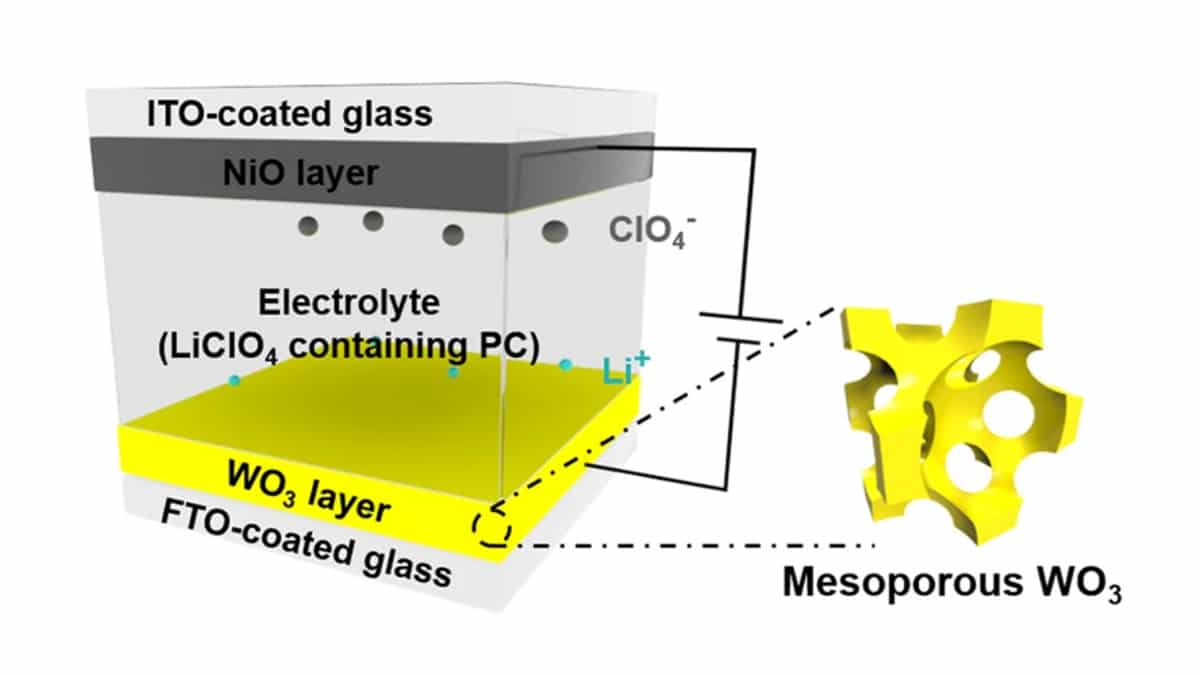
During materials engineering, a network of tiny holes or pores can improve the energy storage capacity of materials for applications as smart windows. Electrochromic devices (ECDs), which control light transmittance through electrochemical redox reactions, have been widely used in electrochemical reflective displays or smart windows for energy efficient buildings. Recently, the functionality of ECDs has been extended to include energy storage, which is referred to as electrochromic supercapacitors (ECSs). ECSs have been increasingly studied as next-generation electrochemical components that can not only change their own optical properties but also store the energy supplied for coloration. In particular, their optical characteristics, such as color intensity, directly reflect the real-time levels of energy stored in these devices.

Smart windows are platforms whose light transmission properties can be altered when light, voltage or heat is applied. Scientists can control the fraction of light passing through the material using an electrical voltage to electrically switch from transparent to opaque materials during charge transfer. While this feature is associated with storage and release of energy, the same materials can be used for energy storage as well. In a new report, Jeon-Woo Kim and a team of scientists at the Pohang University of Science and Technology in South Korea developed and improved electrochromic supercapacitors made from tungsten trioxide (WO3). They used an evaporation-induced self-assembly process to deposit a film of tungsten trioxide with pores, where the porous architecture increased the speed of switching and capacitance in the material compared to conventional tungsten trioxide thin films. The work is now published on Nature Asia Materials.

RelatedPosts

Skeleton Technologies Expands in U.S. to Power AI Data Centers

TDK Releases Stackable µPOL 25A Power Modules

Wk 6 Electronics Supply Chain Digest

During this work, Kim et al. demonstrated the ultrafast response of electrochromic supercapacitors by exploring the mesoporous structure of the constituent materials. Electrochromic devices (ECDs) can generate reversible color changes that correspond to electricity with promising applications across smart windows, displays and military camouflage. The devices can also control light transmittance to build materials for climate adaptive energy-efficient buildings. The functionality of ECDs can be extended to energy storage devices known as electrochromic supercapacitors (ECS). Such supercapacitors are increasingly under investigation as next-generation electrochemical components capable of changing their own optical properties and storing the energy supplied. Their inherent optical characteristics can therefore directly reveal the real-time energy levels stored within. Researchers had developed such high-performance devices using electrochromic chromophores based on transition metal oxides such as tungsten trioxide due to their superior electrochemical properties. The electrochromic displays developed here can change color based on their stored levels of energy and the product will have broad implications as next-generation smart window materials for buildings and portable energy storage.
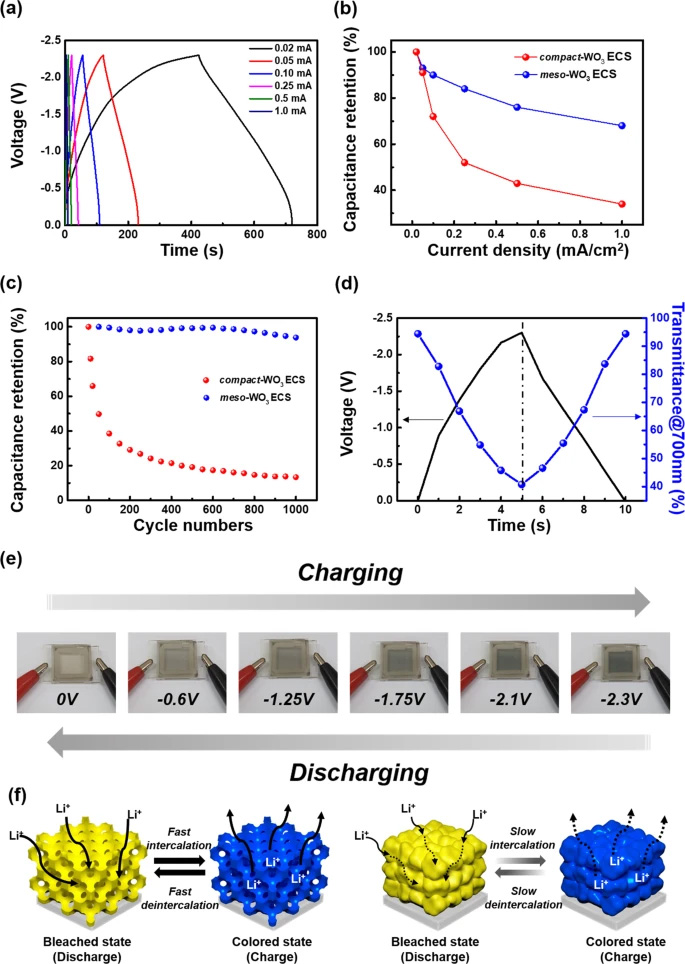
a GCD curves of the meso-WO3 ECS at various current densities. b Dependence of the capacitance retention of the compact- and meso-WO3 ECSs on the charging/discharging current densities. c Charging/discharging cycling stability of the ECSs at a current density of 1.0mA/cm2. d GCD curve at 1.0mA/cm2 and the corresponding in situ transmittance profile at 700nm for the meso-WO3 ECS. e Photographs of the meso-WO3 ECS during the charging and discharging process. f Schematic illustration of the ion intercalation in meso- (left) and compact-WO3 (right).

Printing and evaporation-induced self-assembly

The team combined printing and evaporation-induced self-assembly to develop the highly functional, energy-storing, electrochromic supercapacitor displays. This printing process produced a micellar structure through the nozzle after evaporation, which they then subjected to sequential calcination and oxygen plasma treatment to form a patterned mesoporous WO3 device for energy-storing applications. When they charged the device, the patterns turned dark blue to indicate the charged state. To prove its mechanism of action, the team connected the device to a white-light emitting diode (LED) that initially emitted light, when the stored energy was consumed, the device returned to its original transparent state.

Outlook: next-generation smart electronics.

In this way, Jeon-Woo Kim and colleagues developed multifunctional electrochromic supercapacitors based on amorphous mesoporous WO3 films. Compared to the compact version of electrochromic supercapacitors (compact-WO3-ECS), the mesoporous electrochromic supercapacitors (meso-WO3-ECS) showed superior performance. The scientists credited this to its large surface area and amorphous nature. The mesoporous devices functioned rapidly to serve as electrochemical reflective displays and to store electrical charge. This setup can also power other electronic devices, as the color intensity of the pattern on the device indicated the level of stored energy within. The outcomes will have tremendous potential to form next-generation smart electronics.

More information: Keon-Woo Kim et al. Extremely fast electrochromic supercapacitors based on mesoporous WO3 prepared by an evaporation-induced self-assembly, NPG Asia Materials (2020). DOI: 10.1038/s41427-020-00257-w
Related

Source: Phys.org

Recent Posts

Skeleton Technologies Expands in U.S. to Power AI Data Centers

9.2.2026
10

Smoltek CNF-MIM Capacitors Hit 1,000x Lower Leakage

6.2.2026
19

Murata Opens New Ceramic Capacitor Manufacturing and R&D Center in Japan

5.2.2026
72

Murata Publishes Power Delivery Guide for AI Servers

4.2.2026
94

Mechanical Drift Indicator of Tantalum Capacitor Anodes Degradation under Reverse Bias

3.2.2026
38

Enabling Software‑Defined Vehicle Architectures: Automotive Ethernet and Zonal Smart Power

2.2.2026
30

CMSE 2026 Announces Call for Presentations on High-Reliability Military and Space Electronics

28.1.2026
51

ESA Call for Papers 6th Space Passive Component Days – SPCD 2026

28.1.2026
49

Samsung Q4 2025 Results: MLCC focus for AI, Server and Automotive

26.1.2026
112

Upcoming Events

Feb 11
16:00 - 17:00 CET

What’s Next in Power Electronics Design

Feb 24
16:00 - 17:00 CET

Designing Qi2 Wireless Power Systems: Practical Development and EMC Optimization

Mar 3
16:00 - 17:00 CET

Cybersecurity at the Eleventh Hour – from RED to CRA – Information and Discussion

View Calendar

Popular Posts

  • Buck Converter Design and Calculation

    0 shares
    Share 0 Tweet 0
  • Boost Converter Design and Calculation

    0 shares
    Share 0 Tweet 0
  • LLC Resonant Converter Design and Calculation

    0 shares
    Share 0 Tweet 0
  • Flyback Converter Design and Calculation

    0 shares
    Share 0 Tweet 0
  • Ripple Current and its Effects on the Performance of Capacitors

    3 shares
    Share 3 Tweet 0
  • Dual Active Bridge (DAB) Topology

    0 shares
    Share 0 Tweet 0
  • MLCC and Ceramic Capacitors

    0 shares
    Share 0 Tweet 0
  • How Metal Prices Are Driving Passive Component Price Hikes

    0 shares
    Share 0 Tweet 0
  • What is a Dielectric Constant and DF of Plastic Materials?

    4 shares
    Share 4 Tweet 0
  • MLCC Case Sizes Standards Explained

    0 shares
    Share 0 Tweet 0

Newsletter Subscription


Passive Components Blog

© EPCI - Leading Passive Components Educational and Information Site

  • Home
  • Privacy Policy
  • EPCI Membership & Advertisement
  • About

No Result
View All Result
  • Home
  • Knowledge Blog
  • PCNS

© EPCI - Leading Passive Components Educational and Information Site

This website uses cookies. By continuing to use this website you are giving consent to cookies being used. Visit our Privacy and Cookie Policy.
Go to mobile version