











Passive Components Blog
No Result
View All Result
  • Home
  • NewsFilter
    • All
    • Aerospace & Defence
    • Antenna
    • Applications
    • Automotive
    • Capacitors
    • Circuit Protection Devices
    • electro-mechanical news
    • Filters
    • Fuses
    • Inductors
    • Industrial
    • Integrated Passives
    • inter-connect news
    • Market & Supply Chain
    • Market Insights
    • Medical
    • Modelling and Simulation
    • New Materials & Supply
    • New Technologies
    • Non-linear Passives
    • Oscillators
    • Passive Sensors News
    • Resistors
    • RF & Microwave
    • Telecommunication
    • Weekly Digest

    Molex Completes Acquisition of Smiths Interconnect, Expanding Portfolio of High-Reliability Connectivity Solutions

    APEC 2026 Power Electronics Trends and Implications for Passive Components

    Hydra Enhances Film Capacitor Robustness by Novel Gel Filler

    Würth Elektronik Releases Heat Sinks for TO and IC packages

    Würth Elektronik ICS to Acquire MRS Electronic and Expand Vehicle Electronics Portfolio

    Indias ECMS Wave Brings New Capacity For Passive Components Manufacturing in India

    Binder Introduces Triangular Moulding for M16 and M12 Cable Connectors

    Panasonic High Precision Chip Resistors Bridge Gap Between Thin and Thick Technology

    Wk 13 Electronics Supply Chain Digest

    Trending Tags

    • Ripple Current
    • RF
    • Leakage Current
    • Tantalum vs Ceramic
    • Snubber
    • Low ESR
    • Feedthrough
    • Derating
    • Dielectric Constant
    • New Products
    • Market Reports
  • VideoFilter
    • All
    • Antenna videos
    • Capacitor videos
    • Circuit Protection Video
    • Filter videos
    • Fuse videos
    • Inductor videos
    • Inter-Connect Video
    • Non-linear passives videos
    • Oscillator videos
    • Passive sensors videos
    • Resistor videos

    Transformer-Based Power-Line Harvester Magnetic Design

    Thermal Modeling of Magnetics

    Standard vs Planar LLC transformers Comparison for Battery Chargers

    How Modern Tools Model Magnetic Components for Power Electronics

    Advanced Loss Modeling for Planar Magnetics in the Frenetic Planar Tool

    2026 Power Magnetics Design Trends: Flyback, DAB and Planar

    Enabling Software‑Defined Vehicle Architectures: Automotive Ethernet and Zonal Smart Power

    Calculating Resistance Value of a Flyback RC Snubber 

    One‑Pulse Characterization of Nonlinear Power Inductors

    Trending Tags

    • Capacitors explained
    • Inductors explained
    • Resistors explained
    • Filters explained
    • Application Video Guidelines
    • EMC
    • New Products
    • Ripple Current
    • Simulation
    • Tantalum vs Ceramic
  • Knowledge Blog
  • DossiersNew
  • Suppliers
    • Who is Who
  • PCNS
    • PCNS 2025
    • PCNS 2023
    • PCNS 2021
    • PCNS 2019
    • PCNS 2017
  • Events
  • Home
  • NewsFilter
    • All
    • Aerospace & Defence
    • Antenna
    • Applications
    • Automotive
    • Capacitors
    • Circuit Protection Devices
    • electro-mechanical news
    • Filters
    • Fuses
    • Inductors
    • Industrial
    • Integrated Passives
    • inter-connect news
    • Market & Supply Chain
    • Market Insights
    • Medical
    • Modelling and Simulation
    • New Materials & Supply
    • New Technologies
    • Non-linear Passives
    • Oscillators
    • Passive Sensors News
    • Resistors
    • RF & Microwave
    • Telecommunication
    • Weekly Digest

    Molex Completes Acquisition of Smiths Interconnect, Expanding Portfolio of High-Reliability Connectivity Solutions

    APEC 2026 Power Electronics Trends and Implications for Passive Components

    Hydra Enhances Film Capacitor Robustness by Novel Gel Filler

    Würth Elektronik Releases Heat Sinks for TO and IC packages

    Würth Elektronik ICS to Acquire MRS Electronic and Expand Vehicle Electronics Portfolio

    Indias ECMS Wave Brings New Capacity For Passive Components Manufacturing in India

    Binder Introduces Triangular Moulding for M16 and M12 Cable Connectors

    Panasonic High Precision Chip Resistors Bridge Gap Between Thin and Thick Technology

    Wk 13 Electronics Supply Chain Digest

    Trending Tags

    • Ripple Current
    • RF
    • Leakage Current
    • Tantalum vs Ceramic
    • Snubber
    • Low ESR
    • Feedthrough
    • Derating
    • Dielectric Constant
    • New Products
    • Market Reports
  • VideoFilter
    • All
    • Antenna videos
    • Capacitor videos
    • Circuit Protection Video
    • Filter videos
    • Fuse videos
    • Inductor videos
    • Inter-Connect Video
    • Non-linear passives videos
    • Oscillator videos
    • Passive sensors videos
    • Resistor videos

    Transformer-Based Power-Line Harvester Magnetic Design

    Thermal Modeling of Magnetics

    Standard vs Planar LLC transformers Comparison for Battery Chargers

    How Modern Tools Model Magnetic Components for Power Electronics

    Advanced Loss Modeling for Planar Magnetics in the Frenetic Planar Tool

    2026 Power Magnetics Design Trends: Flyback, DAB and Planar

    Enabling Software‑Defined Vehicle Architectures: Automotive Ethernet and Zonal Smart Power

    Calculating Resistance Value of a Flyback RC Snubber 

    One‑Pulse Characterization of Nonlinear Power Inductors

    Trending Tags

    • Capacitors explained
    • Inductors explained
    • Resistors explained
    • Filters explained
    • Application Video Guidelines
    • EMC
    • New Products
    • Ripple Current
    • Simulation
    • Tantalum vs Ceramic
  • Knowledge Blog
  • DossiersNew
  • Suppliers
    • Who is Who
  • PCNS
    • PCNS 2025
    • PCNS 2023
    • PCNS 2021
    • PCNS 2019
    • PCNS 2017
  • Events
No Result
View All Result
Passive Components Blog
No Result
View All Result

How to Choose the Right Inductor for DC-DC Buck Applications

25.3.2026
Reading Time: 5 mins read
A A

DC-DC converters of different varieties are widely used in markets such as telecommunications, automotive, medical (portable), and industrial.

The ‘buck’ DC-DC converter is employed to step voltages down without isolation and utilizes an inductor as an energy storage element. This article will explain how to choose the right Inductor for DC-DC Buck applications, its calculation of impedance and ripple current to get optimum performance.

RelatedPosts

TDK Releases Hybrid Polymer Aluminum Capacitors with Enhanced Ripple Current Capability

Selection Guide for DC-Link Film Capacitors in Automotive Electric Compressors; KEMET App Note

Tantalum Polymer use in GaN based applications

A simplified buck converter schematic can be observed in Figure 1. The output voltage of this converter is always lower than the input voltage.

When S1 is open, the energy stored in the inductor sustains the current through the load through D1 with C1 also discharging into the load. S1 switches at high frequency and the duty cycle of switching defines the output voltage.

When S1 is closed, the DC input voltage is applied to the output filter inductor L1 and current flows through the inductor into the output capacitor C1 and to the load.

Simplified buck schematic
Figure 1. Simplified buck schematic

When selecting an inductor for a buck converter the following parameters need to be defined:

  • Maximum input voltage = Vin max
  • Minimum input voltage = Vin min
  • Maximum output current = Iout max
  • Operating frequency = f
  • Output voltage = Vout
  • Minimum output current = Iout min

So, for example, with f = 500 kHz, Vo = 5 volts, Iout max = 4 amps, Iout min = 0.5 amps, Vin max = 13.5 volts (car battery) and Vin min = 8.5 volts.

You can select what the inductor ripple current is – it sets output ripple voltage across the ESR of C1.

For this example, the inductor current stays continuous at the minimum specified load. So, the minimum of the ripple current just touches zero at minimum load, as seen in Figure 2. This makes control loop compensation a lot simpler. The inductor current stays continuous at any load, even with high ripple current, if D1 is a synchronous rectifier MOSFET. Though high ripple current does generate higher core losses.

Calculations

Since the operating frequency is 500 kHz,

Find the minimum duty ratio, Dmin

Find the required inductance value, L

DC-DC Buck converter inductor calculation

Find the delta current (ripple current), ∆I

Find the peak current, I pk

Find the RMS current, I rms

DC-DC Buck converter inductor ripple current calculation
Typical inductor ripple current
Figure 2. Typical inductor ripple current

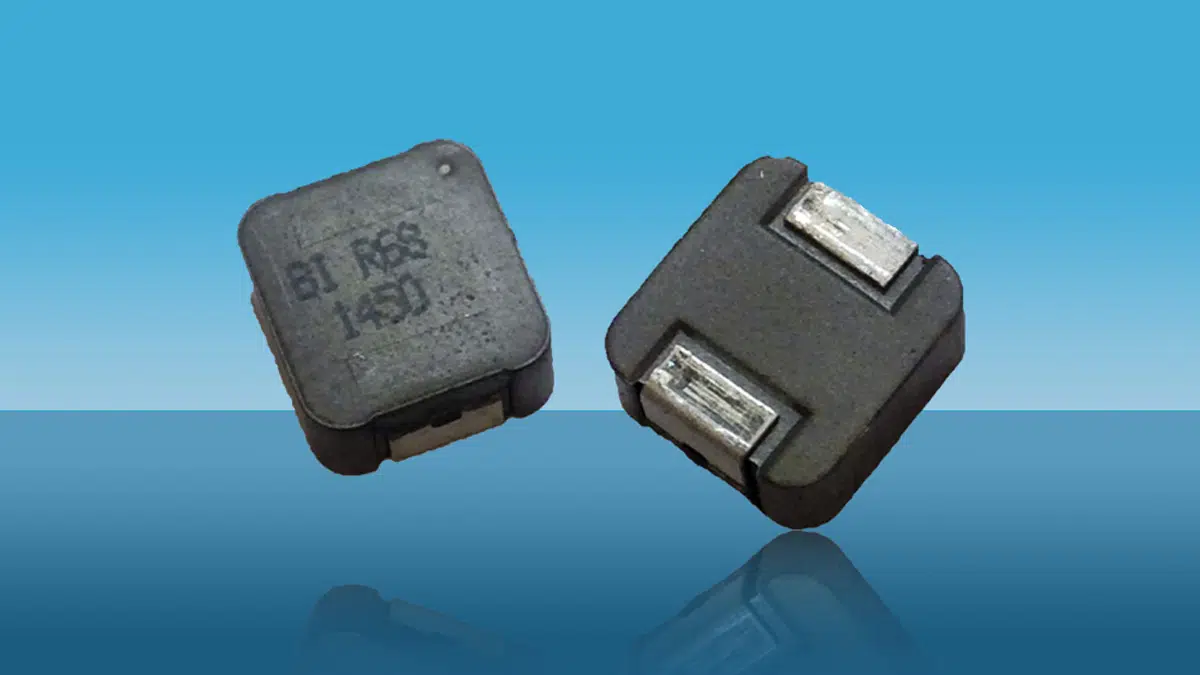
An optimum inductor can be chosen using TT Electronics (TT) inductor datasheets. In this example, TT part number HA72L-06308R2LFTR is suggested, which is automotive grade, -55 ºC to +155 ºC (AEC-Q200 certified) with the electrical parameters below:

TT p/nL @ 0 ampDCR typicalDCR maxI rmsI dc (sat) 30% Roll offTypical picture
HA72L-06308R2LFTR8.2 µH64 mΩ68 mΩ4.0 amps gives about 40 ºC Temp Rise7.5 amps
Table 1. Data sheet specification for TT part HA72L-06308R2LFTR
HA72L-06308R2LF DC bias and Temp rise
Figure 3. DC-DC Buck converter Inductor DC bias and Temp rise example

Figure 3 shows the inductance roll-off is 100 = 6.1% at 4.42 amps DC, which is close to the required value of 7.56 µH with a temperature rise of less than 40 °C.

The temperature rise in the data sheet graph is for DC current. In the example, there is also AC ripple current. A more precise temperature rise calculation, including ohmic and AC loss effects in the core and wire, is beyond the scope of this article but would be dependent on the below parameters:

  1. Skin depth at the operating frequency
  2. Surface area of the inductor
  3. Wire resistance at the operating temperature
  4. AC flux density, BAC, calculated from peak current, inductance, core cross sectional area and number of turns

TT Electronics has provided numerous solutions to the medical, automotive, and various industrial sectors. They provide semi and full custom designs to meet your critical specifications.

Read more in article: Buck Converter Design and Calculation

Related

Source: TT Electronics

Recent Posts

APEC 2026 Power Electronics Trends and Implications for Passive Components

1.4.2026
7

Indias ECMS Wave Brings New Capacity For Passive Components Manufacturing in India

31.3.2026
24

New J‑STD‑075B Standard Elevates Process Sensitivity Classification for Passive and Solid-State Components

27.3.2026
39

Modelithics Expands COMPLETE+3D Library for Ansys HFSS

27.3.2026
8

DigiKey Launches “Engineering Unlocked” Video Series

26.3.2026
17

Equivalent Circuit Constants of Crystal Units Explained

26.3.2026
28

Nanocrystalline Cores for Low‑Loss MHz Chip Inductors

25.3.2026
41

Würth Elektronik Unveils High-Current Automotive Power Inductor

24.3.2026
30

Transformer-Based Power-Line Harvester Magnetic Design

24.3.2026
21

Upcoming Events

Apr 8
17:00 - 18:00 CEST

Trade Secrets of the Flyback Converter

Apr 21
16:00 - 17:00 CEST

Heatsink Solutions: Thermal Management in electronic devices

May 5
16:00 - 17:00 CEST

Understanding and Selecting Capacitors – Fundamentals, Technologies and Latest Trends

View Calendar

Popular Posts

  • Buck Converter Design and Calculation

    0 shares
    Share 0 Tweet 0
  • Boost Converter Design and Calculation

    0 shares
    Share 0 Tweet 0
  • Flyback Converter Design and Calculation

    0 shares
    Share 0 Tweet 0
  • LLC Resonant Converter Design and Calculation

    0 shares
    Share 0 Tweet 0
  • Dual Active Bridge (DAB) Topology

    0 shares
    Share 0 Tweet 0
  • MLCC and Ceramic Capacitors

    0 shares
    Share 0 Tweet 0
  • Ripple Current and its Effects on the Performance of Capacitors

    3 shares
    Share 3 Tweet 0
  • MLCC Case Sizes Standards Explained

    0 shares
    Share 0 Tweet 0
  • Capacitor Charging and Discharging

    0 shares
    Share 0 Tweet 0
  • Plastic Materials Dielectric Constant and DF

    4 shares
    Share 4 Tweet 0

Newsletter Subscription


Passive Components Blog

© EPCI - Leading Passive Components Educational and Information Site

  • Home
  • Privacy Policy
  • EPCI Membership & Advertisement
  • About

No Result
View All Result
  • Home
  • Knowledge Blog
  • PCNS

© EPCI - Leading Passive Components Educational and Information Site

This website uses cookies. By continuing to use this website you are giving consent to cookies being used. Visit our Privacy and Cookie Policy.
Go to mobile version