




Passive Components Blog
No Result
View All Result
  • Home
  • NewsFilter
    • All
    • Aerospace & Defence
    • Antenna
    • Applications
    • Automotive
    • Capacitors
    • Circuit Protection Devices
    • electro-mechanical news
    • Filters
    • Fuses
    • Inductors
    • Industrial
    • Integrated Passives
    • inter-connect news
    • Market & Supply Chain
    • Market Insights
    • Medical
    • Modelling and Simulation
    • New Materials & Supply
    • New Technologies
    • Non-linear Passives
    • Oscillators
    • Passive Sensors News
    • Resistors
    • RF & Microwave
    • Telecommunication
    • Weekly Digest

    Transformer Safety IEC 61558 Standard

    ESR of Capacitors, Measurements and Applications

    Murata Christophe Pottier Appointed President of EPCIA

    3-Phase EMI Filter Design, Simulation, Calculation and Test

    YAGEO Unveils Compact 2.4 GHz SMD Antenna

    KYOCERA AVX Releases Antenna for Iridium Satellite IoT Applications

    Molex Releases Industry-First Quad-Row Board-to-Board Connectors with EMI Shields

    Image credit: Samtec

    How to Match the Right Connector with Protocol Requirements

    Smoltek CNF-MIM Capacitors Pass 1,000h Reliability Test

    Trending Tags

    • Ripple Current
    • RF
    • Leakage Current
    • Tantalum vs Ceramic
    • Snubber
    • Low ESR
    • Feedthrough
    • Derating
    • Dielectric Constant
    • New Products
    • Market Reports
  • VideoFilter
    • All
    • Antenna videos
    • Capacitor videos
    • Circuit Protection Video
    • Filter videos
    • Fuse videos
    • Inductor videos
    • Inter-Connect Video
    • Non-linear passives videos
    • Oscillator videos
    • Passive sensors videos
    • Resistor videos

    Transformer Safety IEC 61558 Standard

    3-Phase EMI Filter Design, Simulation, Calculation and Test

    Transformer Design Optimization for Power Electronics Applications

    Common Mode Chokes Selection for RF Circuits in Next-Generation Communication Systems

    Capacitor Self-balancing in a Flying-Capacitor Buck Converter

    How to Select Ferrite Bead for Filtering in Buck Boost Converter

    Power Inductors Future: Minimal Losses and Compact Designs

    Percolation Phenomenon: Degradation of Molded Power Inductors in DC/DC Converters

    Connector PCB Design Challenges

    Trending Tags

    • Capacitors explained
    • Inductors explained
    • Resistors explained
    • Filters explained
    • Application Video Guidelines
    • EMC
    • New Products
    • Ripple Current
    • Simulation
    • Tantalum vs Ceramic
  • Knowledge Blog
  • Suppliers
    • Who is Who
  • PCNS
    • PCNS 2025
    • PCNS 2023
    • PCNS 2021
    • PCNS 2019
    • PCNS 2017
  • Events
  • Home
  • NewsFilter
    • All
    • Aerospace & Defence
    • Antenna
    • Applications
    • Automotive
    • Capacitors
    • Circuit Protection Devices
    • electro-mechanical news
    • Filters
    • Fuses
    • Inductors
    • Industrial
    • Integrated Passives
    • inter-connect news
    • Market & Supply Chain
    • Market Insights
    • Medical
    • Modelling and Simulation
    • New Materials & Supply
    • New Technologies
    • Non-linear Passives
    • Oscillators
    • Passive Sensors News
    • Resistors
    • RF & Microwave
    • Telecommunication
    • Weekly Digest

    Transformer Safety IEC 61558 Standard

    ESR of Capacitors, Measurements and Applications

    Murata Christophe Pottier Appointed President of EPCIA

    3-Phase EMI Filter Design, Simulation, Calculation and Test

    YAGEO Unveils Compact 2.4 GHz SMD Antenna

    KYOCERA AVX Releases Antenna for Iridium Satellite IoT Applications

    Molex Releases Industry-First Quad-Row Board-to-Board Connectors with EMI Shields

    Image credit: Samtec

    How to Match the Right Connector with Protocol Requirements

    Smoltek CNF-MIM Capacitors Pass 1,000h Reliability Test

    Trending Tags

    • Ripple Current
    • RF
    • Leakage Current
    • Tantalum vs Ceramic
    • Snubber
    • Low ESR
    • Feedthrough
    • Derating
    • Dielectric Constant
    • New Products
    • Market Reports
  • VideoFilter
    • All
    • Antenna videos
    • Capacitor videos
    • Circuit Protection Video
    • Filter videos
    • Fuse videos
    • Inductor videos
    • Inter-Connect Video
    • Non-linear passives videos
    • Oscillator videos
    • Passive sensors videos
    • Resistor videos

    Transformer Safety IEC 61558 Standard

    3-Phase EMI Filter Design, Simulation, Calculation and Test

    Transformer Design Optimization for Power Electronics Applications

    Common Mode Chokes Selection for RF Circuits in Next-Generation Communication Systems

    Capacitor Self-balancing in a Flying-Capacitor Buck Converter

    How to Select Ferrite Bead for Filtering in Buck Boost Converter

    Power Inductors Future: Minimal Losses and Compact Designs

    Percolation Phenomenon: Degradation of Molded Power Inductors in DC/DC Converters

    Connector PCB Design Challenges

    Trending Tags

    • Capacitors explained
    • Inductors explained
    • Resistors explained
    • Filters explained
    • Application Video Guidelines
    • EMC
    • New Products
    • Ripple Current
    • Simulation
    • Tantalum vs Ceramic
  • Knowledge Blog
  • Suppliers
    • Who is Who
  • PCNS
    • PCNS 2025
    • PCNS 2023
    • PCNS 2021
    • PCNS 2019
    • PCNS 2017
  • Events
No Result
View All Result
Passive Components Blog
No Result
View All Result

One Turn Inductors Explained

19.3.2021
Reading Time: 4 mins read
A A

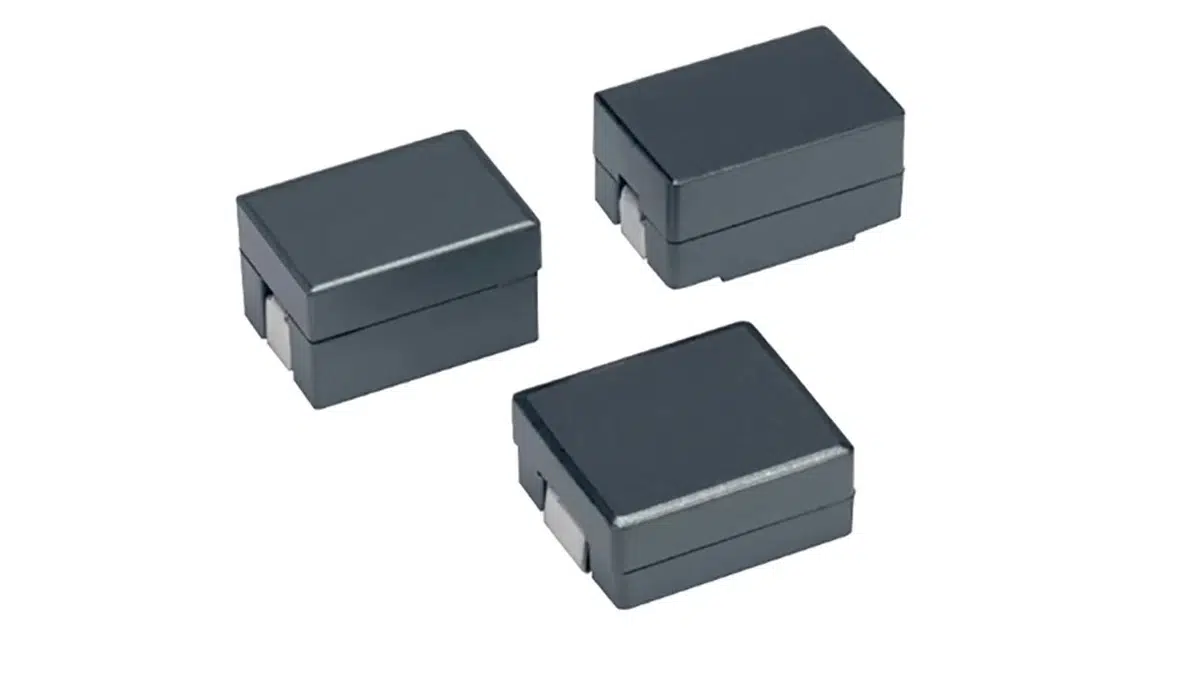
Flat wire, “one turn” inductor construction design, enables high efficiency at large currents ideal for high switching frequency applications. Kemet blog explained its basic construction and features.

Inductor Basics

Engineers know this like they know that capacitors are parallel plates, that inductors are coils of wire. That notion is beat into our heads from the early days of circuits 1. The world was so simple back then, current flowed in one direction, wires were perfect conductors, and capacitors held charge forever. Inductors store energy via a built-up magnetic field. As current flows through the coil of wire a magnetic field is created and sustained by the core material around which that coil is wrapped. When that magnetic field collapses it produces a current in the coil of wire. Fundamentally, an inductor is the dual of a capacitor. Where a capacitor is resistant to changes in voltage, an inductor is resistant to changes in current.

RelatedPosts

Transformer Safety IEC 61558 Standard

ESR of Capacitors, Measurements and Applications

Murata Christophe Pottier Appointed President of EPCIA

The One Turn Inductor

Inductors don’t always have to be tightly packed coils of wire. Yes, the number of turns is one of the factors that give rise to the overall inductance. According to the equation below, it is a squared factor and therefore a major one.
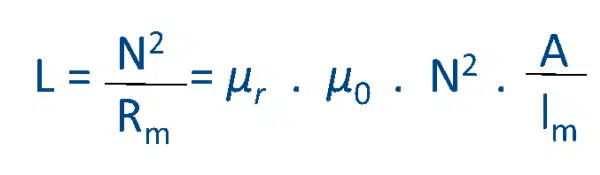
But it isn’t the only factor. The relative permeability of the core, which is determined by the material composition of the core itself, is another factor. It is possible to recover some of the inductance lost by reducing the number of turns by improving the permeability of the core by selection of inductors with high permeability ferrite core material.
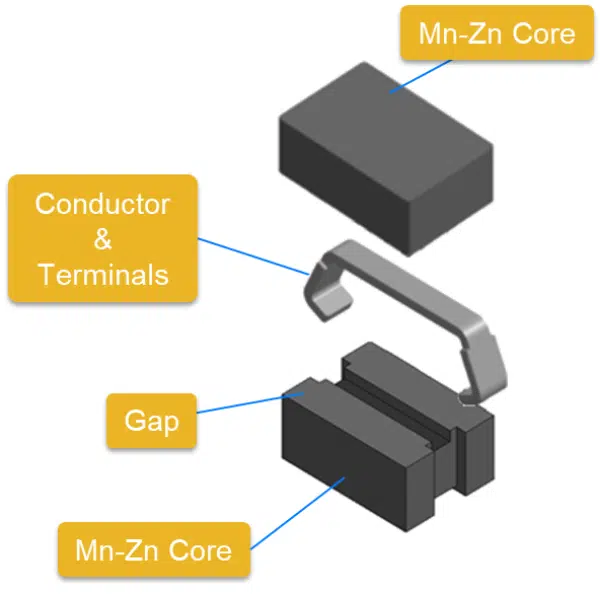
One turn inductor construction; credit Kemet Electronics

It’s All About DCR and Loss

What’s so great about a one-turn inductor? OK, so no matter how great your core material is, you won’t recover all the inductance by going to one turn. But you don’t always need a ton of inductance. Especially as switching frequencies increase, you need less and less inductance. Still, turns come at a cost. One of the biggest components of loss in an inductor is the DC copper loss. If you look at the equation of resistance of a wire:
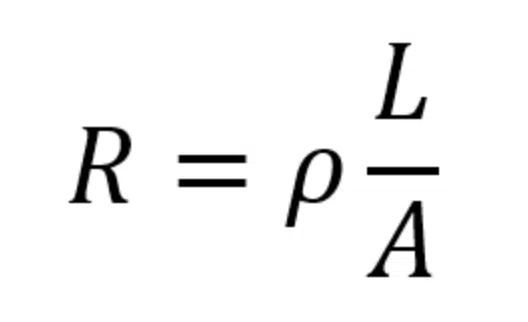
The total resistance is equal to the resistivity, ρ, which is a material parameter multiplied by the length of wire, L, divided by the cross-sectional area, A. That means that if you wanna reduce the loss of your conductor you can make it shorter or fatter (or of a different material). We’re all kinda stuck with copper for many reasons, so the resistivity is what it is. And if you make the wire fatter you increase the overall size of your component, which no one wants. So, you’re left with making it shorter.

The reduction of DCR is necessary to reduce loss. But what’s so bad about loss? Well, that power loss must go somewhere and in electronics it generally becomes heat. Unchecked heat is bad for other components and can be unsafe.

One last benefit of these assembled inductors is that the inductance can be tightly controlled by adjusting the gap size between the two clamshells. That results in inductors that can be finely tuned to ensure maximum power delivery at their operating frequency.

Focus Applications of One Turn Inductors

The inexorable march of electronics is generally one that goes to a higher power while shrinking in size. That is the reason why one turn large current power inductor has been developed. The one-turn design enables high current operation while reducing losses and size. More inductors and more voltage rails can be packed in a tighter space.
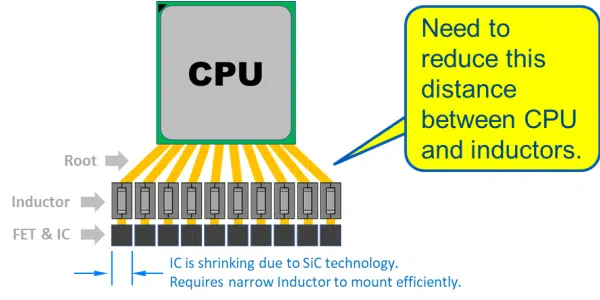

One turn inductors narrow chip design benefits application example; credit Kemet Electronics

Related

Source: Kemet Electronics

Recent Posts

Transformer Safety IEC 61558 Standard

7.11.2025
1

ESR of Capacitors, Measurements and Applications

7.11.2025
10

3-Phase EMI Filter Design, Simulation, Calculation and Test

6.11.2025
23
Image credit: Samtec

How to Match the Right Connector with Protocol Requirements

6.11.2025
12

Coilcraft Introduces Ultra-Low Loss Shielded Power Inductors

6.11.2025
13

Exxelia Presents Smart Integrated Magnetics Solution at Space Tech Expo 2025 

5.11.2025
15

Murata Expands High Cutoff Frequency Chip Common Mode Chokes

5.11.2025
9

Transformer Design Optimization for Power Electronics Applications

4.11.2025
21

Microhardness — the Hidden Key to Understanding MnOx Cathode Quality in Tantalum Capacitors

3.11.2025
23

Lightweight Model for MLCC Appearance Defect Detection

3.11.2025
25

Upcoming Events

Nov 11
17:00 - 18:00 CET

Industrial Applications Demand More from Interconnects in Next-Gen Designs

Nov 12
11:00 - 12:00 CET

PCB Design: Impedance is for everyone!

Nov 12
November 12 @ 12:00 - November 13 @ 14:15 EST

Microelectronic Packaging Failure Modes and Analysis

View Calendar

Popular Posts

  • Buck Converter Design and Calculation

    0 shares
    Share 0 Tweet 0
  • Boost Converter Design and Calculation

    0 shares
    Share 0 Tweet 0
  • LLC Resonant Converter Design and Calculation

    0 shares
    Share 0 Tweet 0
  • Flyback Converter Design and Calculation

    0 shares
    Share 0 Tweet 0
  • Ripple Current and its Effects on the Performance of Capacitors

    3 shares
    Share 3 Tweet 0
  • MLCC and Ceramic Capacitors

    0 shares
    Share 0 Tweet 0
  • Dual Active Bridge (DAB) Topology

    0 shares
    Share 0 Tweet 0
  • What is a Dielectric Constant and DF of Plastic Materials?

    4 shares
    Share 4 Tweet 0
  • SEPIC Converter Design and Calculation

    0 shares
    Share 0 Tweet 0
  • Flying Capacitors

    0 shares
    Share 0 Tweet 0

Newsletter Subscription


Passive Components Blog

© EPCI - Leading Passive Components Educational and Information Site

  • Home
  • Privacy Policy
  • EPCI Membership & Advertisement
  • About

No Result
View All Result
  • Home
  • Knowledge Blog
  • PCNS

© EPCI - Leading Passive Components Educational and Information Site

This website uses cookies. By continuing to use this website you are giving consent to cookies being used. Visit our Privacy and Cookie Policy.
Go to mobile version