







Passive Components Blog
No Result
View All Result
  • Home
  • NewsFilter
    • All
    • Aerospace & Defence
    • Antenna
    • Applications
    • Automotive
    • Capacitors
    • Circuit Protection Devices
    • electro-mechanical news
    • Filters
    • Fuses
    • Inductors
    • Industrial
    • Integrated Passives
    • inter-connect news
    • Market & Supply Chain
    • Market Insights
    • Medical
    • Modelling and Simulation
    • New Materials & Supply
    • New Technologies
    • Non-linear Passives
    • Oscillators
    • Passive Sensors News
    • Resistors
    • RF & Microwave
    • Telecommunication
    • Weekly Digest

    Circuit Protection Technology Annual Dossier

    ESA SPCD 26 Registration Open

    Capacitances of Nonlinear MLCCs: What Datasheets Don’t Tell You

    Stackpole Releases Automotive Wide‑Termination Resistors

    How a Digital Structural Twin Can Predict Tantalum Capacitor Reliability

    SCHURTER Buys Biaodi to Boost High-Voltage Protection Portfolio

    Binder Hybrid Connector Simplifies One Cable Automation

    Tapped Inductor Buck Converter Fundamentals

    TAIYO YUDEN Releases Mini Metal Power Inductors

    Trending Tags

    • Ripple Current
    • RF
    • Leakage Current
    • Tantalum vs Ceramic
    • Snubber
    • Low ESR
    • Feedthrough
    • Derating
    • Dielectric Constant
    • New Products
    • Market Reports
  • VideoFilter
    • All
    • Antenna videos
    • Capacitor videos
    • Circuit Protection Video
    • Filter videos
    • Fuse videos
    • Inductor videos
    • Inter-Connect Video
    • Non-linear passives videos
    • Oscillator videos
    • Passive sensors videos
    • Resistor videos

    Capacitances of Nonlinear MLCCs: What Datasheets Don’t Tell You

    Tapped Inductor Buck Converter Fundamentals

    Planar vs Conventional Transformer: When it Make Sense

    Modeling Fringing Field Losses in Inductors & Transformers

    Why Power Inductors Use a Ferrite Core With an Air Gap

    Transformer-Based Power-Line Harvester Magnetic Design

    Thermal Modeling of Magnetics

    Standard vs Planar LLC transformers Comparison for Battery Chargers

    How Modern Tools Model Magnetic Components for Power Electronics

    Trending Tags

    • Capacitors explained
    • Inductors explained
    • Resistors explained
    • Filters explained
    • Application Video Guidelines
    • EMC
    • New Products
    • Ripple Current
    • Simulation
    • Tantalum vs Ceramic
  • Knowledge Blog
  • DossiersNew
  • Suppliers
    • Who is Who
  • PCNS
    • PCNS 2025
    • PCNS 2023
    • PCNS 2021
    • PCNS 2019
    • PCNS 2017
  • Events
  • Home
  • NewsFilter
    • All
    • Aerospace & Defence
    • Antenna
    • Applications
    • Automotive
    • Capacitors
    • Circuit Protection Devices
    • electro-mechanical news
    • Filters
    • Fuses
    • Inductors
    • Industrial
    • Integrated Passives
    • inter-connect news
    • Market & Supply Chain
    • Market Insights
    • Medical
    • Modelling and Simulation
    • New Materials & Supply
    • New Technologies
    • Non-linear Passives
    • Oscillators
    • Passive Sensors News
    • Resistors
    • RF & Microwave
    • Telecommunication
    • Weekly Digest

    Circuit Protection Technology Annual Dossier

    ESA SPCD 26 Registration Open

    Capacitances of Nonlinear MLCCs: What Datasheets Don’t Tell You

    Stackpole Releases Automotive Wide‑Termination Resistors

    How a Digital Structural Twin Can Predict Tantalum Capacitor Reliability

    SCHURTER Buys Biaodi to Boost High-Voltage Protection Portfolio

    Binder Hybrid Connector Simplifies One Cable Automation

    Tapped Inductor Buck Converter Fundamentals

    TAIYO YUDEN Releases Mini Metal Power Inductors

    Trending Tags

    • Ripple Current
    • RF
    • Leakage Current
    • Tantalum vs Ceramic
    • Snubber
    • Low ESR
    • Feedthrough
    • Derating
    • Dielectric Constant
    • New Products
    • Market Reports
  • VideoFilter
    • All
    • Antenna videos
    • Capacitor videos
    • Circuit Protection Video
    • Filter videos
    • Fuse videos
    • Inductor videos
    • Inter-Connect Video
    • Non-linear passives videos
    • Oscillator videos
    • Passive sensors videos
    • Resistor videos

    Capacitances of Nonlinear MLCCs: What Datasheets Don’t Tell You

    Tapped Inductor Buck Converter Fundamentals

    Planar vs Conventional Transformer: When it Make Sense

    Modeling Fringing Field Losses in Inductors & Transformers

    Why Power Inductors Use a Ferrite Core With an Air Gap

    Transformer-Based Power-Line Harvester Magnetic Design

    Thermal Modeling of Magnetics

    Standard vs Planar LLC transformers Comparison for Battery Chargers

    How Modern Tools Model Magnetic Components for Power Electronics

    Trending Tags

    • Capacitors explained
    • Inductors explained
    • Resistors explained
    • Filters explained
    • Application Video Guidelines
    • EMC
    • New Products
    • Ripple Current
    • Simulation
    • Tantalum vs Ceramic
  • Knowledge Blog
  • DossiersNew
  • Suppliers
    • Who is Who
  • PCNS
    • PCNS 2025
    • PCNS 2023
    • PCNS 2021
    • PCNS 2019
    • PCNS 2017
  • Events
No Result
View All Result
Passive Components Blog
No Result
View All Result

Skeleton Technologies’ Curved Graphene Succeeded at the Hugo Junkers Award 2019

16.12.2019
Reading Time: 5 mins read
A A

At this years’ prestigious Hugo-Junkers-Prize for research and innovations from Saxony-Anhalt, Black Magic GmbH, a subsidiary of Skeleton Technologies, won the 2nd place in the category for „Most innovative projects in the field of mobility and logistics”.

The Skeleton Technologies production facility is located in Großröhrsdorf, Germany, but a big part of the raw material R&D and innovation takes place in the Black Magic facility in Bitterfeld, Germany. Within Skeleton Technologies, Black Magic focuses on material development and scaling of the synthesis process for our magic material “curved graphene”, and it is the only company in Europe producing the material. 

RelatedPosts

Circuit Protection Technology Annual Dossier

ESA SPCD 26 Registration Open

Capacitances of Nonlinear MLCCs: What Datasheets Don’t Tell You

Black Magic already is world market leader in synthesizing capacity according to Dr. Sebastian Pohlmann, Head of Cell Development at Skeleton Technologies. In the future, the black powder from the Bitterfeld production facility will be delivered to Großröhrsdorf for production of ultracapacitor energy storage solutions. 

„We are delighted about being awarded the 2nd prize of the competition, especially with such strong competitors. This prize is the right signal to a young company like us and shows that we are on the right path. With every single kg of our material, 20 tons of CO2 can be saved and it is our vision to produce as soon as possible in industrial scale in Saxony-Anhalt.”, says Dr. Pohlmann.

The market for ultracapacitors is growing very fast and it’s driven by the global need to electrify and be more energy efficient. Skeleton Technologies’ decision to locate Black Magic in Saxony-Anhalt is proving to be the correct decision as proven by this award.

Skeleton Technologies’ production facility in Grossröhrsdorf, Germany, is located in a cluster of high-tech manufacturing companies, in an area known colloquially as Silicon Saxony. In fact, the availability of skilled workforce and existing infrastructure were some of the key reasons behind Skeleton deciding on the location of the new production facility in Saxony.

Ants Vill, Skeleton Technologies’ VP of Product, has been in charge of setting up Skeleton’s first production line in Estonia, and in 2017, together with his team planned and engineered the move to Germany. Mr Vill explains the complexities of ultracapacitor production:

“Although ultracapacitors are relatively simple devices – just aluminium, carbon, paper, and an electrolyte – it’s difficult to make consistently high quality products. In our case it’s even more difficult, because we also produce modules and systems, which get progressively complicated, and quite often need to be customized to meet customer requirements. The move to Germany enabled a complete redesign of our production line to put even more emphasis on quality and automation, and it has paid off.”

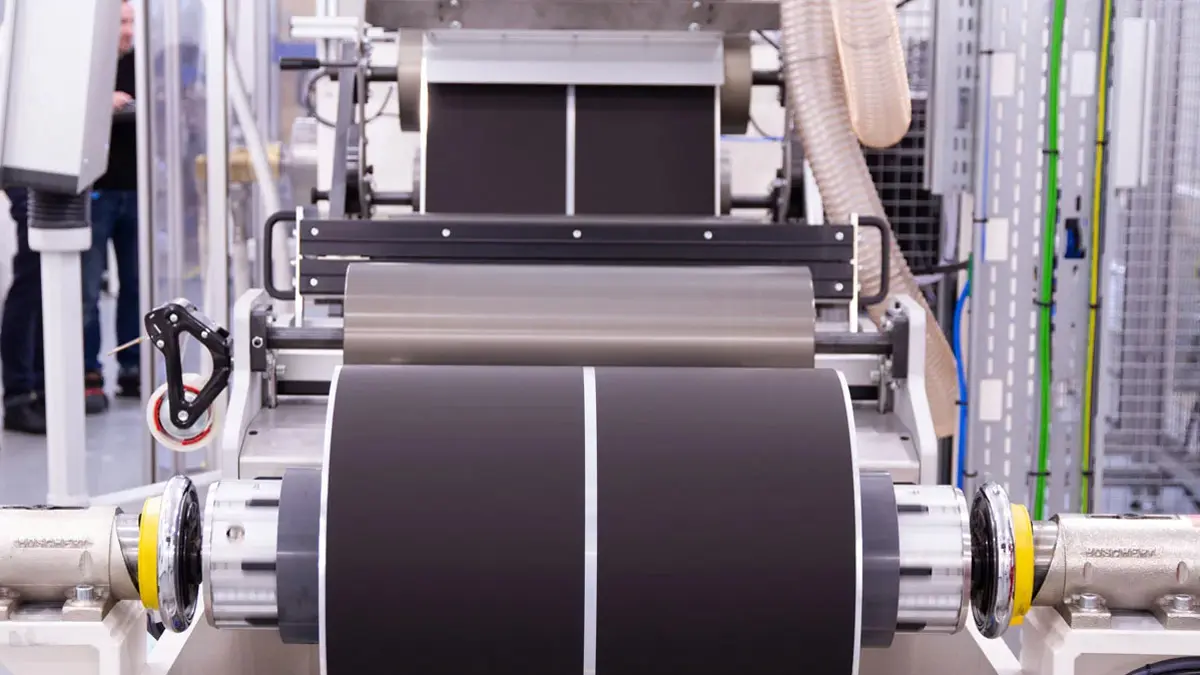
featured image: Custom-designed German machinery fills the floor at Grossröhrsdorf, enabling consistently high quality electrode and calendering process. image credit: Skeleton Technologies

While already impressive and the largest ultracapacitors factory in Europe, we are working on increasing the manufacturing capacity for the Grossröhrsdorf production facility from half a million to about 1,000,000 ultracapacitors per year in 2020. In terms of footprint, the current 3,500 square meters will be double to about 7,000 square meters by 2020.

Following the scale-up, the plan is to implement the next generation cell design, optimized for automated production and cell assembly. Further automation enables scaling up production capacity to 4,000,000 cells in the first phase, and ultimately to 10,000,000 ultracapacitors to meet demand from automotive, grid, and transportation.
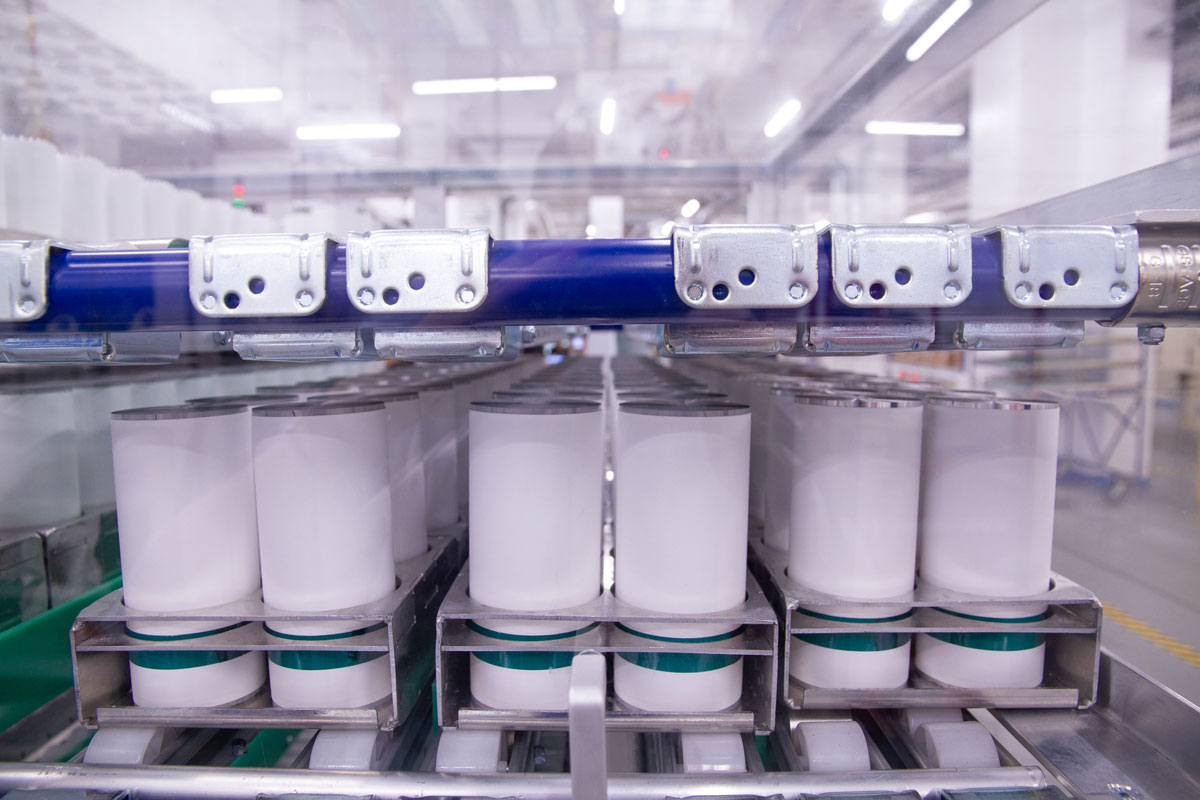
Ultracapacitors waiting for their aluminium casing, filling, and laser-welding. image credit: Skeleton Technologies

As far as electrode manufacturing capacity goes, already in 2017 we were producing the equivalent of 2,000,000 ultracapacitors worth of electrode, and can easily double production to 4,000,000 cell equivalents.
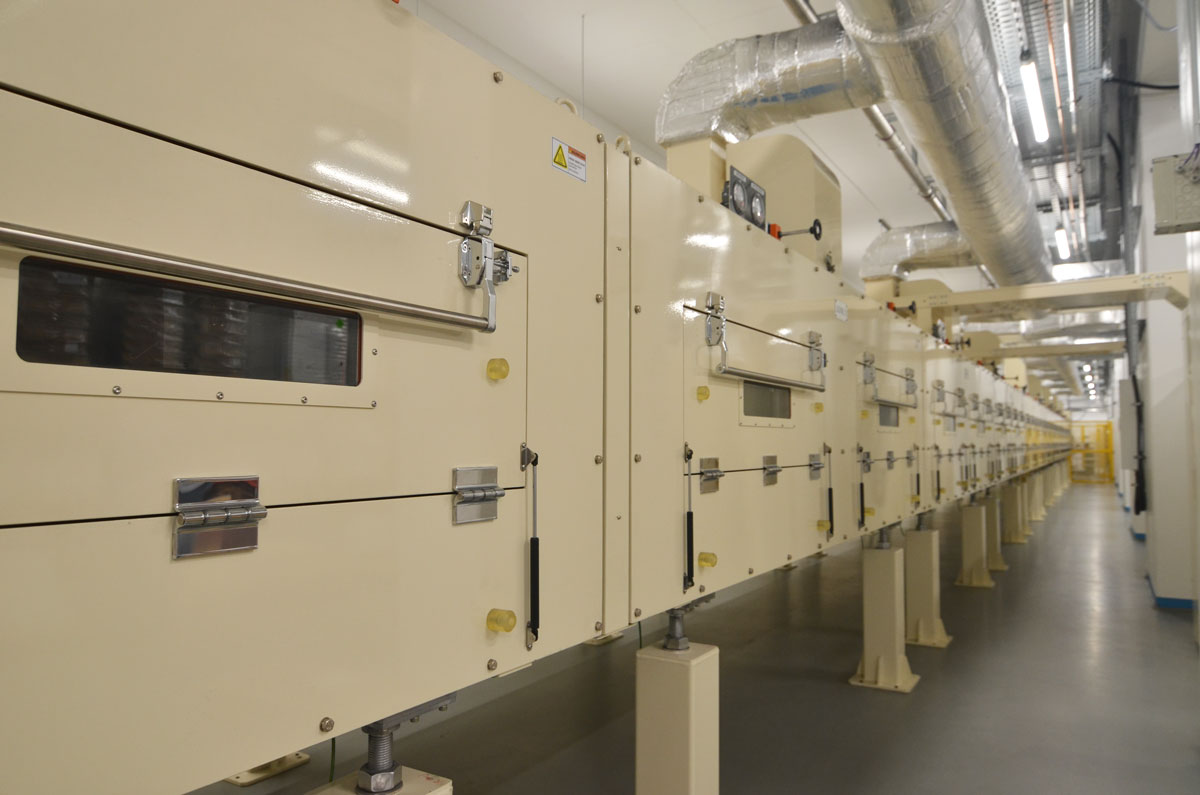
The 55-meter coating line is the largest single piece of machinery in the factory and largest of its kind in the industry. Image credit: Skeleton Technologies

The custom-design electrode mixing unit in Grossröhrsdorf is currently scaled to about 4,000,000 ultracapacitor cells, fully automated, and highly likely the most advanced mixing unit in the industry. The unit was designed and developed together with an industry specialist system manufacturer to reach faster cycle times than standard machinery can achieve.

One of the key capabilities we possess is laser-welding, which makes it possible to design a huge variety of sizes and shapes for ultracapacitor modules. On top of in-house laser-welding, we also do all module and systems design an assembly in-house. All of these capabilities are something none of our competitors offer, and provide unparalleled flexibility and quality to our customers.

Our module and systems production capacity can be quickly increased by adding lean workstations. The current nominal capacity for for example a 18-cell 48V system is about 500,000 modules per year for the laser-welding machinery, but will of course increase in parallel with the scale-up of the factory.

Industry 4.0 and full automation

Working together with large automotive OEMs, global industrial giants, and national grid operators demands a high level of quality control and constant upgrades and improvements in the production process.

The scale-up of our Grossröhrsdorf production facility to a fully automatized factory utilizing industry 4.0 quality control and production settings is no small feat for a company as young as ours. With the most modern and one of the largest ultracapacitor factories anywhere in the world, Skeleton is ideally positioned to drive electrification in industries across the board for years to come. A smart ultracapacitor factory is the key element in competing with the cost-down trend in electrification and electric vehicle production.

“In two years we have built the most modern and efficient ultracapacitor factory in the world, and the scale-up plan will increase our capacity to meet the demand created by electrification. The success of Skeleton is based on a commitment to high-quality manufacturing, and combining German engineering and production know-how with Estonian IT expertise”, Ants Vill concludes.

Related

Source: Skeleton Technologies

Recent Posts

ESA SPCD 26 Registration Open

15.5.2026
10

Capacitances of Nonlinear MLCCs: What Datasheets Don’t Tell You

14.5.2026
52

Stackpole Releases Automotive Wide‑Termination Resistors

14.5.2026
21

How a Digital Structural Twin Can Predict Tantalum Capacitor Reliability

14.5.2026
42

SCHURTER Buys Biaodi to Boost High-Voltage Protection Portfolio

14.5.2026
32

Binder Hybrid Connector Simplifies One Cable Automation

13.5.2026
16

Planar vs Conventional Transformer: When it Make Sense

11.5.2026
67

Researchers Propose Next‑Gen Compact Memory Using Ultra-thin Ferroelectric Capacitors

11.5.2026
49

Nichicon ADN Automotive Hybrid Aluminum Capacitors Now Available in EMEA

11.5.2026
38

Upcoming Events

May 19
16:00 - 17:00 CEST

Designing Qi2 Wireless Power Systems: Practical Development and EMC Optimization

Jun 2
16:00 - 17:00 CEST

Calculation, Simulation and Measurement of 800V EMC Filters

Jun 16
16:00 - 17:00 CEST

EMC with EMC – EMC‑compliant design with electromechanical connectors

View Calendar

Popular Posts

  • Buck Converter Design and Calculation

    0 shares
    Share 0 Tweet 0
  • Boost Converter Design and Calculation

    0 shares
    Share 0 Tweet 0
  • Flyback Converter Design and Calculation

    0 shares
    Share 0 Tweet 0
  • LLC Resonant Converter Design and Calculation

    0 shares
    Share 0 Tweet 0
  • MLCC and Ceramic Capacitors

    0 shares
    Share 0 Tweet 0
  • Capacitor Charging and Discharging

    0 shares
    Share 0 Tweet 0
  • What Electronics Engineer Needs to Know About Passive Low Pass Filters

    0 shares
    Share 0 Tweet 0
  • Dual Active Bridge (DAB) Topology

    0 shares
    Share 0 Tweet 0
  • Ripple Current and its Effects on the Performance of Capacitors

    3 shares
    Share 3 Tweet 0
  • MLCC Case Sizes Standards Explained

    0 shares
    Share 0 Tweet 0

Newsletter Subscription


Passive Components Blog

© EPCI - Leading Passive Components Educational and Information Site

  • Home
  • Privacy Policy
  • EPCI Membership & Advertisement
  • About

No Result
View All Result
  • Home
  • Knowledge Blog
  • PCNS

© EPCI - Leading Passive Components Educational and Information Site

This website uses cookies. By continuing to use this website you are giving consent to cookies being used. Visit our Privacy and Cookie Policy.
Go to mobile version