













Passive Components Blog
No Result
View All Result
  • Home
  • NewsFilter
    • All
    • Aerospace & Defence
    • Antenna
    • Applications
    • Automotive
    • Capacitors
    • Circuit Protection Devices
    • electro-mechanical news
    • Filters
    • Fuses
    • Inductors
    • Industrial
    • Integrated Passives
    • inter-connect news
    • Market & Supply Chain
    • Market Insights
    • Medical
    • Modelling and Simulation
    • New Materials & Supply
    • New Technologies
    • Non-linear Passives
    • Oscillators
    • Passive Sensors News
    • Resistors
    • RF & Microwave
    • Telecommunication
    • Weekly Digest

    Vishay Extends Aluminum Capacitors Rating Up to 600 V for DC Links

    Würth Elektronik Introduces Product Navigator for Passive Components

    Panasonic Passive Components for Reliable Robotic Arms

    Littelfuse Unveils Ultra-Low-Power TMR Magnetic Switches

    DC/DC Push‑Pull Converter vs PSFB Design Guide

    Wk 2 Electronics Supply Chain Digest

    Rubycon PMLCAP DC‑Link Film Capacitors in Mass Production

    Bourns SSD‑1000A AEC‑Q Digital Current Sensors

    YAGEO High‑Capacitance X7R Automotive MLCC Extensions

    Trending Tags

    • Ripple Current
    • RF
    • Leakage Current
    • Tantalum vs Ceramic
    • Snubber
    • Low ESR
    • Feedthrough
    • Derating
    • Dielectric Constant
    • New Products
    • Market Reports
  • VideoFilter
    • All
    • Antenna videos
    • Capacitor videos
    • Circuit Protection Video
    • Filter videos
    • Fuse videos
    • Inductor videos
    • Inter-Connect Video
    • Non-linear passives videos
    • Oscillator videos
    • Passive sensors videos
    • Resistor videos

    One‑Pulse Characterization of Nonlinear Power Inductors

    Thermistor Linearization Challenges

    Coaxial Connectors and How to Connect with PCB

    PCB Manufacturing, Test Methods, Quality and Reliability

    Transformer Behavior – Current Transfer and Hidden Feedback

    Choosing the Right Capacitor: The Importance of Accurate Measurements

    RF Inductors: Selection and Design Challenges for High-Frequency Circuits

    Transformer Safety IEC 61558 Standard

    3-Phase EMI Filter Design, Simulation, Calculation and Test

    Trending Tags

    • Capacitors explained
    • Inductors explained
    • Resistors explained
    • Filters explained
    • Application Video Guidelines
    • EMC
    • New Products
    • Ripple Current
    • Simulation
    • Tantalum vs Ceramic
  • Knowledge Blog
  • Suppliers
    • Who is Who
  • PCNS
    • PCNS 2025
    • PCNS 2023
    • PCNS 2021
    • PCNS 2019
    • PCNS 2017
  • Events
  • Home
  • NewsFilter
    • All
    • Aerospace & Defence
    • Antenna
    • Applications
    • Automotive
    • Capacitors
    • Circuit Protection Devices
    • electro-mechanical news
    • Filters
    • Fuses
    • Inductors
    • Industrial
    • Integrated Passives
    • inter-connect news
    • Market & Supply Chain
    • Market Insights
    • Medical
    • Modelling and Simulation
    • New Materials & Supply
    • New Technologies
    • Non-linear Passives
    • Oscillators
    • Passive Sensors News
    • Resistors
    • RF & Microwave
    • Telecommunication
    • Weekly Digest

    Vishay Extends Aluminum Capacitors Rating Up to 600 V for DC Links

    Würth Elektronik Introduces Product Navigator for Passive Components

    Panasonic Passive Components for Reliable Robotic Arms

    Littelfuse Unveils Ultra-Low-Power TMR Magnetic Switches

    DC/DC Push‑Pull Converter vs PSFB Design Guide

    Wk 2 Electronics Supply Chain Digest

    Rubycon PMLCAP DC‑Link Film Capacitors in Mass Production

    Bourns SSD‑1000A AEC‑Q Digital Current Sensors

    YAGEO High‑Capacitance X7R Automotive MLCC Extensions

    Trending Tags

    • Ripple Current
    • RF
    • Leakage Current
    • Tantalum vs Ceramic
    • Snubber
    • Low ESR
    • Feedthrough
    • Derating
    • Dielectric Constant
    • New Products
    • Market Reports
  • VideoFilter
    • All
    • Antenna videos
    • Capacitor videos
    • Circuit Protection Video
    • Filter videos
    • Fuse videos
    • Inductor videos
    • Inter-Connect Video
    • Non-linear passives videos
    • Oscillator videos
    • Passive sensors videos
    • Resistor videos

    One‑Pulse Characterization of Nonlinear Power Inductors

    Thermistor Linearization Challenges

    Coaxial Connectors and How to Connect with PCB

    PCB Manufacturing, Test Methods, Quality and Reliability

    Transformer Behavior – Current Transfer and Hidden Feedback

    Choosing the Right Capacitor: The Importance of Accurate Measurements

    RF Inductors: Selection and Design Challenges for High-Frequency Circuits

    Transformer Safety IEC 61558 Standard

    3-Phase EMI Filter Design, Simulation, Calculation and Test

    Trending Tags

    • Capacitors explained
    • Inductors explained
    • Resistors explained
    • Filters explained
    • Application Video Guidelines
    • EMC
    • New Products
    • Ripple Current
    • Simulation
    • Tantalum vs Ceramic
  • Knowledge Blog
  • Suppliers
    • Who is Who
  • PCNS
    • PCNS 2025
    • PCNS 2023
    • PCNS 2021
    • PCNS 2019
    • PCNS 2017
  • Events
No Result
View All Result
Passive Components Blog
No Result
View All Result

TDK Releases its Application Guide on Motor/Inverter Circuit Configuration

27.11.2019
Reading Time: 4 mins read
A A

As the electrification of the automotive progresses, the demand for motor generators is on the rise. There is also a trend towards integration of electric motors and inverters, and the requirements with regard to compact dimensions and resistance against heat and vibrations are becoming ever more severe, while high reliability is also an important factor. In some cases, wiring inductance can lead to high surge voltages which requires countermeasures such as suitable wiring design and snubber capacitors. At the same time, noise countermeasures are also essential.

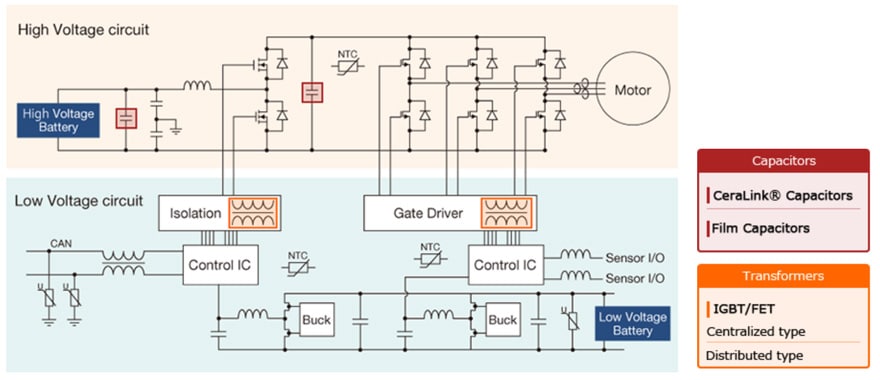
Motor/generator circuit configuration example

Inverter circuits that convert direct current to alternating current are used to drive motors and generators. Such circuits incorporate Insulated-Gate Bipolar Transistors (IGBT) and other semiconductor switches. Recently, Silicon Carbide (SiC) and other high-speed devices are also coming into use, operating at higher frequencies while featuring smaller dimensions. Driving a large electric motor requires voltages of 400 volts and higher. A booster circuit therefore is generally placed in front of the inverter circuit, and a configuration with two semiconductor switches is used to increase efficiency. When the motor is driven, a steep current rise occurs which requires the high-voltage line connecting the booster circuit and the inverter to be stabilized. This task is performed by a capacitor called DC LINK.
RelatedPosts

TDK Releases Hybrid Polymer Aluminum Capacitors with Enhanced Ripple Current Capability

Selection Guide for DC-Link Film Capacitors in Automotive Electric Compressors; KEMET App Note

Tantalum Polymer use in GaN based applications

Figure 1 : Inverter system configuration

Capacitors for DC Link/Snubber Use

The use of high-speed devices such as SiC, Gan etc. is progressing and the dimensions of inverters are shrinking, but this makes it even more important to effectively control noise. Wiring inductance can lead to high surge voltages which requires countermeasures such as suitable wiring design and snubber capacitors.
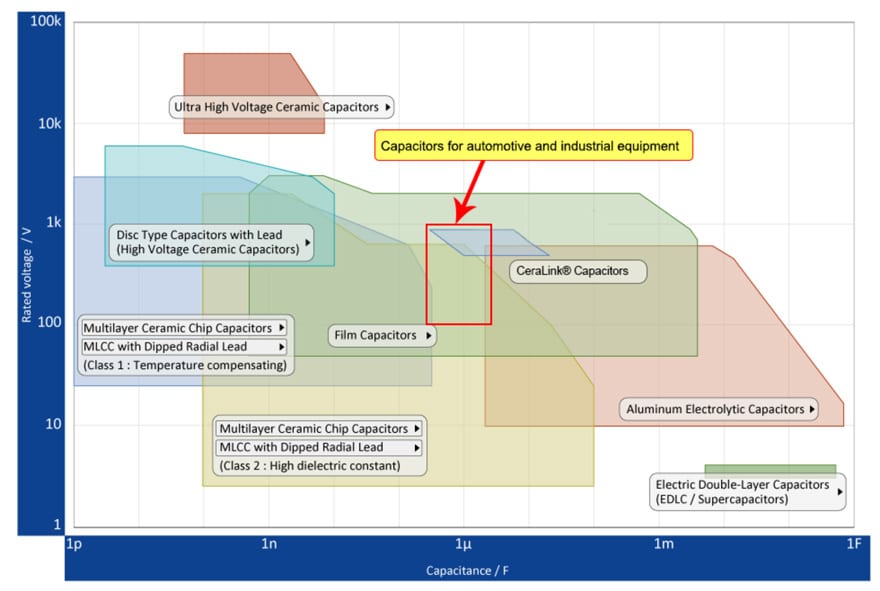
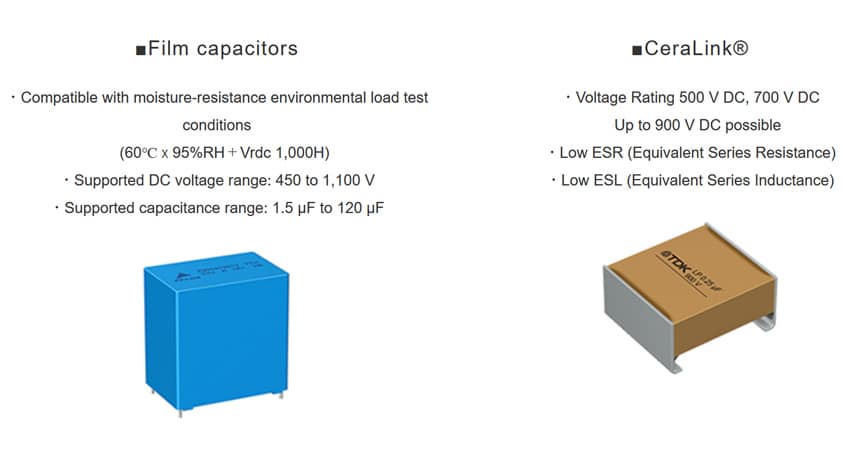
Figure 2 : TDK capacitor product map
Figure 3 : TDK recommended capacitors

Film Capacitors

Inverter circuit inputs require a stable DC voltage at the input. Because electric motors are driven at low frequencies, a relatively large capacitance is required to absorb ripple components. Film capacitors have high allowable ripple current ratings, making them suitable for achieving stable voltage.

CeraLink® Snubber Circuit Application Example

When an electric motor is driven, a steep current rise occurs. This generates a large ringing voltage which results in noise and can lead to withstand voltage degradation in semiconductor devices. Although CeraLink® are SMD products, they realize high withstand voltage and high capacitance. While harnessing the advantages of the SMD format to optimize the pattern layout, parasitic inductance in the wiring can be kept low. Furthermore, the ESL of the devices themselves is low, which makes it possible to reduce ringing voltage generation.
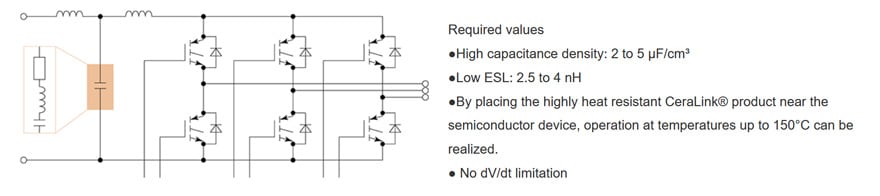
Figure 4 : CeraLink® snubber circuit application example

Transformers for IGBT/FET Drive

Motor drive inverter circuits and high-power converters use a bridge circuit configuration, which consists of semiconductor switches for the high voltage side and the low voltage side. A stable power supply is required for driving these semiconductor switches. The high side in particular has to be able to handle voltages up to 800 V for electric vehicle motors. A power supply that is insulated from the low side is required, and a compact, transformer with high withstand voltage is used for this purpose. Moreover, since multiple semiconductor switches are used and the gate voltage varies, causing reliability differences between devices, voltage equalization is desirable.
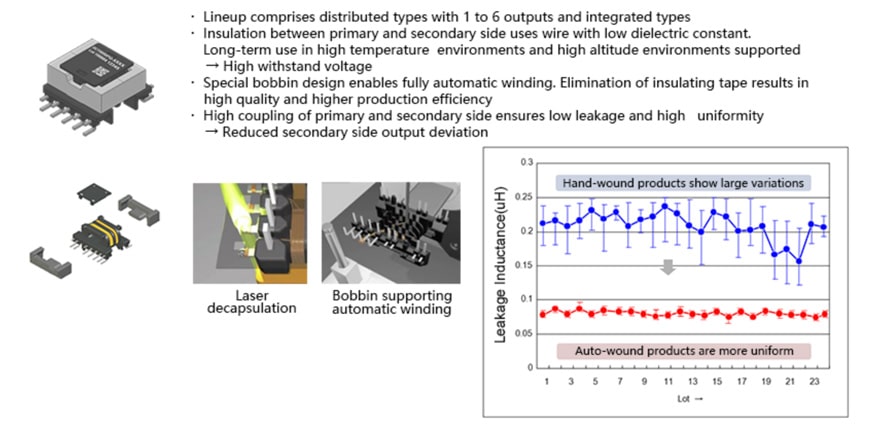
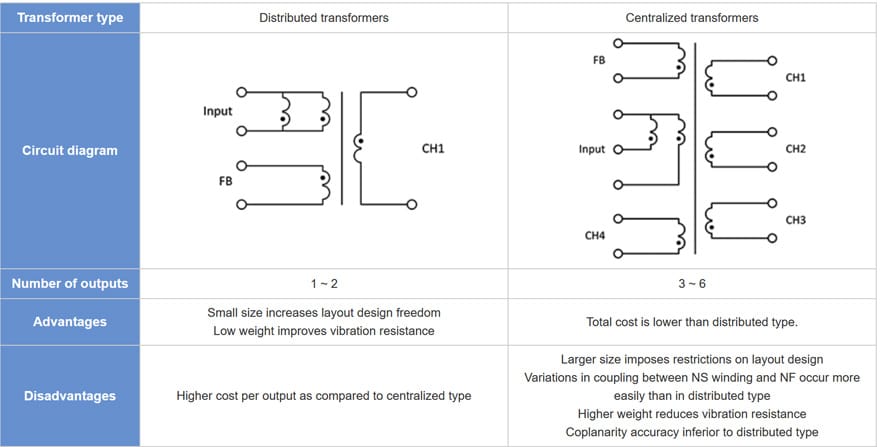
Figure 5 : IGBT FET drive power transformer
Figure 6 : Differences in structure and line up of IGBT FET transformers

Example of IGBT/FET Drive Transformer

IPM (Intelligent Power Modules) are used for high-power inverters, booster circuits, and similar. They are semiconductor components created by combining power devices such as power MOS-FETs or IGBTs with a drive circuit and an integrated self-protection function.
A power supply voltage of 15 V ±10% is required to drive an IPM. Transformers are used to provide insulation from power devices, but poor characteristics of the transformer will degrade voltage stability. The wire material is also crucial in terms of achieving the required insulation reliability. Material that can withstand high temperatures is therefore used. If space and cost are the top considerations, the choice will be an integrated transformer. By contrast, if layout design freedom and voltage stability are given priority, the choice is a distributed transformer.
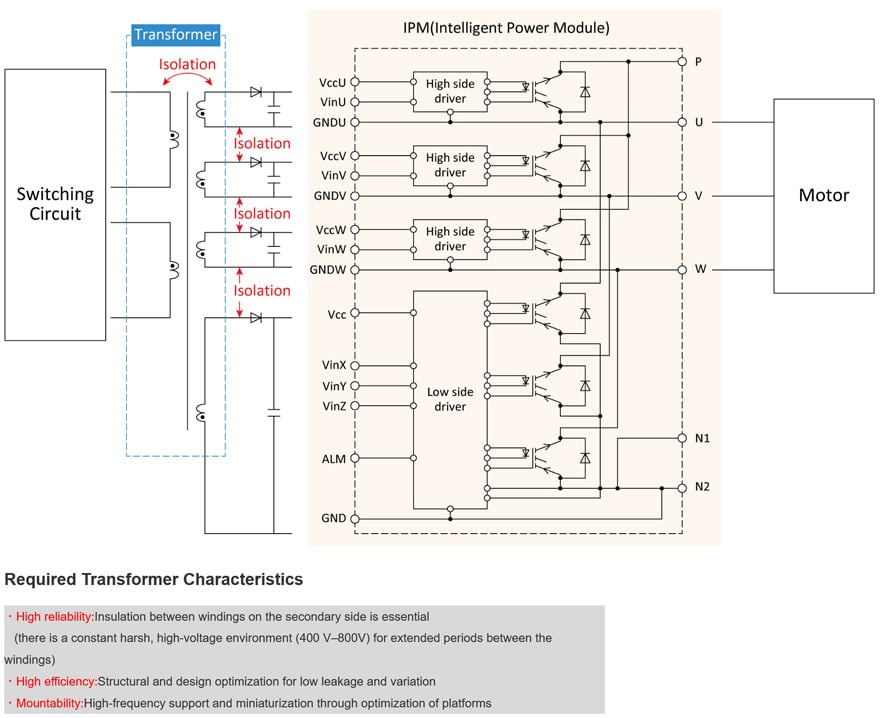
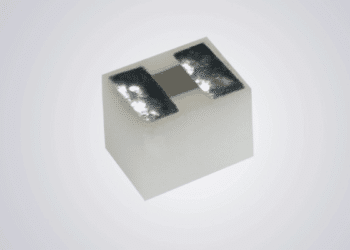
Figure 7 : Example of IGBT/FET drive transformer

Related

Source: TDK

Recent Posts

Vishay Extends Aluminum Capacitors Rating Up to 600 V for DC Links

15.1.2026
7

Würth Elektronik Introduces Product Navigator for Passive Components

14.1.2026
27

Panasonic Passive Components for Reliable Robotic Arms

14.1.2026
31

Littelfuse Unveils Ultra-Low-Power TMR Magnetic Switches

13.1.2026
13

DC/DC Push‑Pull Converter vs PSFB Design Guide

12.1.2026
41

Rubycon PMLCAP DC‑Link Film Capacitors in Mass Production

9.1.2026
37

Bourns SSD‑1000A AEC‑Q Digital Current Sensors

8.1.2026
45

YAGEO High‑Capacitance X7R Automotive MLCC Extensions

8.1.2026
55

How Metal Prices Are Driving Passive Component Price Hikes

8.1.2026
268

Upcoming Events

Jan 21
18:00 - 18:45 CET

To Rogowski or not to Rogowski

Jan 27
16:00 - 17:00 CET

Simplifying Vehicle Development with Automotive Ethernet and Zonal Smart Switch Technologies

Feb 24
16:00 - 17:00 CET

Designing Qi2 Wireless Power Systems: Practical Development and EMC Optimization

View Calendar

Popular Posts

  • Buck Converter Design and Calculation

    0 shares
    Share 0 Tweet 0
  • Boost Converter Design and Calculation

    0 shares
    Share 0 Tweet 0
  • LLC Resonant Converter Design and Calculation

    0 shares
    Share 0 Tweet 0
  • Flyback Converter Design and Calculation

    0 shares
    Share 0 Tweet 0
  • Ripple Current and its Effects on the Performance of Capacitors

    3 shares
    Share 3 Tweet 0
  • MLCC and Ceramic Capacitors

    0 shares
    Share 0 Tweet 0
  • Dual Active Bridge (DAB) Topology

    0 shares
    Share 0 Tweet 0
  • What is a Dielectric Constant and DF of Plastic Materials?

    4 shares
    Share 4 Tweet 0
  • How Metal Prices Are Driving Passive Component Price Hikes

    0 shares
    Share 0 Tweet 0
  • SEPIC Converter Design and Calculation

    0 shares
    Share 0 Tweet 0

Newsletter Subscription


Passive Components Blog

© EPCI - Leading Passive Components Educational and Information Site

  • Home
  • Privacy Policy
  • EPCI Membership & Advertisement
  • About

No Result
View All Result
  • Home
  • Knowledge Blog
  • PCNS

© EPCI - Leading Passive Components Educational and Information Site

This website uses cookies. By continuing to use this website you are giving consent to cookies being used. Visit our Privacy and Cookie Policy.
Go to mobile version