

Passive Components Blog
No Result
View All Result
  • Home
  • NewsFilter
    • All
    • Aerospace & Defence
    • Antenna
    • Applications
    • Automotive
    • Capacitors
    • Circuit Protection Devices
    • electro-mechanical news
    • Filters
    • Fuses
    • Inductors
    • Industrial
    • Integrated Passives
    • inter-connect news
    • Market & Supply Chain
    • Market Insights
    • Medical
    • Modelling and Simulation
    • New Materials & Supply
    • New Technologies
    • Non-linear Passives
    • Oscillators
    • Passive Sensors News
    • Resistors
    • RF & Microwave
    • Telecommunication
    • Weekly Digest

    Molecular Memristor Shows Record 145 kH Emergent Inductance

    Planar vs Conventional Transformer: When it Make Sense

    Researchers Propose Next‑Gen Compact Memory Using Ultra-thin Ferroelectric Capacitors

    Nichicon ADN Automotive Hybrid Aluminum Capacitors Now Available in EMEA

    Wk 19 Electronics Supply Chain Digest

    Electrocaloric Multilayer Capacitors: Towards Quiet, Solid‑State Cooling Around Room Temperature

    High-Crystallinity Nanocrystalline Composites for MHz Chip Inductors

    European Components Distribution Shows Strong Q1 2026 Growth Amid Geopolitical Uncertainty

    Stackpole Expanded its AlN Thick Film Chip Resistors

    Trending Tags

    • Ripple Current
    • RF
    • Leakage Current
    • Tantalum vs Ceramic
    • Snubber
    • Low ESR
    • Feedthrough
    • Derating
    • Dielectric Constant
    • New Products
    • Market Reports
  • VideoFilter
    • All
    • Antenna videos
    • Capacitor videos
    • Circuit Protection Video
    • Filter videos
    • Fuse videos
    • Inductor videos
    • Inter-Connect Video
    • Non-linear passives videos
    • Oscillator videos
    • Passive sensors videos
    • Resistor videos

    Planar vs Conventional Transformer: When it Make Sense

    Modeling Fringing Field Losses in Inductors & Transformers

    Why Power Inductors Use a Ferrite Core With an Air Gap

    Transformer-Based Power-Line Harvester Magnetic Design

    Thermal Modeling of Magnetics

    Standard vs Planar LLC transformers Comparison for Battery Chargers

    How Modern Tools Model Magnetic Components for Power Electronics

    Advanced Loss Modeling for Planar Magnetics in the Frenetic Planar Tool

    2026 Power Magnetics Design Trends: Flyback, DAB and Planar

    Trending Tags

    • Capacitors explained
    • Inductors explained
    • Resistors explained
    • Filters explained
    • Application Video Guidelines
    • EMC
    • New Products
    • Ripple Current
    • Simulation
    • Tantalum vs Ceramic
  • Knowledge Blog
  • DossiersNew
  • Suppliers
    • Who is Who
  • PCNS
    • PCNS 2025
    • PCNS 2023
    • PCNS 2021
    • PCNS 2019
    • PCNS 2017
  • Events
  • Home
  • NewsFilter
    • All
    • Aerospace & Defence
    • Antenna
    • Applications
    • Automotive
    • Capacitors
    • Circuit Protection Devices
    • electro-mechanical news
    • Filters
    • Fuses
    • Inductors
    • Industrial
    • Integrated Passives
    • inter-connect news
    • Market & Supply Chain
    • Market Insights
    • Medical
    • Modelling and Simulation
    • New Materials & Supply
    • New Technologies
    • Non-linear Passives
    • Oscillators
    • Passive Sensors News
    • Resistors
    • RF & Microwave
    • Telecommunication
    • Weekly Digest

    Molecular Memristor Shows Record 145 kH Emergent Inductance

    Planar vs Conventional Transformer: When it Make Sense

    Researchers Propose Next‑Gen Compact Memory Using Ultra-thin Ferroelectric Capacitors

    Nichicon ADN Automotive Hybrid Aluminum Capacitors Now Available in EMEA

    Wk 19 Electronics Supply Chain Digest

    Electrocaloric Multilayer Capacitors: Towards Quiet, Solid‑State Cooling Around Room Temperature

    High-Crystallinity Nanocrystalline Composites for MHz Chip Inductors

    European Components Distribution Shows Strong Q1 2026 Growth Amid Geopolitical Uncertainty

    Stackpole Expanded its AlN Thick Film Chip Resistors

    Trending Tags

    • Ripple Current
    • RF
    • Leakage Current
    • Tantalum vs Ceramic
    • Snubber
    • Low ESR
    • Feedthrough
    • Derating
    • Dielectric Constant
    • New Products
    • Market Reports
  • VideoFilter
    • All
    • Antenna videos
    • Capacitor videos
    • Circuit Protection Video
    • Filter videos
    • Fuse videos
    • Inductor videos
    • Inter-Connect Video
    • Non-linear passives videos
    • Oscillator videos
    • Passive sensors videos
    • Resistor videos

    Planar vs Conventional Transformer: When it Make Sense

    Modeling Fringing Field Losses in Inductors & Transformers

    Why Power Inductors Use a Ferrite Core With an Air Gap

    Transformer-Based Power-Line Harvester Magnetic Design

    Thermal Modeling of Magnetics

    Standard vs Planar LLC transformers Comparison for Battery Chargers

    How Modern Tools Model Magnetic Components for Power Electronics

    Advanced Loss Modeling for Planar Magnetics in the Frenetic Planar Tool

    2026 Power Magnetics Design Trends: Flyback, DAB and Planar

    Trending Tags

    • Capacitors explained
    • Inductors explained
    • Resistors explained
    • Filters explained
    • Application Video Guidelines
    • EMC
    • New Products
    • Ripple Current
    • Simulation
    • Tantalum vs Ceramic
  • Knowledge Blog
  • DossiersNew
  • Suppliers
    • Who is Who
  • PCNS
    • PCNS 2025
    • PCNS 2023
    • PCNS 2021
    • PCNS 2019
    • PCNS 2017
  • Events
No Result
View All Result
Passive Components Blog
No Result
View All Result

TI Releases Industry’s First Stand-Alone Active EMI Filter ICs

4.4.2023
Reading Time: 3 mins read
A A

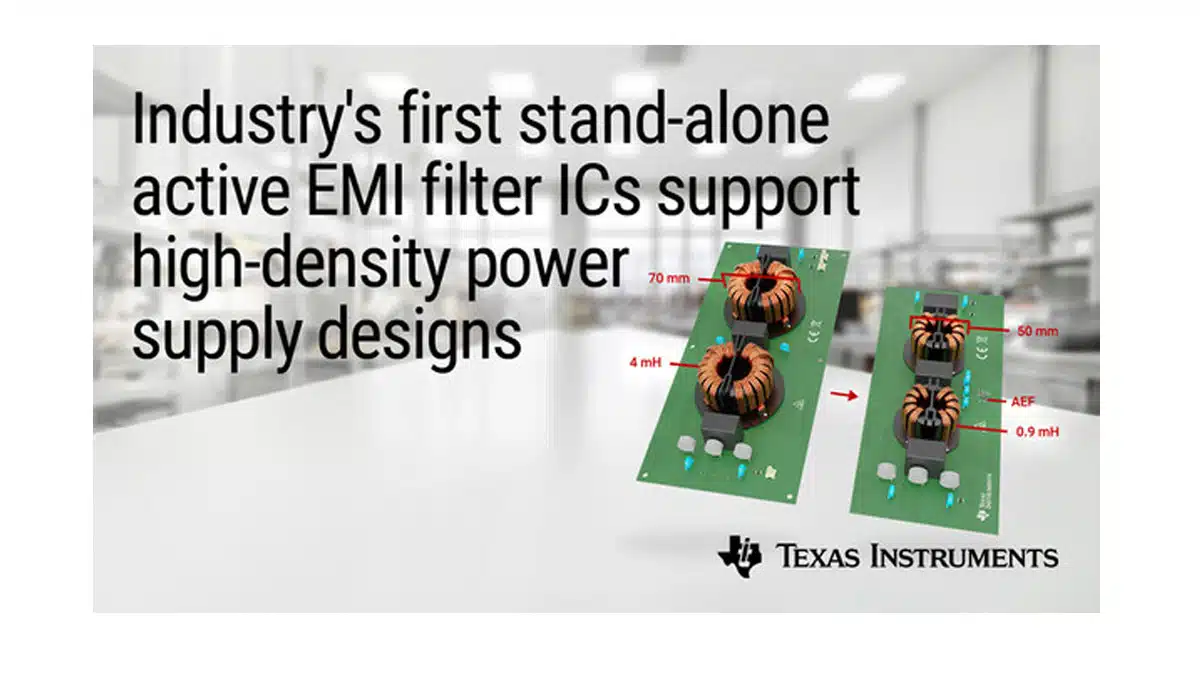
TI Texas Instruments pioneers the industry’s first stand-alone active EMI filter ICs, supporting high-density power supply designs. Engineers can design smaller, lighter and more affordable solutions while optimizing system performance, efficiency and reliability.

Texas Instruments (TI) debuted the industry’s first stand-alone active electromagnetic interference EMI filtering integrated circuits (ICs), enabling engineers to implement smaller, lighter EMI filters, to enhance system functionality at reduced system cost while simultaneously meeting EMI regulatory standards.

RelatedPosts

Molecular Memristor Shows Record 145 kH Emergent Inductance

Planar vs Conventional Transformer: When it Make Sense

Researchers Propose Next‑Gen Compact Memory Using Ultra-thin Ferroelectric Capacitors

As electrical systems become increasingly dense and interconnected, mitigating EMI is a critical system design consideration for engineers. With innovative developments from Kilby Labs, TI’s research and development labs for new concepts and breakthrough ideas, the new portfolio of stand-alone active EMI filter ICs can sense and cancel common-mode EMI by as much as 30 dB at frequencies between 100 kHz and 3 MHz in single- and three-phase AC power systems.

This capability enables designers to reduce the size of chokes by 50%, compared to purely passive filter solutions, and meet stringent EMI requirements.

“To meet customer needs for higher performance and lower-cost systems, TI continues to advance in power innovations to cost-effectively address EMI design challenges,” said Carsten Oppitz, general manager for switching regulators at TI. “We believe that this new portfolio of stand-alone active EMI filter ICs will further help engineers solve their design challenges and maximize performance and power density in automotive, enterprise, aerospace and industrial applications.”

Significantly reduce system size, weight and cost and improve reliability

One of the main challenges when designing high-density switching regulators is how to implement a compact and efficient design of the EMI input filter. Through capacitive amplification, these new active EMI filter ICs enable engineers to shrink the inductance value of common-mode chokes by as much as 80%, helping to cost-effectively achieve improved mechanical reliability and increased power density.

The new family of active EMI filter ICs consists of the TPSF12C1 and TPSF12C3 for single- and three-phase commercial applications and TPSF12C1-Q1 and TPSF12C3-Q1 for automotive applications. These devices can efficiently reduce the heat generated in a power-supply EMI filter, which also extends filter capacitor lifetimes and increases system reliability.

The new active EMI filter ICs incorporate sensing, filtering, gain and injection stages. Offered in a SOT-23 14-pin package, the IC integrates compensation and protection circuitry to further reduce the implementation complexity and minimize the number of external components.

Mitigate common-mode emissions to meet stringent EMI standards

Comité International Spécial des Perturbations Radioélectriques (CISPR) standards are the global benchmark for limiting EMI in electrical and electronic devices. The TPSF12C1, TPSF12C3, TPSF12C1-Q1, and TPSF12C3-Q1 help detect, process and reduce EMI in a broad range of AC/DC power supplies, on-board chargers, servers, UPS and other similar systems where common-mode noise dominates. Therefore, engineers will be able to address EMI design challenges and meet CISPR 11, CISPR 32 and CISPR 25 EMI requirements.

TI’s active EMI filter ICs meet IEC 61000-4-5 surge immunity requirements, thus minimizing the need for external protection components, such as transient voltage suppression (TVS) diodes. With supporting tools, such as PSpice® for TI simulation models and quick-start calculators, designers can easily select and implement the optimal components for their system. To learn more about designing with this new family of active EMI filter ICs, read the technical article, “How a stand-alone active EMI filter IC shrinks common-mode filter size.”

Package, availability and pricing

Preproduction quantities of the automotive-grade TPSF12C1-Q1 and TPSF12C3-Q1 are available now, in a 4.2-mm-by-2-mm SOT-23 14-pin package. The commercial-grade TPSF12C1 and TPSF12C3 will be available in preproduction quantities by end of March 2023. TI expects all devices to be available in volume production in the second quarter of 2023, and plans to release additional stand-alone active EMI filter ICs later in 2023.

Related

Source: Texas Instrument

Recent Posts

TDK Releases Ultra‑small EMI Noise Suppression Filters

8.4.2026
32

Kyocera Offers Small SAW Filters for IoT RF Modules

23.2.2026
32

Transient Suppression Guide

19.11.2025
547

Overvoltage and Transient Protection for DC/DC Power Modules

13.11.2025
273

3-Phase EMI Filter Design, Simulation, Calculation and Test

6.11.2025
1.6k

Kyocera Launches New SAW Filter for GNSS 1.6GHz Satellite Communications

30.9.2025
63

Space Evaluation Testing on SAW Filter Based on Piezo-On-Insulator Technology

29.9.2025
91

EMI Noise Mitigation in Automotive 48V Power Supply Systems

24.9.2025
184

KYOCERA AVX Releases 600MHz Band71 Compact SAW Duplexer

30.7.2025
28

Upcoming Events

May 13
17:00 - 17:30 CEST

Winding Loss Modeling for Toroidal Magnetics – Including Gapped Cores

May 19
16:00 - 17:00 CEST

Designing Qi2 Wireless Power Systems: Practical Development and EMC Optimization

Jun 2
16:00 - 17:00 CEST

Calculation, Simulation and Measurement of 800V EMC Filters

View Calendar

Popular Posts

  • Buck Converter Design and Calculation

    0 shares
    Share 0 Tweet 0
  • Boost Converter Design and Calculation

    0 shares
    Share 0 Tweet 0
  • Flyback Converter Design and Calculation

    0 shares
    Share 0 Tweet 0
  • LLC Resonant Converter Design and Calculation

    0 shares
    Share 0 Tweet 0
  • MLCC and Ceramic Capacitors

    0 shares
    Share 0 Tweet 0
  • Dual Active Bridge (DAB) Topology

    0 shares
    Share 0 Tweet 0
  • What Electronics Engineer Needs to Know About Passive Low Pass Filters

    0 shares
    Share 0 Tweet 0
  • Capacitor Charging and Discharging

    0 shares
    Share 0 Tweet 0
  • Ripple Current and its Effects on the Performance of Capacitors

    3 shares
    Share 3 Tweet 0
  • MLCC Case Sizes Standards Explained

    0 shares
    Share 0 Tweet 0

Newsletter Subscription


Passive Components Blog

© EPCI - Leading Passive Components Educational and Information Site

  • Home
  • Privacy Policy
  • EPCI Membership & Advertisement
  • About

No Result
View All Result
  • Home
  • Knowledge Blog
  • PCNS

© EPCI - Leading Passive Components Educational and Information Site

This website uses cookies. By continuing to use this website you are giving consent to cookies being used. Visit our Privacy and Cookie Policy.
Go to mobile version