







Passive Components Blog
No Result
View All Result
  • Home
  • NewsFilter
    • All
    • Aerospace & Defence
    • Antenna
    • Applications
    • Automotive
    • Capacitors
    • Circuit Protection Devices
    • electro-mechanical news
    • Filters
    • Fuses
    • Inductors
    • Industrial
    • Integrated Passives
    • inter-connect news
    • Market & Supply Chain
    • Market Insights
    • Medical
    • Modelling and Simulation
    • New Materials & Supply
    • New Technologies
    • Non-linear Passives
    • Oscillators
    • Passive Sensors News
    • Resistors
    • RF & Microwave
    • Telecommunication
    • Weekly Digest

    ECIA Industry Pulse Index Cools After Five-Year High

    YAGEO Extends Automotive CAN and CAN-FD Common-Mode Chokes

    Würth Elektronik Updates REDEXPERT DC‑DC Converter Designer

    Stackpole Unveils High-Temperature Automotive Thick Film Chip Resistors for Harsh Environments

    Molex Presents MiniMix Hybrid Power and Signal Connectors for Compact Humanoid Joints

    Bourns Releases Custom SiC AFE/PFC Power Inductor for High‑Voltage Designs

    Littelfuse Releases Toggle Safety Covers for Reliable Control Panels

    Bourns Expanded Blend‑Balance Guitar Potentiometers Resistance Range

    TDK Extends Vibration‑Resistant Axial Aluminum Capacitors for Compact DC‑links

    Trending Tags

    • Ripple Current
    • RF
    • Leakage Current
    • Tantalum vs Ceramic
    • Snubber
    • Low ESR
    • Feedthrough
    • Derating
    • Dielectric Constant
    • New Products
    • Market Reports
  • VideoFilter
    • All
    • Antenna videos
    • Capacitor videos
    • Circuit Protection Video
    • Filter videos
    • Fuse videos
    • Inductor videos
    • Inter-Connect Video
    • Non-linear passives videos
    • Oscillator videos
    • Passive sensors videos
    • Resistor videos

    Current Sense Transformers: Ferrite vs Nanocrystalline Cores for Accurate Current Measurement

    EMC Design Fundamentals: Safe Use of Varistors and Common Mode Chokes in Mains and Data-Line Filters

    Ferrite versus Nanocrystalline Power Inductor Cores: Turns, Gap and Size

    KYOCERA AVX Presents Antenna Integrator Studio Tutorial for Antenna Placement and RF Design

    Power Design Simulation Tools for Faster Inductor Selection and Loss Optimization

    EMC‑Compliant PCB and Connector Design Guidelines

    Why Isolated DC/DC Power Supplies Fail Late, Würth Elektronik Podcast

    Designing 800 V DC EMC Filters: Calculation, Simulation and Measurement

    Current Sense Transformer Datasheet and Design‑in Guide

    Trending Tags

    • Capacitors explained
    • Inductors explained
    • Resistors explained
    • Filters explained
    • Application Video Guidelines
    • EMC
    • New Products
    • Ripple Current
    • Simulation
    • Tantalum vs Ceramic
  • Knowledge Blog
  • Dossiers
    • AI Hardware Dossier
    • Power Converter Dossier
    • Automotive Dossier
    • Capacitor Dossier
    • Resistor Dossier
    • Inductor Dossier
    • Circuit Protection Dossier
  • Suppliers
    • Who is Who
  • PCNS
    • PCNS 2025
    • PCNS 2023
    • PCNS 2021
    • PCNS 2019
    • PCNS 2017
  • Events
  • Home
  • NewsFilter
    • All
    • Aerospace & Defence
    • Antenna
    • Applications
    • Automotive
    • Capacitors
    • Circuit Protection Devices
    • electro-mechanical news
    • Filters
    • Fuses
    • Inductors
    • Industrial
    • Integrated Passives
    • inter-connect news
    • Market & Supply Chain
    • Market Insights
    • Medical
    • Modelling and Simulation
    • New Materials & Supply
    • New Technologies
    • Non-linear Passives
    • Oscillators
    • Passive Sensors News
    • Resistors
    • RF & Microwave
    • Telecommunication
    • Weekly Digest

    ECIA Industry Pulse Index Cools After Five-Year High

    YAGEO Extends Automotive CAN and CAN-FD Common-Mode Chokes

    Würth Elektronik Updates REDEXPERT DC‑DC Converter Designer

    Stackpole Unveils High-Temperature Automotive Thick Film Chip Resistors for Harsh Environments

    Molex Presents MiniMix Hybrid Power and Signal Connectors for Compact Humanoid Joints

    Bourns Releases Custom SiC AFE/PFC Power Inductor for High‑Voltage Designs

    Littelfuse Releases Toggle Safety Covers for Reliable Control Panels

    Bourns Expanded Blend‑Balance Guitar Potentiometers Resistance Range

    TDK Extends Vibration‑Resistant Axial Aluminum Capacitors for Compact DC‑links

    Trending Tags

    • Ripple Current
    • RF
    • Leakage Current
    • Tantalum vs Ceramic
    • Snubber
    • Low ESR
    • Feedthrough
    • Derating
    • Dielectric Constant
    • New Products
    • Market Reports
  • VideoFilter
    • All
    • Antenna videos
    • Capacitor videos
    • Circuit Protection Video
    • Filter videos
    • Fuse videos
    • Inductor videos
    • Inter-Connect Video
    • Non-linear passives videos
    • Oscillator videos
    • Passive sensors videos
    • Resistor videos

    Current Sense Transformers: Ferrite vs Nanocrystalline Cores for Accurate Current Measurement

    EMC Design Fundamentals: Safe Use of Varistors and Common Mode Chokes in Mains and Data-Line Filters

    Ferrite versus Nanocrystalline Power Inductor Cores: Turns, Gap and Size

    KYOCERA AVX Presents Antenna Integrator Studio Tutorial for Antenna Placement and RF Design

    Power Design Simulation Tools for Faster Inductor Selection and Loss Optimization

    EMC‑Compliant PCB and Connector Design Guidelines

    Why Isolated DC/DC Power Supplies Fail Late, Würth Elektronik Podcast

    Designing 800 V DC EMC Filters: Calculation, Simulation and Measurement

    Current Sense Transformer Datasheet and Design‑in Guide

    Trending Tags

    • Capacitors explained
    • Inductors explained
    • Resistors explained
    • Filters explained
    • Application Video Guidelines
    • EMC
    • New Products
    • Ripple Current
    • Simulation
    • Tantalum vs Ceramic
  • Knowledge Blog
  • Dossiers
    • AI Hardware Dossier
    • Power Converter Dossier
    • Automotive Dossier
    • Capacitor Dossier
    • Resistor Dossier
    • Inductor Dossier
    • Circuit Protection Dossier
  • Suppliers
    • Who is Who
  • PCNS
    • PCNS 2025
    • PCNS 2023
    • PCNS 2021
    • PCNS 2019
    • PCNS 2017
  • Events
No Result
View All Result
Passive Components Blog
No Result
View All Result

Bourns Introduces IsoMOV™ Hybrid Protector – a Fully Integrated MOV and GDT Device

23.7.2021
Reading Time: 3 mins read
A A

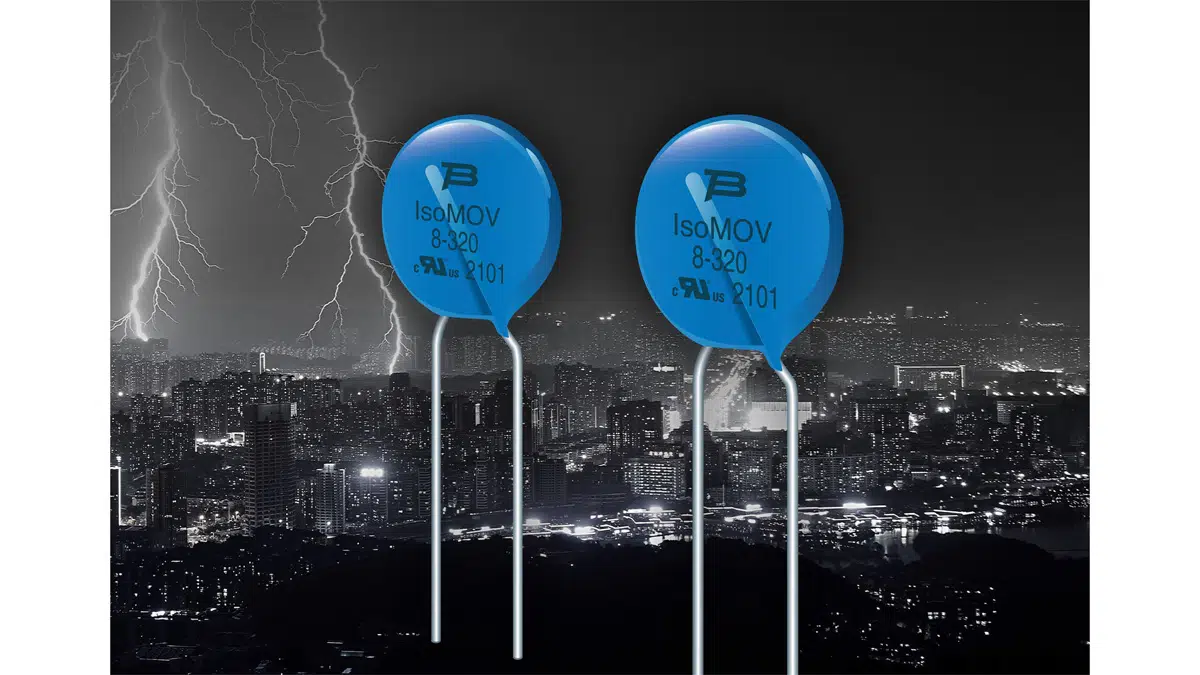
Riverside, California – July 21, 2021 – Bourns is pleased to announce its new lineup of IsoMOV™ technology hybrid overvoltage surge protectors.

With their integrated gas discharge tube structure and extended temperature range, the IsoMOV™ hybrid protection components promise better reliability and longer life in certain harsh environments.

RelatedPosts

Bourns Releases Custom SiC AFE/PFC Power Inductor for High‑Voltage Designs

Bourns Expanded Blend‑Balance Guitar Potentiometers Resistance Range

Bourns Introduces Automotive Wide Terminal Metal Foil Current Sense Resistors for High‑Reliability Designs

The hybrid protection components integrates the gas discharge tube (GDT) function directly into the metal oxide varistor (MOV) itself, providing an elevated level of surge protection in terms of performance, operational life and enhanced device reliability. The integrated, compact hybrid design features performance specifications usually found in larger traditional MOV devices, the Bourns IsoMOV protectors enable designers to better tailor the surge protection performance to stringent space requirements, and allow them to upgrade their MOV over-voltage protection to include the proven benefit of GDT isolation without a PCB redesign. The IsoMOV protectors’ industry standard pin layouts offer a substantial performance and reliability upgrade to same-size standard MOVs in a pin-to-pin drop-in-replacement form factor.
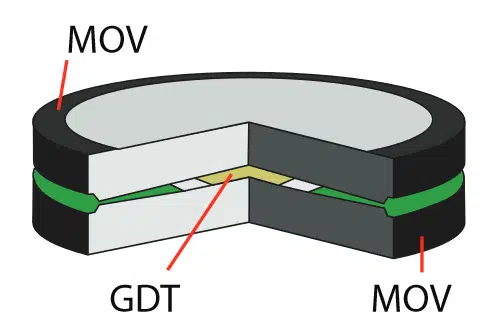
Using proprietary computer-aided design techniques to model performance, Bourns engineers have combined its revolutionary EdgMOV™ technology, which greatly reduces typical MOV edge failures, with a unique integrated structure to create a device with the equivalent function of a discrete MOV and GDT in series. The result is a familiar radial disk MOV package that is only slightly thicker and of substantially smaller diameter than similarly rated conventional devices.

Combining both devices into a single package allows the GDT to block leakage currents through the MOV that may lead to premature failure, making it inherently more robust without adding additional components into the circuit design. Rated at 125 degrees C, which is well above the industry standard 85 degrees C, the IsoMOV protector’s temperature range and low leakage are suited to industrial, power line communications, high speed information and communication technology (ICT) equipment, as well as a range of harsh environment or remote, exposed applications where repairs can be both physically challenging and expensive to perform.

“In our interconnected world, devices need to maintain maximum uptime,” explained Tomaž Bojko, product line manager for over-voltage protection at Bourns. “Because of this, many designers specify MOVs rated for much higher voltages and surge currents in order to ensure they are never stressed to their breaking point. Others have placed GDTs in series with MOVs to eliminate leakage currents and extend the life of the MOV,” he continued. “The efficient design of the Bourns IsoMOV protector allows designers to do away with larger, generally lower-performing, and often more expensive design alternatives,” he said.

Lee Bourns, marketing director for circuit protection, added: “For far too long, design engineers have been forced to select between marginally-performing, space-saving components and larger, over-specified devices in order to meet their protection needs. With IsoMOV protectors, designers can now get the right level of surge protection for their application without having to make any performance, size, cost or redesign compromises.”

The Bourns IsoMOV protector series is UL 1449 Type 5-recognised and available now.

Features

  • AC voltage ratings 175 V – 555 V
  • Nominal surge ratings 3 kA – 5 kA – 8 kA
  • -40 °C to +125 °C operation
  • Low leakage current
  • Low capacitance and insertion loss
  • Stable performance throughout life
  • Design kit available for quick-turn prototype testing
  • UL Listed UL 1449 Type 4 CA
  • RoHS compliant*

Applications

  • Critical AC power applications
  • White goods
  • Motor drives
  • C inverters
  • LED lighting and signage
  • Surge Protective Devices (SPDs)

Related

Source: Bourns

Recent Posts

YAGEO Extends Automotive CAN and CAN-FD Common-Mode Chokes

10.8.2026
6

Stackpole Unveils High-Temperature Automotive Thick Film Chip Resistors for Harsh Environments

6.8.2026
39

Molex Presents MiniMix Hybrid Power and Signal Connectors for Compact Humanoid Joints

6.8.2026
51

Bourns Releases Custom SiC AFE/PFC Power Inductor for High‑Voltage Designs

6.8.2026
41

Littelfuse Releases Toggle Safety Covers for Reliable Control Panels

6.8.2026
15

TDK Extends Vibration‑Resistant Axial Aluminum Capacitors for Compact DC‑links

4.8.2026
49

YAGEO Releases SMD 0402 Pt Temperature Sensors for Space‑Constrained Designs

3.8.2026
60

Bourns Introduces Automotive Wide Terminal Metal Foil Current Sense Resistors for High‑Reliability Designs

3.8.2026
34

YAGEO Extends Automotive Tantalum Polymer Capacitors for AI and ADAS Controllers

31.7.2026
120

Upcoming Events

Sep 10
11:00 - 12:00 CEST

Equipment models and model strategies for Space Missions

Sep 29
16:00 - 17:00 CEST

Cybersecurity 2026

Nov 24
16:00 - 17:00 CET

Component selection with the WE REDEXPERT® DC-DC Converter Designer Tool

View Calendar

Popular Posts

  • Buck Converter Design and Calculation

    0 shares
    Share 0 Tweet 0
  • Boost Converter Design and Calculation

    0 shares
    Share 0 Tweet 0
  • LLC Resonant Converter Design and Calculation

    0 shares
    Share 0 Tweet 0
  • Flyback Converter Design and Calculation

    0 shares
    Share 0 Tweet 0
  • MLCC and Ceramic Capacitors

    0 shares
    Share 0 Tweet 0
  • MLCCs in the Age of AI: Q2 2026 Market Tightness

    0 shares
    Share 0 Tweet 0
  • YAGEO Announces July 2026 Capacitor Price Increase

    0 shares
    Share 0 Tweet 0
  • Earthing Systems and IEC Classification Explained

    0 shares
    Share 0 Tweet 0
  • Dual Active Bridge (DAB) Topology

    0 shares
    Share 0 Tweet 0
  • Ripple Current and its Effects on the Performance of Capacitors

    3 shares
    Share 3 Tweet 0

Newsletter Subscription


Passive Components Blog

© EPCI - Leading Passive Components Educational and Information Site

  • Home
  • Privacy Policy
  • EPCI Membership & Advertisement
  • About

No Result
View All Result
  • Home
  • Knowledge Blog
  • Dossiers
  • PCNS

© EPCI - Leading Passive Components Educational and Information Site