




Passive Components Blog
No Result
View All Result
  • Home
  • NewsFilter
    • All
    • Aerospace & Defence
    • Antenna
    • Applications
    • Automotive
    • Capacitors
    • Circuit Protection Devices
    • electro-mechanical news
    • Filters
    • Fuses
    • Inductors
    • Industrial
    • Integrated Passives
    • inter-connect news
    • Market & Supply Chain
    • Market Insights
    • Medical
    • Modelling and Simulation
    • New Materials & Supply
    • New Technologies
    • Non-linear Passives
    • Oscillators
    • Passive Sensors News
    • Resistors
    • RF & Microwave
    • Telecommunication
    • Weekly Digest

    KYOCERA AVX Introduces Traction‑Grade DC Link Film Capacitors

    When More Capacitance Hurts Reliability: The Role of the Metallic Skeleton in Tantalum Anodes

    Why Power Inductors Use a Ferrite Core With an Air Gap

    Wk 16 Electronics Supply Chain Digest

    YAGEO Introduces High‑Current Y2/X1 Film Capacitors for Wide-bandgap Power Systems

    Amphenol Explanded Liquid Cooling Connectors for AI, ESS and EV Systems

    Hirose Introduced BGA connector for PCIe Gen6 for AI and Edge Computing

    YAGEO Introduces High Rel MLCCs Beyond MIL-Spec Limits

    Würth Elektronik Expanded Capacity for Validation and Services in Asia

    Trending Tags

    • Ripple Current
    • RF
    • Leakage Current
    • Tantalum vs Ceramic
    • Snubber
    • Low ESR
    • Feedthrough
    • Derating
    • Dielectric Constant
    • New Products
    • Market Reports
  • VideoFilter
    • All
    • Antenna videos
    • Capacitor videos
    • Circuit Protection Video
    • Filter videos
    • Fuse videos
    • Inductor videos
    • Inter-Connect Video
    • Non-linear passives videos
    • Oscillator videos
    • Passive sensors videos
    • Resistor videos

    Why Power Inductors Use a Ferrite Core With an Air Gap

    Transformer-Based Power-Line Harvester Magnetic Design

    Thermal Modeling of Magnetics

    Standard vs Planar LLC transformers Comparison for Battery Chargers

    How Modern Tools Model Magnetic Components for Power Electronics

    Advanced Loss Modeling for Planar Magnetics in the Frenetic Planar Tool

    2026 Power Magnetics Design Trends: Flyback, DAB and Planar

    Enabling Software‑Defined Vehicle Architectures: Automotive Ethernet and Zonal Smart Power

    Calculating Resistance Value of a Flyback RC Snubber 

    Trending Tags

    • Capacitors explained
    • Inductors explained
    • Resistors explained
    • Filters explained
    • Application Video Guidelines
    • EMC
    • New Products
    • Ripple Current
    • Simulation
    • Tantalum vs Ceramic
  • Knowledge Blog
  • DossiersNew
  • Suppliers
    • Who is Who
  • PCNS
    • PCNS 2025
    • PCNS 2023
    • PCNS 2021
    • PCNS 2019
    • PCNS 2017
  • Events
  • Home
  • NewsFilter
    • All
    • Aerospace & Defence
    • Antenna
    • Applications
    • Automotive
    • Capacitors
    • Circuit Protection Devices
    • electro-mechanical news
    • Filters
    • Fuses
    • Inductors
    • Industrial
    • Integrated Passives
    • inter-connect news
    • Market & Supply Chain
    • Market Insights
    • Medical
    • Modelling and Simulation
    • New Materials & Supply
    • New Technologies
    • Non-linear Passives
    • Oscillators
    • Passive Sensors News
    • Resistors
    • RF & Microwave
    • Telecommunication
    • Weekly Digest

    KYOCERA AVX Introduces Traction‑Grade DC Link Film Capacitors

    When More Capacitance Hurts Reliability: The Role of the Metallic Skeleton in Tantalum Anodes

    Why Power Inductors Use a Ferrite Core With an Air Gap

    Wk 16 Electronics Supply Chain Digest

    YAGEO Introduces High‑Current Y2/X1 Film Capacitors for Wide-bandgap Power Systems

    Amphenol Explanded Liquid Cooling Connectors for AI, ESS and EV Systems

    Hirose Introduced BGA connector for PCIe Gen6 for AI and Edge Computing

    YAGEO Introduces High Rel MLCCs Beyond MIL-Spec Limits

    Würth Elektronik Expanded Capacity for Validation and Services in Asia

    Trending Tags

    • Ripple Current
    • RF
    • Leakage Current
    • Tantalum vs Ceramic
    • Snubber
    • Low ESR
    • Feedthrough
    • Derating
    • Dielectric Constant
    • New Products
    • Market Reports
  • VideoFilter
    • All
    • Antenna videos
    • Capacitor videos
    • Circuit Protection Video
    • Filter videos
    • Fuse videos
    • Inductor videos
    • Inter-Connect Video
    • Non-linear passives videos
    • Oscillator videos
    • Passive sensors videos
    • Resistor videos

    Why Power Inductors Use a Ferrite Core With an Air Gap

    Transformer-Based Power-Line Harvester Magnetic Design

    Thermal Modeling of Magnetics

    Standard vs Planar LLC transformers Comparison for Battery Chargers

    How Modern Tools Model Magnetic Components for Power Electronics

    Advanced Loss Modeling for Planar Magnetics in the Frenetic Planar Tool

    2026 Power Magnetics Design Trends: Flyback, DAB and Planar

    Enabling Software‑Defined Vehicle Architectures: Automotive Ethernet and Zonal Smart Power

    Calculating Resistance Value of a Flyback RC Snubber 

    Trending Tags

    • Capacitors explained
    • Inductors explained
    • Resistors explained
    • Filters explained
    • Application Video Guidelines
    • EMC
    • New Products
    • Ripple Current
    • Simulation
    • Tantalum vs Ceramic
  • Knowledge Blog
  • DossiersNew
  • Suppliers
    • Who is Who
  • PCNS
    • PCNS 2025
    • PCNS 2023
    • PCNS 2021
    • PCNS 2019
    • PCNS 2017
  • Events
No Result
View All Result
Passive Components Blog
No Result
View All Result

Fluorine grants white graphene new powers turning common insulator into a magnetic semiconductor

18.7.2017
Reading Time: 3 mins read
A A

source: RICE university news

A little fluorine turns an insulating ceramic known as white graphene into a wide-bandgap semiconductor with magnetic properties. Rice University scientists said that could make the unique material suitable for electronics in extreme environments.

RelatedPosts

KYOCERA AVX Introduces Traction‑Grade DC Link Film Capacitors

When More Capacitance Hurts Reliability: The Role of the Metallic Skeleton in Tantalum Anodes

Why Power Inductors Use a Ferrite Core With an Air Gap

A proof-of-concept paper from Rice researchers demonstrates a way to turn two-dimensional hexagonal boron nitride (h-BN) – aka white graphene – from an insulator to a semiconductor. The magnetism, they said, is an unexpected bonus.

Rice graduate student Sruthi Radhakrishnan shows samples of pure hexagonal boron nitride and fluorinated hexagonal boron nitride. Fluorination turns the material known as white graphene, a common insulator, into a magnetic semiconductor that may be suitable for electronics and sensors in extreme environments.

Because the atomically thin material is an exceptional conductor of heat, the researchers suggested it may be useful for electronics in high-temperature applications, perhaps even as magnetic memory devices.

“Boron nitride is a stable insulator and commercially very useful as a protective coating, even in cosmetics, because it absorbs ultraviolet light,” said Rice materials scientist Pulickel Ajayan, whose lab led the study. “There has been a lot of effort to try to modify its electronic structure, but we didn’t think it could become both a semiconductor and a magnetic material.

“So this is something quite different; nobody has seen this kind of behavior in boron nitride before,” he said.

The researchers found that adding fluorine to h-BN introduced defects into its atomic matrix that reduced the bandgap enough to make it a semiconductor. The bandgap determines the electrical conductivity of a material.

“We saw that the gap decreases at about 5 percent fluorination,” said Rice postdoctoral researcher and co-author Chandra Sekhar Tiwary. The gap gets smaller with additional fluorination, but only to a point. “Controlling the precise fluorination is something we need to work on. We can get ranges but we don’t have perfect control yet. Because the material is atomically thin, one atom less or more changes quite a bit.

“In the next set of experiments, we want to learn to tune it precisely, atom by atom,” he said.

They determined that tension applied by invading fluorine atoms altered the “spin” of electrons in the nitrogen atoms and affected their magnetic moments, the ghostly quality that determines how an atom will respond to a magnetic field like an invisible, nanoscale compass.

“We see angle-oriented spins, which are very unconventional for 2-D materials,” said Rice graduate student and lead author Sruthi Radhakrishnan. Rather than aligning to form ferromagnets or canceling each other out, the spins are randomly angled, giving the flat material random pockets of net magnetism. These ferromagnet or anti-ferromagnet pockets can exist in the same swatch of h-BN, which makes them “frustrated magnets” with competing domains.

The researchers said their simple, scalable method can potentially be applied to other 2-D materials. “Making new materials through nanoengineering is exactly what our group is about,” Ajayan said.

Co-authors of the paper are graduate students Carlos de los Reyes and Zehua Jin, chemistry lecturer Lawrence Alemany, postdoctoral researcher Vidya Kochat and Angel Martí, an associate professor of chemistry, of bioengineering and of materials science and nanoengineering, all of Rice; Valery Khabashesku of Rice and the Baker Hughes Center for Technology Innovation, Houston; Parambath Sudeep of Rice and the University of Toronto; Deya Das, Atanu Samanta and Rice alumnus Abhishek Singh of the Indian Institute of Science, Bangalore; Liangzi Deng and Ching-Wu Chu of the University of Houston; Thomas Weldeghiorghis of Louisiana State University and Ajit Roy of the Air Force Research Laboratories at Wright-Patterson Air Force Base.

Ajayan is chair of Rice’s Department of Materials Science and NanoEngineering, the Benjamin M. and Mary Greenwood Anderson Professor in Engineering and a professor of chemistry.

The research was supported by the Department of Defense, the Air Force Office of Scientific Research and its Multidisciplinary University Research Institute, the National Science Foundation and Indian Department of Science and Technology Nano Mission. The Indian Institute of Science provided supercomputer resources.

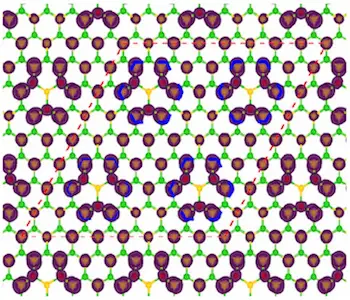
featured image: A density functional theory calculation showed the magnetic properties of a fluorinated sample of hexagonal boron nitride. This version is ferromagnetic, determined by how the fluorine atoms (red) attach to the boron and nitrogen matrix. Courtesy of the Ajayan Group
Related

Recent Posts

KYOCERA AVX Introduces Traction‑Grade DC Link Film Capacitors

21.4.2026
3

Why Power Inductors Use a Ferrite Core With an Air Gap

20.4.2026
9

YAGEO Introduces High‑Current Y2/X1 Film Capacitors for Wide-bandgap Power Systems

17.4.2026
15

Amphenol Explanded Liquid Cooling Connectors for AI, ESS and EV Systems

17.4.2026
5

Hirose Introduced BGA connector for PCIe Gen6 for AI and Edge Computing

17.4.2026
5

YAGEO Introduces High Rel MLCCs Beyond MIL-Spec Limits

16.4.2026
43

Samsung Introduces Ultra-High-Voltage 1500 V MLCCs for xEV Powertrains

16.4.2026
22

TDK Introduces High‑Voltage Common‑Mode Chokes for Compact 1250 V DC Converters

16.4.2026
22

Vishay Extends Power Inductors for DC/DC with 1212 Compact Case

16.4.2026
16

Upcoming Events

Apr 21
16:00 - 17:00 CEST

Heatsink Solutions: Thermal Management in electronic devices

Apr 22
17:00 - 17:30 CEST

Magnetics in a high frequency GaN era

Apr 22
17:00 - 18:00 CEST

Derating Tantalum, Film, and Ceramic Capacitors

View Calendar

Popular Posts

  • Buck Converter Design and Calculation

    0 shares
    Share 0 Tweet 0
  • Boost Converter Design and Calculation

    0 shares
    Share 0 Tweet 0
  • Flyback Converter Design and Calculation

    0 shares
    Share 0 Tweet 0
  • LLC Resonant Converter Design and Calculation

    0 shares
    Share 0 Tweet 0
  • Dual Active Bridge (DAB) Topology

    0 shares
    Share 0 Tweet 0
  • MLCC and Ceramic Capacitors

    0 shares
    Share 0 Tweet 0
  • Capacitor Charging and Discharging

    0 shares
    Share 0 Tweet 0
  • Ripple Current and its Effects on the Performance of Capacitors

    3 shares
    Share 3 Tweet 0
  • MLCC Case Sizes Standards Explained

    0 shares
    Share 0 Tweet 0
  • Plastic Materials Dielectric Constant and DF

    4 shares
    Share 4 Tweet 0

Newsletter Subscription


Passive Components Blog

© EPCI - Leading Passive Components Educational and Information Site

  • Home
  • Privacy Policy
  • EPCI Membership & Advertisement
  • About

No Result
View All Result
  • Home
  • Knowledge Blog
  • PCNS

© EPCI - Leading Passive Components Educational and Information Site

This website uses cookies. By continuing to use this website you are giving consent to cookies being used. Visit our Privacy and Cookie Policy.
Go to mobile version