






Passive Components Blog
No Result
View All Result
  • Home
  • NewsFilter
    • All
    • Aerospace & Defence
    • Antenna
    • Applications
    • Automotive
    • Capacitors
    • Circuit Protection Devices
    • electro-mechanical news
    • Filters
    • Fuses
    • Inductors
    • Industrial
    • Integrated Passives
    • inter-connect news
    • Market & Supply Chain
    • Market Insights
    • Medical
    • Modelling and Simulation
    • New Materials & Supply
    • New Technologies
    • Non-linear Passives
    • Oscillators
    • Passive Sensors News
    • Resistors
    • RF & Microwave
    • Telecommunication
    • Weekly Digest

    Samsung Introduces Automotive 1206 100uF X7T MLCC for Power Rails in ADAS and SoCs

    Hirose Releases Ultra‑low Profile FPC‑to‑board Connector

    YMIN Hybrid Aluminum Capacitors for Automotive LiDAR Power Rails

    Samsung Presents Ultra‑Thin Silicon Capacitors for AI and Server PDN

    YAGEO Introduces 310VAC SMD Y2 Safety MP Capacitors for Compact EMI Filtering

    DMASS: European Components Distribution Returns To Growth In Q1 2026

    German Component Distribution Market Rebounds in Q1 2026 According to FBDi

    Nippon Chemi-Con Announces New Capacitor series for AI, Automotive and Immersion Cooling

    Ultrahigh Energy Storage in Lead‑Free BiFeO₃‑Based Ceramic Capacitors via Local Polar Structure Design

    Trending Tags

    • Ripple Current
    • RF
    • Leakage Current
    • Tantalum vs Ceramic
    • Snubber
    • Low ESR
    • Feedthrough
    • Derating
    • Dielectric Constant
    • New Products
    • Market Reports
  • VideoFilter
    • All
    • Antenna videos
    • Capacitor videos
    • Circuit Protection Video
    • Filter videos
    • Fuse videos
    • Inductor videos
    • Inter-Connect Video
    • Non-linear passives videos
    • Oscillator videos
    • Passive sensors videos
    • Resistor videos

    Why Isolated DC/DC Power Supplies Fail Late, Würth Elektronik Podcast

    Designing 800 V DC EMC Filters: Calculation, Simulation and Measurement

    Current Sense Transformer Datasheet and Design‑in Guide

    Designing a USB Type‑C Flyback Planar Transformer with Frenetic’s Planar Tool

    Magnetics Design in High‑Frequency GaN Converters

    Qi2 Wireless Charging: Inductors, Capacitors and EMC Filters

    Two‑capacitor paradox explained for engineers

    Capacitances of Nonlinear MLCCs: What Datasheets Don’t Tell You

    Tapped Inductor Buck Converter Fundamentals

    Trending Tags

    • Capacitors explained
    • Inductors explained
    • Resistors explained
    • Filters explained
    • Application Video Guidelines
    • EMC
    • New Products
    • Ripple Current
    • Simulation
    • Tantalum vs Ceramic
  • Knowledge Blog
  • DossiersNew
  • Suppliers
    • Who is Who
  • PCNS
    • PCNS 2025
    • PCNS 2023
    • PCNS 2021
    • PCNS 2019
    • PCNS 2017
  • Events
  • Home
  • NewsFilter
    • All
    • Aerospace & Defence
    • Antenna
    • Applications
    • Automotive
    • Capacitors
    • Circuit Protection Devices
    • electro-mechanical news
    • Filters
    • Fuses
    • Inductors
    • Industrial
    • Integrated Passives
    • inter-connect news
    • Market & Supply Chain
    • Market Insights
    • Medical
    • Modelling and Simulation
    • New Materials & Supply
    • New Technologies
    • Non-linear Passives
    • Oscillators
    • Passive Sensors News
    • Resistors
    • RF & Microwave
    • Telecommunication
    • Weekly Digest

    Samsung Introduces Automotive 1206 100uF X7T MLCC for Power Rails in ADAS and SoCs

    Hirose Releases Ultra‑low Profile FPC‑to‑board Connector

    YMIN Hybrid Aluminum Capacitors for Automotive LiDAR Power Rails

    Samsung Presents Ultra‑Thin Silicon Capacitors for AI and Server PDN

    YAGEO Introduces 310VAC SMD Y2 Safety MP Capacitors for Compact EMI Filtering

    DMASS: European Components Distribution Returns To Growth In Q1 2026

    German Component Distribution Market Rebounds in Q1 2026 According to FBDi

    Nippon Chemi-Con Announces New Capacitor series for AI, Automotive and Immersion Cooling

    Ultrahigh Energy Storage in Lead‑Free BiFeO₃‑Based Ceramic Capacitors via Local Polar Structure Design

    Trending Tags

    • Ripple Current
    • RF
    • Leakage Current
    • Tantalum vs Ceramic
    • Snubber
    • Low ESR
    • Feedthrough
    • Derating
    • Dielectric Constant
    • New Products
    • Market Reports
  • VideoFilter
    • All
    • Antenna videos
    • Capacitor videos
    • Circuit Protection Video
    • Filter videos
    • Fuse videos
    • Inductor videos
    • Inter-Connect Video
    • Non-linear passives videos
    • Oscillator videos
    • Passive sensors videos
    • Resistor videos

    Why Isolated DC/DC Power Supplies Fail Late, Würth Elektronik Podcast

    Designing 800 V DC EMC Filters: Calculation, Simulation and Measurement

    Current Sense Transformer Datasheet and Design‑in Guide

    Designing a USB Type‑C Flyback Planar Transformer with Frenetic’s Planar Tool

    Magnetics Design in High‑Frequency GaN Converters

    Qi2 Wireless Charging: Inductors, Capacitors and EMC Filters

    Two‑capacitor paradox explained for engineers

    Capacitances of Nonlinear MLCCs: What Datasheets Don’t Tell You

    Tapped Inductor Buck Converter Fundamentals

    Trending Tags

    • Capacitors explained
    • Inductors explained
    • Resistors explained
    • Filters explained
    • Application Video Guidelines
    • EMC
    • New Products
    • Ripple Current
    • Simulation
    • Tantalum vs Ceramic
  • Knowledge Blog
  • DossiersNew
  • Suppliers
    • Who is Who
  • PCNS
    • PCNS 2025
    • PCNS 2023
    • PCNS 2021
    • PCNS 2019
    • PCNS 2017
  • Events
No Result
View All Result
Passive Components Blog
No Result
View All Result

Fraikin Harnessing the Power of KERS with Skeleton Technologies’ Ultracapacitors

18.7.2017
Reading Time: 2 mins read
A A

source: Skeleton news

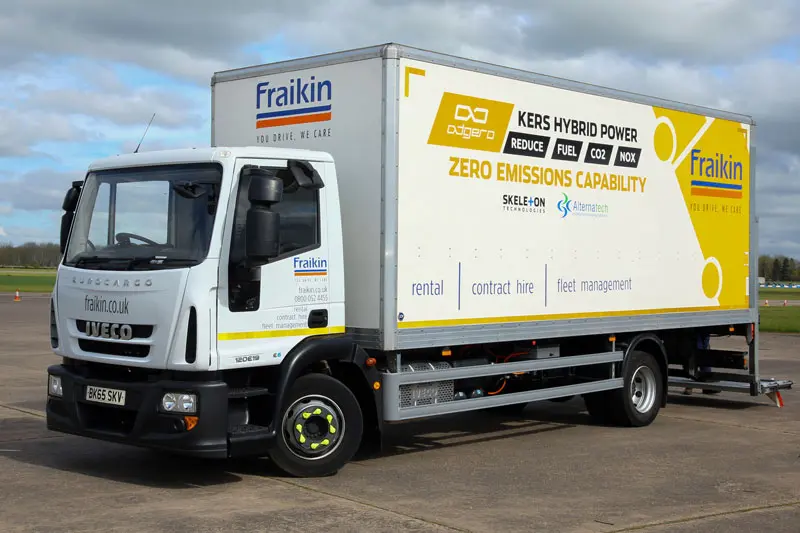
Jul 17, 2017 – Skeleton Technologies, together with Fraikin, one of the largest fleet operators in Europe, announced the first installation of a Kinetic Energy Recovery System (KERS) in a rigid truck – a 12-tonne Iveco Eurocargo from Fraiking’s rental fleet – in what represents a major step forward in urban truck operations that provides operators with significant fuel savings while also cutting emissions.

RelatedPosts

Samsung Introduces Automotive 1206 100uF X7T MLCC for Power Rails in ADAS and SoCs

Hirose Releases Ultra‑low Profile FPC‑to‑board Connector

YMIN Hybrid Aluminum Capacitors for Automotive LiDAR Power Rails

The KERS system works by harnessing the energy created under braking. This energy is stored in a set of SkelCap ultracapacitors – a lighter, less costly and more efficient alternative to lithium-ion batteries – then used to provide acceleration assistance via an electric motor fitted to the prop shaft.

https://youtu.be/TDOQnkFNwuM

Colin Melvin, Sales Director of Fraikin, explains:

“We talk to customers every single day about new ways to reduce environmental impact – it is something we are really passionate about. By being the first adopter of KERS on a rigid truck, we have put our customers at the front of the queue to trial this new technology within their own fleets.”

The KERS technology, developed by Skeleton Technologies and Adgero, has already been successfully installed on articulated vehicles, but this is believed to be the first time the system has been fitted to a rigid truck. The power conversion is made possible thanks to Skeleton Technologies’ patented graphene ultracapacitors, which facilitate better conductivity and are able to absorb and store greater amounts of power. This power is then channelled to the electric motor via specialised ECU software developed by Skeleton Technologies’ engineers in Estonia.

Taavi Madiberk, CEO of Skeleton Technologies, says:

“The partnership with Fraikin highlights the significant impact utilising regenerative braking technology and energy storage can have. This is an important first step in realising essential efficiencies for the industry and we look forward to seeing further advances in this field.”

During initial testing, the KERS system offered 32 per cent fuel savings when compared to a standard vehicle of the same type, as well as slashing associated nitrogen oxide emissions by around 50 per cent and carbon dioxide emissions by around 30 per cent.

A conservative estimate for an operational life-span of the system is 10 years, often longer than the working life of the vehicle it is fitted to. It has been designed to be removed and re-fitted to a replacement truck when required.

Related

Recent Posts

Samsung Introduces Automotive 1206 100uF X7T MLCC for Power Rails in ADAS and SoCs

17.6.2026
5

YMIN Hybrid Aluminum Capacitors for Automotive LiDAR Power Rails

17.6.2026
3

Samsung Presents Ultra‑Thin Silicon Capacitors for AI and Server PDN

17.6.2026
4

YAGEO Introduces 310VAC SMD Y2 Safety MP Capacitors for Compact EMI Filtering

16.6.2026
13

DMASS: European Components Distribution Returns To Growth In Q1 2026

16.6.2026
12

German Component Distribution Market Rebounds in Q1 2026 According to FBDi

16.6.2026
11

Nippon Chemi-Con Announces New Capacitor series for AI, Automotive and Immersion Cooling

16.6.2026
15

Ultrahigh Energy Storage in Lead‑Free BiFeO₃‑Based Ceramic Capacitors via Local Polar Structure Design

16.6.2026
17

Murata Expands Ansys Simulation Models for RF inductors, MLCCs, and Power Inductors

16.6.2026
13

Upcoming Events

Jul 14
16:00 - 17:00 CEST

EMC Design Essentials: Mastering Varistors and Common Mode Chokes

Jul 21
16:00 - 17:00 CEST

Safety by design: X and Y Interference suppression capacitors for power line filters

View Calendar

Popular Posts

  • Buck Converter Design and Calculation

    0 shares
    Share 0 Tweet 0
  • Boost Converter Design and Calculation

    0 shares
    Share 0 Tweet 0
  • LLC Resonant Converter Design and Calculation

    0 shares
    Share 0 Tweet 0
  • Flyback Converter Design and Calculation

    0 shares
    Share 0 Tweet 0
  • MLCC and Ceramic Capacitors

    0 shares
    Share 0 Tweet 0
  • Earthing Systems and IEC Classification Explained

    0 shares
    Share 0 Tweet 0
  • SEPIC Converter Design and Calculation

    0 shares
    Share 0 Tweet 0
  • Dual Active Bridge (DAB) Topology

    0 shares
    Share 0 Tweet 0
  • What Electronics Engineer Needs to Know About Passive Low Pass Filters

    0 shares
    Share 0 Tweet 0
  • MLCC Case Sizes Standards Explained

    0 shares
    Share 0 Tweet 0

Newsletter Subscription


Passive Components Blog

© EPCI - Leading Passive Components Educational and Information Site

  • Home
  • Privacy Policy
  • EPCI Membership & Advertisement
  • About

No Result
View All Result
  • Home
  • Knowledge Blog
  • Dossiers
  • PCNS

© EPCI - Leading Passive Components Educational and Information Site

This website uses cookies. By continuing to use this website you are giving consent to cookies being used. Visit our Privacy and Cookie Policy.
Go to mobile version