











Passive Components Blog
No Result
View All Result
  • Home
  • NewsFilter
    • All
    • Aerospace & Defence
    • Antenna
    • Applications
    • Automotive
    • Capacitors
    • Circuit Protection Devices
    • electro-mechanical news
    • Filters
    • Fuses
    • Inductors
    • Industrial
    • Integrated Passives
    • inter-connect news
    • Market & Supply Chain
    • Market Insights
    • Medical
    • Modelling and Simulation
    • New Materials & Supply
    • New Technologies
    • Non-linear Passives
    • Oscillators
    • Passive Sensors News
    • Resistors
    • RF & Microwave
    • Telecommunication
    • Weekly Digest

    When More Capacitance Hurts Reliability: The Role of the Metallic Skeleton in Tantalum Anodes

    Why Power Inductors Use a Ferrite Core With an Air Gap

    Wk 16 Electronics Supply Chain Digest

    YAGEO Introduces High‑Current Y2/X1 Film Capacitors for Wide-bandgap Power Systems

    Amphenol Explanded Liquid Cooling Connectors for AI, ESS and EV Systems

    Hirose Introduced BGA connector for PCIe Gen6 for AI and Edge Computing

    YAGEO Introduces High Rel MLCCs Beyond MIL-Spec Limits

    Würth Elektronik Expanded Capacity for Validation and Services in Asia

    Samsung Introduces Ultra-High-Voltage 1500 V MLCCs for xEV Powertrains

    Trending Tags

    • Ripple Current
    • RF
    • Leakage Current
    • Tantalum vs Ceramic
    • Snubber
    • Low ESR
    • Feedthrough
    • Derating
    • Dielectric Constant
    • New Products
    • Market Reports
  • VideoFilter
    • All
    • Antenna videos
    • Capacitor videos
    • Circuit Protection Video
    • Filter videos
    • Fuse videos
    • Inductor videos
    • Inter-Connect Video
    • Non-linear passives videos
    • Oscillator videos
    • Passive sensors videos
    • Resistor videos

    Why Power Inductors Use a Ferrite Core With an Air Gap

    Transformer-Based Power-Line Harvester Magnetic Design

    Thermal Modeling of Magnetics

    Standard vs Planar LLC transformers Comparison for Battery Chargers

    How Modern Tools Model Magnetic Components for Power Electronics

    Advanced Loss Modeling for Planar Magnetics in the Frenetic Planar Tool

    2026 Power Magnetics Design Trends: Flyback, DAB and Planar

    Enabling Software‑Defined Vehicle Architectures: Automotive Ethernet and Zonal Smart Power

    Calculating Resistance Value of a Flyback RC Snubber 

    Trending Tags

    • Capacitors explained
    • Inductors explained
    • Resistors explained
    • Filters explained
    • Application Video Guidelines
    • EMC
    • New Products
    • Ripple Current
    • Simulation
    • Tantalum vs Ceramic
  • Knowledge Blog
  • DossiersNew
  • Suppliers
    • Who is Who
  • PCNS
    • PCNS 2025
    • PCNS 2023
    • PCNS 2021
    • PCNS 2019
    • PCNS 2017
  • Events
  • Home
  • NewsFilter
    • All
    • Aerospace & Defence
    • Antenna
    • Applications
    • Automotive
    • Capacitors
    • Circuit Protection Devices
    • electro-mechanical news
    • Filters
    • Fuses
    • Inductors
    • Industrial
    • Integrated Passives
    • inter-connect news
    • Market & Supply Chain
    • Market Insights
    • Medical
    • Modelling and Simulation
    • New Materials & Supply
    • New Technologies
    • Non-linear Passives
    • Oscillators
    • Passive Sensors News
    • Resistors
    • RF & Microwave
    • Telecommunication
    • Weekly Digest

    When More Capacitance Hurts Reliability: The Role of the Metallic Skeleton in Tantalum Anodes

    Why Power Inductors Use a Ferrite Core With an Air Gap

    Wk 16 Electronics Supply Chain Digest

    YAGEO Introduces High‑Current Y2/X1 Film Capacitors for Wide-bandgap Power Systems

    Amphenol Explanded Liquid Cooling Connectors for AI, ESS and EV Systems

    Hirose Introduced BGA connector for PCIe Gen6 for AI and Edge Computing

    YAGEO Introduces High Rel MLCCs Beyond MIL-Spec Limits

    Würth Elektronik Expanded Capacity for Validation and Services in Asia

    Samsung Introduces Ultra-High-Voltage 1500 V MLCCs for xEV Powertrains

    Trending Tags

    • Ripple Current
    • RF
    • Leakage Current
    • Tantalum vs Ceramic
    • Snubber
    • Low ESR
    • Feedthrough
    • Derating
    • Dielectric Constant
    • New Products
    • Market Reports
  • VideoFilter
    • All
    • Antenna videos
    • Capacitor videos
    • Circuit Protection Video
    • Filter videos
    • Fuse videos
    • Inductor videos
    • Inter-Connect Video
    • Non-linear passives videos
    • Oscillator videos
    • Passive sensors videos
    • Resistor videos

    Why Power Inductors Use a Ferrite Core With an Air Gap

    Transformer-Based Power-Line Harvester Magnetic Design

    Thermal Modeling of Magnetics

    Standard vs Planar LLC transformers Comparison for Battery Chargers

    How Modern Tools Model Magnetic Components for Power Electronics

    Advanced Loss Modeling for Planar Magnetics in the Frenetic Planar Tool

    2026 Power Magnetics Design Trends: Flyback, DAB and Planar

    Enabling Software‑Defined Vehicle Architectures: Automotive Ethernet and Zonal Smart Power

    Calculating Resistance Value of a Flyback RC Snubber 

    Trending Tags

    • Capacitors explained
    • Inductors explained
    • Resistors explained
    • Filters explained
    • Application Video Guidelines
    • EMC
    • New Products
    • Ripple Current
    • Simulation
    • Tantalum vs Ceramic
  • Knowledge Blog
  • DossiersNew
  • Suppliers
    • Who is Who
  • PCNS
    • PCNS 2025
    • PCNS 2023
    • PCNS 2021
    • PCNS 2019
    • PCNS 2017
  • Events
No Result
View All Result
Passive Components Blog
No Result
View All Result

MIL-PRF-32535 QPL SMD BME MLCCs by Kemet explained

9.11.2019
Reading Time: 5 mins read
A A

Source: doEEEt article

Surface mount ceramic capacitors, such as MLCCs, for use in Defense and Aerospace applications usually require a superior level of reliability. To achieve high reliability, capacitor suppliers follow MIL-PRF standards for manufacturing, processing, qualification, and testing and are tightly controlled for design changes and material traceability. Historically, all MLCCs utilized precious metal electrode (PME) technology and is currently the predominate technology in use for high reliability Defense and Aerospace applications.

RelatedPosts

When More Capacitance Hurts Reliability: The Role of the Metallic Skeleton in Tantalum Anodes

Why Power Inductors Use a Ferrite Core With an Air Gap

Wk 16 Electronics Supply Chain Digest

However, when we look at the commercial and automotive trends over the past 30 years, we can see major advancements in technology ranging from PCs, to laptops, cell phones, smart phones, electric vehicles, IoT, autonomous vehicles, and so on. Functionality and circuit density have increased exponentially over time, which means active and passive component size must decrease at the same pace.

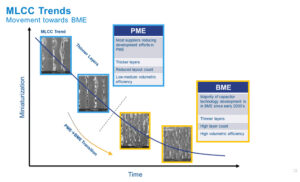
In order to shrink the size of MLCCs, while maintaining the same capacitance values, dielectric layers must become as thin as possible. In fact, making MLCC layers thinner is the driving factor for increasing volumetric efficiency. Since MLCCs historically used PME technology, suppliers ran into limitations on how thin the dielectric could be made, while maintaining reliability.

Therefore, Base Metal Electrode (BME) technology was introduced in the early 2000s, which allowed suppliers to create much thinner layers, drastically increase volumetric efficiency, and decrease cost.

Today, BME MLCCs make up the overwhelming majority of MLCCs in used in the electronics industry. These also include many applications where reliability is critical. For example, the automotive industry has been using BME technology for over 15 years in applications such as ABD systems and airbags. The medical industry has been using BME MLCCs in instrumentation and implantable devices for over 10 years.
 

MLCC Trends

BME vs PME

BME vs PME

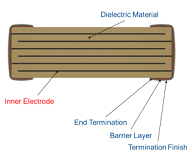
MLCCs are constructed using alternating layers of ceramic dielectric and metal electrodes. BME MLCCs use nickel as the conductive inner electrodes and are the predominant technology for MLCCs today. PME MLCCs use precious metals such as silver or palladium as the inner electrodes. The use of precious metal electrodes increase cost and prevent thinner layers making them poor candidates for high density applications.

The conversion from PME to BME technology in MLCCs helped enable the trend of miniaturization and circuit density for every industry except one, the Defense and Aerospace industry.

The two predominant specifications for high reliability MLCCs are the MIL-PRF-55681 and MIL-PRF-123.  The MIL-PRF-55681 specification has been around for over 25 years and customers will only use PME MLCCs qualified to this standard. Since this is limited to PME, Defense and Aerospace customers cannot capitalize on miniaturization trends and limits circuit density.

The MIL-PRF-123 specification prevents the use of nickel electrodes (BME MLCCs) and therefore is limited to PME technology, which, as mentioned previously, Defense and Aerospace customers cannot capitalize on mediatization trends and limits design density. This led to the creation of a new standard for high reliability MLCCs, MIL-PRF-32535.
MIL-PRF

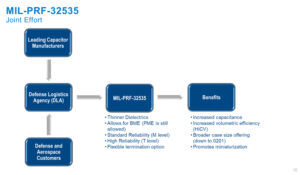
The creation of the MIL-PRF-32535 specification is a joint effort between the Defense Logistics Agency (DLA), leading capacitor manufacturers, and defense/aerospace customers. The new standard allows for thinner dielectrics and the use of BME technology while maintaining the same reliability levels as MIL-PRF-55681 and MIL-PRF-123. In addition, MIL-PRF-32535 is the first standard to allow for a flexible termination to increase flex robustness.

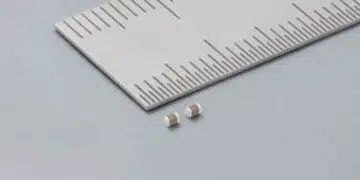
By utilizing BME technology and thinner dielectrics, this specification allows defense and aerospace customers to take advantage of the increase capacitance and smaller case sizes. For example, thanks to the increased volumetric efficiency of BME vs PME, it is possible to replace 18 1206 1nF PME MLCCs with one 1206 18nF BME MLCC.
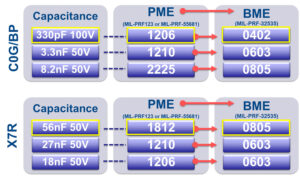
C0G-BP

Not A Replacement

The MIL-PRF-32535 specification is not intended to replace MIL-PRF-123 or MIL-PRF-55681 but rather allow for thinner dielectric MLCCs and BME technology.

By allowing thinner dielectrics and BME technology, higher capacitance values in the same case size and voltage ratings can now be achieved.  Therefore, the MIL-PRF-32535 specification can be thought of as an extension to the legacy standards that have been in place for many years.
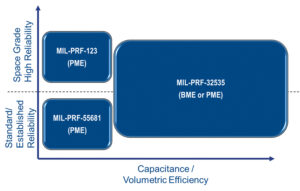
Space grade

KEMET MIL-PRF-32535 are available in M (standard reliability) and T (high reliability) product levels

KEMET was one of the capacitor manufacturers at the forefront of specifying the details behind the MIL-PRF-32535. So much so that KEMET was the first manufacturer to provide capacitors built to the new standard.

The KEMET Hi-Rel BME capacitors are available in a wide range of voltages and case sizes and in both X7R and C0G dielectric platforms.

Related

Recent Posts

When More Capacitance Hurts Reliability: The Role of the Metallic Skeleton in Tantalum Anodes

20.4.2026
7

YAGEO Introduces High‑Current Y2/X1 Film Capacitors for Wide-bandgap Power Systems

17.4.2026
11

YAGEO Introduces High Rel MLCCs Beyond MIL-Spec Limits

16.4.2026
37

Samsung Introduces Ultra-High-Voltage 1500 V MLCCs for xEV Powertrains

16.4.2026
19

YAGEO Q1 2026 Results: AI Servers and Pricing Power Behind a Moderate Q2 Outlook

16.4.2026
56

Samsung Presents MLCC Selection Guide for Humanoids and Robotic Applications

15.4.2026
24

AI-Assisted Structural Diagnostics and Physics-Based Reliability Interpretation of Tantalum Capacitor Anodes

14.4.2026
29

KYOCERA AVX MIL-PRF-32535 BME NP0 MLCCs Approved to the DLA QPD

16.4.2026
27

ECIA March 2026 Industry Pulse Points to Best Sales Climate in Five Years

13.4.2026
46

Upcoming Events

Apr 21
16:00 - 17:00 CEST

Heatsink Solutions: Thermal Management in electronic devices

Apr 22
17:00 - 17:30 CEST

Magnetics in a high frequency GaN era

Apr 22
17:00 - 18:00 CEST

Derating Tantalum, Film, and Ceramic Capacitors

View Calendar

Popular Posts

  • Buck Converter Design and Calculation

    0 shares
    Share 0 Tweet 0
  • Boost Converter Design and Calculation

    0 shares
    Share 0 Tweet 0
  • Flyback Converter Design and Calculation

    0 shares
    Share 0 Tweet 0
  • LLC Resonant Converter Design and Calculation

    0 shares
    Share 0 Tweet 0
  • Dual Active Bridge (DAB) Topology

    0 shares
    Share 0 Tweet 0
  • MLCC and Ceramic Capacitors

    0 shares
    Share 0 Tweet 0
  • Capacitor Charging and Discharging

    0 shares
    Share 0 Tweet 0
  • Plastic Materials Dielectric Constant and DF

    4 shares
    Share 4 Tweet 0
  • Ripple Current and its Effects on the Performance of Capacitors

    3 shares
    Share 3 Tweet 0
  • MLCC Case Sizes Standards Explained

    0 shares
    Share 0 Tweet 0

Newsletter Subscription


Passive Components Blog

© EPCI - Leading Passive Components Educational and Information Site

  • Home
  • Privacy Policy
  • EPCI Membership & Advertisement
  • About

No Result
View All Result
  • Home
  • Knowledge Blog
  • PCNS

© EPCI - Leading Passive Components Educational and Information Site

This website uses cookies. By continuing to use this website you are giving consent to cookies being used. Visit our Privacy and Cookie Policy.
Go to mobile version