






Passive Components Blog
No Result
View All Result
  • Home
  • NewsFilter
    • All
    • Aerospace & Defence
    • Antenna
    • Applications
    • Automotive
    • Capacitors
    • Circuit Protection Devices
    • electro-mechanical news
    • Filters
    • Fuses
    • Inductors
    • Industrial
    • Integrated Passives
    • inter-connect news
    • Market & Supply Chain
    • Market Insights
    • Medical
    • Modelling and Simulation
    • New Materials & Supply
    • New Technologies
    • Non-linear Passives
    • Oscillators
    • Passive Sensors News
    • Resistors
    • RF & Microwave
    • Telecommunication
    • Weekly Digest

    All‑Water Supercapacitor Based on 1‑nm Clay Channels and Nanoconfined Water Electrolyte

    Littelfuse Unveils High‑Current 48V SMD Fuse for AI Data Center Protection

    Modelithics Releases COMPLETE Library v26.2 for Keysight Genesys

    Why Isolated DC/DC Power Supplies Fail Late, Würth Elektronik Podcast

    Wk 23 Electronics Supply Chain Digest

    Power Converter Dossier: Passive Components Design and Selection Guide 2026

    Evans Group Unifies Four High-Rel Capacitor Leaders

    Skeleton Releases Graphene‑Based UPS for AI Data Centers

    Designing 800 V DC EMC Filters: Calculation, Simulation and Measurement

    Trending Tags

    • Ripple Current
    • RF
    • Leakage Current
    • Tantalum vs Ceramic
    • Snubber
    • Low ESR
    • Feedthrough
    • Derating
    • Dielectric Constant
    • New Products
    • Market Reports
  • VideoFilter
    • All
    • Antenna videos
    • Capacitor videos
    • Circuit Protection Video
    • Filter videos
    • Fuse videos
    • Inductor videos
    • Inter-Connect Video
    • Non-linear passives videos
    • Oscillator videos
    • Passive sensors videos
    • Resistor videos

    Why Isolated DC/DC Power Supplies Fail Late, Würth Elektronik Podcast

    Designing 800 V DC EMC Filters: Calculation, Simulation and Measurement

    Current Sense Transformer Datasheet and Design‑in Guide

    Designing a USB Type‑C Flyback Planar Transformer with Frenetic’s Planar Tool

    Magnetics Design in High‑Frequency GaN Converters

    Qi2 Wireless Charging: Inductors, Capacitors and EMC Filters

    Two‑capacitor paradox explained for engineers

    Capacitances of Nonlinear MLCCs: What Datasheets Don’t Tell You

    Tapped Inductor Buck Converter Fundamentals

    Trending Tags

    • Capacitors explained
    • Inductors explained
    • Resistors explained
    • Filters explained
    • Application Video Guidelines
    • EMC
    • New Products
    • Ripple Current
    • Simulation
    • Tantalum vs Ceramic
  • Knowledge Blog
  • DossiersNew
  • Suppliers
    • Who is Who
  • PCNS
    • PCNS 2025
    • PCNS 2023
    • PCNS 2021
    • PCNS 2019
    • PCNS 2017
  • Events
  • Home
  • NewsFilter
    • All
    • Aerospace & Defence
    • Antenna
    • Applications
    • Automotive
    • Capacitors
    • Circuit Protection Devices
    • electro-mechanical news
    • Filters
    • Fuses
    • Inductors
    • Industrial
    • Integrated Passives
    • inter-connect news
    • Market & Supply Chain
    • Market Insights
    • Medical
    • Modelling and Simulation
    • New Materials & Supply
    • New Technologies
    • Non-linear Passives
    • Oscillators
    • Passive Sensors News
    • Resistors
    • RF & Microwave
    • Telecommunication
    • Weekly Digest

    All‑Water Supercapacitor Based on 1‑nm Clay Channels and Nanoconfined Water Electrolyte

    Littelfuse Unveils High‑Current 48V SMD Fuse for AI Data Center Protection

    Modelithics Releases COMPLETE Library v26.2 for Keysight Genesys

    Why Isolated DC/DC Power Supplies Fail Late, Würth Elektronik Podcast

    Wk 23 Electronics Supply Chain Digest

    Power Converter Dossier: Passive Components Design and Selection Guide 2026

    Evans Group Unifies Four High-Rel Capacitor Leaders

    Skeleton Releases Graphene‑Based UPS for AI Data Centers

    Designing 800 V DC EMC Filters: Calculation, Simulation and Measurement

    Trending Tags

    • Ripple Current
    • RF
    • Leakage Current
    • Tantalum vs Ceramic
    • Snubber
    • Low ESR
    • Feedthrough
    • Derating
    • Dielectric Constant
    • New Products
    • Market Reports
  • VideoFilter
    • All
    • Antenna videos
    • Capacitor videos
    • Circuit Protection Video
    • Filter videos
    • Fuse videos
    • Inductor videos
    • Inter-Connect Video
    • Non-linear passives videos
    • Oscillator videos
    • Passive sensors videos
    • Resistor videos

    Why Isolated DC/DC Power Supplies Fail Late, Würth Elektronik Podcast

    Designing 800 V DC EMC Filters: Calculation, Simulation and Measurement

    Current Sense Transformer Datasheet and Design‑in Guide

    Designing a USB Type‑C Flyback Planar Transformer with Frenetic’s Planar Tool

    Magnetics Design in High‑Frequency GaN Converters

    Qi2 Wireless Charging: Inductors, Capacitors and EMC Filters

    Two‑capacitor paradox explained for engineers

    Capacitances of Nonlinear MLCCs: What Datasheets Don’t Tell You

    Tapped Inductor Buck Converter Fundamentals

    Trending Tags

    • Capacitors explained
    • Inductors explained
    • Resistors explained
    • Filters explained
    • Application Video Guidelines
    • EMC
    • New Products
    • Ripple Current
    • Simulation
    • Tantalum vs Ceramic
  • Knowledge Blog
  • DossiersNew
  • Suppliers
    • Who is Who
  • PCNS
    • PCNS 2025
    • PCNS 2023
    • PCNS 2021
    • PCNS 2019
    • PCNS 2017
  • Events
No Result
View All Result
Passive Components Blog
No Result
View All Result

T.I.C. Announced Tantalum Industry Ekeberg Prize 2020 Winner

18.9.2020
Reading Time: 3 mins read
A A

A team from Edinburgh University, UK, led by Prof. Jason Love, has won the 2020 Anders Gustaf Ekeberg Tantalum Prize (‘Ekeberg Prize’) for its paper “Tantalum recycling by solvent extraction: chloride is better than fluoride” published in Metals.

The Ekeberg Prize is awarded annually for excellence in research and innovation of the element tantalum (Ta) and is sponsored by the Tantalum-Niobium International Study Center (T.I.C.), the global trade body representing the tantalum and niobium industry.

RelatedPosts

All‑Water Supercapacitor Based on 1‑nm Clay Channels and Nanoconfined Water Electrolyte

Littelfuse Unveils High‑Current 48V SMD Fuse for AI Data Center Protection

Modelithics Releases COMPLETE Library v26.2 for Keysight Genesys

Announcing the winner, the independent judging panel led by Richard Burt stated that tantalum recycling will continue to increase in importance, both due to dwindling reserves, and also because recycling is of great societal interest, adding that this work is an important step toward significant improvement in the chemistry of recycling, which deserves more attention. 

EPCI as a proud member of the G.A.Ekerberg panel board congratulate to the winner team.

The winning team (left to right): Prof. Bryne Ngwenya, Luke Kinsman, Prof. Jason Love and Prof. Carole Morrison in a chemistry laboratory at Edinburgh University. Rosa Crevecoeur and Amrita Singh-Morgan unfortunately could not attend.

The authors of the winning paper are Prof. Jason Love, Prof. Carole Morrison, Luke Kinsman, Rosa Crevecoeur and Amrita Singh-Morgan of the EaStCHEM School of Chemistry, University of Edinburgh, and Prof. Bryne Ngwenya of the School of Geosciences at the University of Edinburgh. The full paper will be reprinted in the October journal of the Tantalum-Niobium International Study Center (T.I.C.) and can also be downloaded at https://www.mdpi.com/2075-4701/10/3/346.

The prize and award ceremony

Usually the Ekeberg Prize is awarded at the T.I.C.’s in-person General Assembly, where the winner is the guest of honour, but this year Covid-19 has caused the physical meeting to be replaced by a virtual conference (details here), which threatened to make the award ceremony somewhat two dimensional. However, not to be outdone, on September 11th Roland Chavasse, T.I.C. Director, visited Edinburgh University to award the prize in a suitably socially distanced ceremony.

“In a year when Covid-19 is causing so much disruption and forcing many of us to reconsider what is important in our lives, high on the list of priorities after family and friends must surely be meaningful work, and what could exemplify this goal better than helping society use a critical raw material more efficiently?” Chavasse asked.

There can be no doubt Anders Ekeberg himself would have found this year’s winning paper particularly interesting, since it was the difficulties Ekeberg had with tantalum extraction which caused him to name it ‘tantalum’ in the first place (after the Greek demi-god cursed to endure eternal thirst and hunger).  

On receiving the Ekeberg Prize, Professor Love explained that the winning paper was part of a wider field of research which aims to develop a zero-waste solution to the question posed by waste electrical and electronic equipment (WEEE).

“WEEE from phones and other sources is a highly concentrated resource of 30 or so metals, making it richer than many ores”, Prof. Love described, adding that his goal was to develop recycling methods which allow society to avoid simply dumping hard-won materials back into the ground after briefly using them.

The T.I.C. wishes to congratulate all entrants whose papers are challenging the boundaries of current knowledge of tantalum, and which may well lead to significant breakthroughs into exciting new applications of the element.

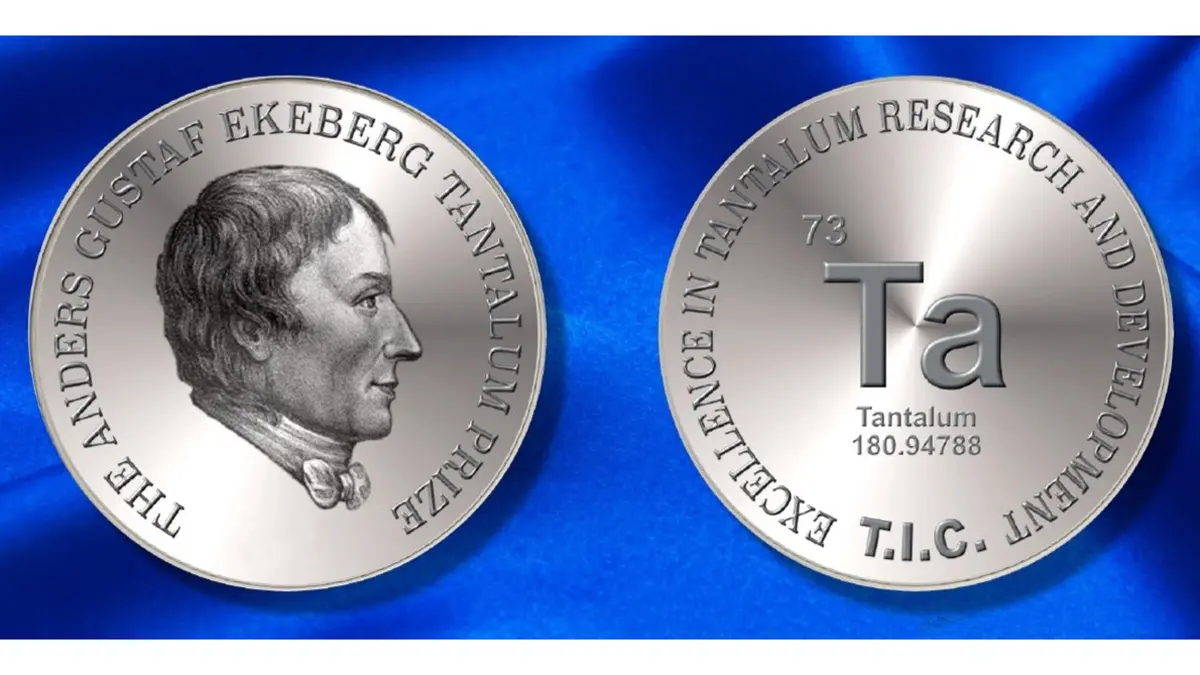
The medal for the Ekeberg Prize has been manufactured from pure tantalum metal by the Kazakhstan Mint and the winners will be acknowledged at the T.I.C.’s annual conference, the 61st (virtual) General Assembly, to held on October 12th 2020 from 11:00 CEST. 

Related

Source: T.I.C. Tantalum-Niobium International Study Center

Recent Posts

Power Converter Dossier: Passive Components Design and Selection Guide 2026

5.6.2026
35

Evans Group Unifies Four High-Rel Capacitor Leaders

5.6.2026
26

Murata and Xona Partner on LEO Satellite Navigation for Industrial Applications

3.6.2026
40

Nvidia Vera Rubin: Why One AI Rack Needs So Many More MLCC Capacitors

2.6.2026
240

Passive Components in 2026: From Invisible Commodity to Design Parameter

2.6.2026
75

May 2026 Interconnect, Passives and Electromechanical Components Market Insights

29.5.2026
120

ECIA Industry Pulse April 2026: Sentiment Cools but Stays Strong

21.5.2026
83

Industrial Passive Components Markets and Technologies 2026

21.5.2026
167

Automotive Passive Components Technology Dossier

5.6.2026
93

Upcoming Events

Jun 16
16:00 - 17:00 CEST

EMC with EMC – EMC‑compliant design with electromechanical connectors

Jul 14
16:00 - 17:00 CEST

EMC Design Essentials: Mastering Varistors and Common Mode Chokes

Jul 21
16:00 - 17:00 CEST

Safety by design: X and Y Interference suppression capacitors for power line filters

View Calendar

Popular Posts

  • Buck Converter Design and Calculation

    0 shares
    Share 0 Tweet 0
  • Boost Converter Design and Calculation

    0 shares
    Share 0 Tweet 0
  • MLCC and Ceramic Capacitors

    0 shares
    Share 0 Tweet 0
  • LLC Resonant Converter Design and Calculation

    0 shares
    Share 0 Tweet 0
  • Flyback Converter Design and Calculation

    0 shares
    Share 0 Tweet 0
  • What Electronics Engineer Needs to Know About Passive Low Pass Filters

    0 shares
    Share 0 Tweet 0
  • Dual Active Bridge (DAB) Topology

    0 shares
    Share 0 Tweet 0
  • Capacitor Charging and Discharging

    0 shares
    Share 0 Tweet 0
  • SEPIC Converter Design and Calculation

    0 shares
    Share 0 Tweet 0
  • Earthing Systems and IEC Classification Explained

    0 shares
    Share 0 Tweet 0

Newsletter Subscription


Passive Components Blog

© EPCI - Leading Passive Components Educational and Information Site

  • Home
  • Privacy Policy
  • EPCI Membership & Advertisement
  • About

No Result
View All Result
  • Home
  • Knowledge Blog
  • Dossiers
  • PCNS

© EPCI - Leading Passive Components Educational and Information Site

This website uses cookies. By continuing to use this website you are giving consent to cookies being used. Visit our Privacy and Cookie Policy.
Go to mobile version