



Passive Components Blog
No Result
View All Result
  • Home
  • NewsFilter
    • All
    • Aerospace & Defence
    • Antenna
    • Applications
    • Automotive
    • Capacitors
    • Circuit Protection Devices
    • electro-mechanical news
    • Filters
    • Fuses
    • Inductors
    • Industrial
    • Integrated Passives
    • inter-connect news
    • Market & Supply Chain
    • Market Insights
    • Medical
    • Modelling and Simulation
    • New Materials & Supply
    • New Technologies
    • Non-linear Passives
    • Oscillators
    • Passive Sensors News
    • Resistors
    • RF & Microwave
    • Telecommunication
    • Weekly Digest

    KYOCERA AVX Introduces Traction‑Grade DC Link Film Capacitors

    When More Capacitance Hurts Reliability: The Role of the Metallic Skeleton in Tantalum Anodes

    Why Power Inductors Use a Ferrite Core With an Air Gap

    Wk 16 Electronics Supply Chain Digest

    YAGEO Introduces High‑Current Y2/X1 Film Capacitors for Wide-bandgap Power Systems

    Amphenol Explanded Liquid Cooling Connectors for AI, ESS and EV Systems

    Hirose Introduced BGA connector for PCIe Gen6 for AI and Edge Computing

    YAGEO Introduces High Rel MLCCs Beyond MIL-Spec Limits

    Würth Elektronik Expanded Capacity for Validation and Services in Asia

    Trending Tags

    • Ripple Current
    • RF
    • Leakage Current
    • Tantalum vs Ceramic
    • Snubber
    • Low ESR
    • Feedthrough
    • Derating
    • Dielectric Constant
    • New Products
    • Market Reports
  • VideoFilter
    • All
    • Antenna videos
    • Capacitor videos
    • Circuit Protection Video
    • Filter videos
    • Fuse videos
    • Inductor videos
    • Inter-Connect Video
    • Non-linear passives videos
    • Oscillator videos
    • Passive sensors videos
    • Resistor videos

    Why Power Inductors Use a Ferrite Core With an Air Gap

    Transformer-Based Power-Line Harvester Magnetic Design

    Thermal Modeling of Magnetics

    Standard vs Planar LLC transformers Comparison for Battery Chargers

    How Modern Tools Model Magnetic Components for Power Electronics

    Advanced Loss Modeling for Planar Magnetics in the Frenetic Planar Tool

    2026 Power Magnetics Design Trends: Flyback, DAB and Planar

    Enabling Software‑Defined Vehicle Architectures: Automotive Ethernet and Zonal Smart Power

    Calculating Resistance Value of a Flyback RC Snubber 

    Trending Tags

    • Capacitors explained
    • Inductors explained
    • Resistors explained
    • Filters explained
    • Application Video Guidelines
    • EMC
    • New Products
    • Ripple Current
    • Simulation
    • Tantalum vs Ceramic
  • Knowledge Blog
  • DossiersNew
  • Suppliers
    • Who is Who
  • PCNS
    • PCNS 2025
    • PCNS 2023
    • PCNS 2021
    • PCNS 2019
    • PCNS 2017
  • Events
  • Home
  • NewsFilter
    • All
    • Aerospace & Defence
    • Antenna
    • Applications
    • Automotive
    • Capacitors
    • Circuit Protection Devices
    • electro-mechanical news
    • Filters
    • Fuses
    • Inductors
    • Industrial
    • Integrated Passives
    • inter-connect news
    • Market & Supply Chain
    • Market Insights
    • Medical
    • Modelling and Simulation
    • New Materials & Supply
    • New Technologies
    • Non-linear Passives
    • Oscillators
    • Passive Sensors News
    • Resistors
    • RF & Microwave
    • Telecommunication
    • Weekly Digest

    KYOCERA AVX Introduces Traction‑Grade DC Link Film Capacitors

    When More Capacitance Hurts Reliability: The Role of the Metallic Skeleton in Tantalum Anodes

    Why Power Inductors Use a Ferrite Core With an Air Gap

    Wk 16 Electronics Supply Chain Digest

    YAGEO Introduces High‑Current Y2/X1 Film Capacitors for Wide-bandgap Power Systems

    Amphenol Explanded Liquid Cooling Connectors for AI, ESS and EV Systems

    Hirose Introduced BGA connector for PCIe Gen6 for AI and Edge Computing

    YAGEO Introduces High Rel MLCCs Beyond MIL-Spec Limits

    Würth Elektronik Expanded Capacity for Validation and Services in Asia

    Trending Tags

    • Ripple Current
    • RF
    • Leakage Current
    • Tantalum vs Ceramic
    • Snubber
    • Low ESR
    • Feedthrough
    • Derating
    • Dielectric Constant
    • New Products
    • Market Reports
  • VideoFilter
    • All
    • Antenna videos
    • Capacitor videos
    • Circuit Protection Video
    • Filter videos
    • Fuse videos
    • Inductor videos
    • Inter-Connect Video
    • Non-linear passives videos
    • Oscillator videos
    • Passive sensors videos
    • Resistor videos

    Why Power Inductors Use a Ferrite Core With an Air Gap

    Transformer-Based Power-Line Harvester Magnetic Design

    Thermal Modeling of Magnetics

    Standard vs Planar LLC transformers Comparison for Battery Chargers

    How Modern Tools Model Magnetic Components for Power Electronics

    Advanced Loss Modeling for Planar Magnetics in the Frenetic Planar Tool

    2026 Power Magnetics Design Trends: Flyback, DAB and Planar

    Enabling Software‑Defined Vehicle Architectures: Automotive Ethernet and Zonal Smart Power

    Calculating Resistance Value of a Flyback RC Snubber 

    Trending Tags

    • Capacitors explained
    • Inductors explained
    • Resistors explained
    • Filters explained
    • Application Video Guidelines
    • EMC
    • New Products
    • Ripple Current
    • Simulation
    • Tantalum vs Ceramic
  • Knowledge Blog
  • DossiersNew
  • Suppliers
    • Who is Who
  • PCNS
    • PCNS 2025
    • PCNS 2023
    • PCNS 2021
    • PCNS 2019
    • PCNS 2017
  • Events
No Result
View All Result
Passive Components Blog
No Result
View All Result

Chinas MLCC Makers Reach 10% Market Share

16.6.2025
Reading Time: 3 mins read
A A

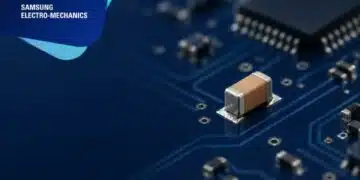
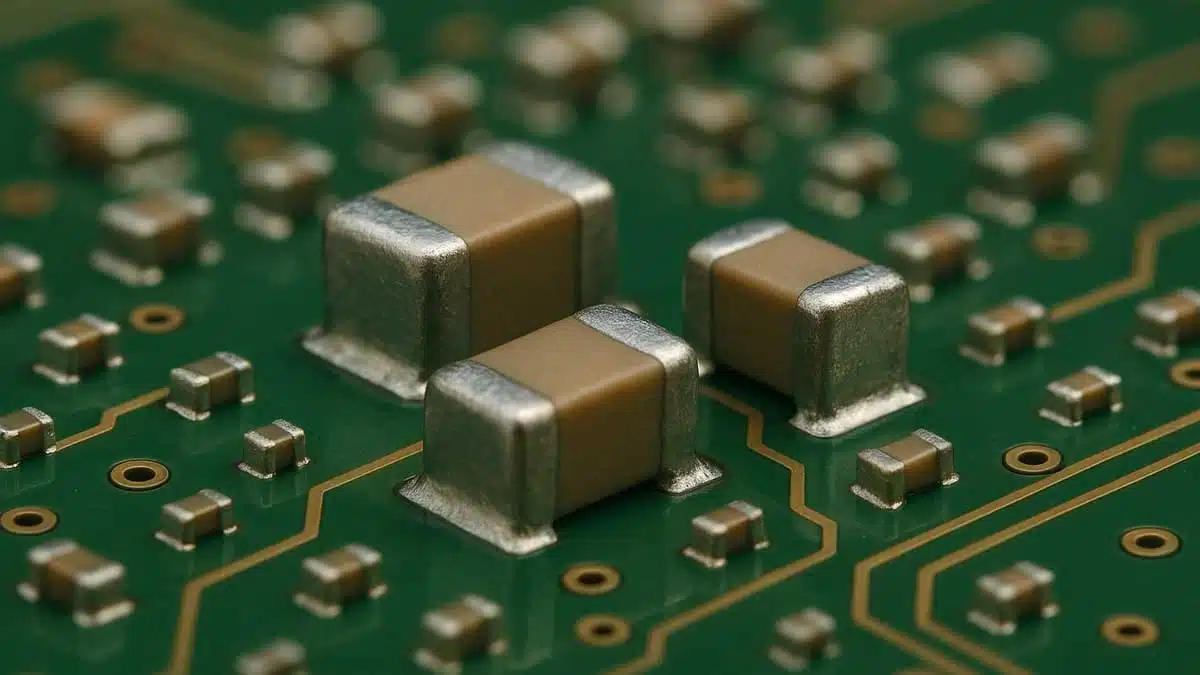
Chinese multilayer ceramic capacitor (MLCC) manufacturers, such as Guangdong Fenghua Advanced Technology, Chaozhou Three-Circle Group, and Eyang Technology, have experienced rapid expansion in the global market. Established manufacturers such as Samsung Electro-Mechanics (Semco) and Murata have to adjust their strategies.

Their market share has surged to 10% of total revenue in the second half of 2024, a significant four-percentage-point increase from 2019, as reported by Business Post and Futubull. This growth indicates heightened competitive pressure on established players like Samsung Electro-Mechanics (Semco).

RelatedPosts

KYOCERA AVX Introduces Traction‑Grade DC Link Film Capacitors

When More Capacitance Hurts Reliability: The Role of the Metallic Skeleton in Tantalum Anodes

Why Power Inductors Use a Ferrite Core With an Air Gap

Traditionally, China relied on importing IT-grade MLCCs from South Korea, Japan, and Taiwan. However, the post-COVID boom in remote work and digital learning led to a surge in demand for computers and home appliances, accelerating the expansion of local MLCC production. According to the Korea Trade-Investment Promotion Agency (KOTRA), this trend has prompted strategic investment in China’s foundational components ecosystem.

A researcher at South Korea’s iM Securities noted that as Chinese OEMs gain influence in IT hardware, they are also strategically cultivating supply chains for essential component materials like MLCCs to support large-scale manufacturing.

Despite their growth, Chinese MLCC firms still lag behind in technical capabilities and hold a relatively small share compared to global leaders. In the first half of 2024, Samsung Electro-Mechanics captured 24% of the global market, second only to Japan’s Murata Manufacturing. However, Chinese smartphone brands have reportedly begun using domestic MLCC suppliers as leverage in pricing negotiations.

Semco, a major player in the MLCC industry, faces challenges due to its significant reliance on China for approximately 40% of its revenue. To mitigate this vulnerability, the company has intensified its efforts to diversify its portfolio, focusing on high-margin segments such as automotive electronics and AI servers.

Semco’s strategic shift is already yielding tangible results. In 2024, its automotive MLCC division experienced double-digit revenue growth. Moreover, the company secured a substantial supply deal worth several hundred billion South Korean won with Chinese electric vehicle manufacturer BYD, with shipments already underway. At the March 2025 shareholder meeting, CEO Chang Duckhyun revealed that automotive MLCCs now constitute 15% of total MLCC revenue and have the potential to surpass 25% by the end of 2025.

AI servers are also emerging as a key growth driver. These systems require significantly more MLCCs compared to traditional servers, with estimates suggesting up to eight times more MLCCs per AI server compared to conventional units, as per SK Securities. This increased demand is fueled by the rise of AI accelerators, autonomous driving, and the growing adoption of electric vehicles.

According to The Korea Economic Daily, Samsung now holds approximately 40% of the global MLCC market for AI servers, narrowing the gap with Murata’s 45%. This near-equal footing contrasts sharply with the broader MLCC market, where Murata leads with over 40%, while Semco, TDK Corp., Yageo Group, and Taiyo Yuden collectively hold between 10% and 20%.

Beyond the field of artificial intelligence, Samsung recognizes substantial growth potential in the high-voltage automotive MLCC market. Mordor Intelligence projects the global high-voltage MLCC market to expand from US$4 billion in 2024 to US$11 billion by 2029, with a compound annual growth rate of 22%.

Related

Source: DigiTimes

Recent Posts

KYOCERA AVX Introduces Traction‑Grade DC Link Film Capacitors

21.4.2026
3

When More Capacitance Hurts Reliability: The Role of the Metallic Skeleton in Tantalum Anodes

20.4.2026
18

YAGEO Introduces High‑Current Y2/X1 Film Capacitors for Wide-bandgap Power Systems

17.4.2026
15

YAGEO Introduces High Rel MLCCs Beyond MIL-Spec Limits

16.4.2026
43

Würth Elektronik Expanded Capacity for Validation and Services in Asia

16.4.2026
12

Samsung Introduces Ultra-High-Voltage 1500 V MLCCs for xEV Powertrains

16.4.2026
22

YAGEO Q1 2026 Results: AI Servers and Pricing Power Behind a Moderate Q2 Outlook

16.4.2026
61

Samsung Presents MLCC Selection Guide for Humanoids and Robotic Applications

15.4.2026
29

AI-Assisted Structural Diagnostics and Physics-Based Reliability Interpretation of Tantalum Capacitor Anodes

14.4.2026
31

Upcoming Events

Apr 21
16:00 - 17:00 CEST

Heatsink Solutions: Thermal Management in electronic devices

Apr 22
17:00 - 17:30 CEST

Magnetics in a high frequency GaN era

Apr 22
17:00 - 18:00 CEST

Derating Tantalum, Film, and Ceramic Capacitors

View Calendar

Popular Posts

  • Buck Converter Design and Calculation

    0 shares
    Share 0 Tweet 0
  • Boost Converter Design and Calculation

    0 shares
    Share 0 Tweet 0
  • Flyback Converter Design and Calculation

    0 shares
    Share 0 Tweet 0
  • LLC Resonant Converter Design and Calculation

    0 shares
    Share 0 Tweet 0
  • Dual Active Bridge (DAB) Topology

    0 shares
    Share 0 Tweet 0
  • MLCC and Ceramic Capacitors

    0 shares
    Share 0 Tweet 0
  • Capacitor Charging and Discharging

    0 shares
    Share 0 Tweet 0
  • Ripple Current and its Effects on the Performance of Capacitors

    3 shares
    Share 3 Tweet 0
  • MLCC Case Sizes Standards Explained

    0 shares
    Share 0 Tweet 0
  • Plastic Materials Dielectric Constant and DF

    4 shares
    Share 4 Tweet 0

Newsletter Subscription


Passive Components Blog

© EPCI - Leading Passive Components Educational and Information Site

  • Home
  • Privacy Policy
  • EPCI Membership & Advertisement
  • About

No Result
View All Result
  • Home
  • Knowledge Blog
  • PCNS

© EPCI - Leading Passive Components Educational and Information Site

This website uses cookies. By continuing to use this website you are giving consent to cookies being used. Visit our Privacy and Cookie Policy.
Go to mobile version