






Passive Components Blog
No Result
View All Result
  • Home
  • NewsFilter
    • All
    • Aerospace & Defence
    • Antenna
    • Applications
    • Automotive
    • Capacitors
    • Circuit Protection Devices
    • electro-mechanical news
    • Filters
    • Fuses
    • Inductors
    • Industrial
    • Integrated Passives
    • inter-connect news
    • Market & Supply Chain
    • Market Insights
    • Medical
    • Modelling and Simulation
    • New Materials & Supply
    • New Technologies
    • Non-linear Passives
    • Oscillators
    • Passive Sensors News
    • Resistors
    • RF & Microwave
    • Telecommunication
    • Weekly Digest

    Vishay Releases High‑Current Radial Inductors up to 209 A

    May 2026 Interconnect, Passives and Electromechanical Components Market Insights

    Passive Components Enable Safe and Reliable ADAS Architectures

    Current Sense Transformer Datasheet and Design‑in Guide

    Designing a USB Type‑C Flyback Planar Transformer with Frenetic’s Planar Tool

    YMIN Releases Square Supercapacitors for AI Server Power System

    Exxelia Extends Temperature Range of its PP Film Capacitors to 140C

    How Long-Term Storage Causes Aging in Electronic Components

    Nichicon Presents Self-Charging LTO Board for Maintenance-Free IoT Nodes

    Trending Tags

    • Ripple Current
    • RF
    • Leakage Current
    • Tantalum vs Ceramic
    • Snubber
    • Low ESR
    • Feedthrough
    • Derating
    • Dielectric Constant
    • New Products
    • Market Reports
  • VideoFilter
    • All
    • Antenna videos
    • Capacitor videos
    • Circuit Protection Video
    • Filter videos
    • Fuse videos
    • Inductor videos
    • Inter-Connect Video
    • Non-linear passives videos
    • Oscillator videos
    • Passive sensors videos
    • Resistor videos

    Current Sense Transformer Datasheet and Design‑in Guide

    Designing a USB Type‑C Flyback Planar Transformer with Frenetic’s Planar Tool

    Magnetics Design in High‑Frequency GaN Converters

    Qi2 Wireless Charging: Inductors, Capacitors and EMC Filters

    Two‑capacitor paradox explained for engineers

    Capacitances of Nonlinear MLCCs: What Datasheets Don’t Tell You

    Tapped Inductor Buck Converter Fundamentals

    Planar vs Conventional Transformer: When it Make Sense

    Modeling Fringing Field Losses in Inductors & Transformers

    Trending Tags

    • Capacitors explained
    • Inductors explained
    • Resistors explained
    • Filters explained
    • Application Video Guidelines
    • EMC
    • New Products
    • Ripple Current
    • Simulation
    • Tantalum vs Ceramic
  • Knowledge Blog
  • DossiersNew
  • Suppliers
    • Who is Who
  • PCNS
    • PCNS 2025
    • PCNS 2023
    • PCNS 2021
    • PCNS 2019
    • PCNS 2017
  • Events
  • Home
  • NewsFilter
    • All
    • Aerospace & Defence
    • Antenna
    • Applications
    • Automotive
    • Capacitors
    • Circuit Protection Devices
    • electro-mechanical news
    • Filters
    • Fuses
    • Inductors
    • Industrial
    • Integrated Passives
    • inter-connect news
    • Market & Supply Chain
    • Market Insights
    • Medical
    • Modelling and Simulation
    • New Materials & Supply
    • New Technologies
    • Non-linear Passives
    • Oscillators
    • Passive Sensors News
    • Resistors
    • RF & Microwave
    • Telecommunication
    • Weekly Digest

    Vishay Releases High‑Current Radial Inductors up to 209 A

    May 2026 Interconnect, Passives and Electromechanical Components Market Insights

    Passive Components Enable Safe and Reliable ADAS Architectures

    Current Sense Transformer Datasheet and Design‑in Guide

    Designing a USB Type‑C Flyback Planar Transformer with Frenetic’s Planar Tool

    YMIN Releases Square Supercapacitors for AI Server Power System

    Exxelia Extends Temperature Range of its PP Film Capacitors to 140C

    How Long-Term Storage Causes Aging in Electronic Components

    Nichicon Presents Self-Charging LTO Board for Maintenance-Free IoT Nodes

    Trending Tags

    • Ripple Current
    • RF
    • Leakage Current
    • Tantalum vs Ceramic
    • Snubber
    • Low ESR
    • Feedthrough
    • Derating
    • Dielectric Constant
    • New Products
    • Market Reports
  • VideoFilter
    • All
    • Antenna videos
    • Capacitor videos
    • Circuit Protection Video
    • Filter videos
    • Fuse videos
    • Inductor videos
    • Inter-Connect Video
    • Non-linear passives videos
    • Oscillator videos
    • Passive sensors videos
    • Resistor videos

    Current Sense Transformer Datasheet and Design‑in Guide

    Designing a USB Type‑C Flyback Planar Transformer with Frenetic’s Planar Tool

    Magnetics Design in High‑Frequency GaN Converters

    Qi2 Wireless Charging: Inductors, Capacitors and EMC Filters

    Two‑capacitor paradox explained for engineers

    Capacitances of Nonlinear MLCCs: What Datasheets Don’t Tell You

    Tapped Inductor Buck Converter Fundamentals

    Planar vs Conventional Transformer: When it Make Sense

    Modeling Fringing Field Losses in Inductors & Transformers

    Trending Tags

    • Capacitors explained
    • Inductors explained
    • Resistors explained
    • Filters explained
    • Application Video Guidelines
    • EMC
    • New Products
    • Ripple Current
    • Simulation
    • Tantalum vs Ceramic
  • Knowledge Blog
  • DossiersNew
  • Suppliers
    • Who is Who
  • PCNS
    • PCNS 2025
    • PCNS 2023
    • PCNS 2021
    • PCNS 2019
    • PCNS 2017
  • Events
No Result
View All Result
Passive Components Blog
No Result
View All Result

Tantalum Capacitors: Best Practices for Increasing Profitability in 2019

27.8.2019
Reading Time: 2 mins read
A A

Source: Paumanok blog

The global capacitor industry, which for the purposes of this article includes ceramic, aluminum, tantalum , plastic film and carbon capacitors of all types and configurations, accounted for approximately $30 billion US dollars in global revenues for FY 2019 (Fiscal Year ending March) with almost 4 trillion pieces shipped, and 2 trillion consumed.

RelatedPosts

Vishay Releases High‑Current Radial Inductors up to 209 A

May 2026 Interconnect, Passives and Electromechanical Components Market Insights

Passive Components Enable Safe and Reliable ADAS Architectures

Fixed and Variable Costs To Produce Capacitors:

In the worldwide capacitor industry, fixed costs represent about 20% of the costs of goods sold, while variable costs- those that fluctuate, represent a full 80% of CGS; with vendors focusing primarily on variable costs as the area to improve profitability. Variable costs include raw material costs, labor costs, variable overhead costs and variable manufacturing costs.

Raw Materials: The Largest Single Variable Associated With Cost of Goods Sold:

Raw material costs represent the largest single cost factor in the production of capacitors regardless of dielectric, so the reader will notice that many historical methods for cost savings and increased profitability are related to management and manipulation of the costs associated with buying and processing raw materials, which include feedstocks, engineered dielectrics, cathode materials, additives, electrodes, terminations and leads.

Tantalum Capacitors: Documented Methods for Increasing Profitability-

Vertical Integration of Powder and Wire Production:

It is difficult to find cost savings for the production of tantalum capacitors, because unlike the other capacitor dielectrics, it is extremely difficult to produce capacitor grade tantalum metal powder, requiring a level of expertise that is considered advanced among metallurgists.

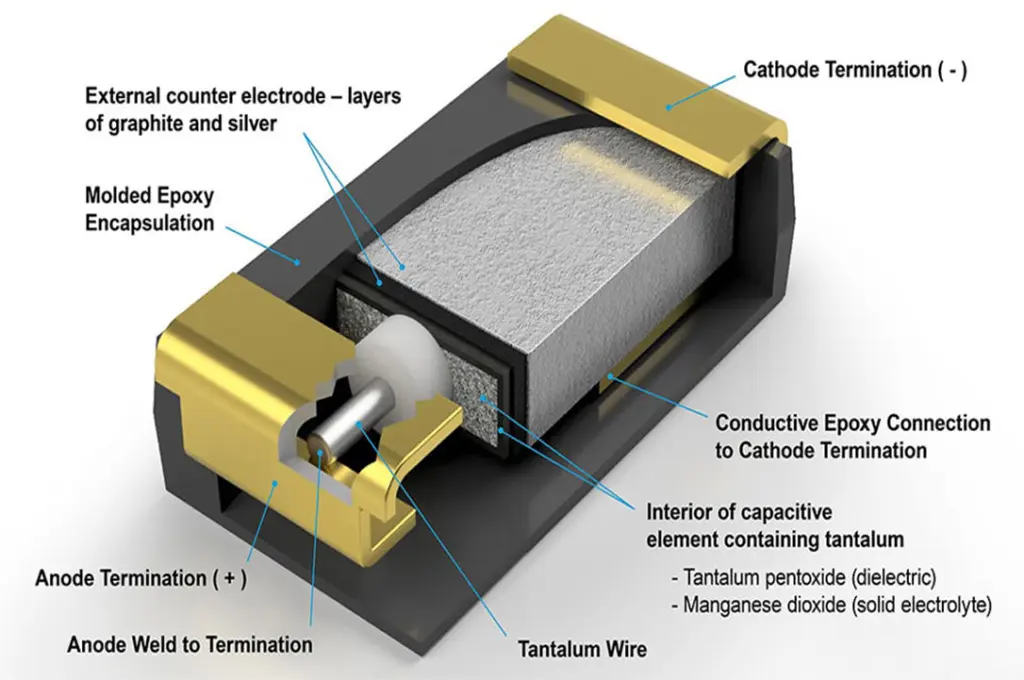
The chemistry and processing capabilities to create tantalum pentoxide, the active ingredient in tantalum capacitor anodes- are significantly advanced and require a level of expertise that is beyond the capabilities of many governments, much less trade vendors. Therefore the number of active production facilities that can produce capacitor grade powder and wire is limited worldwide to Japan, Germany, China and the USA.

However, the vertical integration of a smaller tantalum powder producer into the largest tantalum capacitor manufacturer has shown, through presentations and reports to the financial community, that such actions can produce significant cost savings over time by eliminating the premiums associated with the merchant market.

Tantalum wire production has become more prevalent in the supply chain with more and more capacitor manufacturers bringing wire drawing capabilities in-house. This is prevalent in the tantalum supply chain because of the dwindling number of merchant vendors of tantalum wire.

Cathode Application- Gas Versus Dipping:

A gas infusion process for the application of conductive polymers into the porous structure of tantalum anodes generates a higher margin than the alternative monomer and polymer “dipping” process due to the excessive waste stream associated with impregnating anodes by chemical bath. Manufacturing facilities that employ dipping processes to impregnate anode porous structure with conductive polymers have also taken steps to limit the number of dip cycles as a method of cost savings as well.

featured image source: AVX Corporation

Related

Recent Posts

May 2026 Interconnect, Passives and Electromechanical Components Market Insights

29.5.2026
27

Passive Components Enable Safe and Reliable ADAS Architectures

28.5.2026
37

YMIN Releases Square Supercapacitors for AI Server Power System

27.5.2026
39

Exxelia Extends Temperature Range of its PP Film Capacitors to 140C

27.5.2026
28

Nichicon Presents Self-Charging LTO Board for Maintenance-Free IoT Nodes

26.5.2026
19

Mechanical SSC Testing as a Structural Diagnostic Tool for Tantalum Capacitor Anodes

25.5.2026
41

YMIN Introduces Vibration Resistant Compact Low ESR Aluminum Capacitors for Home Appliances

25.5.2026
35

ECIA Industry Pulse April 2026: Sentiment Cools but Stays Strong

21.5.2026
61

Industrial Passive Components Markets and Technologies 2026

21.5.2026
132

Upcoming Events

Jun 2
16:00 - 17:00 CEST

Calculation, Simulation and Measurement of 800V EMC Filters

Jun 16
16:00 - 17:00 CEST

EMC with EMC – EMC‑compliant design with electromechanical connectors

View Calendar

Popular Posts

  • Buck Converter Design and Calculation

    0 shares
    Share 0 Tweet 0
  • Boost Converter Design and Calculation

    0 shares
    Share 0 Tweet 0
  • Flyback Converter Design and Calculation

    0 shares
    Share 0 Tweet 0
  • MLCC and Ceramic Capacitors

    0 shares
    Share 0 Tweet 0
  • LLC Resonant Converter Design and Calculation

    0 shares
    Share 0 Tweet 0
  • Capacitor Charging and Discharging

    0 shares
    Share 0 Tweet 0
  • What Electronics Engineer Needs to Know About Passive Low Pass Filters

    0 shares
    Share 0 Tweet 0
  • Dual Active Bridge (DAB) Topology

    0 shares
    Share 0 Tweet 0
  • Ripple Current and its Effects on the Performance of Capacitors

    3 shares
    Share 3 Tweet 0
  • Samsung Electro-Mechanics Releases High-Capacitance MLCCs for AI Server Applications

    0 shares
    Share 0 Tweet 0

Newsletter Subscription


Passive Components Blog

© EPCI - Leading Passive Components Educational and Information Site

  • Home
  • Privacy Policy
  • EPCI Membership & Advertisement
  • About

No Result
View All Result
  • Home
  • Knowledge Blog
  • Dossiers
  • PCNS

© EPCI - Leading Passive Components Educational and Information Site

This website uses cookies. By continuing to use this website you are giving consent to cookies being used. Visit our Privacy and Cookie Policy.
Go to mobile version