





Passive Components Blog
No Result
View All Result
  • Home
  • NewsFilter
    • All
    • Aerospace & Defence
    • Antenna
    • Applications
    • Automotive
    • Capacitors
    • Circuit Protection Devices
    • electro-mechanical news
    • Filters
    • Fuses
    • Inductors
    • Industrial
    • Integrated Passives
    • inter-connect news
    • Market & Supply Chain
    • Market Insights
    • Medical
    • Modelling and Simulation
    • New Materials & Supply
    • New Technologies
    • Non-linear Passives
    • Oscillators
    • Passive Sensors News
    • Resistors
    • RF & Microwave
    • Telecommunication
    • Weekly Digest

    Nvidia Vera Rubin: Why One AI Rack Needs So Many More MLCC Capacitors

    Stackpole Introduces 1400A Busbar Shunt Resistors

    Tecate Unveils High‑temp 105C Supercapacitors for Harsh‑Environment Designs

    Bourns Expands 1000V High‑Power Fuses for Semiconductor and Battery Protection

    Passive Components in 2026: From Invisible Commodity to Design Parameter

    Bourns Introduces High Current Chip Ferrite Beads for Dense Power Rails

    Wk 22 Electronics Supply Chain Digest

    Vishay Releases High‑Current Radial Inductors up to 209 A

    May 2026 Interconnect, Passives and Electromechanical Components Market Insights

    Trending Tags

    • Ripple Current
    • RF
    • Leakage Current
    • Tantalum vs Ceramic
    • Snubber
    • Low ESR
    • Feedthrough
    • Derating
    • Dielectric Constant
    • New Products
    • Market Reports
  • VideoFilter
    • All
    • Antenna videos
    • Capacitor videos
    • Circuit Protection Video
    • Filter videos
    • Fuse videos
    • Inductor videos
    • Inter-Connect Video
    • Non-linear passives videos
    • Oscillator videos
    • Passive sensors videos
    • Resistor videos

    Current Sense Transformer Datasheet and Design‑in Guide

    Designing a USB Type‑C Flyback Planar Transformer with Frenetic’s Planar Tool

    Magnetics Design in High‑Frequency GaN Converters

    Qi2 Wireless Charging: Inductors, Capacitors and EMC Filters

    Two‑capacitor paradox explained for engineers

    Capacitances of Nonlinear MLCCs: What Datasheets Don’t Tell You

    Tapped Inductor Buck Converter Fundamentals

    Planar vs Conventional Transformer: When it Make Sense

    Modeling Fringing Field Losses in Inductors & Transformers

    Trending Tags

    • Capacitors explained
    • Inductors explained
    • Resistors explained
    • Filters explained
    • Application Video Guidelines
    • EMC
    • New Products
    • Ripple Current
    • Simulation
    • Tantalum vs Ceramic
  • Knowledge Blog
  • DossiersNew
  • Suppliers
    • Who is Who
  • PCNS
    • PCNS 2025
    • PCNS 2023
    • PCNS 2021
    • PCNS 2019
    • PCNS 2017
  • Events
  • Home
  • NewsFilter
    • All
    • Aerospace & Defence
    • Antenna
    • Applications
    • Automotive
    • Capacitors
    • Circuit Protection Devices
    • electro-mechanical news
    • Filters
    • Fuses
    • Inductors
    • Industrial
    • Integrated Passives
    • inter-connect news
    • Market & Supply Chain
    • Market Insights
    • Medical
    • Modelling and Simulation
    • New Materials & Supply
    • New Technologies
    • Non-linear Passives
    • Oscillators
    • Passive Sensors News
    • Resistors
    • RF & Microwave
    • Telecommunication
    • Weekly Digest

    Nvidia Vera Rubin: Why One AI Rack Needs So Many More MLCC Capacitors

    Stackpole Introduces 1400A Busbar Shunt Resistors

    Tecate Unveils High‑temp 105C Supercapacitors for Harsh‑Environment Designs

    Bourns Expands 1000V High‑Power Fuses for Semiconductor and Battery Protection

    Passive Components in 2026: From Invisible Commodity to Design Parameter

    Bourns Introduces High Current Chip Ferrite Beads for Dense Power Rails

    Wk 22 Electronics Supply Chain Digest

    Vishay Releases High‑Current Radial Inductors up to 209 A

    May 2026 Interconnect, Passives and Electromechanical Components Market Insights

    Trending Tags

    • Ripple Current
    • RF
    • Leakage Current
    • Tantalum vs Ceramic
    • Snubber
    • Low ESR
    • Feedthrough
    • Derating
    • Dielectric Constant
    • New Products
    • Market Reports
  • VideoFilter
    • All
    • Antenna videos
    • Capacitor videos
    • Circuit Protection Video
    • Filter videos
    • Fuse videos
    • Inductor videos
    • Inter-Connect Video
    • Non-linear passives videos
    • Oscillator videos
    • Passive sensors videos
    • Resistor videos

    Current Sense Transformer Datasheet and Design‑in Guide

    Designing a USB Type‑C Flyback Planar Transformer with Frenetic’s Planar Tool

    Magnetics Design in High‑Frequency GaN Converters

    Qi2 Wireless Charging: Inductors, Capacitors and EMC Filters

    Two‑capacitor paradox explained for engineers

    Capacitances of Nonlinear MLCCs: What Datasheets Don’t Tell You

    Tapped Inductor Buck Converter Fundamentals

    Planar vs Conventional Transformer: When it Make Sense

    Modeling Fringing Field Losses in Inductors & Transformers

    Trending Tags

    • Capacitors explained
    • Inductors explained
    • Resistors explained
    • Filters explained
    • Application Video Guidelines
    • EMC
    • New Products
    • Ripple Current
    • Simulation
    • Tantalum vs Ceramic
  • Knowledge Blog
  • DossiersNew
  • Suppliers
    • Who is Who
  • PCNS
    • PCNS 2025
    • PCNS 2023
    • PCNS 2021
    • PCNS 2019
    • PCNS 2017
  • Events
No Result
View All Result
Passive Components Blog
No Result
View All Result

Bootstrap Capacitors

22.5.2026
Reading Time: 7 mins read
A A

This article based on Knowles Precision Devices blog discusses bootsrap capacitors its function and benefits of using ceramic capacitors.

Power electronics play a critical role in converting and managing electrical energy efficiently. As electric vehicles (EVs), renewable energy systems, and consumer electronics quickly become more powerful, the demand for high-voltage power electronics is quickly increasing.

RelatedPosts

Knowles Doubles Capacitance of its Class I Ceramic C0G Capacitors

ESR of Capacitors, Measurements and Applications

Degradation of Capacitors and its Failure Mechanisms

This means the importance of components like bootstrap capacitors has grown significantly.

Key Takeaways

  • Bootstrap capacitors are vital for driving high-side MOSFETs in power electronics, especially in EVs and renewable energy systems.
  • They maintain the required gate voltage for efficient switching, ensuring proper power conversion.
  • Multilayer ceramic capacitors (MLCCs) can effectively serve as bootstrap capacitors due to their compact size and high capacitance.
  • Using MLCCs improves reliability, temperature stability, and energy efficiency while reducing PCB space requirements.
  • Overall, MLCCs offer benefits like low failure rates, wide voltage range, and low ESR for better performance in power electronics applications.

Bootstrap Capacitors

In power electronics, a bootstrap capacitor is a specific type of capacitor used to drive high-side MOSFETs efficiently.

The bootstrap capacitor plays a critical role in maintaining the gate voltage required to turn on the high-side MOSFET in a half-bridge or full-bridge configuration. By using the charge stored in the bootstrap capacitor, the high-side MOSFET’s gate voltage can be boosted above the supply voltage, ensuring proper switching operation and enabling efficient power conversion (Figure 1).
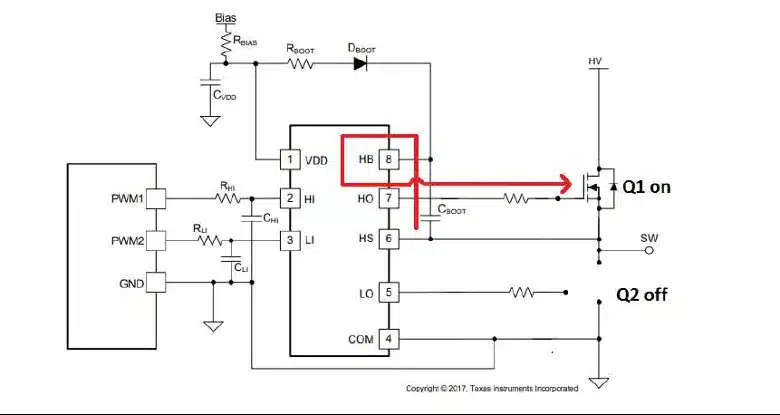
Figure 1. A representation of the discharge path of the bootstrap capacitor. Source. 

How MLCCs Fill the Role of the Bootstrap Capacitor 

Now that it’s clear the role a bootstrap capacitor plays in a circuit, let’s look at how multilayer ceramic capacitors (MLCCs) can fulfill the bootstrap capacitor role and help you design more efficient and reliable power circuits. Since MLCCs are compact and have high capacitance and low equivalent series resistance (ESR), these components are generally well-suited for using as bootstrap capacitors.

Integrating MLCCs in the capacitor role within bootstrap circuits can improve system performance, reduce the PCB space required, and enhance overall energy efficiency.

Using an MLCC as a bootstrap capacitor brings the following additional benefits for your power electronics applications: 

  • Reliability: MLCCs have low failure rates and stable performance over extended operating periods, enhancing the longevity of power electronics systems.
  • Compact Form Factor: The small footprint of MLCCs allows for space-saving designs, making them ideal for modern, miniaturized power electronics applications.
  • Temperature Stability: MLCCs maintain their capacitance and performance across a wide range of operating temperatures, ensuring consistent functionality in diverse environments.
  • Wide Voltage Range: MLCCs are available in a wide range of voltage ratings, providing flexibility in design for various power electronics systems.
  • Low ESR: The low ESR of MLCCs ensures minimal power loss during switching, contributing to higher overall efficiency in power electronics circuits.

FAQ: Benefits of Ceramic Capacitors as Bootstrap Capacitors

What is a bootstrap capacitor in power electronics?

A bootstrap capacitor is used to drive high-side MOSFETs in half-bridge or full-bridge circuits. It stores charge to boost the gate voltage above the supply voltage, ensuring efficient switching.

Why are MLCCs suitable as bootstrap capacitors?

Multilayer ceramic capacitors (MLCCs) are compact, have high capacitance, low ESR, and excellent reliability, making them ideal for bootstrap roles in modern power circuits.

What benefits do MLCCs bring to bootstrap circuits?

They improve efficiency, save PCB space, provide temperature stability, support a wide voltage range, and reduce power loss during switching.

In which applications are bootstrap capacitors critical?

They are essential in EV inverters, renewable energy systems, and consumer electronics where efficient high-voltage switching is required.

How-to: Implement Ceramic Capacitors as Bootstrap Capacitors

  1. Identify the switching circuit

    Determine if your design uses half-bridge or full-bridge MOSFET configurations that require a bootstrap capacitor.

  2. Select an MLCC with proper rating

    Choose an MLCC with the correct capacitance, voltage rating, and low ESR to handle the switching frequency and load.

  3. Place the capacitor close to the MOSFET

    Minimize parasitic inductance by positioning the MLCC near the high-side MOSFET gate driver.

  4. Validate performance

    Test the circuit for stable gate drive voltage, efficient switching, and thermal stability across operating conditions.

  5. Optimize for reliability

    Ensure long-term stability by monitoring ESR, temperature behavior, and cycle endurance of the MLCC in the application.

Related

Source: Knowles Precision Devices

Recent Posts

Nvidia Vera Rubin: Why One AI Rack Needs So Many More MLCC Capacitors

2.6.2026
13

Tecate Unveils High‑temp 105C Supercapacitors for Harsh‑Environment Designs

2.6.2026
6

Passive Components in 2026: From Invisible Commodity to Design Parameter

2.6.2026
15

May 2026 Interconnect, Passives and Electromechanical Components Market Insights

29.5.2026
87

Passive Components Enable Safe and Reliable ADAS Architectures

28.5.2026
64

Current Sense Transformer Datasheet and Design‑in Guide

27.5.2026
64

Designing a USB Type‑C Flyback Planar Transformer with Frenetic’s Planar Tool

27.5.2026
30

YMIN Releases Square Supercapacitors for AI Server Power System

27.5.2026
51

Exxelia Extends Temperature Range of its PP Film Capacitors to 140C

1.6.2026
47

Upcoming Events

Jun 16
16:00 - 17:00 CEST

EMC with EMC – EMC‑compliant design with electromechanical connectors

View Calendar

Popular Posts

  • Buck Converter Design and Calculation

    0 shares
    Share 0 Tweet 0
  • Boost Converter Design and Calculation

    0 shares
    Share 0 Tweet 0
  • Flyback Converter Design and Calculation

    0 shares
    Share 0 Tweet 0
  • MLCC and Ceramic Capacitors

    0 shares
    Share 0 Tweet 0
  • LLC Resonant Converter Design and Calculation

    0 shares
    Share 0 Tweet 0
  • Capacitor Charging and Discharging

    0 shares
    Share 0 Tweet 0
  • What Electronics Engineer Needs to Know About Passive Low Pass Filters

    0 shares
    Share 0 Tweet 0
  • Dual Active Bridge (DAB) Topology

    0 shares
    Share 0 Tweet 0
  • Ripple Current and its Effects on the Performance of Capacitors

    3 shares
    Share 3 Tweet 0
  • SEPIC Converter Design and Calculation

    0 shares
    Share 0 Tweet 0

Newsletter Subscription


Passive Components Blog

© EPCI - Leading Passive Components Educational and Information Site

  • Home
  • Privacy Policy
  • EPCI Membership & Advertisement
  • About

No Result
View All Result
  • Home
  • Knowledge Blog
  • Dossiers
  • PCNS

© EPCI - Leading Passive Components Educational and Information Site

This website uses cookies. By continuing to use this website you are giving consent to cookies being used. Visit our Privacy and Cookie Policy.
Go to mobile version