











Passive Components Blog
No Result
View All Result
  • Home
  • NewsFilter
    • All
    • Aerospace & Defence
    • Antenna
    • Applications
    • Automotive
    • Capacitors
    • Circuit Protection Devices
    • electro-mechanical news
    • Filters
    • Fuses
    • Inductors
    • Industrial
    • Integrated Passives
    • inter-connect news
    • Market & Supply Chain
    • Market Insights
    • Medical
    • Modelling and Simulation
    • New Materials & Supply
    • New Technologies
    • Non-linear Passives
    • Oscillators
    • Passive Sensors News
    • Resistors
    • RF & Microwave
    • Telecommunication
    • Weekly Digest

    Power Electronics Tools for Passives and Magnetic Designs

    Modelithics Releases Component Model Library for SIMULIA CST Studio Suite

    Exxelia Publishes Micropen White Papers for Printed Electronics

    Stackpole Releases AlN High‑Power Thick Film Chip Resistors

    Samsung Q4 2025 Results: MLCC focus for AI, Server and Automotive

    Würth Elektronik Developed a Custom Transformer for Active Hand Orthosis

    Wk 4 Electronics Supply Chain Digest

    Capacitor Technology Dossier

    ROHM Extends 2012 Shunt Resistors Power Rating up to 1.25 W

    Trending Tags

    • Ripple Current
    • RF
    • Leakage Current
    • Tantalum vs Ceramic
    • Snubber
    • Low ESR
    • Feedthrough
    • Derating
    • Dielectric Constant
    • New Products
    • Market Reports
  • VideoFilter
    • All
    • Antenna videos
    • Capacitor videos
    • Circuit Protection Video
    • Filter videos
    • Fuse videos
    • Inductor videos
    • Inter-Connect Video
    • Non-linear passives videos
    • Oscillator videos
    • Passive sensors videos
    • Resistor videos

    One‑Pulse Characterization of Nonlinear Power Inductors

    Thermistor Linearization Challenges

    Coaxial Connectors and How to Connect with PCB

    PCB Manufacturing, Test Methods, Quality and Reliability

    Transformer Behavior – Current Transfer and Hidden Feedback

    Choosing the Right Capacitor: The Importance of Accurate Measurements

    RF Inductors: Selection and Design Challenges for High-Frequency Circuits

    Transformer Safety IEC 61558 Standard

    3-Phase EMI Filter Design, Simulation, Calculation and Test

    Trending Tags

    • Capacitors explained
    • Inductors explained
    • Resistors explained
    • Filters explained
    • Application Video Guidelines
    • EMC
    • New Products
    • Ripple Current
    • Simulation
    • Tantalum vs Ceramic
  • Knowledge Blog
  • DossiersNew
  • Suppliers
    • Who is Who
  • PCNS
    • PCNS 2025
    • PCNS 2023
    • PCNS 2021
    • PCNS 2019
    • PCNS 2017
  • Events
  • Home
  • NewsFilter
    • All
    • Aerospace & Defence
    • Antenna
    • Applications
    • Automotive
    • Capacitors
    • Circuit Protection Devices
    • electro-mechanical news
    • Filters
    • Fuses
    • Inductors
    • Industrial
    • Integrated Passives
    • inter-connect news
    • Market & Supply Chain
    • Market Insights
    • Medical
    • Modelling and Simulation
    • New Materials & Supply
    • New Technologies
    • Non-linear Passives
    • Oscillators
    • Passive Sensors News
    • Resistors
    • RF & Microwave
    • Telecommunication
    • Weekly Digest

    Power Electronics Tools for Passives and Magnetic Designs

    Modelithics Releases Component Model Library for SIMULIA CST Studio Suite

    Exxelia Publishes Micropen White Papers for Printed Electronics

    Stackpole Releases AlN High‑Power Thick Film Chip Resistors

    Samsung Q4 2025 Results: MLCC focus for AI, Server and Automotive

    Würth Elektronik Developed a Custom Transformer for Active Hand Orthosis

    Wk 4 Electronics Supply Chain Digest

    Capacitor Technology Dossier

    ROHM Extends 2012 Shunt Resistors Power Rating up to 1.25 W

    Trending Tags

    • Ripple Current
    • RF
    • Leakage Current
    • Tantalum vs Ceramic
    • Snubber
    • Low ESR
    • Feedthrough
    • Derating
    • Dielectric Constant
    • New Products
    • Market Reports
  • VideoFilter
    • All
    • Antenna videos
    • Capacitor videos
    • Circuit Protection Video
    • Filter videos
    • Fuse videos
    • Inductor videos
    • Inter-Connect Video
    • Non-linear passives videos
    • Oscillator videos
    • Passive sensors videos
    • Resistor videos

    One‑Pulse Characterization of Nonlinear Power Inductors

    Thermistor Linearization Challenges

    Coaxial Connectors and How to Connect with PCB

    PCB Manufacturing, Test Methods, Quality and Reliability

    Transformer Behavior – Current Transfer and Hidden Feedback

    Choosing the Right Capacitor: The Importance of Accurate Measurements

    RF Inductors: Selection and Design Challenges for High-Frequency Circuits

    Transformer Safety IEC 61558 Standard

    3-Phase EMI Filter Design, Simulation, Calculation and Test

    Trending Tags

    • Capacitors explained
    • Inductors explained
    • Resistors explained
    • Filters explained
    • Application Video Guidelines
    • EMC
    • New Products
    • Ripple Current
    • Simulation
    • Tantalum vs Ceramic
  • Knowledge Blog
  • DossiersNew
  • Suppliers
    • Who is Who
  • PCNS
    • PCNS 2025
    • PCNS 2023
    • PCNS 2021
    • PCNS 2019
    • PCNS 2017
  • Events
No Result
View All Result
Passive Components Blog
No Result
View All Result

Murata introduces innovative new transformer for high power, high frequency applications

30.9.2019
Reading Time: 2 mins read
A A

Source: Murata news

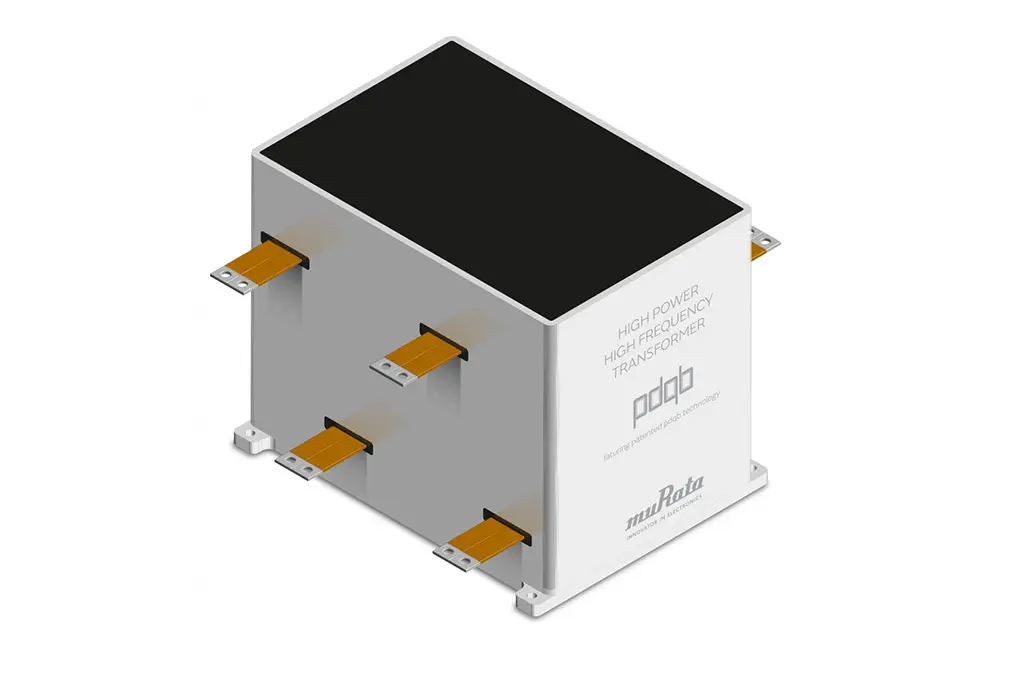
Murata has announced a new transformer technology for high power, high frequency applications that uses a novel winding technique to allow designers to efficiently reach power and frequency levels that were never possible with conventional winding methods.

RelatedPosts

Power Electronics Tools for Passives and Magnetic Designs

Modelithics Releases Component Model Library for SIMULIA CST Studio Suite

Exxelia Publishes Micropen White Papers for Printed Electronics

Murata’s innovative and patented pdqb winding technology makes it possible to construct high frequency transformers of up to and over 400kW that can operate at frequencies as high as 50kHz. The pdqb winding technique overcomes the skin and proximity effects as well as other high frequency losses associated with conventional construction methods, delivering an efficient (>99.5 %) solution in a compact footprint.

There are a number of further benefits to the winding technique including an increased working voltage and elevated isolation voltage (up to 10 kV). The leakage inductance is highly controllable and interwinding capacitance is low, both of which enhance performance in customer’s designs.

Thermal performance is also improved, eliminating the space requirements and cost associated with heat sinking. Each design can be optimized by a combination of Murata’s transformer expertise and their own simulation software.

Murata is able to design custom high power, high frequency transformers operating around 4-50 kHz with power ratings from 30 kW to 400 kW. The transformers can be designed with turns ratios from 1:1 to 10:1 having multiple secondary windings if desired, and are capable of handling input and output voltages in the range 50 V to 1 kV. A 100 kW transformer fits within an ultra-compact 18 cm x 21 cm x 25 cm package size.

Commenting on the release, Andrea Polti, Global Product Manager, Murata said “More than just launching a series of standard transformers, the HPHF solution really showcases a technology capability that allows us at Murata to provide customized solutions to meet or exceed specific customer requirements.”

Transformers using the pdqb winding technology are ideally suited to challenging applications including eV/HeV fast charging, railway (both rolling stock and trackside), renewable energy, smart grid energy distribution and medical applications including x-ray and MRI systems.


Related

Recent Posts

Exxelia Publishes Micropen White Papers for Printed Electronics

26.1.2026
23

Stackpole Releases AlN High‑Power Thick Film Chip Resistors

26.1.2026
11

Samsung Q4 2025 Results: MLCC focus for AI, Server and Automotive

26.1.2026
32

Würth Elektronik Developed a Custom Transformer for Active Hand Orthosis

26.1.2026
28

Capacitor Technology Dossier

26.1.2026
59

ROHM Extends 2012 Shunt Resistors Power Rating up to 1.25 W

23.1.2026
16

Passive Components in Quantum Computing

22.1.2026
101

0603 Automotive Chip Varistors as TVS Diode Replacements, TDK Tech Note

21.1.2026
27

Exxelia Offers Custom Naval Transformers and Inductors

21.1.2026
15

Upcoming Events

Feb 24
16:00 - 17:00 CET

Designing Qi2 Wireless Power Systems: Practical Development and EMC Optimization

Mar 3
16:00 - 17:00 CET

Cybersecurity at the Eleventh Hour – from RED to CRA – Information and Discussion

Mar 21
All day

PSMA Capacitor Workshop 2026

View Calendar

Popular Posts

  • Buck Converter Design and Calculation

    0 shares
    Share 0 Tweet 0
  • Boost Converter Design and Calculation

    0 shares
    Share 0 Tweet 0
  • LLC Resonant Converter Design and Calculation

    0 shares
    Share 0 Tweet 0
  • Flyback Converter Design and Calculation

    0 shares
    Share 0 Tweet 0
  • Ripple Current and its Effects on the Performance of Capacitors

    3 shares
    Share 3 Tweet 0
  • How Metal Prices Are Driving Passive Component Price Hikes

    0 shares
    Share 0 Tweet 0
  • MLCC and Ceramic Capacitors

    0 shares
    Share 0 Tweet 0
  • What is a Dielectric Constant and DF of Plastic Materials?

    4 shares
    Share 4 Tweet 0
  • Dual Active Bridge (DAB) Topology

    0 shares
    Share 0 Tweet 0
  • Degradation of Capacitors and its Failure Mechanisms

    0 shares
    Share 0 Tweet 0

Newsletter Subscription


Passive Components Blog

© EPCI - Leading Passive Components Educational and Information Site

  • Home
  • Privacy Policy
  • EPCI Membership & Advertisement
  • About

No Result
View All Result
  • Home
  • Knowledge Blog
  • PCNS

© EPCI - Leading Passive Components Educational and Information Site

This website uses cookies. By continuing to use this website you are giving consent to cookies being used. Visit our Privacy and Cookie Policy.
Go to mobile version