




Passive Components Blog
No Result
View All Result
  • Home
  • NewsFilter
    • All
    • Aerospace & Defence
    • Antenna
    • Applications
    • Automotive
    • Capacitors
    • Circuit Protection Devices
    • electro-mechanical news
    • Filters
    • Fuses
    • Inductors
    • Industrial
    • Integrated Passives
    • inter-connect news
    • Market & Supply Chain
    • Market Insights
    • Medical
    • Modelling and Simulation
    • New Materials & Supply
    • New Technologies
    • Non-linear Passives
    • Oscillators
    • Passive Sensors News
    • Resistors
    • RF & Microwave
    • Telecommunication
    • Weekly Digest

    YAGEO Extends Automotive Tantalum Polymer Capacitors for AI and ADAS Controllers

    Knowles Introduces PP Film Capacitors for Highโ€‘Stress Power Electronics

    Highโ€‘Power Current Sensing with YAGEO PK Metal Current Sensors

    AI Data Centers Push Aluminium Capacitor Prices Higher

    Murata Releases 1210 Metal Terminal Common Mode Choke for 10Baseโ€‘T1S Inโ€‘Vehicle Ethernet

    DigiKey Ads 27,000 New In-Stock Parts and 104 Additional Suppliers in Q2 2026

    Wรผrth Elektronik Coupled Inductors Harnessing Leakage Inductance in SEPIC, ZETA and ฤ†uk Converters

    Samsung Introduces Ultraโ€‘compact, Highโ€‘Capacitance MLCCs for AI Edge and Wearable designs

    Knowles Presents Pulse Power Capacitors for Demanding MedTech, Industrial and Defense Applications

    Trending Tags

    • Ripple Current
    • RF
    • Leakage Current
    • Tantalum vs Ceramic
    • Snubber
    • Low ESR
    • Feedthrough
    • Derating
    • Dielectric Constant
    • New Products
    • Market Reports
  • VideoFilter
    • All
    • Antenna videos
    • Capacitor videos
    • Circuit Protection Video
    • Filter videos
    • Fuse videos
    • Inductor videos
    • Inter-Connect Video
    • Non-linear passives videos
    • Oscillator videos
    • Passive sensors videos
    • Resistor videos

    EMC Design Fundamentals: Safe Use of Varistors and Common Mode Chokes in Mains and Data-Line Filters

    Ferrite versus Nanocrystalline Power Inductor Cores: Turns, Gap and Size

    KYOCERA AVX Presents Antenna Integrator Studio Tutorial for Antenna Placement and RF Design

    Power Design Simulation Tools for Faster Inductor Selection and Loss Optimization

    EMCโ€‘Compliant PCB and Connector Design Guidelines

    Why Isolated DC/DC Power Supplies Fail Late, Wรผrth Elektronik Podcast

    Designing 800 V DC EMC Filters: Calculation, Simulation and Measurement

    Current Sense Transformer Datasheet and Designโ€‘in Guide

    Designing a USB Typeโ€‘C Flyback Planar Transformer with Freneticโ€™s Planar Tool

    Trending Tags

    • Capacitors explained
    • Inductors explained
    • Resistors explained
    • Filters explained
    • Application Video Guidelines
    • EMC
    • New Products
    • Ripple Current
    • Simulation
    • Tantalum vs Ceramic
  • Knowledge Blog
  • Dossiers
    • AI Hardware Dossier
    • Power Converter Dossier
    • Automotive Dossier
    • Capacitor Dossier
    • Resistor Dossier
    • Inductor Dossier
    • Circuit Protection Dossier
  • Suppliers
    • Who is Who
  • PCNS
    • PCNS 2025
    • PCNS 2023
    • PCNS 2021
    • PCNS 2019
    • PCNS 2017
  • Events
  • Home
  • NewsFilter
    • All
    • Aerospace & Defence
    • Antenna
    • Applications
    • Automotive
    • Capacitors
    • Circuit Protection Devices
    • electro-mechanical news
    • Filters
    • Fuses
    • Inductors
    • Industrial
    • Integrated Passives
    • inter-connect news
    • Market & Supply Chain
    • Market Insights
    • Medical
    • Modelling and Simulation
    • New Materials & Supply
    • New Technologies
    • Non-linear Passives
    • Oscillators
    • Passive Sensors News
    • Resistors
    • RF & Microwave
    • Telecommunication
    • Weekly Digest

    YAGEO Extends Automotive Tantalum Polymer Capacitors for AI and ADAS Controllers

    Knowles Introduces PP Film Capacitors for Highโ€‘Stress Power Electronics

    Highโ€‘Power Current Sensing with YAGEO PK Metal Current Sensors

    AI Data Centers Push Aluminium Capacitor Prices Higher

    Murata Releases 1210 Metal Terminal Common Mode Choke for 10Baseโ€‘T1S Inโ€‘Vehicle Ethernet

    DigiKey Ads 27,000 New In-Stock Parts and 104 Additional Suppliers in Q2 2026

    Wรผrth Elektronik Coupled Inductors Harnessing Leakage Inductance in SEPIC, ZETA and ฤ†uk Converters

    Samsung Introduces Ultraโ€‘compact, Highโ€‘Capacitance MLCCs for AI Edge and Wearable designs

    Knowles Presents Pulse Power Capacitors for Demanding MedTech, Industrial and Defense Applications

    Trending Tags

    • Ripple Current
    • RF
    • Leakage Current
    • Tantalum vs Ceramic
    • Snubber
    • Low ESR
    • Feedthrough
    • Derating
    • Dielectric Constant
    • New Products
    • Market Reports
  • VideoFilter
    • All
    • Antenna videos
    • Capacitor videos
    • Circuit Protection Video
    • Filter videos
    • Fuse videos
    • Inductor videos
    • Inter-Connect Video
    • Non-linear passives videos
    • Oscillator videos
    • Passive sensors videos
    • Resistor videos

    EMC Design Fundamentals: Safe Use of Varistors and Common Mode Chokes in Mains and Data-Line Filters

    Ferrite versus Nanocrystalline Power Inductor Cores: Turns, Gap and Size

    KYOCERA AVX Presents Antenna Integrator Studio Tutorial for Antenna Placement and RF Design

    Power Design Simulation Tools for Faster Inductor Selection and Loss Optimization

    EMCโ€‘Compliant PCB and Connector Design Guidelines

    Why Isolated DC/DC Power Supplies Fail Late, Wรผrth Elektronik Podcast

    Designing 800 V DC EMC Filters: Calculation, Simulation and Measurement

    Current Sense Transformer Datasheet and Designโ€‘in Guide

    Designing a USB Typeโ€‘C Flyback Planar Transformer with Freneticโ€™s Planar Tool

    Trending Tags

    • Capacitors explained
    • Inductors explained
    • Resistors explained
    • Filters explained
    • Application Video Guidelines
    • EMC
    • New Products
    • Ripple Current
    • Simulation
    • Tantalum vs Ceramic
  • Knowledge Blog
  • Dossiers
    • AI Hardware Dossier
    • Power Converter Dossier
    • Automotive Dossier
    • Capacitor Dossier
    • Resistor Dossier
    • Inductor Dossier
    • Circuit Protection Dossier
  • Suppliers
    • Who is Who
  • PCNS
    • PCNS 2025
    • PCNS 2023
    • PCNS 2021
    • PCNS 2019
    • PCNS 2017
  • Events
No Result
View All Result
Passive Components Blog
No Result
View All Result

Binder Introduces Triangular Moulding for M16 and M12 Cable Connectors

31.3.2026
Reading Time: 30 mins read
A A

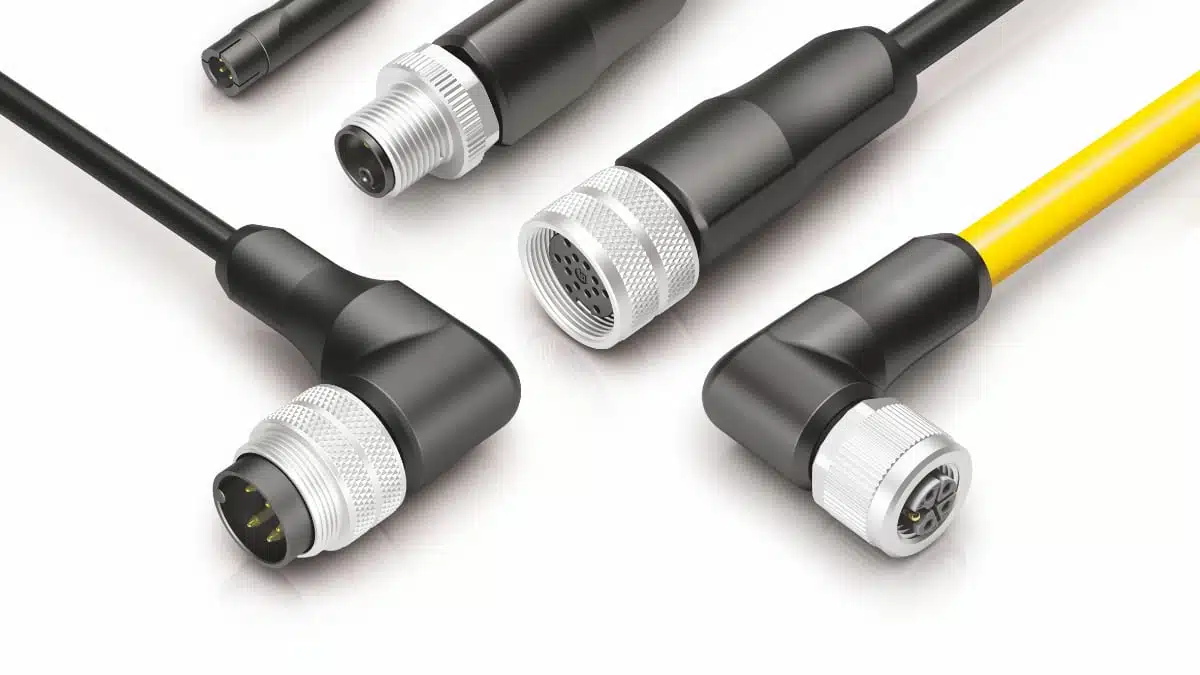
Binder has introduced a new triangular moulding design for selected M16 and M12 cable connectors to improve mechanical robustness, strain relief, and handling in dynamic industrial applications.

The concept targets moving machinery, chain flex and robotic systems where connector fatigue, cable breakage and contamination are recurring field issues for design and maintenance engineers.

RelatedPosts

binder Prints Electronics on 3D Components Connector Surface

Binder Hybrid Connector Simplifies One Cable Automation

binder Releases Toolโ€‘Tightenable M12 Connectors for Improved Reliability

Key features and benefits

The triangular moulding is a new overmould geometry implemented at the transition between cable and connector housing on revised M16 cable connectors and on M12 Kโ€‘ and Lโ€‘coded power connectors. It is designed to distribute mechanical loads more evenly and to provide a distinctive visual and tactile interface for the user.

Key mechanical and handling advantages include:

  • Optimised force distribution in the cableโ€“connector transition, reducing peak stress under bending and tensile loading in dynamic applications.
  • Enhanced antiโ€‘twist protection, helping to prevent cable rotation at the connector entry and reducing conductor fatigue.
  • Structured gripping surfaces that improve manual handling during assembly and disconnection, even when operators wear gloves or work with oily hands.
  • Reduced dirt traps around the strain relief area, simplifying cleaning and reducing the accumulation of dust, oil and process residues in harsh industrial environments.

For engineering teams standardising on binder circular connectors, the triangular moulding also provides a clear visual differentiator across machine builds and makes it easier for technicians to recognise the newer generation of assemblies in crowded control cabinets and on machinery.

Typical applications

The new moulding targets applications where cables experience frequent movement, vibration or operator interaction, and where connector failure can lead to unexpected downtime or safety concerns.

Typical use cases include:

  • Automation technology: distributed I/O, power and signal connections on modular machines, linear axes and handling systems.
  • Mechanical and plant engineering: interconnects on production lines, processing equipment and auxiliary systems, including areas with regular washโ€‘down or cleaning.
  • Robotics: robot arm cabling, cable chains and joint connections subject to continuous flex, torsion and shock loads.
  • Conveyor technology: sensor and motor connectors on conveyors, diverters and sorters where vibration and repetitive motion are present.
  • Packaging machinery: toolโ€‘less or quickโ€‘change sections where operators repeatedly plug and unplug assemblies for format changeovers.
  • Measurement and sensor technology: fieldโ€‘mounted sensors and actuators in demanding environments that combine movement, contaminants and tight space constraints.

In these scenarios, improved strain relief and antiโ€‘twist behaviour can extend connector service life, reduce maintenance interventions and support higher overall process reliability.

Technical highlights

M16 series 425 cable connectors with triangular moulding

The triangular moulding is implemented in M16 circular cable connectors of series 425, which are positioned as robust miniature connectors for industrial signal transmission.

Key characteristics of the M16 series 425 cable assemblies include:

  • Contact configuration: 3 to 12 contacts, supporting typical sensor, signal and lowโ€‘power loads.
  • Electrical ratings: rated voltages up to 150 V and rated currents up to 3 A, depending on pin count and configuration (exact values per contact arrangement according to the manufacturer datasheet).
  • Environmental protection: IP67 and IP68 in the mated and locked condition, enabling use in dusty, humid or splashโ€‘water environments and temporary immersion situations.
  • Contact system: goldโ€‘plated contacts to maintain low and stable contact resistance over many mating cycles and under corrosive influences.
  • Shielding options: shielded and unshielded variants, allowing designers to align EMC performance with system requirements and cable concepts.
  • Cable integration: factoryโ€‘moulded PUR cables with standard lengths of 2 m and 5 m, and further lengths available on request.

From a designโ€‘in perspective, the IP67/IP68 rating in combination with a fully moulded strain relief and optional shielding provides a compact, fieldโ€‘proof signal interface that is suited to distributed I/O architectures and outdoor or washโ€‘down exposed equipment.

M12 Kโ€‘ and Lโ€‘coded power connectors

The triangular moulding is also being introduced on M12 power connectors with K and L coding, which are widely used for compact AC and DC power interfaces in industrial automation.

Relevant technical aspects for these M12 power variants include:

  • Coding and use case:
    • Kโ€‘coded M12 connectors (e.g. series 824) are intended for AC power up to 630 V, with 4 power contacts plus PE and currents up to approximately 12 A, supporting motor and drive power distribution in compact form factors.
    • Lโ€‘coded M12 connectors address lowโ€‘voltage DC power distribution, for example for 24 V or 48 V DC bus systems in modular machines and IOโ€‘Link or Ethernetโ€‘based infrastructures (specific voltage and current ratings as per binder datasheets).
  • Mechanical configuration: angled and straight versions, with screwโ€‘locking according to the relevant M12 standards, and IP67/IP68 ingress protection in the mated state for robust use in field wiring.
  • Typical current capability: M12 power Kโ€‘coded variants with current ratings in the 12 A class per contact, enabling compact yet powerful line and device connectors for decentralized power distribution.

By combining the established electrical performance of these M12 power connectors with the improved strain relief and grip of the triangular moulding, binder supports higher reliability in compact power distribution systems where cable movement is unavoidable.

Designโ€‘in notes for engineers

For design engineers working on new machines or upgrading existing lines, the triangular moulding concept impacts both mechanical reliability and practical handling of field wiring.

Key designโ€‘in considerations include:

  • Dynamic cable routing: in cable chains and robot joints, place the triangular moulded area outside of the tightest bending radius where possible, so that the optimised force distribution complements good cable routing rather than compensating for excessively small bend radii.
  • Strain relief and antiโ€‘twist: the improved antiโ€‘twist behaviour helps protect conductors from torsional stress at the connector entry, but designers should still define cable clamps, guides or brackets so that repeated torque is not transferred solely to the connector.
  • Environmental sealing: IP67/IP68 performance applies to the fully mated and locked interface; ensure mating connectors and panel receptacles are specified with matching IP ratings and that sealing surfaces are not compromised by mounting tolerances or contamination.
  • EMC layout: for shielded variants, consider how the shield termination at the connector interfaces with the rest of the grounding and shielding concept (for example, connection to machine ground at one or both ends, bonding to control cabinet earth and separation from sensitive signal wiring).
  • Service and ergonomics: the structured triangular shape improves grip, especially in oily or wet environments; placing connectors in accessible locations can further reduce assembly time and lower the risk of improper mating or overโ€‘tightening in the field.
  • Standards and compliance: M16 and M12 connectors from binder follow relevant IEC/DIN standards for circular connectors; when designing safetyโ€‘relevant systems or EMCโ€‘critical equipment, use the official binder datasheets and approvals (UL, VDE, etc.) as the design authority for creepage/clearance, current carrying capability and pollution degree.

Overall, the triangular moulding offers a lowโ€‘risk mechanical upgrade path within familiar connector families, which can be attractive for OEMs looking to improve field reliability without overhauling existing electrical architectures.

Source

This article is based on information from a binder manufacturer press release on the introduction of triangular moulding for M16 and M12 cable connectors, supplemented by publicly available technical data from the binder website and related product documentation.

  1. binder โ€“ M16 IP67 miniature circular connectors overviewbinder-usa
  2. binder โ€“ M12 Kโ€‘coded power connectors (series 824)binder-connector
  3. binder โ€“ Data and automation connectors overviewbinder-connector
  4. binder USA โ€“ M12 Power connectors overviewbinder-usa
  5. Press release: Optimised force distribution and modern design โ€“ triangular moulding for M16 and M12 cable connectors (March 2026)
Related

Recent Posts

YAGEO Extends Automotive Tantalum Polymer Capacitors for AI and ADAS Controllers

31.7.2026
47

Knowles Introduces PP Film Capacitors for Highโ€‘Stress Power Electronics

30.7.2026
42

Highโ€‘Power Current Sensing with YAGEO PK Metal Current Sensors

30.7.2026
17

Wรผrth Elektronik Coupled Inductors Harnessing Leakage Inductance in SEPIC, ZETA and ฤ†uk Converters

29.7.2026
40

Knowles Presents Pulse Power Capacitors for Demanding MedTech, Industrial and Defense Applications

29.7.2026
24

YAGEO Extends its Supercapacitor Series Line-Up

28.7.2026
70

SCHURTER Presents EKO Highโ€‘Voltage Fuses for Global Energy Systems

28.7.2026
22

TDK Releases SMD Commonโ€‘Mode Chokes for Compact Highโ€‘Current EMI Filtering

28.7.2026
44

Samsung Introduces 1000V C0G and X7 MLCCs for 800V DC Systems

27.7.2026
75

Upcoming Events

Sep 29
16:00 - 17:00 CEST

Cybersecurity 2026

View Calendar

Popular Posts

  • Buck Converter Design and Calculation

    0 shares
    Share 0 Tweet 0
  • Boost Converter Design and Calculation

    0 shares
    Share 0 Tweet 0
  • YAGEO Announces July 2026 Capacitor Price Increase

    0 shares
    Share 0 Tweet 0
  • LLC Resonant Converter Design and Calculation

    0 shares
    Share 0 Tweet 0
  • Flyback Converter Design and Calculation

    0 shares
    Share 0 Tweet 0
  • MLCCs in the Age of AI: Q2 2026 Market Tightness

    0 shares
    Share 0 Tweet 0
  • MLCC and Ceramic Capacitors

    0 shares
    Share 0 Tweet 0
  • Earthing Systems and IEC Classification Explained

    0 shares
    Share 0 Tweet 0
  • Dual Active Bridge (DAB) Topology

    0 shares
    Share 0 Tweet 0
  • Core Materials, Permeability and Their Losses

    0 shares
    Share 0 Tweet 0

Newsletter Subscription


Passive Components Blog

ยฉ EPCI - Leading Passive Components Educational and Information Site

  • Home
  • Privacy Policy
  • EPCI Membership & Advertisement
  • About

No Result
View All Result
  • Home
  • Knowledge Blog
  • Dossiers
  • PCNS

ยฉ EPCI - Leading Passive Components Educational and Information Site