






Passive Components Blog
No Result
View All Result
  • Home
  • NewsFilter
    • All
    • Aerospace & Defence
    • Antenna
    • Applications
    • Automotive
    • Capacitors
    • Circuit Protection Devices
    • electro-mechanical news
    • Filters
    • Fuses
    • Inductors
    • Industrial
    • Integrated Passives
    • inter-connect news
    • Market & Supply Chain
    • Market Insights
    • Medical
    • Modelling and Simulation
    • New Materials & Supply
    • New Technologies
    • Non-linear Passives
    • Oscillators
    • Passive Sensors News
    • Resistors
    • RF & Microwave
    • Telecommunication
    • Weekly Digest
    Researchers developed a polymer capacitor by combining two cheap, commercially available plastics. The new polymer capacitor makes use of the transparent material — pictured here, with vintage Penn State athletic marks visible through it — to store four times the energy and withstand significantly more heat.  Credit: Penn State

    Penn State Demonstrated Polymer Alloy Capacitor Film with 4× Energy Density up to 250C

    ECIA January 2026 Reports Strong Sales Confidence

    Vishay Unveils Ultra-Compact 0201 Thick Film Chip Resistors

    Würth Elektronik Component Data Live in Accuris

    Coilcraft Releases Automotive Common Mode Chokes

    MLCC Manufacturers Consider Price Increase as AI Demand Outpaces Supply

    YAGEO Extends Antenna Portfolio with Wi‑Fi 6E/7 and Tri‑band GNSS Solutions

    SCHURTER Introduces 2410 SMD Fuse for Robust AC/DC Protection

    TDK Releases High Temp 175C Automotive NTC thermistors

    Trending Tags

    • Ripple Current
    • RF
    • Leakage Current
    • Tantalum vs Ceramic
    • Snubber
    • Low ESR
    • Feedthrough
    • Derating
    • Dielectric Constant
    • New Products
    • Market Reports
  • VideoFilter
    • All
    • Antenna videos
    • Capacitor videos
    • Circuit Protection Video
    • Filter videos
    • Fuse videos
    • Inductor videos
    • Inter-Connect Video
    • Non-linear passives videos
    • Oscillator videos
    • Passive sensors videos
    • Resistor videos

    2026 Power Magnetics Design Trends: Flyback, DAB and Planar

    Enabling Software‑Defined Vehicle Architectures: Automotive Ethernet and Zonal Smart Power

    Calculating Resistance Value of a Flyback RC Snubber 

    One‑Pulse Characterization of Nonlinear Power Inductors

    Thermistor Linearization Challenges

    Coaxial Connectors and How to Connect with PCB

    PCB Manufacturing, Test Methods, Quality and Reliability

    Transformer Behavior – Current Transfer and Hidden Feedback

    Choosing the Right Capacitor: The Importance of Accurate Measurements

    Trending Tags

    • Capacitors explained
    • Inductors explained
    • Resistors explained
    • Filters explained
    • Application Video Guidelines
    • EMC
    • New Products
    • Ripple Current
    • Simulation
    • Tantalum vs Ceramic
  • Knowledge Blog
  • DossiersNew
  • Suppliers
    • Who is Who
  • PCNS
    • PCNS 2025
    • PCNS 2023
    • PCNS 2021
    • PCNS 2019
    • PCNS 2017
  • Events
  • Home
  • NewsFilter
    • All
    • Aerospace & Defence
    • Antenna
    • Applications
    • Automotive
    • Capacitors
    • Circuit Protection Devices
    • electro-mechanical news
    • Filters
    • Fuses
    • Inductors
    • Industrial
    • Integrated Passives
    • inter-connect news
    • Market & Supply Chain
    • Market Insights
    • Medical
    • Modelling and Simulation
    • New Materials & Supply
    • New Technologies
    • Non-linear Passives
    • Oscillators
    • Passive Sensors News
    • Resistors
    • RF & Microwave
    • Telecommunication
    • Weekly Digest
    Researchers developed a polymer capacitor by combining two cheap, commercially available plastics. The new polymer capacitor makes use of the transparent material — pictured here, with vintage Penn State athletic marks visible through it — to store four times the energy and withstand significantly more heat.  Credit: Penn State

    Penn State Demonstrated Polymer Alloy Capacitor Film with 4× Energy Density up to 250C

    ECIA January 2026 Reports Strong Sales Confidence

    Vishay Unveils Ultra-Compact 0201 Thick Film Chip Resistors

    Würth Elektronik Component Data Live in Accuris

    Coilcraft Releases Automotive Common Mode Chokes

    MLCC Manufacturers Consider Price Increase as AI Demand Outpaces Supply

    YAGEO Extends Antenna Portfolio with Wi‑Fi 6E/7 and Tri‑band GNSS Solutions

    SCHURTER Introduces 2410 SMD Fuse for Robust AC/DC Protection

    TDK Releases High Temp 175C Automotive NTC thermistors

    Trending Tags

    • Ripple Current
    • RF
    • Leakage Current
    • Tantalum vs Ceramic
    • Snubber
    • Low ESR
    • Feedthrough
    • Derating
    • Dielectric Constant
    • New Products
    • Market Reports
  • VideoFilter
    • All
    • Antenna videos
    • Capacitor videos
    • Circuit Protection Video
    • Filter videos
    • Fuse videos
    • Inductor videos
    • Inter-Connect Video
    • Non-linear passives videos
    • Oscillator videos
    • Passive sensors videos
    • Resistor videos

    2026 Power Magnetics Design Trends: Flyback, DAB and Planar

    Enabling Software‑Defined Vehicle Architectures: Automotive Ethernet and Zonal Smart Power

    Calculating Resistance Value of a Flyback RC Snubber 

    One‑Pulse Characterization of Nonlinear Power Inductors

    Thermistor Linearization Challenges

    Coaxial Connectors and How to Connect with PCB

    PCB Manufacturing, Test Methods, Quality and Reliability

    Transformer Behavior – Current Transfer and Hidden Feedback

    Choosing the Right Capacitor: The Importance of Accurate Measurements

    Trending Tags

    • Capacitors explained
    • Inductors explained
    • Resistors explained
    • Filters explained
    • Application Video Guidelines
    • EMC
    • New Products
    • Ripple Current
    • Simulation
    • Tantalum vs Ceramic
  • Knowledge Blog
  • DossiersNew
  • Suppliers
    • Who is Who
  • PCNS
    • PCNS 2025
    • PCNS 2023
    • PCNS 2021
    • PCNS 2019
    • PCNS 2017
  • Events
No Result
View All Result
Passive Components Blog
No Result
View All Result

NA Component Sales Continue to Show Positive Growth

29.6.2022
Reading Time: 3 mins read
A A

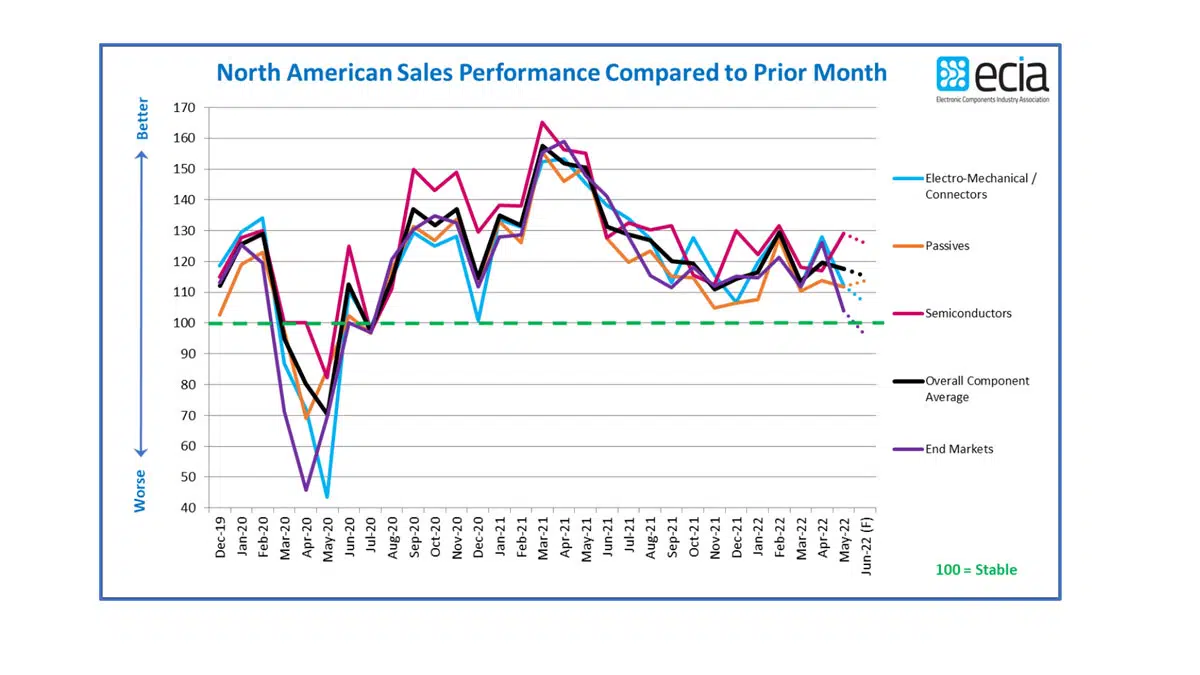
The results of June 2022 Electronic Component Sales Trend Survey (ECST) reported by ECIA continue to show positive growth expectations despite strong economic headwinds.

The overall average sales sentiment for May registered at 117.6, six points about the outlook projected last month. Over the past nine months, starting in September 2021, overall average sales sentiment has tracked within a nine-point range of 111 to 120 except for February when it surged up to nearly 130.

RelatedPosts

ECIA January 2026 Reports Strong Sales Confidence

October 2025 ECIA US Components Sales Sentiment Remains Strong but Weakens in November

September 2025 ECIA US Components Sales Sentiment Continues in Optimism

All major component categories have achieved solid, positive sales sentiment during this time with Semiconductors demonstrating the highest overall sentiment of 123.1 during this period and Passives coming in with the lowest average of 112.5 – less that ten points separating the highest and lowest. Survey participants continue their positive assessment for component growth with the index only dipping slightly to 115.4 for June.

This dip is driven primarily by weaker Electro-Mechanical growth expectations. The end-market outlook presents an interesting anomaly in the overall picture. In assessing June prospects, the overall sentiment drops below 100 to 96.1. However, the average of the individual market outlooks comes in at 107.8 with only the Compute and Consumer Electronics categories dropping below one hundred. It would appear that there is a general sense of concern about the impact of the economy on the market while judging specific end markets still yields more hopeful expectations.

The medium-term outlook measured by the Quarterly ECST paints a solidly positive picture through Q3 of this year. Over half of respondents report expectations of growth in Q2 and Q3 with roughly 25% expecting growth above 3%. An average of only 13% see a decline in Q2 and that drops to 9% in Q3.
Expectations for Semiconductor growth jump significantly in Q3 as expectations of growth improve from 43% in Q2 to 59% in Q3. Nobody saw any possibility of a decline in Semiconductor sales in Q3. This is an encouraging result given several prognostications by industry analysts that the semiconductor industry
would experience a precipitous decline in 2022. In contrast to Semiconductors, Passive and Electro-Mechanical sales sentiment becomes slightly more conservative in Q3 compared to Q2 – but still very positive overall.

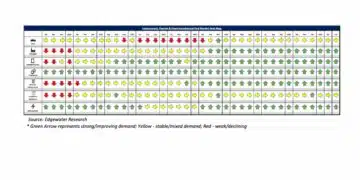
As noted previously, the overall end-market index delivers a result that is inconsistent with both the component views as well as the sentiment of the individual end-markets. On the positive side, Avionics/Military/Aerospace continue to see improving sales expectations. Perhaps this is not surprising
given events around the world. Industrial Electronics and Automotive Electronics also deliver very positive expectations. Telecom Networks and Medical Electronics see a drop in sales expectations while Consumer Electronics maintains a mostly flat outlook. Mobile Phones and Computers continue to see
declining sales in the index with results well below one hundred for a number of months now. The outlook for Mobile Phones improves modestly to a flat outlook for June.
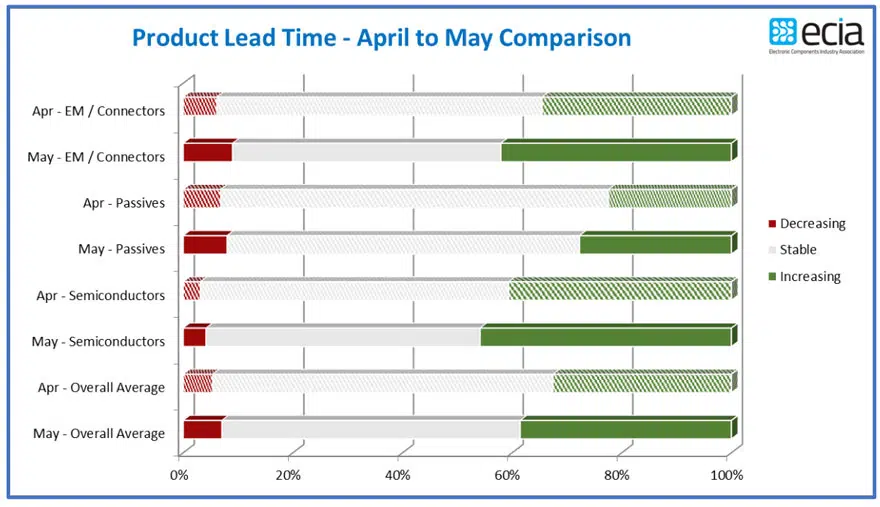
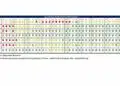
Component Lead Time Comparison April to May 2022; source: ECIA

Expectations of increasing Product Lead Times in May compared to April jumped significantly across all major component categories. An overall average of 39% saw increasing lead times in May with only 7% seeing a decline in the average. The most painful view comes from Semiconductors with 46% seeing an
increase in lead times. Passives had the most hopeful view with 28% seeing longer lead times. However, that is up from 22% in April. The lead time pressure results mirror the sales growth expectations between Semiconductor and Passive components. The combination of solid end-market demand and supply chain challenges are continuing to stress the lead time expectation.
Related

Source: ECIA

Recent Posts

Researchers developed a polymer capacitor by combining two cheap, commercially available plastics. The new polymer capacitor makes use of the transparent material — pictured here, with vintage Penn State athletic marks visible through it — to store four times the energy and withstand significantly more heat.  Credit: Penn State

Penn State Demonstrated Polymer Alloy Capacitor Film with 4× Energy Density up to 250C

19.2.2026
1

ECIA January 2026 Reports Strong Sales Confidence

19.2.2026
0

Vishay Unveils Ultra-Compact 0201 Thick Film Chip Resistors

19.2.2026
2

Würth Elektronik Component Data Live in Accuris

19.2.2026
3

Coilcraft Releases Automotive Common Mode Chokes

19.2.2026
1

MLCC Manufacturers Consider Price Increase as AI Demand Outpaces Supply

18.2.2026
28

YAGEO Extends Antenna Portfolio with Wi‑Fi 6E/7 and Tri‑band GNSS Solutions

17.2.2026
6

SCHURTER Introduces 2410 SMD Fuse for Robust AC/DC Protection

17.2.2026
4

TDK Releases High Temp 175C Automotive NTC thermistors

17.2.2026
3

Upcoming Events

Feb 24
16:00 - 17:00 CET

Mastering Galvanic Isolation: Ensuring Safety in Power Electronics

Mar 3
16:00 - 17:00 CET

Cybersecurity at the Eleventh Hour – from RED to CRA – Information and Discussion

Mar 21
All day

PSMA Capacitor Workshop 2026

View Calendar

Popular Posts

  • Buck Converter Design and Calculation

    0 shares
    Share 0 Tweet 0
  • Boost Converter Design and Calculation

    0 shares
    Share 0 Tweet 0
  • LLC Resonant Converter Design and Calculation

    0 shares
    Share 0 Tweet 0
  • Flyback Converter Design and Calculation

    0 shares
    Share 0 Tweet 0
  • Ripple Current and its Effects on the Performance of Capacitors

    3 shares
    Share 3 Tweet 0
  • Dual Active Bridge (DAB) Topology

    0 shares
    Share 0 Tweet 0
  • What is a Dielectric Constant and DF of Plastic Materials?

    4 shares
    Share 4 Tweet 0
  • MLCC and Ceramic Capacitors

    0 shares
    Share 0 Tweet 0
  • 3-Phase EMI Filter Design, Simulation, Calculation and Test

    0 shares
    Share 0 Tweet 0
  • SEPIC Converter Design and Calculation

    0 shares
    Share 0 Tweet 0

Newsletter Subscription


Passive Components Blog

© EPCI - Leading Passive Components Educational and Information Site

  • Home
  • Privacy Policy
  • EPCI Membership & Advertisement
  • About

No Result
View All Result
  • Home
  • Knowledge Blog
  • PCNS

© EPCI - Leading Passive Components Educational and Information Site

This website uses cookies. By continuing to use this website you are giving consent to cookies being used. Visit our Privacy and Cookie Policy.
Go to mobile version