





Passive Components Blog
No Result
View All Result
  • Home
  • NewsFilter
    • All
    • Aerospace & Defence
    • Antenna
    • Applications
    • Automotive
    • Capacitors
    • Circuit Protection Devices
    • electro-mechanical news
    • Filters
    • Fuses
    • Inductors
    • Industrial
    • Integrated Passives
    • inter-connect news
    • Market & Supply Chain
    • Market Insights
    • Medical
    • Modelling and Simulation
    • New Materials & Supply
    • New Technologies
    • Non-linear Passives
    • Oscillators
    • Passive Sensors News
    • Resistors
    • RF & Microwave
    • Telecommunication
    • Weekly Digest

    Planar vs Conventional Transformer: When it Make Sense

    Researchers Propose Next‑Gen Compact Memory Using Ultra-thin Ferroelectric Capacitors

    Nichicon ADN Automotive Hybrid Aluminum Capacitors Now Available in EMEA

    Wk 19 Electronics Supply Chain Digest

    Electrocaloric Multilayer Capacitors: Towards Quiet, Solid‑State Cooling Around Room Temperature

    High-Crystallinity Nanocrystalline Composites for MHz Chip Inductors

    European Components Distribution Shows Strong Q1 2026 Growth Amid Geopolitical Uncertainty

    Stackpole Expanded its AlN Thick Film Chip Resistors

    KYOCERA 10 µF 0201 MLCC Brings High‑Capacitance into Mobile Designs

    Trending Tags

    • Ripple Current
    • RF
    • Leakage Current
    • Tantalum vs Ceramic
    • Snubber
    • Low ESR
    • Feedthrough
    • Derating
    • Dielectric Constant
    • New Products
    • Market Reports
  • VideoFilter
    • All
    • Antenna videos
    • Capacitor videos
    • Circuit Protection Video
    • Filter videos
    • Fuse videos
    • Inductor videos
    • Inter-Connect Video
    • Non-linear passives videos
    • Oscillator videos
    • Passive sensors videos
    • Resistor videos

    Planar vs Conventional Transformer: When it Make Sense

    Modeling Fringing Field Losses in Inductors & Transformers

    Why Power Inductors Use a Ferrite Core With an Air Gap

    Transformer-Based Power-Line Harvester Magnetic Design

    Thermal Modeling of Magnetics

    Standard vs Planar LLC transformers Comparison for Battery Chargers

    How Modern Tools Model Magnetic Components for Power Electronics

    Advanced Loss Modeling for Planar Magnetics in the Frenetic Planar Tool

    2026 Power Magnetics Design Trends: Flyback, DAB and Planar

    Trending Tags

    • Capacitors explained
    • Inductors explained
    • Resistors explained
    • Filters explained
    • Application Video Guidelines
    • EMC
    • New Products
    • Ripple Current
    • Simulation
    • Tantalum vs Ceramic
  • Knowledge Blog
  • DossiersNew
  • Suppliers
    • Who is Who
  • PCNS
    • PCNS 2025
    • PCNS 2023
    • PCNS 2021
    • PCNS 2019
    • PCNS 2017
  • Events
  • Home
  • NewsFilter
    • All
    • Aerospace & Defence
    • Antenna
    • Applications
    • Automotive
    • Capacitors
    • Circuit Protection Devices
    • electro-mechanical news
    • Filters
    • Fuses
    • Inductors
    • Industrial
    • Integrated Passives
    • inter-connect news
    • Market & Supply Chain
    • Market Insights
    • Medical
    • Modelling and Simulation
    • New Materials & Supply
    • New Technologies
    • Non-linear Passives
    • Oscillators
    • Passive Sensors News
    • Resistors
    • RF & Microwave
    • Telecommunication
    • Weekly Digest

    Planar vs Conventional Transformer: When it Make Sense

    Researchers Propose Next‑Gen Compact Memory Using Ultra-thin Ferroelectric Capacitors

    Nichicon ADN Automotive Hybrid Aluminum Capacitors Now Available in EMEA

    Wk 19 Electronics Supply Chain Digest

    Electrocaloric Multilayer Capacitors: Towards Quiet, Solid‑State Cooling Around Room Temperature

    High-Crystallinity Nanocrystalline Composites for MHz Chip Inductors

    European Components Distribution Shows Strong Q1 2026 Growth Amid Geopolitical Uncertainty

    Stackpole Expanded its AlN Thick Film Chip Resistors

    KYOCERA 10 µF 0201 MLCC Brings High‑Capacitance into Mobile Designs

    Trending Tags

    • Ripple Current
    • RF
    • Leakage Current
    • Tantalum vs Ceramic
    • Snubber
    • Low ESR
    • Feedthrough
    • Derating
    • Dielectric Constant
    • New Products
    • Market Reports
  • VideoFilter
    • All
    • Antenna videos
    • Capacitor videos
    • Circuit Protection Video
    • Filter videos
    • Fuse videos
    • Inductor videos
    • Inter-Connect Video
    • Non-linear passives videos
    • Oscillator videos
    • Passive sensors videos
    • Resistor videos

    Planar vs Conventional Transformer: When it Make Sense

    Modeling Fringing Field Losses in Inductors & Transformers

    Why Power Inductors Use a Ferrite Core With an Air Gap

    Transformer-Based Power-Line Harvester Magnetic Design

    Thermal Modeling of Magnetics

    Standard vs Planar LLC transformers Comparison for Battery Chargers

    How Modern Tools Model Magnetic Components for Power Electronics

    Advanced Loss Modeling for Planar Magnetics in the Frenetic Planar Tool

    2026 Power Magnetics Design Trends: Flyback, DAB and Planar

    Trending Tags

    • Capacitors explained
    • Inductors explained
    • Resistors explained
    • Filters explained
    • Application Video Guidelines
    • EMC
    • New Products
    • Ripple Current
    • Simulation
    • Tantalum vs Ceramic
  • Knowledge Blog
  • DossiersNew
  • Suppliers
    • Who is Who
  • PCNS
    • PCNS 2025
    • PCNS 2023
    • PCNS 2021
    • PCNS 2019
    • PCNS 2017
  • Events
No Result
View All Result
Passive Components Blog
No Result
View All Result

Schaffner Extend High Performance Common-Mode Chokes for Lighting Applications

4.4.2022
Reading Time: 2 mins read
A A

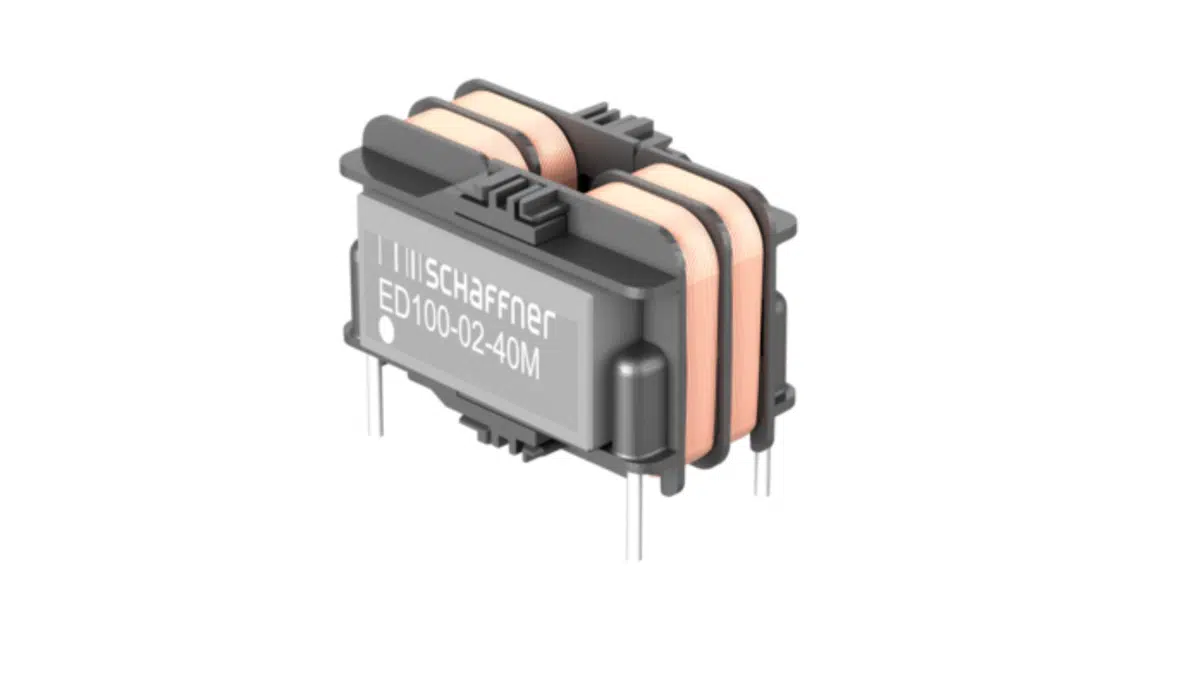
Schaffner, the internationally leading company in the field of electromagnetic compatibility, extends its range of ED100 and ED101 high performance common-mode chokes for lighting applications.

The new ED100/ED101 EMC filter series has been designed specifically for the requirements of LED driver circuits. The new choke’s common-mode inductance is matched by a substantial differential-mode inductance. With only one component required on the PCB both types of noise can be mitigated, saving cost and space while increasing reliability.

RelatedPosts

Schaffner Releases Nanocrystalline Core Common Mode Choke

TE Connectivity Cleared to Acquire Shares of Schaffner Holding

Schaffner Unveils Common Mode Choke for EV Charging Stations

In the last decade, light emitting diodes (LED) have disrupted the lighting industry. No application has remained untouched. Even harsh and ambitious applications such as powerful streetlamps and car headlights are now common applications for LEDs.

LEDs are exceptionally energy efficient and robust, but they are very sensitive to current fluctuations. Driver circuits are used to keep the current in an optimal range. This is necessary to set the desired efficiency and luminosity, as well as to protect the LEDs from harm.

Increase of power factor

LED drivers must not only be highly efficient and cost-effective, but also comply with EMC regulations. Inevitably, they generate electro-magnetic interference (EMI).  To suppress EMI and meet EMC regulations, common-mode (CM) chokes are a good alternative to capacitors in LED drive circuits. They reduce the earth leakage current, help stabilizing the power factor and increase overall reliability.

ED100 and ED101 chokes have identical footprint and dimensions, offering same level of CM inductance while ED101 offers much higher differential mode noise mitigation than ED100 for more demanding applications.

Key features:

  • Space Saving on PCB; CM and DM inductances in one package
  • Choice of differential-mode attenuation: high (ED100) / very high (ED101)
  • Rated currents 0.2A to 2 A; choice of 18 products with same PCB pin layout
  • High reliability with MTBF of 13 million hours
  • Increased power factor and reduced earth leakage current by eliminating or reducing capacitors

Typical applications are LED equipment, especially LED driver circuits and displays, fluorescent lamp ballasts or any other application that with high demand for differential-mode performance.

The ED100 / ED101 series is designed for a maximum continuous operating voltage of 300 VAC, 50 / 60 Hz. They meet the requirements for RoHS and REACH regulation.
Related

Source: Schaffner

Recent Posts

Planar vs Conventional Transformer: When it Make Sense

11.5.2026
7

Nichicon ADN Automotive Hybrid Aluminum Capacitors Now Available in EMEA

11.5.2026
11

High-Crystallinity Nanocrystalline Composites for MHz Chip Inductors

7.5.2026
36

Stackpole Expanded its AlN Thick Film Chip Resistors

6.5.2026
20

Würth Elektronik Introduces Compact Flat-wire SMT Power Inductors for Automotive

5.5.2026
44

KYOCERA AVX Extends MLV Varistors for 48V Automotive Protection

5.5.2026
21

YAGEO Introduces C0G Flexible Termination Automotive MLCCs

30.4.2026
34

SCHURTER Releases SMT Micro Switch for Compact HMIs

30.4.2026
9

binder Releases Tool‑Tightenable M12 Connectors for Improved Reliability

30.4.2026
11

Upcoming Events

May 12
8:00 - 15:00 CEST

ESCC Space Splice connectors

May 12
16:00 - 17:00 CEST

Accelerating Power Supply Design with Wurth Elektronik and STMicroelectronics

May 13
17:00 - 17:30 CEST

Winding Loss Modeling for Toroidal Magnetics – Including Gapped Cores

View Calendar

Popular Posts

  • Buck Converter Design and Calculation

    0 shares
    Share 0 Tweet 0
  • Boost Converter Design and Calculation

    0 shares
    Share 0 Tweet 0
  • Flyback Converter Design and Calculation

    0 shares
    Share 0 Tweet 0
  • LLC Resonant Converter Design and Calculation

    0 shares
    Share 0 Tweet 0
  • MLCC and Ceramic Capacitors

    0 shares
    Share 0 Tweet 0
  • Dual Active Bridge (DAB) Topology

    0 shares
    Share 0 Tweet 0
  • Capacitor Charging and Discharging

    0 shares
    Share 0 Tweet 0
  • What Electronics Engineer Needs to Know About Passive Low Pass Filters

    0 shares
    Share 0 Tweet 0
  • Ripple Current and its Effects on the Performance of Capacitors

    3 shares
    Share 3 Tweet 0
  • MLCC Case Sizes Standards Explained

    0 shares
    Share 0 Tweet 0

Newsletter Subscription


Passive Components Blog

© EPCI - Leading Passive Components Educational and Information Site

  • Home
  • Privacy Policy
  • EPCI Membership & Advertisement
  • About

No Result
View All Result
  • Home
  • Knowledge Blog
  • PCNS

© EPCI - Leading Passive Components Educational and Information Site

This website uses cookies. By continuing to use this website you are giving consent to cookies being used. Visit our Privacy and Cookie Policy.
Go to mobile version