








Passive Components Blog
No Result
View All Result
  • Home
  • NewsFilter
    • All
    • Aerospace & Defence
    • Antenna
    • Applications
    • Automotive
    • Capacitors
    • Circuit Protection Devices
    • electro-mechanical news
    • Filters
    • Fuses
    • Inductors
    • Industrial
    • Integrated Passives
    • inter-connect news
    • Market & Supply Chain
    • Market Insights
    • Medical
    • Modelling and Simulation
    • New Materials & Supply
    • New Technologies
    • Non-linear Passives
    • Oscillators
    • Passive Sensors News
    • Resistors
    • RF & Microwave
    • Telecommunication
    • Weekly Digest

    Capacitances of Nonlinear MLCCs: What Datasheets Don’t Tell You

    Stackpole Releases Automotive Wide‑Termination Resistors

    How a Digital Structural Twin Can Predict Tantalum Capacitor Reliability

    SCHURTER Buys Biaodi to Boost High-Voltage Protection Portfolio

    Binder Hybrid Connector Simplifies One Cable Automation

    Tapped Inductor Buck Converter Fundamentals

    TAIYO YUDEN Releases Mini Metal Power Inductors

    Molecular Memristor Shows Record 145 kH Emergent Inductance

    Planar vs Conventional Transformer: When it Make Sense

    Trending Tags

    • Ripple Current
    • RF
    • Leakage Current
    • Tantalum vs Ceramic
    • Snubber
    • Low ESR
    • Feedthrough
    • Derating
    • Dielectric Constant
    • New Products
    • Market Reports
  • VideoFilter
    • All
    • Antenna videos
    • Capacitor videos
    • Circuit Protection Video
    • Filter videos
    • Fuse videos
    • Inductor videos
    • Inter-Connect Video
    • Non-linear passives videos
    • Oscillator videos
    • Passive sensors videos
    • Resistor videos

    Capacitances of Nonlinear MLCCs: What Datasheets Don’t Tell You

    Tapped Inductor Buck Converter Fundamentals

    Planar vs Conventional Transformer: When it Make Sense

    Modeling Fringing Field Losses in Inductors & Transformers

    Why Power Inductors Use a Ferrite Core With an Air Gap

    Transformer-Based Power-Line Harvester Magnetic Design

    Thermal Modeling of Magnetics

    Standard vs Planar LLC transformers Comparison for Battery Chargers

    How Modern Tools Model Magnetic Components for Power Electronics

    Trending Tags

    • Capacitors explained
    • Inductors explained
    • Resistors explained
    • Filters explained
    • Application Video Guidelines
    • EMC
    • New Products
    • Ripple Current
    • Simulation
    • Tantalum vs Ceramic
  • Knowledge Blog
  • DossiersNew
  • Suppliers
    • Who is Who
  • PCNS
    • PCNS 2025
    • PCNS 2023
    • PCNS 2021
    • PCNS 2019
    • PCNS 2017
  • Events
  • Home
  • NewsFilter
    • All
    • Aerospace & Defence
    • Antenna
    • Applications
    • Automotive
    • Capacitors
    • Circuit Protection Devices
    • electro-mechanical news
    • Filters
    • Fuses
    • Inductors
    • Industrial
    • Integrated Passives
    • inter-connect news
    • Market & Supply Chain
    • Market Insights
    • Medical
    • Modelling and Simulation
    • New Materials & Supply
    • New Technologies
    • Non-linear Passives
    • Oscillators
    • Passive Sensors News
    • Resistors
    • RF & Microwave
    • Telecommunication
    • Weekly Digest

    Capacitances of Nonlinear MLCCs: What Datasheets Don’t Tell You

    Stackpole Releases Automotive Wide‑Termination Resistors

    How a Digital Structural Twin Can Predict Tantalum Capacitor Reliability

    SCHURTER Buys Biaodi to Boost High-Voltage Protection Portfolio

    Binder Hybrid Connector Simplifies One Cable Automation

    Tapped Inductor Buck Converter Fundamentals

    TAIYO YUDEN Releases Mini Metal Power Inductors

    Molecular Memristor Shows Record 145 kH Emergent Inductance

    Planar vs Conventional Transformer: When it Make Sense

    Trending Tags

    • Ripple Current
    • RF
    • Leakage Current
    • Tantalum vs Ceramic
    • Snubber
    • Low ESR
    • Feedthrough
    • Derating
    • Dielectric Constant
    • New Products
    • Market Reports
  • VideoFilter
    • All
    • Antenna videos
    • Capacitor videos
    • Circuit Protection Video
    • Filter videos
    • Fuse videos
    • Inductor videos
    • Inter-Connect Video
    • Non-linear passives videos
    • Oscillator videos
    • Passive sensors videos
    • Resistor videos

    Capacitances of Nonlinear MLCCs: What Datasheets Don’t Tell You

    Tapped Inductor Buck Converter Fundamentals

    Planar vs Conventional Transformer: When it Make Sense

    Modeling Fringing Field Losses in Inductors & Transformers

    Why Power Inductors Use a Ferrite Core With an Air Gap

    Transformer-Based Power-Line Harvester Magnetic Design

    Thermal Modeling of Magnetics

    Standard vs Planar LLC transformers Comparison for Battery Chargers

    How Modern Tools Model Magnetic Components for Power Electronics

    Trending Tags

    • Capacitors explained
    • Inductors explained
    • Resistors explained
    • Filters explained
    • Application Video Guidelines
    • EMC
    • New Products
    • Ripple Current
    • Simulation
    • Tantalum vs Ceramic
  • Knowledge Blog
  • DossiersNew
  • Suppliers
    • Who is Who
  • PCNS
    • PCNS 2025
    • PCNS 2023
    • PCNS 2021
    • PCNS 2019
    • PCNS 2017
  • Events
No Result
View All Result
Passive Components Blog
No Result
View All Result

Tantalum capacitors in medical applications: life support monitoring equipment and ventilators

24.4.2020
Reading Time: 4 mins read
A A
Artificial lung ventilation in pediatric ICU

Artificial lung ventilation in pediatric ICU

The ability of tantalum capacitors to answer requirements for reliability, robustness and high energy density make them critically important for advanced medical applications such as lung ventilators and life support monitoring equipment. EPCI president Tomas Zednicek published an article tracking use of tantalum capacitors in lung ventilators. The article was published by T.I.C. Bulletin No. 181 in April 2020.

Medical ventilators provide assistance for hospital patients suffering with breathing difficulties; critically important today for patients around the world suffering from critical stages of Covid-19.

RelatedPosts

Capacitances of Nonlinear MLCCs: What Datasheets Don’t Tell You

Stackpole Releases Automotive Wide‑Termination Resistors

How a Digital Structural Twin Can Predict Tantalum Capacitor Reliability

This was also emphasized on April 1st 2020 when the European Passive Components Industry Association (EPCIA) and German Electrical and Electronic Manufacturers ́ Association (ZVEI) issued a joint request that countries classify the passive components supply chain as a “key” industry operation which must continue during the crisis:

Passive Components Industry Calls on Nations to Prioritize Essential Supply Chain Operations During COVID-19

Motor Controller

High performance ventilator requires stable and reliable computerized turbine control to match synchronization with patient’s efforts. Tantalum capacitors on board of brushless motor controller assist to drive precise rotational velocity and direction control of scroll compressor. (Fig.1.)
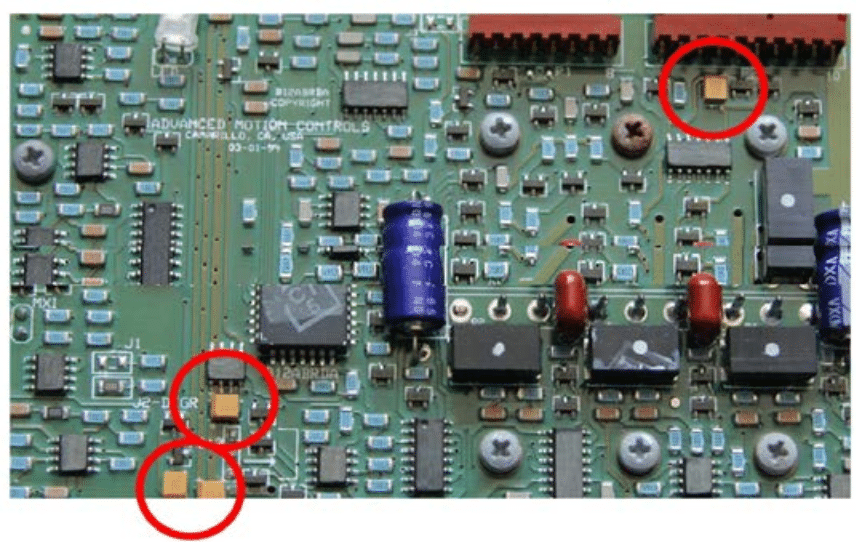
Figure 1: Direction control PCB of brushless motor with tantalum capacitors circled in red. Photo: Advanced Motion Control

Main control processing unit (CPU) board

The main CPU is the ‘brain’ of the system; it requires fast processing with reliable continuous operation. There are multiple input and output circuits, processor coupling and local DC/DC converters that require a long operating life and stable operating conditions. They are supported by tantalum capacitors (see Figure 2).
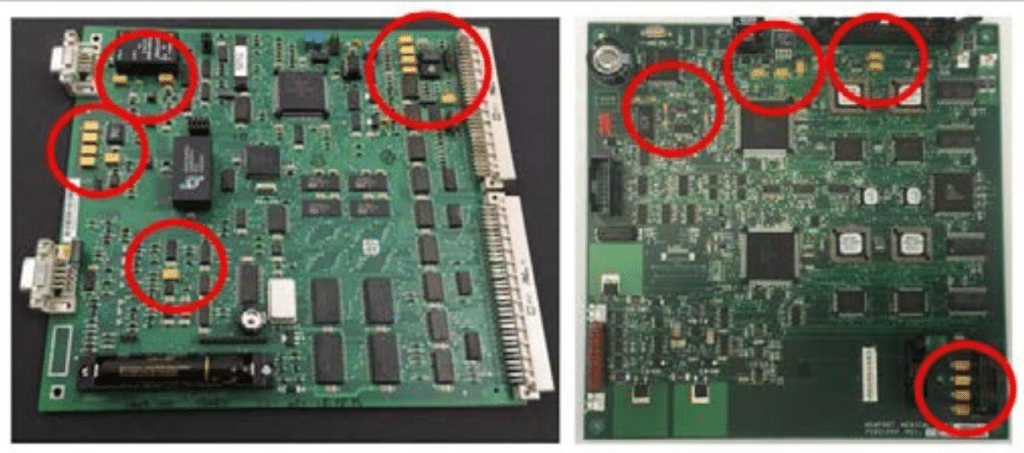
Figure 2: Ventilator main CPU PCBs, showing tantalum capacitors circled in red

High accuracy analogue measurement boards

Control accuracy and the precise response of medical devices also depends on reliable measurement and conversion of AC voltage and current inputs from the patient monitoring sensors. Texas Instruments TI TIDA-01214 is an example of isolated 16-Bit ADC, high-accuracy analog input module with improved trip time performance and reliability suitable for medical applications (see Figure 3). The alarm feature is designed to identify the AC analog input faults on a sample basis for faster fault detection.
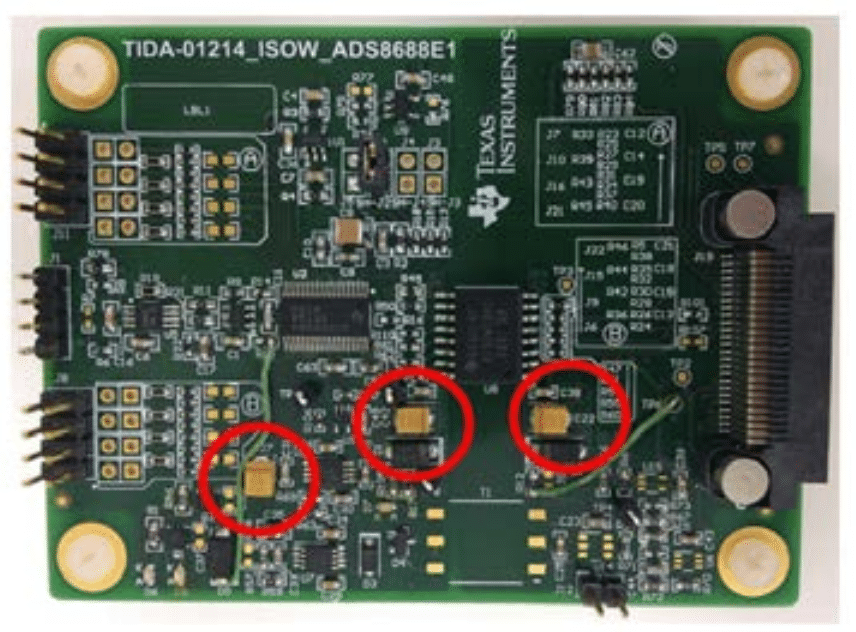
Figure 3: Texas Instruments TI TIDA-01214 ADC converter, with tantalum capacitors circled in red (photo: Texas Instruments)

Main power board and DC/DC Converters

The continuous uninterrupted operation of medical devices depends on the main power supply and the local DC/DC converters to supply a wide range of functionalities. A number of such power supply designs depend, among other components, on the reliability of tantalum capacitors. Figure 4 demonstrates use of tantalum capacitors with DC/DC step down switching regulator LT1374 on a medical board.
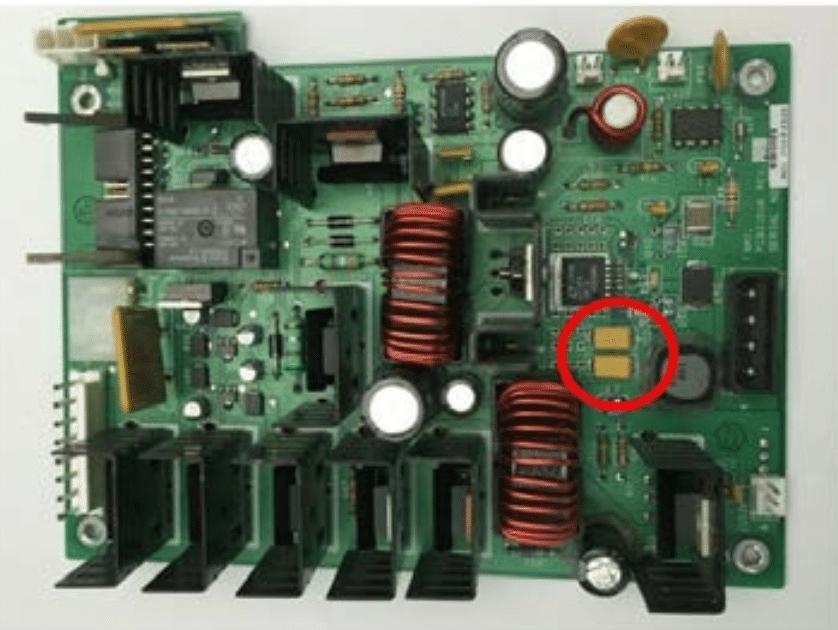
Figure 4: DC/DC power converter for medical application, tantalum capacitors circled in red

Summary and Conclusion

Tantalum capacitors play a critically important role in medical applications, including life support monitoring equipment and lung ventilators. Today, more than ever, tantalum capacitors are vital in the urgent struggle of healthcare institutions and healthcare professionals battling the global Covid-19 pandemic. Tantalum capacitor manufacturers are faced with increased customer demand for critical medical equipment including lung ventilators, mobile X-ray, CT systems, ultrasound and patient monitors. All current efforts are focused on ensuring the delivery of parts as soon as possible, with shortest possible lead-times.

Tantalum capacitor industry and manufacturers responded adequately with priority in manufacturing and delivery to medical industry as an released example by AVX below:

AVX Builds & Delivers Critical Components for the Healthcare Industry

Related

Source: T.I.C. Tantalum-Niobium International Study Center

Recent Posts

Capacitances of Nonlinear MLCCs: What Datasheets Don’t Tell You

14.5.2026
11

How a Digital Structural Twin Can Predict Tantalum Capacitor Reliability

14.5.2026
20

Tapped Inductor Buck Converter Fundamentals

13.5.2026
18

Molecular Memristor Shows Record 145 kH Emergent Inductance

12.5.2026
18

Planar vs Conventional Transformer: When it Make Sense

11.5.2026
45

Researchers Propose Next‑Gen Compact Memory Using Ultra-thin Ferroelectric Capacitors

11.5.2026
32

Nichicon ADN Automotive Hybrid Aluminum Capacitors Now Available in EMEA

11.5.2026
25

Electrocaloric Multilayer Capacitors: Towards Quiet, Solid‑State Cooling Around Room Temperature

7.5.2026
188

KYOCERA 10 µF 0201 MLCC Brings High‑Capacitance into Mobile Designs

6.5.2026
56

Upcoming Events

May 19
16:00 - 17:00 CEST

Designing Qi2 Wireless Power Systems: Practical Development and EMC Optimization

Jun 2
16:00 - 17:00 CEST

Calculation, Simulation and Measurement of 800V EMC Filters

Jun 16
16:00 - 17:00 CEST

EMC with EMC – EMC‑compliant design with electromechanical connectors

View Calendar

Popular Posts

  • Buck Converter Design and Calculation

    0 shares
    Share 0 Tweet 0
  • Boost Converter Design and Calculation

    0 shares
    Share 0 Tweet 0
  • Flyback Converter Design and Calculation

    0 shares
    Share 0 Tweet 0
  • LLC Resonant Converter Design and Calculation

    0 shares
    Share 0 Tweet 0
  • MLCC and Ceramic Capacitors

    0 shares
    Share 0 Tweet 0
  • Dual Active Bridge (DAB) Topology

    0 shares
    Share 0 Tweet 0
  • Capacitor Charging and Discharging

    0 shares
    Share 0 Tweet 0
  • What Electronics Engineer Needs to Know About Passive Low Pass Filters

    0 shares
    Share 0 Tweet 0
  • Ripple Current and its Effects on the Performance of Capacitors

    3 shares
    Share 3 Tweet 0
  • MLCC Case Sizes Standards Explained

    0 shares
    Share 0 Tweet 0

Newsletter Subscription


Passive Components Blog

© EPCI - Leading Passive Components Educational and Information Site

  • Home
  • Privacy Policy
  • EPCI Membership & Advertisement
  • About

No Result
View All Result
  • Home
  • Knowledge Blog
  • PCNS

© EPCI - Leading Passive Components Educational and Information Site

This website uses cookies. By continuing to use this website you are giving consent to cookies being used. Visit our Privacy and Cookie Policy.
Go to mobile version