Click on the Dossier payment button will redirect you to the online payment gateway. After a successful payment, a download link will appear, displaying the PDF report for your download or email transfer. Upon billing details, a PDF invoice will be sent to your email.
Capacitor Technology Annual Dossier
Passive Components Blog has released the 2025 Annual Capacitor Technology Dossier, a 37‑page deep dive into how capacitors moved from low-margin commodity parts to strategic enablers of AI, EV and 5G infrastructure in 2025.
Executive Overview
The passive component industry underwent a fundamental transformation in 2025, as capacitors evolved from standardized commodities into strategic enablers of next-generation infrastructure. This shift was driven by three converging forces: the exponential power demands of artificial intelligence accelerators, the voltage architecture revolution in electric vehicles, and the density requirements of 5G-Advanced networks. Collectively, these applications created a bifurcated market where high-reliability, application-specific capacitors commanded premium pricing and extended lead times, while commodity segments faced oversupply and margin pressure.
The global capacitor market reached USD 41.23 billion in 2025, representing a 5.91% compound annual growth rate that significantly outpaced broader semiconductor segments. This growth was not uniform—strategic segments including high-voltage MLCCs, polymer electrolytics, and DC-link film capacitors grew at 12-17% CAGR, while general-purpose consumer MLCCs stagnated. The divergence reflects a critical industry inflection point: capacitors are no longer passive elements in a bill of materials but active determinants of system performance, thermal management, and reliability in mission-critical applications.
What the dossier covers
Seven structural trends shaping 2025 The report identifies seven forces that redefined the industry, including AI server power architectures, the 800 V EV tipping point, 5G‑Advanced RF front‑ends, regional supply chain reconfiguration, miniaturization limits, intensifying AEC‑Q200 qualification, and new sustainability mandates in the EU.
Hard numbers behind the shift Detailed tables quantify 2025 market size and 2035 projections by technology, from MLCC and high‑voltage MLCC to polymer/hybrid aluminum, DC‑link film, tantalum and supercapacitors. The dossier contrasts differing “total market” definitions among major research houses and shows how that changes the view of opportunity sizing.
AI, EV and other application chapters Application-focused sections dissect capacitor roles in AI data-center PDNs, 800 V EV powertrains and on‑board chargers, and Advanced base stations. Readers see which capacitor types win in each architecture – and why.
Technology landscape & roadmap A full technology map compares MLCC families, polymer and hybrid aluminum, film, tantalum/niobium and supercapacitors across capacitance, voltage, ESR, temperature and volumetric efficiency. A dedicated positioning diagram shows how each technology sits in the voltage–frequency space, from RF matching networks to DC‑link energy storage and grid‑level buffering.
Qualification, compliance and derating The dossier summarizes AEC‑Q200 Revision E implications for automotive capacitors, extended temperature and voltage stress regimes, and the resulting 12–18 month qualification cycles. It also covers updated RoHS/REACH and Digital Product Passport requirements, and provides concrete lead‑free derating guidelines that cut field failure rates for X7R, X5R and Y5V ceramics by ~86–94%.
Who should read it
This dossier is written for:
Component manufacturers and distributors refining 2026–2030 product roadmaps for MLCC, polymer/hybrid aluminum, film and supercapacitors.
OEM and Tier‑1 engineering teams designing AI servers, EV powertrains, OBC/BMS, industrial drives, solar inverters and other applications who need a consolidated view of capacitor options and trade‑offs.
Sourcing, category and product managers responsible for mitigating lead‑time and qualification risk in strategic capacitor categories.
Why it is different from generic market reports
Unlike broad passive-component reports that focus on high-level market sizing, the 2025 Annual Capacitor Technology Dossier combines:
Quantitative market and CAGR data across all major capacitor technologies.
Application engineering guidance for AI, EV, 5G and grid-tied systems, including real power-rail and derating examples.
The result is a compact, high‑density reference that can be read in an afternoon and used throughout the year for strategy, design and sourcing decisions.
69 pages, 15 tables, 7 charts
Issued: Mar 2026
Click on the Dossier payment button will redirect you to the online payment gateway. After a successful payment, a download link will appear, displaying the PDF report for your download or email transfer. Upon billing details, a PDF invoice will be sent to your email.
Resistor Technology Annual Dossier
Passive Components Blog has released the 2026 Annual Resistor Dossier, a 69‑page deep dive into how resistors moved from low‑margin commodity parts to strategic enablers of AI, EV and 5G infrastructure in 2025–2026.
Executive Overview
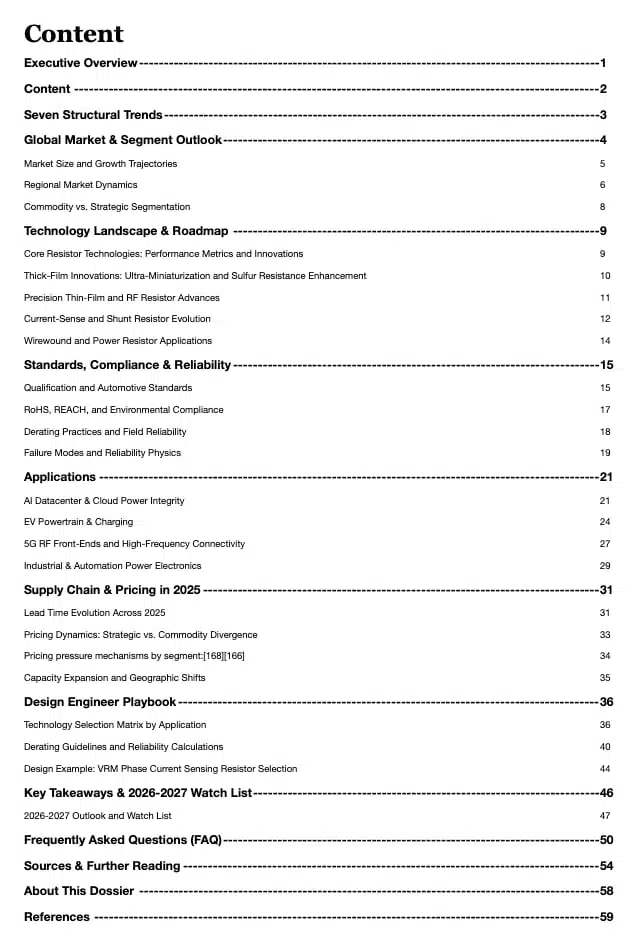
The resistor industry experienced a pivotal transformation in 2025, evolving from a predominantly commodity-driven sector into a strategic technology landscape where high-precision, current-sensing, and high-reliability resistors became critical enablers of AI infrastructure, electric vehicle powertrains, and 5G connectivity. This shift was driven by three converging forces: the exponential current-sensing demands of artificial intelligence accelerators and datacenter power distribution, the voltage architecture revolution in electric vehicles requiring precision shunt resistors for battery management and traction control, and the frequency stability requirements of 5G-Advanced RF front-ends. Collectively, these applications created a bifurcated market where application-specific, high-accuracy resistors commanded premium pricing and extended lead times, while general-purpose thick-film segments faced margin pressure from Asian oversupply.
The global resistor market reached USD 10.82 billion in 2025, representing a 4.2% compound annual growth rate that lagged broader passive component growth but masked dramatic segment divergence. This growth was highly non-uniform—strategic segments including current-sense/shunt resistors, precision thin-film, and automotive-qualified thick-film resistors grew at 8-14% CAGR, while commodity general-purpose chip resistors stagnated or declined in value despite volume growth. The divergence reflects a critical industry inflection point: resistors are no longer passive price-driven commodities but active determinants of system accuracy, power efficiency, and functional safety in mission-critical applications.
What the dossier covers
Seven structural trends shaping 2025 From AI datacenter current‑sensing dominance and the 800 V EV tipping point to 5G‑Advanced RF front‑ends, regional supply chain reconfiguration, miniaturization limits, intensifying AEC‑Q200 regimes and sulfur‑resistance requirements.
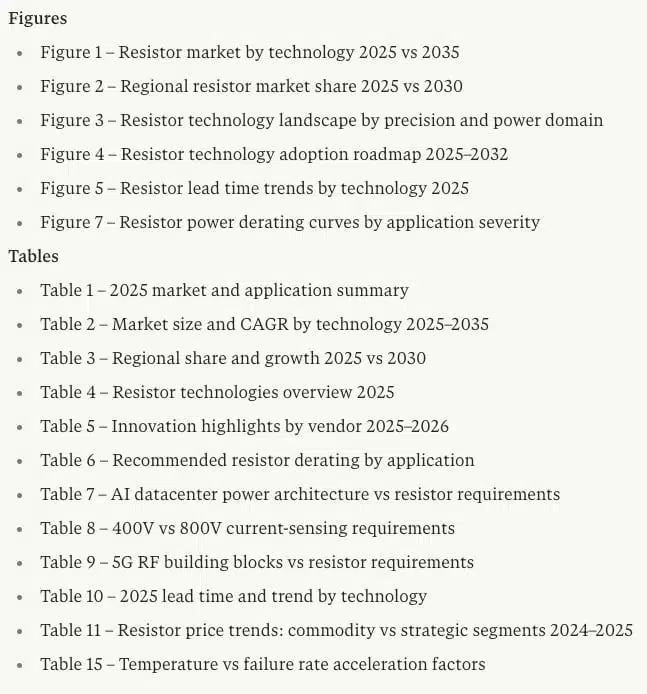
Hard numbers behind the shift Detailed tables quantify 2025 market size and 2035 projections by technology, including general thick‑film, current‑sense/shunt, precision thin‑film, automotive‑qualified thick‑film, wirewound/power and networks/arrays, highlighting the value shift toward strategic segments.
AI, EV and other application chapters Application‑focused sections dissect resistor roles in AI server PDNs, 800 V EV traction inverters and BMS/OBC, 5G RF front‑ends, industrial drives, solar inverters and DC fast‑charging, with concrete current‑sensing and derating examples.
Technology landscape & roadmap A full technology map compares thick‑film, thin‑film, current‑sense shunts, wirewound and legacy metal‑film across resistance range, power rating, TCR, temperature and volumetric efficiency, plus a roadmap of adoption for currentsense, thin‑film RF, automotive thick‑film and other key platforms through 2032.
Qualification, compliance and reliability The dossier summarizes AEC‑Q200 Rev. E implications for resistors, extended temperature and overload stress regimes, RoHS/REACH and sulfur‑resistance requirements, and provides practical derating tables and failure‑mode analysis for long‑life automotive, industrial and datacenter designs.
Who should read it
Component manufacturers and distributors Planning 2026–2030 roadmaps for thick‑film, thin‑film, current‑sense shunts and wirewound/power resistors.
OEM and Tier‑1 engineering teams Designing AI servers, EV powertrains and charging, industrial automation, renewables and 5G RF systems who need a consolidated view of resistor options, limits and trade‑offs.
Sourcing, category and product managers Managing lead‑time, qualification and single‑source risk in strategic resistor categories across automotive, datacenter and industrial programs.
Why it stands apart
Unlike generic resistor reports that stop at high‑level market sizing, the 2026 Annual Resistor Dossier combines:
Quantitative market and CAGR data across all major resistor technologies.
Application engineering guidance for AI, EV, 5G, industrial and grid‑tied systems, including real current‑sense design, derating and reliability examples.
The result is a compact, high‑density reference that can be read in an afternoon and used all year for strategy, design and sourcing decisions.
28 pages, 9 tables, 8 charts
Issued: Mar 2026
Click on the Dossier payment button will redirect you to the online payment gateway. After a successful payment, a download link will appear, displaying the PDF report for your download or email transfer. Upon billing details, a PDF invoice will be sent to your email.
Inductor Technology Annual Dossier
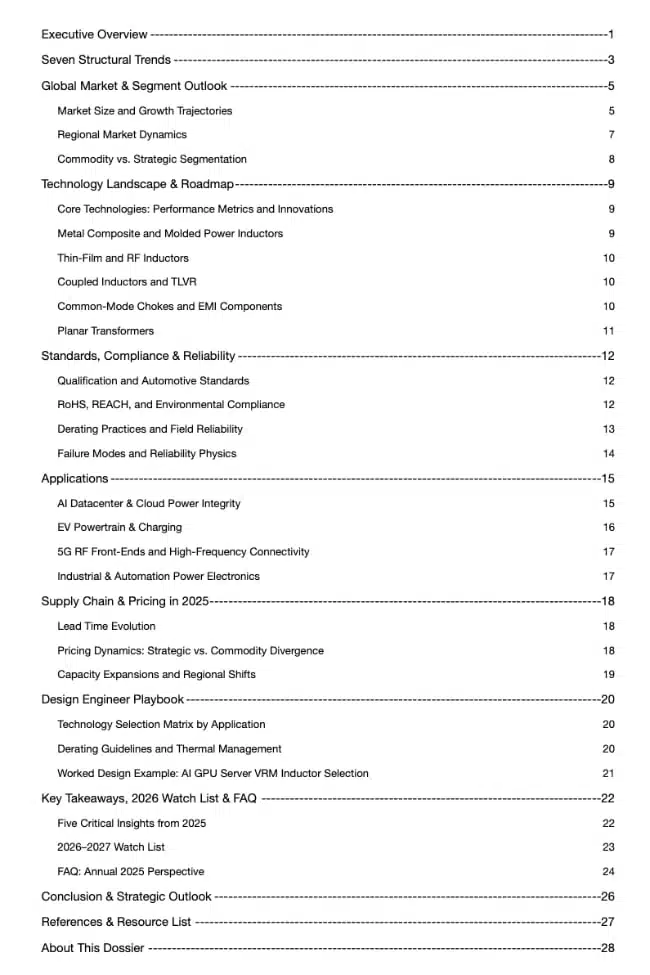
Passive Components Blog has released the 2026 Annual Inductor, Transformer & Magnetics Technology Dossier, a 28‑page comprehensive analysis of how inductors and transformers evolved from commodity supply‑chain components to strategic enablers of AI infrastructure, electric vehicle powertrains, and 5G connectivity in 2025.
Executive Overview
The inductor, transformer, and magnetics industry underwent a pivotal transformation in 2025, evolving from a supply-chain-constrained, commodity-dominated sector into a strategic technology landscape where high-current power inductors, coupled TLVR magnetics, and high-frequency planar transformers became critical enablers of AI infrastructure, electric vehicle powertrains, and 5G-Advanced connectivity. This shift was driven by three converging forces: the exponential power delivery demands of artificial intelligence accelerators requiring 180–250 inductors per 8-GPU server with sub-milliohm DCR and saturation currents exceeding 90 A per phase; the voltage architecture revolution in electric vehicles demanding 150–300 magnetic components per vehicle for 800V on-board chargers, DC-DC converters, and EMI filtering; and the frequency density requirements of 5G-Advanced massive MIMO arrays consuming 200–400 inductors per macro base station. Collectively, these applications created a bifurcated market where application-specific, high-performance magnetics commanded premium pricing and extended lead times, while general-purpose chip inductors faced margin pressure from Asian oversupply.
The global inductor market reached an estimated USD 11.28 billion in 2025, representing a 4.23% compound annual growth rate, while the broader transformer market exceeded USD 64–71 billion driven by grid modernization and data center power infrastructure. Growth was highly non-uniform: strategic segments including coupled TLVR inductors for AI servers, automotive-qualified power inductors, and thin-film RF inductors grew at 8–15% CAGR, while commodity multilayer chip inductors stagnated at 3–4%. The divergence reflects a critical industry inflection point: inductors and transformers are no longer passive cost-driven commodities but active determinants of power conversion efficiency, electromagnetic compatibility, and thermal management in mission-critical applications.
What the dossier covers
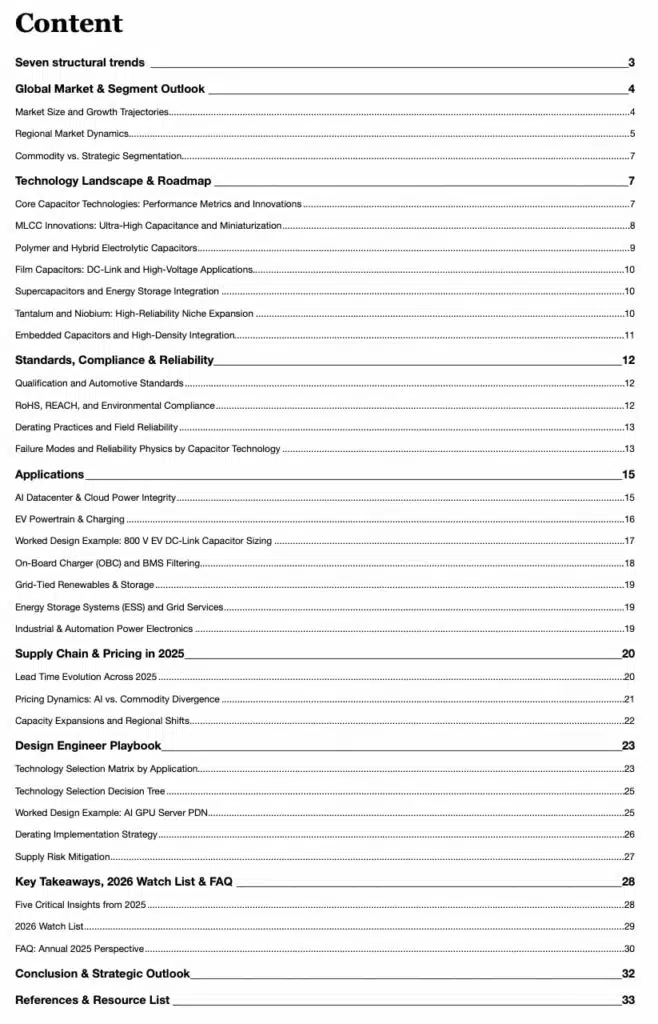
Content
Seven structural trends shaping 2025 From AI datacenter power delivery dominance and the 800V EV architecture tipping point to 5G‑Advanced RF front‑end proliferation, GaN/SiC high‑frequency switching revolution, regional supply chain reconfiguration, materials innovation (nanocrystalline and metal composite cores), and integrated power modules with embedded magnetics.
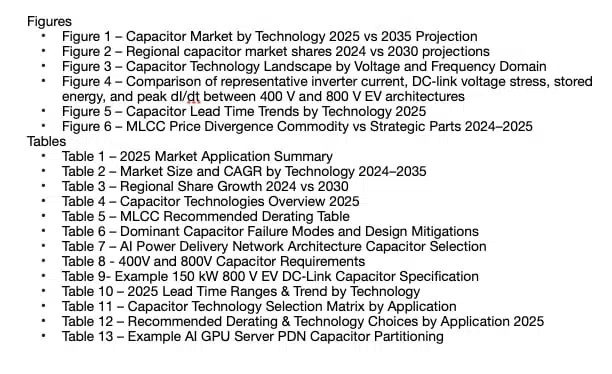
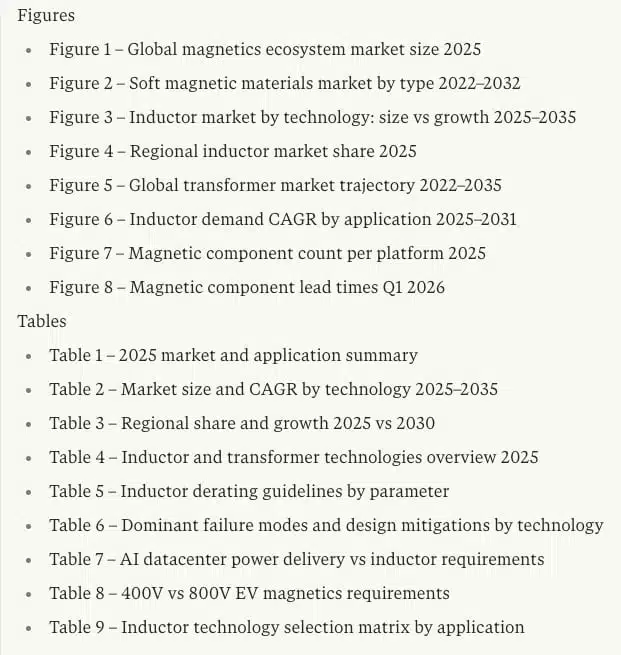
Hard numbers behind the shift Detailed tables quantify 2025 market size and 2035 projections by technology, including multilayer chip inductors, power inductors (molded/composite), thin‑film RF inductors, coupled/TLVR inductors, common‑mode chokes, planar transformers, and ferrite beads, revealing the dramatic value shift toward strategic segments.
AI, EV and other application chapters Application‑focused sections dissect magnetic component roles in AI datacenter power integrity and TLVR VRMs, 800V EV powertrains, OBC and charging, 5G RF front‑ends and massive MIMO, and industrial automation, with concrete design examples including a worked AI GPU server VRM inductor selection.
Technology landscape & roadmap A comprehensive technology map compares multilayer chip, wire‑wound chip, thin‑film RF, molded power, coupled/TLVR, common‑mode chokes, planar transformers, and ferrite beads across inductance range, current capability, DCR, frequency range, temperature ratings and primary applications, plus adoption roadmap through 2031.
Qualification, compliance and reliability The dossier summarizes AEC‑Q200 Rev. E implications for automotive magnetics, insulation and voltage surge requirements, RoHS/REACH and Digital Product Passport mandates, and provides practical derating guidelines, thermal management strategies, and failure‑mode analysis for long‑life automotive, datacenter and industrial designs.
Who should read it
Component manufacturers and distributors Planning 2026–2030 roadmaps for power inductors, TLVR coupled magnetics, thin‑film RF inductors, planar transformers and automotive‑qualified magnetic components.
OEM and Tier‑1 engineering teams Designing AI servers, EV powertrains and charging infrastructure, 5G base stations, industrial motor drives and renewable energy systems who need a consolidated view of inductor and transformer technologies, specifications and trade‑offs.
Sourcing, category and product managers Managing lead‑time risk, qualification challenges, and strategic allocation in TLVR coupled inductors and automotive‑grade magnetics.
Why it stands apart
Unlike generic inductor reports that stop at high‑level market sizing, the 2026 Annual Inductor, Transformer & Magnetics Technology Dossier combines:
Quantitative market and CAGR data across all major inductor and transformer technologies with regional dynamics and commodity vs. strategic segmentation analysis.
Detailed technology benchmarking (saturation current, DCR, frequency capability, temperature ratings, core materials, volumetric efficiency).
Application engineering guidance for AI datacenters, EV powertrains, 5G infrastructure, and industrial systems, including real TLVR design examples, derating calculations, and thermal management best practices.
Supply chain intelligence covering lead times, pricing dynamics (strategic vs. commodity divergence), capacity expansions, and regional shifts affecting availability and costs.
The result is a compact, high‑density reference that can be read in an afternoon and used all year for strategy, design and sourcing decisions.
under preparation.
Scheduled: April 2026
under preparation.
Scheduled: May 2026
under preparation.
Scheduled: June 2026
under preparation.
Scheduled: June 2026
ABOUT DOSSIERS
Introduced in January 2026, requested by readers, Passive Components Blog offers a structured view of the passive component world built around two complementary publication types: an Annual Technical Dossier and Quarterly Capacitor Industry Dossiers.
Annual Technical Dossier
The Annual Technical Dossier is an in-depth, year-in-review intelligence publication that focuses on a specific passive component type as strategic enablers, rather than mere commodities. It compiles comprehensive market data, vendor roadmaps, standards updates, and application case studies into a single technical reference for the year and beyond.
Scope: 30–70 pages covering global market outlook, technology roadmap (component device types), standards and compliance, key applications (EV, AI datacenters, grid, industrial etc.), and supply‑chain evolution.
Purpose: Long‑horizon planning for engineering, sourcing, and product strategy teams; a baseline that quarterly updates can reference instead of repeating
Positioning: A curated “yearbook” for the component technology and markets, built on the most relevant market studies and vendor publication.
Quarterly Component Dossiers
The Quarterly Component Dossiers are lighter, operational updates that track how conditions change from one quarter to the next.
Scope: 20–30 pages per quarter, focused on “what changed” versus the annual baseline:
Lead‑time and availability shifts by component family.
New product releases and platform updates from major vendors.
Short‑term market signals from distributors and component market trackers.
Quarterly application deep dives aligned with current hot topics.
Purpose: Give design and sourcing teams timely guidance on risk, substitution options, and pricing/availability without re‑reading a full annual report every time.
Link to Annual Dossier: Each quarterly issue explicitly references the latest Annual Dossier for background charts and long‑term forecasts, and concentrates on deltas in numbers, standards notes, and design implications.
How the Two Fit Together
This two‑tier model mirrors how professional market intelligence is consumed in electronics: an annual deep reference plus more frequent tactical updates.
The Annual Dossier answers:
“Where is the passive component device industry heading over the next 5–10 years?”
“Which technologies and applications define the strategic roadmap at present stage?”
The Quarterly Dossiers answer:
“What has changed in lead times, pricing, and key launches since last quarter?”
“How should current designs adapt to this quarter’s risks and opportunities?”
Together, they turn Passive Components Blog’s research into a consistent technical dossier series that supports day‑to‑day design decisions and multi‑year component strategy on the same platform.
Dossiers vs Market Reports
Passive Components Blog Technical Dossiers go beyond classic market reports by combining real market data with engineering‑grade guidance that design and sourcing teams can use immediately in their projects. Focused, shorter dossiers deliver the signal without the noise, which is exactly what busy engineers and sourcing teams need. Concise dossiers filter and prioritize only the most relevant trends, lead‑time signals, and design implications, improving clarity, saving time, and reducing errors in interpretation. For B2B buyers and technical stakeholders, shorter, research‑based formats are also more attractive to read, share, and act on than bulky reports, aligning with broader evidence that decision‑makers increasingly prefer concise, high‑value content over exhaustive documents.
While traditional reports focus on high‑level metrics such as market size, CAGR, and vendor rankings for investors and management, our Annual Deep Dossier and Quarterly Dossiers integrate those numbers with technology comparisons, standards and reliability guidance, application, market intelligence, and practical checklists tailored to the application requirements. This hybrid of market intelligence and design‑centric content makes the dossiers a continuous, engineer‑friendly decision tool rather than just a one‑off PowerPoint for strategic planning.