


Passive Components Blog
No Result
View All Result
  • Home
  • NewsFilter
    • All
    • Aerospace & Defence
    • Antenna
    • Applications
    • Automotive
    • Capacitors
    • Circuit Protection Devices
    • electro-mechanical news
    • Filters
    • Fuses
    • Inductors
    • Industrial
    • Integrated Passives
    • inter-connect news
    • Market & Supply Chain
    • Market Insights
    • Medical
    • Modelling and Simulation
    • New Materials & Supply
    • New Technologies
    • Non-linear Passives
    • Oscillators
    • Passive Sensors News
    • Resistors
    • RF & Microwave
    • Telecommunication
    • Weekly Digest

    Wk 28 Electronics Supply Chain Digest

    Bourns Introduces Automotive BMS Signal Transformer with Integrated Common Mode Chokes

    Itelcond Introduces High‑Voltage Aluminium Capacitors for Modern IGBT DC‑links

    Bourns Introduces Automotive Shielded Power Inductors for Compact DC‑DC Converters

    EMC Design Fundamentals: Safe Use of Varistors and Common Mode Chokes in Mains and Data-Line Filters

    Murata Unveils Lead Disc Ceramic Capacitors for Automotive Safety and EMI Suppression

    SCHURTER Releases Intelligent Three‑Terminal Fuses for Safer Li‑ion Battery Systems

    Can Copper Conductive Inks Displace Silver in Hybrid Electronics?

    Square-Wave Harmonics and RMS Currents in Power Converters

    Trending Tags

    • Ripple Current
    • RF
    • Leakage Current
    • Tantalum vs Ceramic
    • Snubber
    • Low ESR
    • Feedthrough
    • Derating
    • Dielectric Constant
    • New Products
    • Market Reports
  • VideoFilter
    • All
    • Antenna videos
    • Capacitor videos
    • Circuit Protection Video
    • Filter videos
    • Fuse videos
    • Inductor videos
    • Inter-Connect Video
    • Non-linear passives videos
    • Oscillator videos
    • Passive sensors videos
    • Resistor videos

    EMC Design Fundamentals: Safe Use of Varistors and Common Mode Chokes in Mains and Data-Line Filters

    Ferrite versus Nanocrystalline Power Inductor Cores: Turns, Gap and Size

    KYOCERA AVX Presents Antenna Integrator Studio Tutorial for Antenna Placement and RF Design

    Power Design Simulation Tools for Faster Inductor Selection and Loss Optimization

    EMC‑Compliant PCB and Connector Design Guidelines

    Why Isolated DC/DC Power Supplies Fail Late, Würth Elektronik Podcast

    Designing 800 V DC EMC Filters: Calculation, Simulation and Measurement

    Current Sense Transformer Datasheet and Design‑in Guide

    Designing a USB Type‑C Flyback Planar Transformer with Frenetic’s Planar Tool

    Trending Tags

    • Capacitors explained
    • Inductors explained
    • Resistors explained
    • Filters explained
    • Application Video Guidelines
    • EMC
    • New Products
    • Ripple Current
    • Simulation
    • Tantalum vs Ceramic
  • Knowledge Blog
  • Dossiers
    • AI Hardware Dossier
    • Power Converter Dossier
    • Automotive Dossier
    • Capacitor Dossier
    • Resistor Dossier
    • Inductor Dossier
    • Circuit Protection Dossier
  • Suppliers
    • Who is Who
  • PCNS
    • PCNS 2025
    • PCNS 2023
    • PCNS 2021
    • PCNS 2019
    • PCNS 2017
  • Events
  • Home
  • NewsFilter
    • All
    • Aerospace & Defence
    • Antenna
    • Applications
    • Automotive
    • Capacitors
    • Circuit Protection Devices
    • electro-mechanical news
    • Filters
    • Fuses
    • Inductors
    • Industrial
    • Integrated Passives
    • inter-connect news
    • Market & Supply Chain
    • Market Insights
    • Medical
    • Modelling and Simulation
    • New Materials & Supply
    • New Technologies
    • Non-linear Passives
    • Oscillators
    • Passive Sensors News
    • Resistors
    • RF & Microwave
    • Telecommunication
    • Weekly Digest

    Wk 28 Electronics Supply Chain Digest

    Bourns Introduces Automotive BMS Signal Transformer with Integrated Common Mode Chokes

    Itelcond Introduces High‑Voltage Aluminium Capacitors for Modern IGBT DC‑links

    Bourns Introduces Automotive Shielded Power Inductors for Compact DC‑DC Converters

    EMC Design Fundamentals: Safe Use of Varistors and Common Mode Chokes in Mains and Data-Line Filters

    Murata Unveils Lead Disc Ceramic Capacitors for Automotive Safety and EMI Suppression

    SCHURTER Releases Intelligent Three‑Terminal Fuses for Safer Li‑ion Battery Systems

    Can Copper Conductive Inks Displace Silver in Hybrid Electronics?

    Square-Wave Harmonics and RMS Currents in Power Converters

    Trending Tags

    • Ripple Current
    • RF
    • Leakage Current
    • Tantalum vs Ceramic
    • Snubber
    • Low ESR
    • Feedthrough
    • Derating
    • Dielectric Constant
    • New Products
    • Market Reports
  • VideoFilter
    • All
    • Antenna videos
    • Capacitor videos
    • Circuit Protection Video
    • Filter videos
    • Fuse videos
    • Inductor videos
    • Inter-Connect Video
    • Non-linear passives videos
    • Oscillator videos
    • Passive sensors videos
    • Resistor videos

    EMC Design Fundamentals: Safe Use of Varistors and Common Mode Chokes in Mains and Data-Line Filters

    Ferrite versus Nanocrystalline Power Inductor Cores: Turns, Gap and Size

    KYOCERA AVX Presents Antenna Integrator Studio Tutorial for Antenna Placement and RF Design

    Power Design Simulation Tools for Faster Inductor Selection and Loss Optimization

    EMC‑Compliant PCB and Connector Design Guidelines

    Why Isolated DC/DC Power Supplies Fail Late, Würth Elektronik Podcast

    Designing 800 V DC EMC Filters: Calculation, Simulation and Measurement

    Current Sense Transformer Datasheet and Design‑in Guide

    Designing a USB Type‑C Flyback Planar Transformer with Frenetic’s Planar Tool

    Trending Tags

    • Capacitors explained
    • Inductors explained
    • Resistors explained
    • Filters explained
    • Application Video Guidelines
    • EMC
    • New Products
    • Ripple Current
    • Simulation
    • Tantalum vs Ceramic
  • Knowledge Blog
  • Dossiers
    • AI Hardware Dossier
    • Power Converter Dossier
    • Automotive Dossier
    • Capacitor Dossier
    • Resistor Dossier
    • Inductor Dossier
    • Circuit Protection Dossier
  • Suppliers
    • Who is Who
  • PCNS
    • PCNS 2025
    • PCNS 2023
    • PCNS 2021
    • PCNS 2019
    • PCNS 2017
  • Events
No Result
View All Result
Passive Components Blog
No Result
View All Result

Exxelia Releases Updated Microwave Materials and Frequency Tuning Catalogues

8.4.2026
Reading Time: 5 mins read
A A

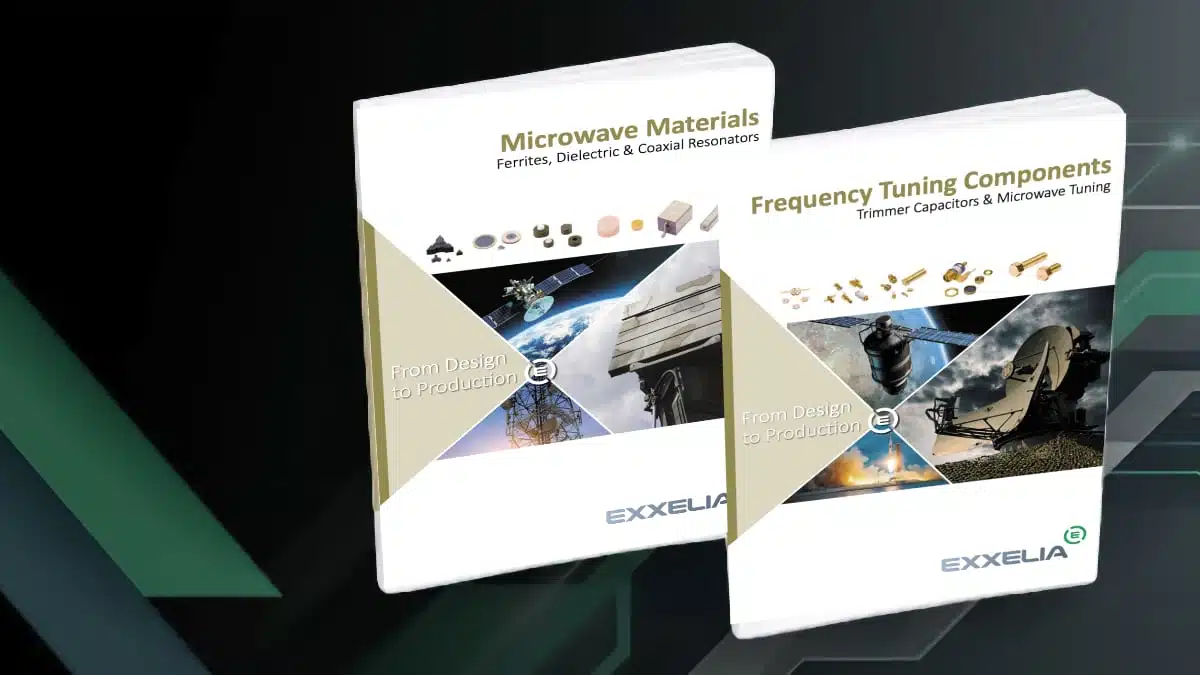
Exxelia has released two updated catalogues dedicated to RF and microwave design, covering microwave materials and frequency tuning components for applications up to the millimeter‑wave range.

The new Exxelia documents consolidate ferrite core materials, dielectric and coaxial resonators, and tuning elements into a single reference set aimed at designers of high‑performance filters, oscillators and non‑reciprocal devices in radar, satcom, telecom and defense.

RelatedPosts

HEICO’s Exxelia Expands High-Voltage Ceramic Capacitor Portfolio with CalRamic Acquisition

Exxelia Extends Temperature Range of its PP Film Capacitors to 140C

Exxelia Introduces SMD High‑Voltage Mica Capacitors

Two Complementary Catalogues for RF and Microwave Designers

Microwave Materials: From Ferrites to Resonators

The first catalogue focuses on microwave materials such as ferrite formulations and dielectric and coaxial resonators used in resonant structures and non‑reciprocal components. It provides a structured overview of material families, electrical parameters and typical application frequency bands, making it easier to align material selection with filter, oscillator or circulator requirements.

The second catalogue is dedicated to frequency tuning components including mechanical tuning screws, plungers and related hardware for cavity and dielectric‑based microwave assemblies. It details geometries, dimensions and mounting options so designers can integrate tuning features at the mechanical design stage rather than as a late correction step during RF validation.

High‑Permittivity EPSILON 21 Ferrite for Miniaturized Microwave Devices

A key highlight of the updated documentation is the inclusion of the EPSILON 21 high‑permittivity ferrite material. This ferrite, also known through the YK21 and DK21 product families, offers a relative permittivity of approximately 21 and is designed to support the miniaturization of microwave devices such as circulators, isolators and ferrite‑dielectric assemblies used in active antenna RF systems.

EPSILON 21 is intended for applications up to at least the X‑band, making it attractive for AESA radar front‑ends and compact satcom platforms where board space and volume are at a premium. The combination of high permittivity with tailored magnetic properties allows designers to reduce device footprint while maintaining the necessary power handling and stability required by mission‑critical systems.

Expanded Dielectric and Coaxial Resonator Offering

In addition to ferrite materials, the catalogues bring together a wide range of dielectric and coaxial resonators engineered for high Q factor, temperature stability and narrow bandwidths in the multi‑GHz range. These resonators are offered in different permittivity classes and form factors, enabling designers to choose between maximum miniaturization, lowest loss or best temperature coefficient depending on system requirements.

Typical use cases include replacement of bulky resonant cavities in filters and oscillators, as well as the implementation of compact frequency‑determining elements in low‑phase‑noise oscillators and channel‑selective filters. The unified documentation helps compare material families and size options across series, which is especially useful when migrating existing designs to smaller footprints or higher operating frequencies.

Microwave Materials – Ferrites, Dielectric & Coaxial Resonators

Frequency Tuning Components: Precision Adjustment at Microwave Frequencies

The frequency tuning catalogue covers a portfolio of tuning screws, plungers and related mechanical components used to adjust resonance in cavity filters, dielectric resonators and other RF structures. These elements are available in various thread types, diameters and lengths, including self‑locking and fine‑pitch options intended to improve long‑term stability under vibration and thermal cycling.

By documenting the tuning elements alongside the relevant material families, Exxelia supports a more holistic approach to RF design where electrical performance, mechanical constraints and environmental robustness are considered together. This allows engineers to plan tuning ranges, accessibility and reliability from the beginning of the mechanical layout.

Frequency Tuning Components – Trimmer Capacitors & Microwave Tuning

Design and Supply‑Chain Benefits for Microwave Applications

Bringing ferrites, dielectric and coaxial resonators, and tuning elements into two coordinated catalogues offers clear benefits to RF and microwave design teams. A unified material and component view simplifies technology selection across multiple building blocks, while consistent data formats support faster comparison and parametric selection during the early concept phase.

For procurement and industrialization teams, the catalogues also provide a clearer map of standard product families and material platforms, supporting qualification strategies and second‑source planning. This is particularly relevant in markets such as aerospace, defense and telecom infrastructure, where long‑term availability and obsolescence management are critical alongside pure RF performance.

Source

This article is based on information provided by Exxelia in its official press release and related public product information about microwave materials, EPSILON 21 ferrite, dielectric and coaxial resonators, and frequency tuning components.


References

  1. Exxelia – Exxelia Releases Two New Catalogues for Microwave Materials and Frequency Tuning
  2. Exxelia – Materials & Tuning Components Overview
  3. Exxelia – YK21 / DK21 High Permittivity (Eps 21) Ferrite
  4. Exxelia – Microwave Components Catalogue (Ferrites, Dielectric & Coaxial Resonators, Tuning Elements)

Related

Recent Posts

RF Filters and Passive Components Enabling the 7 Missile RF Subsystems

9.7.2026
60

Vishay Unveils Multi-Turn Position Sensor for Harsh Industrial Environments

7.7.2026
36

High-Q RF & Microwave MLCCs: A Cross-Vendor Benchmark

2.7.2026
106

YAGEO Announces July 2026 Capacitor Price Increase

1.7.2026
925

KYOCERA AVX Releases NTN Antenna Selection Guide Brochure

25.6.2026
53

Coilcraft Releases 0402 Ferrite-Core Wirewound Chip Inductors for RF and EMI Control

25.6.2026
47

Hall-Effect Sensing for Harsh Environments: TT Electronics Selected in NASA’s Dragonfly Fan

22.6.2026
69

Stackpole Releases High-Frequency Thin Film Chip Resistors for RF up to 50 GHz

19.6.2026
58

Knowles Expands High‑Q Ceramic Core Inductors for RF designs

19.6.2026
47

Upcoming Events

Jul 21
16:00 - 17:00 CEST

Safety by design: X and Y Interference suppression capacitors for power line filters

Jul 28
8:00 - 11:00 CEST

Post Procurement Testing of EEE Components for LEO Space Applications

Jul 29
17:30 - 18:30 CEST

To Ferrite or to Nanocrystalline in Transformer Design

View Calendar

Popular Posts

  • Boost Converter Design and Calculation

    0 shares
    Share 0 Tweet 0
  • Buck Converter Design and Calculation

    0 shares
    Share 0 Tweet 0
  • YAGEO Announces July 2026 Capacitor Price Increase

    0 shares
    Share 0 Tweet 0
  • Flyback Converter Design and Calculation

    0 shares
    Share 0 Tweet 0
  • LLC Resonant Converter Design and Calculation

    0 shares
    Share 0 Tweet 0
  • MLCC and Ceramic Capacitors

    0 shares
    Share 0 Tweet 0
  • Earthing Systems and IEC Classification Explained

    0 shares
    Share 0 Tweet 0
  • MLCCs in the Age of AI: Q2 2026 Market Tightness

    0 shares
    Share 0 Tweet 0
  • Nvidia Vera Rubin: Why One AI Rack Needs So Many More MLCC Capacitors

    0 shares
    Share 0 Tweet 0
  • Dual Active Bridge (DAB) Topology

    0 shares
    Share 0 Tweet 0

Newsletter Subscription


Passive Components Blog

© EPCI - Leading Passive Components Educational and Information Site

  • Home
  • Privacy Policy
  • EPCI Membership & Advertisement
  • About

No Result
View All Result
  • Home
  • Knowledge Blog
  • Dossiers
  • PCNS

© EPCI - Leading Passive Components Educational and Information Site

This website uses cookies. By continuing to use this website you are giving consent to cookies being used. Visit our Privacy and Cookie Policy.
Go to mobile version