

















Passive Components Blog
No Result
View All Result
  • Home
  • NewsFilter
    • All
    • Aerospace & Defence
    • Antenna
    • Applications
    • Automotive
    • Capacitors
    • Circuit Protection Devices
    • electro-mechanical news
    • Filters
    • Fuses
    • Inductors
    • Industrial
    • Integrated Passives
    • inter-connect news
    • Market & Supply Chain
    • Market Insights
    • Medical
    • Modelling and Simulation
    • New Materials & Supply
    • New Technologies
    • Non-linear Passives
    • Oscillators
    • Passive Sensors News
    • Resistors
    • RF & Microwave
    • Telecommunication
    • Weekly Digest

    Binder Extends NCC Circular Connectors for Harsh Environments

    Standard vs Planar LLC transformers Comparison for Battery Chargers

    Würth Elektronik and Grinn Launch Edge AI Cooperation

    Bourns Expanded Semi-Shielded Low Profile Automotive Power Inductor

    Peak Nano to Develop Fusion Grade High Energy Film Capacitors

    Murata New Vibration Sensor Targets High‑Frequency Predictive Maintenance

    Kyocera Releases 30fs Jitter Differential Clock Oscillator

    Panasonic Expands Automotive PP Film Capacitors Voltage Range

    Panasonic Extends Automotive Power Inductor Line

    Trending Tags

    • Ripple Current
    • RF
    • Leakage Current
    • Tantalum vs Ceramic
    • Snubber
    • Low ESR
    • Feedthrough
    • Derating
    • Dielectric Constant
    • New Products
    • Market Reports
  • VideoFilter
    • All
    • Antenna videos
    • Capacitor videos
    • Circuit Protection Video
    • Filter videos
    • Fuse videos
    • Inductor videos
    • Inter-Connect Video
    • Non-linear passives videos
    • Oscillator videos
    • Passive sensors videos
    • Resistor videos

    Standard vs Planar LLC transformers Comparison for Battery Chargers

    How Modern Tools Model Magnetic Components for Power Electronics

    Advanced Loss Modeling for Planar Magnetics in the Frenetic Planar Tool

    2026 Power Magnetics Design Trends: Flyback, DAB and Planar

    Enabling Software‑Defined Vehicle Architectures: Automotive Ethernet and Zonal Smart Power

    Calculating Resistance Value of a Flyback RC Snubber 

    One‑Pulse Characterization of Nonlinear Power Inductors

    Thermistor Linearization Challenges

    Coaxial Connectors and How to Connect with PCB

    Trending Tags

    • Capacitors explained
    • Inductors explained
    • Resistors explained
    • Filters explained
    • Application Video Guidelines
    • EMC
    • New Products
    • Ripple Current
    • Simulation
    • Tantalum vs Ceramic
  • Knowledge Blog
  • DossiersNew
  • Suppliers
    • Who is Who
  • PCNS
    • PCNS 2025
    • PCNS 2023
    • PCNS 2021
    • PCNS 2019
    • PCNS 2017
  • Events
  • Home
  • NewsFilter
    • All
    • Aerospace & Defence
    • Antenna
    • Applications
    • Automotive
    • Capacitors
    • Circuit Protection Devices
    • electro-mechanical news
    • Filters
    • Fuses
    • Inductors
    • Industrial
    • Integrated Passives
    • inter-connect news
    • Market & Supply Chain
    • Market Insights
    • Medical
    • Modelling and Simulation
    • New Materials & Supply
    • New Technologies
    • Non-linear Passives
    • Oscillators
    • Passive Sensors News
    • Resistors
    • RF & Microwave
    • Telecommunication
    • Weekly Digest

    Binder Extends NCC Circular Connectors for Harsh Environments

    Standard vs Planar LLC transformers Comparison for Battery Chargers

    Würth Elektronik and Grinn Launch Edge AI Cooperation

    Bourns Expanded Semi-Shielded Low Profile Automotive Power Inductor

    Peak Nano to Develop Fusion Grade High Energy Film Capacitors

    Murata New Vibration Sensor Targets High‑Frequency Predictive Maintenance

    Kyocera Releases 30fs Jitter Differential Clock Oscillator

    Panasonic Expands Automotive PP Film Capacitors Voltage Range

    Panasonic Extends Automotive Power Inductor Line

    Trending Tags

    • Ripple Current
    • RF
    • Leakage Current
    • Tantalum vs Ceramic
    • Snubber
    • Low ESR
    • Feedthrough
    • Derating
    • Dielectric Constant
    • New Products
    • Market Reports
  • VideoFilter
    • All
    • Antenna videos
    • Capacitor videos
    • Circuit Protection Video
    • Filter videos
    • Fuse videos
    • Inductor videos
    • Inter-Connect Video
    • Non-linear passives videos
    • Oscillator videos
    • Passive sensors videos
    • Resistor videos

    Standard vs Planar LLC transformers Comparison for Battery Chargers

    How Modern Tools Model Magnetic Components for Power Electronics

    Advanced Loss Modeling for Planar Magnetics in the Frenetic Planar Tool

    2026 Power Magnetics Design Trends: Flyback, DAB and Planar

    Enabling Software‑Defined Vehicle Architectures: Automotive Ethernet and Zonal Smart Power

    Calculating Resistance Value of a Flyback RC Snubber 

    One‑Pulse Characterization of Nonlinear Power Inductors

    Thermistor Linearization Challenges

    Coaxial Connectors and How to Connect with PCB

    Trending Tags

    • Capacitors explained
    • Inductors explained
    • Resistors explained
    • Filters explained
    • Application Video Guidelines
    • EMC
    • New Products
    • Ripple Current
    • Simulation
    • Tantalum vs Ceramic
  • Knowledge Blog
  • DossiersNew
  • Suppliers
    • Who is Who
  • PCNS
    • PCNS 2025
    • PCNS 2023
    • PCNS 2021
    • PCNS 2019
    • PCNS 2017
  • Events
No Result
View All Result
Passive Components Blog
No Result
View All Result

Binder Extends NCC Circular Connectors for Harsh Environments

13.3.2026
Reading Time: 6 mins read
A A

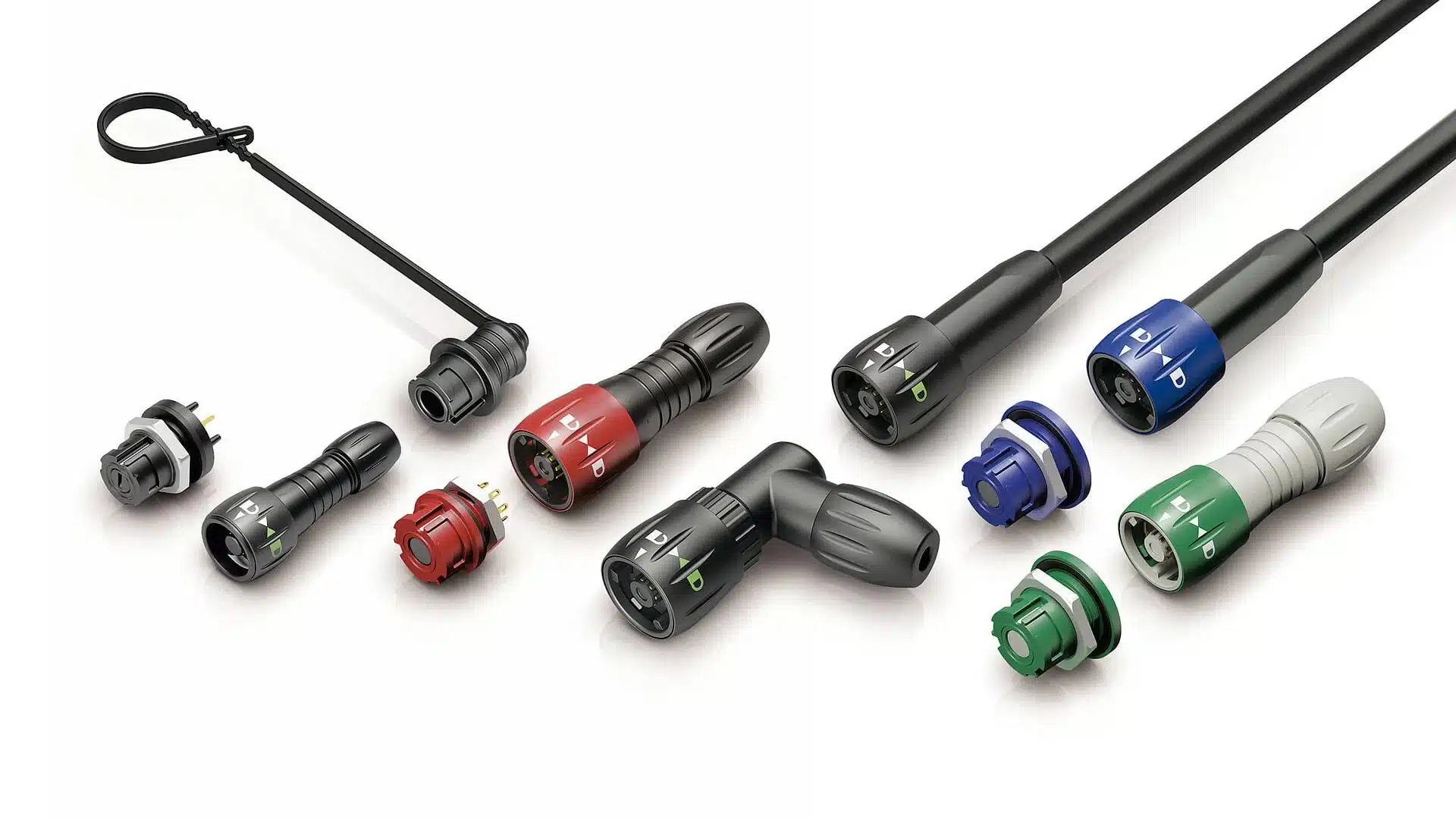
Binder’s Not Connected Closed (NCC) circular connector family provides sealed, bayonet‑locking interfaces that remain protected even when unmated, targeting demanding industrial and medical environments with frequent connect/disconnect cycles.

The range spans subminiature series 670 and miniature series 770, including a dedicated medical version, and focuses on ingress protection, high mating‑cycle endurance and intuitive handling.

RelatedPosts

Binder Unveils M8 Flange Solder Connectors for Flexible Cabling

binder Presents Harsh Environment Connector for Outdoor Environments

binder expands M8 portfolio with 360° shielded cable connectors

Key features and benefits

The NCC concept uses a spring‑loaded plastic cover on the female panel mount connector that closes automatically as soon as the mating plug is removed. This protects the contact interface from dust, dirt and liquids in applications where connectors cannot remain mated at all times.

Key characteristics of the NCC family include:

  • Automatic spring‑loaded sealing cover on the female panel mount connector for protection in the unmated state
  • Bayonet locking system for quick, secure and tool‑free connection and disconnection
  • Series 670 (subminiature) with IP54 protection when unmated and IP67 when mated
  • Series 770 (miniature) with IP67 protection in both unmated and mated conditions
  • High mating‑cycle capability (more than 1,000 cycles for series 670, more than 5,000 cycles for series 770 according to manufacturer data)
  • Plastic housings including DEHP‑free medical‑grade variants

In practice, the IP54/IP67 ratings indicate that the interface is protected against dust ingress and water splashes in the unmated condition (IP54 for series 670) and protected against temporary immersion in the mated condition (IP67 for both series 670 and 770), which is particularly relevant for outdoor or wash‑down environments.

Typical applications

Binder positions the NCC family for use wherever frequent mating and unmating is required without sacrificing environmental protection and hygiene. This includes both general industrial electronics and medical devices.

Typical application areas mentioned by the manufacturer include:

  • Automation equipment and control systems in dusty or humid environments
  • Measurement and testing technology, including field instrumentation and portable test equipment
  • Laboratory environments with routine cleaning and disinfection procedures
  • Medical devices and diagnostic equipment where connectors are frequently mated/unmated but must tolerate exposure to cleaning agents and liquids
  • Lighting and signal indication systems exposed to moisture or outdoor conditions

A typical medical example is diagnostic equipment where cables are plugged and unplugged between patients yet must meet strict hygiene requirements and resist contact with disinfectants and liquids. In industrial measurement systems, sensors exposed to humidity or airborne contamination benefit from the sealed interface in both mated and unmated states.

Technical highlights

From a design perspective, the NCC family combines compact circular geometry with differentiated pin counts and form factors for subminiature and miniature device interfaces.

Key technical data (according to the manufacturer’s press information and datasheet):

  • Series: 670 (subminiature), 770 (miniature)
  • Number of contacts: 5‑pin (series 670), 8‑pin (series 770)
  • Locking system: Bayonet coupling for fast 90°‑type twist locking
  • Protection rating:
    • Series 670: IP54 (unmated) / IP67 (mated)
    • Series 770: IP67 (unmated and mated)
  • Mating cycles:
    • Series 670: more than 1,000 mating cycles
    • Series 770: more than 5,000 mating cycles
  • Materials: Plastic housings, including DEHP‑free medical‑grade material for dedicated versions

The integrated sealing cap in the female panel mount connectors is driven by a precisely designed spring mechanism to ensure repeatable closing movement and consistent long‑term sealing performance. For designers, this means the environmental seal is not solely dependent on the user fitting a separate cap or blind plug; protection in the unmated state is inherent to the connector design.

Medical‑grade variant (series 770)

For series 770, Binder offers a medical‑grade version in grey‑white (similar to RAL 9002). This variant is specified as biocompatible according to ISO 10993‑5, targeting medical technology where the connector may be in indirect contact with patients or needs to withstand regular cleaning and disinfection.

Using a standardized biocompatibility evaluation such as ISO 10993‑5 simplifies regulatory documentation for medical device manufacturers and helps shorten design‑in qualification where such materials requirements are critical.

Design‑in notes for engineers

When designing in NCC connectors, it is useful to treat them as environmental‑sealed circular I/O interfaces where both mated and unmated sealing must be considered early in the mechanical concept.

Key design‑in considerations:

  • Space and panel layout: Account for the circular panel cutouts of series 670 or 770 and the required clearance for bayonet coupling. The spring‑loaded cover will also require a defined movement space on the panel side.
  • Ingress protection strategy: If the equipment specification calls for a certain enclosure protection class, ensure that the connector’s IP rating in both mated and unmated states aligns with the overall device IP concept. For example, using series 770 can simplify designs that need IP67 even when connectors are unplugged.
  • Mating‑cycle expectations: For applications with intensive plug/unplug use, such as test equipment or frequently serviced medical devices, the higher mating‑cycle capability of series 770 (more than 5,000 cycles) may offer better long‑term reliability.
  • Cleaning and sterilization: In medical and laboratory environments, consider the chemicals and procedures used for cleaning. The DEHP‑free medical‑grade plastics and ISO 10993‑5 biocompatibility of the dedicated series 770 version are relevant for regulatory compliance and chemical resistance, but detailed compatibility with specific disinfectants should be verified against the datasheet or binder application notes.
  • Cable management and strain relief: Combine the NCC connectors with appropriate cable relief and accessories from Binder’s portfolio to maintain environmental protection under mechanical stress and vibration.

For designers working with passive sensor interfaces, low‑power signaling or auxiliary power distribution in harsh environments, NCC connectors can provide a robust, sealed connection with intuitive handling for operators.

Source

This article is based on information provided by Binder in their official press release on the Not Connected Closed (NCC) connector family, complemented with general engineering context for design‑in and application selection. For detailed electrical ratings and complete ordering information, readers should consult the corresponding manufacturer datasheets and catalog documentation.


References

  1. Binder press release – The Not Connected Closed (NCC) family
  2. Binder product overview – Subminiature circular connectors, bayonet NCC (series 670)
  3. Binder product overview – Miniature circular connectors, bayonet NCC (series 770)

Related

Recent Posts

Standard vs Planar LLC transformers Comparison for Battery Chargers

13.3.2026
3

Bourns Expanded Semi-Shielded Low Profile Automotive Power Inductor

12.3.2026
8

Peak Nano to Develop Fusion Grade High Energy Film Capacitors

11.3.2026
19

Murata New Vibration Sensor Targets High‑Frequency Predictive Maintenance

10.3.2026
13

Panasonic Expands Automotive PP Film Capacitors Voltage Range

9.3.2026
21

Panasonic Extends Automotive Power Inductor Line

9.3.2026
24

YAGEO Presents 3.6 kW LLC Transformer Platform

6.3.2026
43

ECIA February 2026 Industry Pulse Signals Strong Component Growth

6.3.2026
26

Inductors and Ferrite Beads Price Hikes 

5.3.2026
70

Upcoming Events

Mar 19
13:00 - 14:00 CDT

Smart Consideration of Inductor Thermal Performance

Mar 21
All day

PSMA Capacitor Workshop 2026

Apr 21
16:00 - 17:00 CEST

Heatsink Solutions: Thermal Management in electronic devices

View Calendar

Popular Posts

  • Buck Converter Design and Calculation

    0 shares
    Share 0 Tweet 0
  • Boost Converter Design and Calculation

    0 shares
    Share 0 Tweet 0
  • Flyback Converter Design and Calculation

    0 shares
    Share 0 Tweet 0
  • LLC Resonant Converter Design and Calculation

    0 shares
    Share 0 Tweet 0
  • MLCC Manufacturers Consider Price Increase as AI Demand Outpaces Supply

    0 shares
    Share 0 Tweet 0
  • Dual Active Bridge (DAB) Topology

    0 shares
    Share 0 Tweet 0
  • Ripple Current and its Effects on the Performance of Capacitors

    3 shares
    Share 3 Tweet 0
  • MLCC and Ceramic Capacitors

    0 shares
    Share 0 Tweet 0
  • MLCC Case Sizes Standards Explained

    0 shares
    Share 0 Tweet 0
  • What is a Dielectric Constant and DF of Plastic Materials?

    4 shares
    Share 4 Tweet 0

Newsletter Subscription


Passive Components Blog

© EPCI - Leading Passive Components Educational and Information Site

  • Home
  • Privacy Policy
  • EPCI Membership & Advertisement
  • About

No Result
View All Result
  • Home
  • Knowledge Blog
  • PCNS

© EPCI - Leading Passive Components Educational and Information Site

This website uses cookies. By continuing to use this website you are giving consent to cookies being used. Visit our Privacy and Cookie Policy.
Go to mobile version