






Passive Components Blog
No Result
View All Result
  • Home
  • NewsFilter
    • All
    • Aerospace & Defence
    • Antenna
    • Applications
    • Automotive
    • Capacitors
    • Circuit Protection Devices
    • electro-mechanical news
    • Filters
    • Fuses
    • Inductors
    • Industrial
    • Integrated Passives
    • inter-connect news
    • Market & Supply Chain
    • Market Insights
    • Medical
    • Modelling and Simulation
    • New Materials & Supply
    • New Technologies
    • Non-linear Passives
    • Oscillators
    • Passive Sensors News
    • Resistors
    • RF & Microwave
    • Telecommunication
    • Weekly Digest

    Power Converter Dossier: Passive Components Design and Selection Guide 2026

    Evans Group Unifies Four High-Rel Capacitor Leaders

    Skeleton Releases Graphene‑Based UPS for AI Data Centers

    Designing 800 V DC EMC Filters: Calculation, Simulation and Measurement

    TDK Releases DC-link Film Capacitors with Ultra-low Inductance for SiC Power Converters

    Murata Introduces World First 2.2uF 100V Soft‑Term MLCC in 0805 Size for Automotive

    Murata and Xona Partner on LEO Satellite Navigation for Industrial Applications

    Bourns Offers Custom Magnetics for 3‑Phase Flying Capacitor Inverters

    YAGEO Releases Cost Efficient Pt‑RTD Sensors with Ni wires

    Trending Tags

    • Ripple Current
    • RF
    • Leakage Current
    • Tantalum vs Ceramic
    • Snubber
    • Low ESR
    • Feedthrough
    • Derating
    • Dielectric Constant
    • New Products
    • Market Reports
  • VideoFilter
    • All
    • Antenna videos
    • Capacitor videos
    • Circuit Protection Video
    • Filter videos
    • Fuse videos
    • Inductor videos
    • Inter-Connect Video
    • Non-linear passives videos
    • Oscillator videos
    • Passive sensors videos
    • Resistor videos

    Designing 800 V DC EMC Filters: Calculation, Simulation and Measurement

    Current Sense Transformer Datasheet and Design‑in Guide

    Designing a USB Type‑C Flyback Planar Transformer with Frenetic’s Planar Tool

    Magnetics Design in High‑Frequency GaN Converters

    Qi2 Wireless Charging: Inductors, Capacitors and EMC Filters

    Two‑capacitor paradox explained for engineers

    Capacitances of Nonlinear MLCCs: What Datasheets Don’t Tell You

    Tapped Inductor Buck Converter Fundamentals

    Planar vs Conventional Transformer: When it Make Sense

    Trending Tags

    • Capacitors explained
    • Inductors explained
    • Resistors explained
    • Filters explained
    • Application Video Guidelines
    • EMC
    • New Products
    • Ripple Current
    • Simulation
    • Tantalum vs Ceramic
  • Knowledge Blog
  • DossiersNew
  • Suppliers
    • Who is Who
  • PCNS
    • PCNS 2025
    • PCNS 2023
    • PCNS 2021
    • PCNS 2019
    • PCNS 2017
  • Events
  • Home
  • NewsFilter
    • All
    • Aerospace & Defence
    • Antenna
    • Applications
    • Automotive
    • Capacitors
    • Circuit Protection Devices
    • electro-mechanical news
    • Filters
    • Fuses
    • Inductors
    • Industrial
    • Integrated Passives
    • inter-connect news
    • Market & Supply Chain
    • Market Insights
    • Medical
    • Modelling and Simulation
    • New Materials & Supply
    • New Technologies
    • Non-linear Passives
    • Oscillators
    • Passive Sensors News
    • Resistors
    • RF & Microwave
    • Telecommunication
    • Weekly Digest

    Power Converter Dossier: Passive Components Design and Selection Guide 2026

    Evans Group Unifies Four High-Rel Capacitor Leaders

    Skeleton Releases Graphene‑Based UPS for AI Data Centers

    Designing 800 V DC EMC Filters: Calculation, Simulation and Measurement

    TDK Releases DC-link Film Capacitors with Ultra-low Inductance for SiC Power Converters

    Murata Introduces World First 2.2uF 100V Soft‑Term MLCC in 0805 Size for Automotive

    Murata and Xona Partner on LEO Satellite Navigation for Industrial Applications

    Bourns Offers Custom Magnetics for 3‑Phase Flying Capacitor Inverters

    YAGEO Releases Cost Efficient Pt‑RTD Sensors with Ni wires

    Trending Tags

    • Ripple Current
    • RF
    • Leakage Current
    • Tantalum vs Ceramic
    • Snubber
    • Low ESR
    • Feedthrough
    • Derating
    • Dielectric Constant
    • New Products
    • Market Reports
  • VideoFilter
    • All
    • Antenna videos
    • Capacitor videos
    • Circuit Protection Video
    • Filter videos
    • Fuse videos
    • Inductor videos
    • Inter-Connect Video
    • Non-linear passives videos
    • Oscillator videos
    • Passive sensors videos
    • Resistor videos

    Designing 800 V DC EMC Filters: Calculation, Simulation and Measurement

    Current Sense Transformer Datasheet and Design‑in Guide

    Designing a USB Type‑C Flyback Planar Transformer with Frenetic’s Planar Tool

    Magnetics Design in High‑Frequency GaN Converters

    Qi2 Wireless Charging: Inductors, Capacitors and EMC Filters

    Two‑capacitor paradox explained for engineers

    Capacitances of Nonlinear MLCCs: What Datasheets Don’t Tell You

    Tapped Inductor Buck Converter Fundamentals

    Planar vs Conventional Transformer: When it Make Sense

    Trending Tags

    • Capacitors explained
    • Inductors explained
    • Resistors explained
    • Filters explained
    • Application Video Guidelines
    • EMC
    • New Products
    • Ripple Current
    • Simulation
    • Tantalum vs Ceramic
  • Knowledge Blog
  • DossiersNew
  • Suppliers
    • Who is Who
  • PCNS
    • PCNS 2025
    • PCNS 2023
    • PCNS 2021
    • PCNS 2019
    • PCNS 2017
  • Events
No Result
View All Result
Passive Components Blog
No Result
View All Result

Bourns Announces Three-pin Current Sense Resistors to Reduce Sensing Errors

7.10.2022
Reading Time: 3 mins read
A A

Bourns is pleased to announce the extension of the model CSM2F series AEC-Q200 compliant current sense resistor families with additional sensing pins which connect to the customer’s PCB by through-hole soldering. The three-pin current sense resistors designs aims to reduce the sensing error.

Current sense resistors are growing in popularity due to their high measurement accuracy and relatively low cost compared to other technologies. This new product series complements Bourns’ other circuit conditioning components, such as power inductors and rectifier diodes.

RelatedPosts

Bourns Offers Custom Magnetics for 3‑Phase Flying Capacitor Inverters

Bourns Expands 1000V High‑Power Fuses for Semiconductor and Battery Protection

Bourns Introduces High Current Chip Ferrite Beads for Dense Power Rails

These new models come with either two or three tin-plated copper pins. Two pins are riveted to the voltage test points of the shunt resistor in order to measure the voltage drop on the resistive element, which is proportional to the current flow through the resistor.

The optional third pin connects to the ground side of the circuit. For two-pin designs, the current used by the sensor device flows through the ground side pin and causes a voltage drop between the PCB connection and the resistor, which can result in a sensing error. Three-pin designs reduce the sensing error by carrying the ground current on a separate path from the sensing circuit.
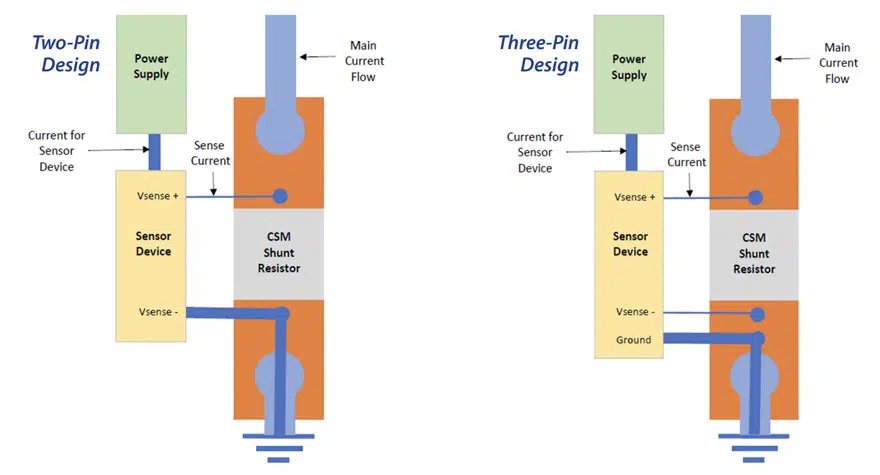
Principle of two and three termination pin current sense shunt resistors; source: Bourns

Bourns® CSM2F Series Current Sense Resistors are manufactured using electron beam welded resistive and copper alloys. This product family is available with three different surface finishes.

  • The “Pre-Plated” copper terminal version is tin-plated before the electron beam welding process. The top and bottom surface of the copper terminals are plated while the side terminals and the resistive element remain non-plated due to the stamping process.
  • The “Fully-Plated” version goes through the tin-plating process after material stamping to ensure the resistive element and all side terminals are covered by tin. This process enhances the performance of the Model CSM2F Series with better long-term stability and lower resistance drift.
  • The “Bare-Copper” version is without tin-plating and provides better TCR (Temperature Coefficient of Resistance) performance.

The Bourns® Model CSM2F Series is available in four different footprint sizes: 6918, 8518, 7036, and the new 8536 metric. The series features resistance values ranging from as low as 25 µΩ up to 200 µΩ, with permanent power ratings of up to 50 watts, continuous current up to 1414 amps and the ability to handle high pulse power ratings. The metal alloy current sensing element enables thermal EMF as low as 0.25 µV/K and low TCRs of ±50 PPM/°C in the 20 °C to 60 °C temperature range.

Features

  • EB welded metal strip
  • Passivated bare copper, plated top and bottom surface or fully-plated terminals
  • Two sensing pins for voltage sensing
  • Optional third sensing pin for ground connection
  • Up to 50 W permanent power
  • Excellent long-term stability
  • Low resistance, low TCR
  • Low thermal EMF
  • Maximum fastening torque: 10 Nm
  • Bulk or tray packaging
  • RoHS compliant*
  • Automotive AEC-Q200 compliant

Applications

  • Battery Management Systems (BMS)
  • Current sensing for hybrid and electric vehicles
  • Current sensing in bus bars
  • Current sensing in welding equipment
  • Voltage division
  • Power modules
  • Frequency converters
  • Industrial

Related

Source: Bourns

Recent Posts

Power Converter Dossier: Passive Components Design and Selection Guide 2026

5.6.2026
6

Evans Group Unifies Four High-Rel Capacitor Leaders

5.6.2026
10

Skeleton Releases Graphene‑Based UPS for AI Data Centers

5.6.2026
10

TDK Releases DC-link Film Capacitors with Ultra-low Inductance for SiC Power Converters

4.6.2026
33

Murata Introduces World First 2.2uF 100V Soft‑Term MLCC in 0805 Size for Automotive

4.6.2026
18

Bourns Offers Custom Magnetics for 3‑Phase Flying Capacitor Inverters

3.6.2026
23

YAGEO Releases Cost Efficient Pt‑RTD Sensors with Ni wires

3.6.2026
13

Stackpole Introduces 1400A Busbar Shunt Resistors

2.6.2026
22

Tecate Unveils High‑temp 105C Supercapacitors for Harsh‑Environment Designs

2.6.2026
17

Upcoming Events

Jun 16
16:00 - 17:00 CEST

EMC with EMC – EMC‑compliant design with electromechanical connectors

View Calendar

Popular Posts

  • Buck Converter Design and Calculation

    0 shares
    Share 0 Tweet 0
  • Boost Converter Design and Calculation

    0 shares
    Share 0 Tweet 0
  • MLCC and Ceramic Capacitors

    0 shares
    Share 0 Tweet 0
  • Flyback Converter Design and Calculation

    0 shares
    Share 0 Tweet 0
  • LLC Resonant Converter Design and Calculation

    0 shares
    Share 0 Tweet 0
  • Dual Active Bridge (DAB) Topology

    0 shares
    Share 0 Tweet 0
  • What Electronics Engineer Needs to Know About Passive Low Pass Filters

    0 shares
    Share 0 Tweet 0
  • Capacitor Charging and Discharging

    0 shares
    Share 0 Tweet 0
  • SEPIC Converter Design and Calculation

    0 shares
    Share 0 Tweet 0
  • Earthing Systems and IEC Classification Explained

    0 shares
    Share 0 Tweet 0

Newsletter Subscription


Passive Components Blog

© EPCI - Leading Passive Components Educational and Information Site

  • Home
  • Privacy Policy
  • EPCI Membership & Advertisement
  • About

No Result
View All Result
  • Home
  • Knowledge Blog
  • Dossiers
  • PCNS

© EPCI - Leading Passive Components Educational and Information Site

This website uses cookies. By continuing to use this website you are giving consent to cookies being used. Visit our Privacy and Cookie Policy.
Go to mobile version