




Passive Components Blog
No Result
View All Result
  • Home
  • NewsFilter
    • All
    • Aerospace & Defence
    • Antenna
    • Applications
    • Automotive
    • Capacitors
    • Circuit Protection Devices
    • electro-mechanical news
    • Filters
    • Fuses
    • Inductors
    • Industrial
    • Integrated Passives
    • inter-connect news
    • Market & Supply Chain
    • Market Insights
    • Medical
    • Modelling and Simulation
    • New Materials & Supply
    • New Technologies
    • Non-linear Passives
    • Oscillators
    • Passive Sensors News
    • Resistors
    • RF & Microwave
    • Telecommunication
    • Weekly Digest

    Vishay Extends Aluminum Capacitors Rating Up to 600 V for DC Links

    Würth Elektronik Introduces Product Navigator for Passive Components

    Panasonic Passive Components for Reliable Robotic Arms

    Littelfuse Unveils Ultra-Low-Power TMR Magnetic Switches

    DC/DC Push‑Pull Converter vs PSFB Design Guide

    Wk 2 Electronics Supply Chain Digest

    Rubycon PMLCAP DC‑Link Film Capacitors in Mass Production

    Bourns SSD‑1000A AEC‑Q Digital Current Sensors

    YAGEO High‑Capacitance X7R Automotive MLCC Extensions

    Trending Tags

    • Ripple Current
    • RF
    • Leakage Current
    • Tantalum vs Ceramic
    • Snubber
    • Low ESR
    • Feedthrough
    • Derating
    • Dielectric Constant
    • New Products
    • Market Reports
  • VideoFilter
    • All
    • Antenna videos
    • Capacitor videos
    • Circuit Protection Video
    • Filter videos
    • Fuse videos
    • Inductor videos
    • Inter-Connect Video
    • Non-linear passives videos
    • Oscillator videos
    • Passive sensors videos
    • Resistor videos

    One‑Pulse Characterization of Nonlinear Power Inductors

    Thermistor Linearization Challenges

    Coaxial Connectors and How to Connect with PCB

    PCB Manufacturing, Test Methods, Quality and Reliability

    Transformer Behavior – Current Transfer and Hidden Feedback

    Choosing the Right Capacitor: The Importance of Accurate Measurements

    RF Inductors: Selection and Design Challenges for High-Frequency Circuits

    Transformer Safety IEC 61558 Standard

    3-Phase EMI Filter Design, Simulation, Calculation and Test

    Trending Tags

    • Capacitors explained
    • Inductors explained
    • Resistors explained
    • Filters explained
    • Application Video Guidelines
    • EMC
    • New Products
    • Ripple Current
    • Simulation
    • Tantalum vs Ceramic
  • Knowledge Blog
  • Suppliers
    • Who is Who
  • PCNS
    • PCNS 2025
    • PCNS 2023
    • PCNS 2021
    • PCNS 2019
    • PCNS 2017
  • Events
  • Home
  • NewsFilter
    • All
    • Aerospace & Defence
    • Antenna
    • Applications
    • Automotive
    • Capacitors
    • Circuit Protection Devices
    • electro-mechanical news
    • Filters
    • Fuses
    • Inductors
    • Industrial
    • Integrated Passives
    • inter-connect news
    • Market & Supply Chain
    • Market Insights
    • Medical
    • Modelling and Simulation
    • New Materials & Supply
    • New Technologies
    • Non-linear Passives
    • Oscillators
    • Passive Sensors News
    • Resistors
    • RF & Microwave
    • Telecommunication
    • Weekly Digest

    Vishay Extends Aluminum Capacitors Rating Up to 600 V for DC Links

    Würth Elektronik Introduces Product Navigator for Passive Components

    Panasonic Passive Components for Reliable Robotic Arms

    Littelfuse Unveils Ultra-Low-Power TMR Magnetic Switches

    DC/DC Push‑Pull Converter vs PSFB Design Guide

    Wk 2 Electronics Supply Chain Digest

    Rubycon PMLCAP DC‑Link Film Capacitors in Mass Production

    Bourns SSD‑1000A AEC‑Q Digital Current Sensors

    YAGEO High‑Capacitance X7R Automotive MLCC Extensions

    Trending Tags

    • Ripple Current
    • RF
    • Leakage Current
    • Tantalum vs Ceramic
    • Snubber
    • Low ESR
    • Feedthrough
    • Derating
    • Dielectric Constant
    • New Products
    • Market Reports
  • VideoFilter
    • All
    • Antenna videos
    • Capacitor videos
    • Circuit Protection Video
    • Filter videos
    • Fuse videos
    • Inductor videos
    • Inter-Connect Video
    • Non-linear passives videos
    • Oscillator videos
    • Passive sensors videos
    • Resistor videos

    One‑Pulse Characterization of Nonlinear Power Inductors

    Thermistor Linearization Challenges

    Coaxial Connectors and How to Connect with PCB

    PCB Manufacturing, Test Methods, Quality and Reliability

    Transformer Behavior – Current Transfer and Hidden Feedback

    Choosing the Right Capacitor: The Importance of Accurate Measurements

    RF Inductors: Selection and Design Challenges for High-Frequency Circuits

    Transformer Safety IEC 61558 Standard

    3-Phase EMI Filter Design, Simulation, Calculation and Test

    Trending Tags

    • Capacitors explained
    • Inductors explained
    • Resistors explained
    • Filters explained
    • Application Video Guidelines
    • EMC
    • New Products
    • Ripple Current
    • Simulation
    • Tantalum vs Ceramic
  • Knowledge Blog
  • Suppliers
    • Who is Who
  • PCNS
    • PCNS 2025
    • PCNS 2023
    • PCNS 2021
    • PCNS 2019
    • PCNS 2017
  • Events
No Result
View All Result
Passive Components Blog
No Result
View All Result

Power Inductors in Automotive Applications

22.11.2022
Reading Time: 4 mins read
A A

TDK blog article discusses use of power inductors in the electrification of cars including ADAS and EVs.

The automobile has been undergoing a substantial transformation in recent years. With the advent of Advanced Driver Assistance Systems (ADAS), the shift toward electric vehicles, and the growing sophistication of infotainment, cars have evolved to the point where they can be considered advanced electronic devices.

RelatedPosts

TDK Unveils Small Automotive Power Inductors

TDK Releases 35A 750J Current Limiters for High-Power Applications

TDK and NIPPON CHEMICAL to Establish Joint Venture for MLCC Material Development

Electronic components are playing vital roles in this transformation. This article takes a close look at an electronic component that underpins the further evolution of automobiles: the power inductor for automotive applications.

Cars are rapidly turning electric

Against the backdrop of growing worldwide attention to carbon neutrality, major car manufacturers have been announcing their forays into the electric vehicle (EV) market one after another. xEVs, which refer to vehicles powered partially or entirely by batteries and motors, are leading the trend. The automotive industry is also experiencing a massive wave of technological innovation, as seen in the accelerating development of ADAS, which assist in driving using cameras and sensors to detect surrounding information, as well as in autonomous driving technologies.

With the shift toward EVs and electronics, the number of onboard Electronic Control Units (ECUs) —computers that control engines, motors, brakes, and sensors—is rising. In fact, more than a hundred ECUs can be found in the latest cars. Cars are equipped with a variety of ECUs—those related to the powertrain, information processing, and safety—electronically controlling various vehicle functions. The number of ECUs is climbing year by year.
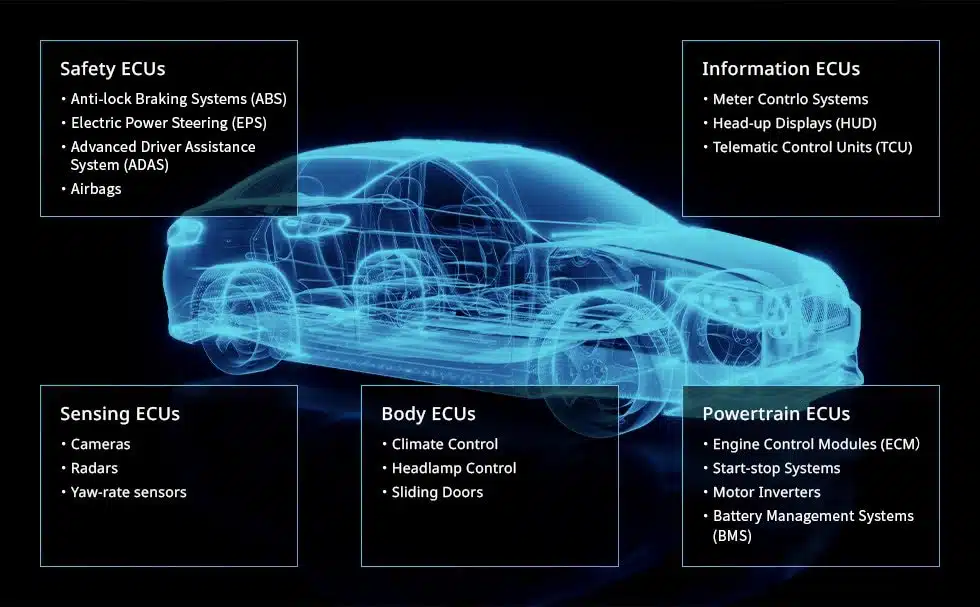
Automotive ECUs by category

The role of automotive electronic components

All ECUs contain DC-DC converters that adjust the battery’s voltage to optimum levels. The power inductor is a critical component that determines the performance of these converters. Inductors pass direct current (DC) freely while behaving like resistance against alternating current (AC). When coupled with ICs that perform high-speed switching, they enable DC-DC converters to convert voltages to the required levels.

Power inductors are broadly classified into wire wound, multilayer, and thin-film types, depending on their construction. The wire wound type is characterized by its ability to carry large currents; a variety of products paired with ferrite or soft magnetic metal cores are available. The multilayer and thin-film types can be made smaller and thinner; recent years have seen their ability to handle larger currents. Because ECUs require DC-DC converters optimal for the devices they control, a broad range of power inductor products with distinct characteristics is needed.

Demand forecast for automotive power inductors

The growing demand for ECUs is expected to drive demand for automotive inductors significantly. Source:TDK 2020 value represented as 100. Based on research by TDK)

With the growing number of ECUs installed in cars, demand is surging for electronic components like inductors, capacitors, and EMC products. Global demand for automotive inductors is expected to continue expanding, approximately doubling that of 2020 by 2030.(Based on research by TDK)

TDK power inductors cover a broad range of characteristics

As xEVs and autonomous driving evolve, so do the performance requirements for automotive electronic components. Since the safety of the occupants and the surroundings is closely tied to automotive functions like autonomous driving and collision safety systems, electronic components are required to be more reliable and higher-performance than ever before. And because DC-DC converters are trending toward higher-frequency switching to reduce size and weight, power inductors must also be able to handle higher frequencies.

TDK offers an extensive lineup of power inductors designed for automotive applications to support ECUs with different inductance and current requirements based on their roles, such as for ADAS, sensors, and image processing. They deliver robust reliability by reducing the risk of failures to extreme extents, serving the sophisticated needs of autonomous driving technologies. They are also resilient against noise, a benefit that complements the increasingly higher operating frequencies of switching elements.

Hitoshi Okubo of TDK Corporation’s Magnetics Business Group discussed the strengths of TDK’s automotive power inductors. “Cars have become smarter in recent years with enhanced safety capabilities like ADAS and autonomous driving, richer infotainment features, and telematics. Because the number of electronic equipment in cars is expected to continue growing, we are looking forward to a significant expansion of the playing field for our products. At the same time, however, malfunctions in electronic equipment now have substantially adverse implications on automotive safety, so the demand for ‘zero-defect’ quality is stronger than ever. TDK offers compact, feature-rich, highly reliable inductor products by leveraging various construction methods, including wire wound, multilayer, and thin film. In particular, thin-film power inductors designed for automotive applications—which combine TDK’s proprietary thin-film and long-cultivated magnetic material technologies to produce characteristics unavailable in conventional products—offer superior properties and high reliability despite their compact size. We will continue to respond to the market’s needs by providing a wide range of products that suit customer applications.”
Related

Source: TDK

Recent Posts

Würth Elektronik Introduces Product Navigator for Passive Components

14.1.2026
40

Panasonic Passive Components for Reliable Robotic Arms

14.1.2026
46

Littelfuse Unveils Ultra-Low-Power TMR Magnetic Switches

13.1.2026
21

DC/DC Push‑Pull Converter vs PSFB Design Guide

12.1.2026
60

Rubycon PMLCAP DC‑Link Film Capacitors in Mass Production

9.1.2026
60

Bourns SSD‑1000A AEC‑Q Digital Current Sensors

8.1.2026
46

YAGEO High‑Capacitance X7R Automotive MLCC Extensions

8.1.2026
60

How Metal Prices Are Driving Passive Component Price Hikes

8.1.2026
294

Modelithics COMPLETE Library v25.8 for Keysight ADS

7.1.2026
39

Upcoming Events

Jan 21
18:00 - 18:45 CET

To Rogowski or not to Rogowski

Jan 27
16:00 - 17:00 CET

Simplifying Vehicle Development with Automotive Ethernet and Zonal Smart Switch Technologies

Feb 24
16:00 - 17:00 CET

Designing Qi2 Wireless Power Systems: Practical Development and EMC Optimization

View Calendar

Popular Posts

  • Buck Converter Design and Calculation

    0 shares
    Share 0 Tweet 0
  • Boost Converter Design and Calculation

    0 shares
    Share 0 Tweet 0
  • LLC Resonant Converter Design and Calculation

    0 shares
    Share 0 Tweet 0
  • Flyback Converter Design and Calculation

    0 shares
    Share 0 Tweet 0
  • Ripple Current and its Effects on the Performance of Capacitors

    3 shares
    Share 3 Tweet 0
  • MLCC and Ceramic Capacitors

    0 shares
    Share 0 Tweet 0
  • How Metal Prices Are Driving Passive Component Price Hikes

    0 shares
    Share 0 Tweet 0
  • What is a Dielectric Constant and DF of Plastic Materials?

    4 shares
    Share 4 Tweet 0
  • Dual Active Bridge (DAB) Topology

    0 shares
    Share 0 Tweet 0
  • Degradation of Capacitors and its Failure Mechanisms

    0 shares
    Share 0 Tweet 0

Newsletter Subscription


Passive Components Blog

© EPCI - Leading Passive Components Educational and Information Site

  • Home
  • Privacy Policy
  • EPCI Membership & Advertisement
  • About

No Result
View All Result
  • Home
  • Knowledge Blog
  • PCNS

© EPCI - Leading Passive Components Educational and Information Site

This website uses cookies. By continuing to use this website you are giving consent to cookies being used. Visit our Privacy and Cookie Policy.
Go to mobile version