


Passive Components Blog
No Result
View All Result
  • Home
  • News
    • All
    • Aerospace & Defence
    • Antenna
    • Applications
    • Automotive
    • Capacitors
    • Circuit Protection Devices
    • electro-mechanical news
    • Filters
    • Fuses
    • Inductors
    • Industrial
    • Integrated Passives
    • inter-connect news
    • Market & Supply Chain
    • Market Insights
    • Medical
    • Modelling and Simulation
    • New Materials & Supply
    • New Technologies
    • Non-linear Passives
    • Optoelectronics and Isolation
    • Oscillators
    • Passive Sensors News
    • Resistors
    • RF & Microwave
    • Telecommunication
    • Weekly Digest
    Rheinmetall Pierburg Pump Technology NanoLam DC-link capacitors for high-power electric vehicle traction inverter applications

    Rheinmetall Funds NanoLam Capacitor Production Scale-Up

    Bourns CSS4C-1216 four-terminal metal-strip current sense resistor for high-current Kelvin measurement

    Bourns Extends 1216 Kelvin Current Sense Resistors

    Modelithics COMPLETE+3D Library v26.3 for Ansys HFSS with RF passive component and 3D electromagnetic simulation models

    Modelithics COMPLETE+3D v26.3 Expands HFSS RF Models

    Samsung Electro-Mechanics low-profile and embedded MLCCs for compact PCB and power-delivery applications

    Samsung Low-Profile and Embedded MLCCs for Compact Devices

    Wk 36 Electronics Supply Chain Digest

    Bourns Adds ACXX57SQ Air Coil Inductors for RF Design

    Samsung Electro-Mechanics MLCC capacitor solutions for high-voltage converter snubbing and GPU power delivery

    Samsung MLCC Options for 1 MW AI Rack Power

    Frenetic planar ER transformer simulation for a 5 kW 800 V-to-50 V PSFB converter, showing low-profile core geometry and high-current planar winding arrangement

    5 kW 800 V-to-50 V PSFB Transformer Design for Data Centers

    Samtec 100-CM 1.0 mm vertical solderless compression-mount 50 ohm RF PCB connector

    Samtec 100-CM 1.0 mm RF Connectors Extend to 120 GHz

    Trending Tags

    • Ripple Current
    • RF
    • Leakage Current
    • Tantalum vs Ceramic
    • Snubber
    • Low ESR
    • Feedthrough
    • Derating
    • Dielectric Constant
    • New Products
    • Market Reports
  • Knowledge Blog
  • Dossiers
    • AI Hardware Dossier
    • Automotive Dossier
    • Industrial Robotics Dossier
    • Power Converter Dossier
    • Capacitor Dossier
    • Resistor Dossier
    • Inductor Dossier
    • Circuit Protection Dossier
  • Suppliers
    • Who is Who
  • PCNS
    • PCNS 2025
    • PCNS 2023
    • PCNS 2021
    • PCNS 2019
    • PCNS 2017
  • Events
  • Home
  • News
    • All
    • Aerospace & Defence
    • Antenna
    • Applications
    • Automotive
    • Capacitors
    • Circuit Protection Devices
    • electro-mechanical news
    • Filters
    • Fuses
    • Inductors
    • Industrial
    • Integrated Passives
    • inter-connect news
    • Market & Supply Chain
    • Market Insights
    • Medical
    • Modelling and Simulation
    • New Materials & Supply
    • New Technologies
    • Non-linear Passives
    • Optoelectronics and Isolation
    • Oscillators
    • Passive Sensors News
    • Resistors
    • RF & Microwave
    • Telecommunication
    • Weekly Digest
    Rheinmetall Pierburg Pump Technology NanoLam DC-link capacitors for high-power electric vehicle traction inverter applications

    Rheinmetall Funds NanoLam Capacitor Production Scale-Up

    Bourns CSS4C-1216 four-terminal metal-strip current sense resistor for high-current Kelvin measurement

    Bourns Extends 1216 Kelvin Current Sense Resistors

    Modelithics COMPLETE+3D Library v26.3 for Ansys HFSS with RF passive component and 3D electromagnetic simulation models

    Modelithics COMPLETE+3D v26.3 Expands HFSS RF Models

    Samsung Electro-Mechanics low-profile and embedded MLCCs for compact PCB and power-delivery applications

    Samsung Low-Profile and Embedded MLCCs for Compact Devices

    Wk 36 Electronics Supply Chain Digest

    Bourns Adds ACXX57SQ Air Coil Inductors for RF Design

    Samsung Electro-Mechanics MLCC capacitor solutions for high-voltage converter snubbing and GPU power delivery

    Samsung MLCC Options for 1 MW AI Rack Power

    Frenetic planar ER transformer simulation for a 5 kW 800 V-to-50 V PSFB converter, showing low-profile core geometry and high-current planar winding arrangement

    5 kW 800 V-to-50 V PSFB Transformer Design for Data Centers

    Samtec 100-CM 1.0 mm vertical solderless compression-mount 50 ohm RF PCB connector

    Samtec 100-CM 1.0 mm RF Connectors Extend to 120 GHz

    Trending Tags

    • Ripple Current
    • RF
    • Leakage Current
    • Tantalum vs Ceramic
    • Snubber
    • Low ESR
    • Feedthrough
    • Derating
    • Dielectric Constant
    • New Products
    • Market Reports
  • Knowledge Blog
  • Dossiers
    • AI Hardware Dossier
    • Automotive Dossier
    • Industrial Robotics Dossier
    • Power Converter Dossier
    • Capacitor Dossier
    • Resistor Dossier
    • Inductor Dossier
    • Circuit Protection Dossier
  • Suppliers
    • Who is Who
  • PCNS
    • PCNS 2025
    • PCNS 2023
    • PCNS 2021
    • PCNS 2019
    • PCNS 2017
  • Events
No Result
View All Result
Passive Components Blog
No Result
View All Result

Power Inductors in Automotive Applications

22.11.2022
Reading Time: 4 mins read
A A

TDK blog article discusses use of power inductors in the electrification of cars including ADAS and EVs.

The automobile has been undergoing a substantial transformation in recent years. With the advent of Advanced Driver Assistance Systems (ADAS), the shift toward electric vehicles, and the growing sophistication of infotainment, cars have evolved to the point where they can be considered advanced electronic devices.

RelatedPosts

TDK Extends Compact Snap-In Capacitors to 500 V for AI Servers

TDK Releases 100 V Soft-Termination X7R MLCCs 10 uF in 3225 Package

TDK Extends Vibration‑Resistant Axial Aluminum Capacitors for Compact DC‑links

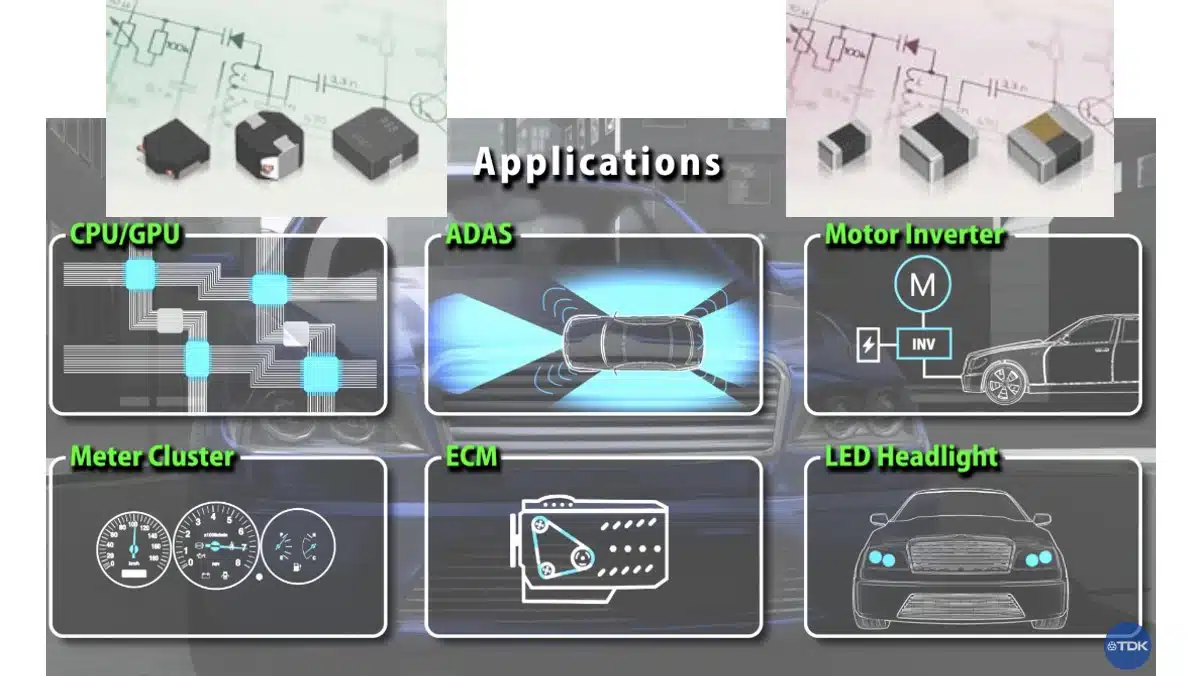
Electronic components are playing vital roles in this transformation. This article takes a close look at an electronic component that underpins the further evolution of automobiles: the power inductor for automotive applications.

Cars are rapidly turning electric

Against the backdrop of growing worldwide attention to carbon neutrality, major car manufacturers have been announcing their forays into the electric vehicle (EV) market one after another. xEVs, which refer to vehicles powered partially or entirely by batteries and motors, are leading the trend. The automotive industry is also experiencing a massive wave of technological innovation, as seen in the accelerating development of ADAS, which assist in driving using cameras and sensors to detect surrounding information, as well as in autonomous driving technologies.

With the shift toward EVs and electronics, the number of onboard Electronic Control Units (ECUs) —computers that control engines, motors, brakes, and sensors—is rising. In fact, more than a hundred ECUs can be found in the latest cars. Cars are equipped with a variety of ECUs—those related to the powertrain, information processing, and safety—electronically controlling various vehicle functions. The number of ECUs is climbing year by year.
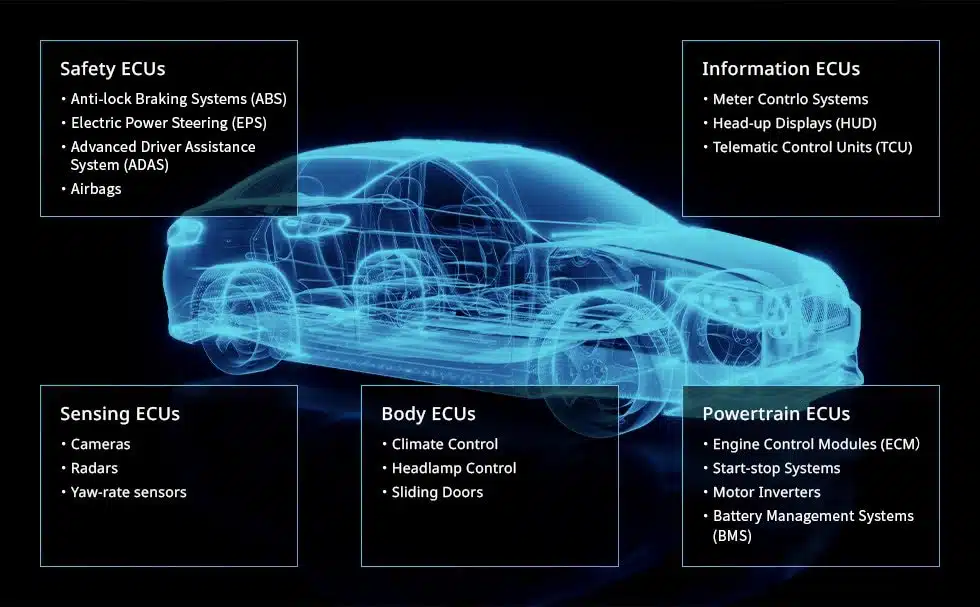
Automotive ECUs by category

The role of automotive electronic components

All ECUs contain DC-DC converters that adjust the battery’s voltage to optimum levels. The power inductor is a critical component that determines the performance of these converters. Inductors pass direct current (DC) freely while behaving like resistance against alternating current (AC). When coupled with ICs that perform high-speed switching, they enable DC-DC converters to convert voltages to the required levels.

Power inductors are broadly classified into wire wound, multilayer, and thin-film types, depending on their construction. The wire wound type is characterized by its ability to carry large currents; a variety of products paired with ferrite or soft magnetic metal cores are available. The multilayer and thin-film types can be made smaller and thinner; recent years have seen their ability to handle larger currents. Because ECUs require DC-DC converters optimal for the devices they control, a broad range of power inductor products with distinct characteristics is needed.

Demand forecast for automotive power inductors

The growing demand for ECUs is expected to drive demand for automotive inductors significantly. Source:TDK 2020 value represented as 100. Based on research by TDK)

With the growing number of ECUs installed in cars, demand is surging for electronic components like inductors, capacitors, and EMC products. Global demand for automotive inductors is expected to continue expanding, approximately doubling that of 2020 by 2030.(Based on research by TDK)

TDK power inductors cover a broad range of characteristics

As xEVs and autonomous driving evolve, so do the performance requirements for automotive electronic components. Since the safety of the occupants and the surroundings is closely tied to automotive functions like autonomous driving and collision safety systems, electronic components are required to be more reliable and higher-performance than ever before. And because DC-DC converters are trending toward higher-frequency switching to reduce size and weight, power inductors must also be able to handle higher frequencies.

TDK offers an extensive lineup of power inductors designed for automotive applications to support ECUs with different inductance and current requirements based on their roles, such as for ADAS, sensors, and image processing. They deliver robust reliability by reducing the risk of failures to extreme extents, serving the sophisticated needs of autonomous driving technologies. They are also resilient against noise, a benefit that complements the increasingly higher operating frequencies of switching elements.

Hitoshi Okubo of TDK Corporation’s Magnetics Business Group discussed the strengths of TDK’s automotive power inductors. “Cars have become smarter in recent years with enhanced safety capabilities like ADAS and autonomous driving, richer infotainment features, and telematics. Because the number of electronic equipment in cars is expected to continue growing, we are looking forward to a significant expansion of the playing field for our products. At the same time, however, malfunctions in electronic equipment now have substantially adverse implications on automotive safety, so the demand for ‘zero-defect’ quality is stronger than ever. TDK offers compact, feature-rich, highly reliable inductor products by leveraging various construction methods, including wire wound, multilayer, and thin film. In particular, thin-film power inductors designed for automotive applications—which combine TDK’s proprietary thin-film and long-cultivated magnetic material technologies to produce characteristics unavailable in conventional products—offer superior properties and high reliability despite their compact size. We will continue to respond to the market’s needs by providing a wide range of products that suit customer applications.”
Related

Source: TDK

Recent Posts

Rheinmetall Pierburg Pump Technology NanoLam DC-link capacitors for high-power electric vehicle traction inverter applications

Rheinmetall Funds NanoLam Capacitor Production Scale-Up

22.9.2026
21
Bourns CSS4C-1216 four-terminal metal-strip current sense resistor for high-current Kelvin measurement

Bourns Extends 1216 Kelvin Current Sense Resistors

22.9.2026
10

Bourns Adds ACXX57SQ Air Coil Inductors for RF Design

18.9.2026
10
Frenetic planar ER transformer simulation for a 5 kW 800 V-to-50 V PSFB converter, showing low-profile core geometry and high-current planar winding arrangement

5 kW 800 V-to-50 V PSFB Transformer Design for Data Centers

18.9.2026
33

Samsung MLCC Revenue Seen Above KRW 8T by 2027, Murata EOL Actions Reshape Supply

11.9.2026
85
ROHM SDR01 high anti-surge thick-film chip resistor in 1005 metric 0402 package with 0.33 W rated power

ROHM Introduces Anti-Surge 0402 Resistors Rated at 0.33 W

11.9.2026
22
ECIA Industry Pulse Q3 2026 chart showing passive components, semiconductors and electro-mechanical component market sentiment and lead-time pressure

ECIA Industry Pulse Moderates as Passive Lead Times Tighten

10.9.2026
47

On-Chip 3D-Printed Copper Microinductors: A New Route to Compact RF Electronics

10.9.2026
34

Emerging Capacitor Markets in Fusion Energy

10.9.2026
65

Upcoming Events

Sep 29
16:00 - 17:00 CEST

Cybersecurity 2026

Sep 30
15:00 - 16:00 CEST

Positronic Space and Military Connectors

Oct 14
17:00 - 18:00 CEST

Live Demo! Discover KYOCERA AVX Antenna Integrator Studio (AIS)

View Calendar

Popular Posts

  • Buck Converter Design and Calculation

    0 shares
    Share 0 Tweet 0
  • LLC Resonant Converter Design and Calculation

    0 shares
    Share 0 Tweet 0
  • Boost Converter Design and Calculation

    0 shares
    Share 0 Tweet 0
  • Flyback Converter Design and Calculation

    0 shares
    Share 0 Tweet 0
  • Capacitor Charging and Discharging

    0 shares
    Share 0 Tweet 0
  • Resistor Symbols

    0 shares
    Share 0 Tweet 0
  • Thermistors Basics, NTC and PTC Thermistors

    0 shares
    Share 0 Tweet 0
  • MLCC and Ceramic Capacitors

    0 shares
    Share 0 Tweet 0
  • Audio Capacitors: Choosing Capacitors for Crossover Circuits

    0 shares
    Share 0 Tweet 0
  • Ohm’s Law Answers Your Questions

    0 shares
    Share 0 Tweet 0

Newsletter Subscription


Passive Components Blog

© 2015–2026
All rights reserved

  • Home
  • Privacy Policy
  • EPCI Membership & Advertisement
  • About

No Result
View All Result
  • Home
  • Knowledge Blog
  • Dossiers
  • PCNS

© 2015–2026
All rights reserved