









Passive Components Blog
No Result
View All Result
  • Home
  • NewsFilter
    • All
    • Aerospace & Defence
    • Antenna
    • Applications
    • Automotive
    • Capacitors
    • Circuit Protection Devices
    • electro-mechanical news
    • Filters
    • Fuses
    • Inductors
    • Industrial
    • Integrated Passives
    • inter-connect news
    • Market & Supply Chain
    • Market Insights
    • Medical
    • Modelling and Simulation
    • New Materials & Supply
    • New Technologies
    • Non-linear Passives
    • Oscillators
    • Passive Sensors News
    • Resistors
    • RF & Microwave
    • Telecommunication
    • Weekly Digest

    Samsung Releases Automotive Molded 2220 1kV C0G MLCC

    How to Select Ferrite Bead for Filtering in Buck Boost Converter

    VINATech Offers Smallest 100µF Al-Hybrid Capacitor

    Vishay Unveils SMD 1200V PTC Thermistors in Compact Size

    Power Inductors Future: Minimal Losses and Compact Designs

    Bourns Unveils Automotive 3 Watt Gate Driver Transformer

    Murata Opens EMC Test Lab in Nuremberg to Enhance Automotive Support

    Percolation Phenomenon: Degradation of Molded Power Inductors in DC/DC Converters

    Molex Acquires Smiths Interconnect

    Trending Tags

    • Ripple Current
    • RF
    • Leakage Current
    • Tantalum vs Ceramic
    • Snubber
    • Low ESR
    • Feedthrough
    • Derating
    • Dielectric Constant
    • New Products
    • Market Reports
  • VideoFilter
    • All
    • Antenna videos
    • Capacitor videos
    • Circuit Protection Video
    • Filter videos
    • Fuse videos
    • Inductor videos
    • Inter-Connect Video
    • Non-linear passives videos
    • Oscillator videos
    • Passive sensors videos
    • Resistor videos

    How to Select Ferrite Bead for Filtering in Buck Boost Converter

    Power Inductors Future: Minimal Losses and Compact Designs

    Percolation Phenomenon: Degradation of Molded Power Inductors in DC/DC Converters

    Connector PCB Design Challenges

    Efficient Power Converters: Duty Cycle vs Conduction Losses

    Ripple Steering in Coupled Inductors: SEPIC Case

    SEPIC Converter with Coupled and Uncoupled Inductors

    Coupled Inductors in SEPIC versus Flyback Converters

    Non-Linear MLCC Class II Capacitor Measurements Challenges

    Trending Tags

    • Capacitors explained
    • Inductors explained
    • Resistors explained
    • Filters explained
    • Application Video Guidelines
    • EMC
    • New Products
    • Ripple Current
    • Simulation
    • Tantalum vs Ceramic
  • Knowledge Blog
  • Suppliers
    • Who is Who
  • PCNS
    • PCNS 2025
    • PCNS 2023
    • PCNS 2021
    • PCNS 2019
    • PCNS 2017
  • Events
  • Home
  • NewsFilter
    • All
    • Aerospace & Defence
    • Antenna
    • Applications
    • Automotive
    • Capacitors
    • Circuit Protection Devices
    • electro-mechanical news
    • Filters
    • Fuses
    • Inductors
    • Industrial
    • Integrated Passives
    • inter-connect news
    • Market & Supply Chain
    • Market Insights
    • Medical
    • Modelling and Simulation
    • New Materials & Supply
    • New Technologies
    • Non-linear Passives
    • Oscillators
    • Passive Sensors News
    • Resistors
    • RF & Microwave
    • Telecommunication
    • Weekly Digest

    Samsung Releases Automotive Molded 2220 1kV C0G MLCC

    How to Select Ferrite Bead for Filtering in Buck Boost Converter

    VINATech Offers Smallest 100µF Al-Hybrid Capacitor

    Vishay Unveils SMD 1200V PTC Thermistors in Compact Size

    Power Inductors Future: Minimal Losses and Compact Designs

    Bourns Unveils Automotive 3 Watt Gate Driver Transformer

    Murata Opens EMC Test Lab in Nuremberg to Enhance Automotive Support

    Percolation Phenomenon: Degradation of Molded Power Inductors in DC/DC Converters

    Molex Acquires Smiths Interconnect

    Trending Tags

    • Ripple Current
    • RF
    • Leakage Current
    • Tantalum vs Ceramic
    • Snubber
    • Low ESR
    • Feedthrough
    • Derating
    • Dielectric Constant
    • New Products
    • Market Reports
  • VideoFilter
    • All
    • Antenna videos
    • Capacitor videos
    • Circuit Protection Video
    • Filter videos
    • Fuse videos
    • Inductor videos
    • Inter-Connect Video
    • Non-linear passives videos
    • Oscillator videos
    • Passive sensors videos
    • Resistor videos

    How to Select Ferrite Bead for Filtering in Buck Boost Converter

    Power Inductors Future: Minimal Losses and Compact Designs

    Percolation Phenomenon: Degradation of Molded Power Inductors in DC/DC Converters

    Connector PCB Design Challenges

    Efficient Power Converters: Duty Cycle vs Conduction Losses

    Ripple Steering in Coupled Inductors: SEPIC Case

    SEPIC Converter with Coupled and Uncoupled Inductors

    Coupled Inductors in SEPIC versus Flyback Converters

    Non-Linear MLCC Class II Capacitor Measurements Challenges

    Trending Tags

    • Capacitors explained
    • Inductors explained
    • Resistors explained
    • Filters explained
    • Application Video Guidelines
    • EMC
    • New Products
    • Ripple Current
    • Simulation
    • Tantalum vs Ceramic
  • Knowledge Blog
  • Suppliers
    • Who is Who
  • PCNS
    • PCNS 2025
    • PCNS 2023
    • PCNS 2021
    • PCNS 2019
    • PCNS 2017
  • Events
No Result
View All Result
Passive Components Blog
No Result
View All Result

Researchers Demonstrated 200C Polymer Film Dielectric

28.7.2025
Reading Time: 4 mins read
A A

Researchers from China published article titled “Enhancement of high-temperature capacitive energy storage performance in all-polymer dielectric composites via microphase separation” in Applied Physics Letters.

Abstract

RelatedPosts

Samsung Releases Automotive Molded 2220 1kV C0G MLCC

How to Select Ferrite Bead for Filtering in Buck Boost Converter

VINATech Offers Smallest 100µF Al-Hybrid Capacitor

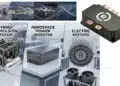
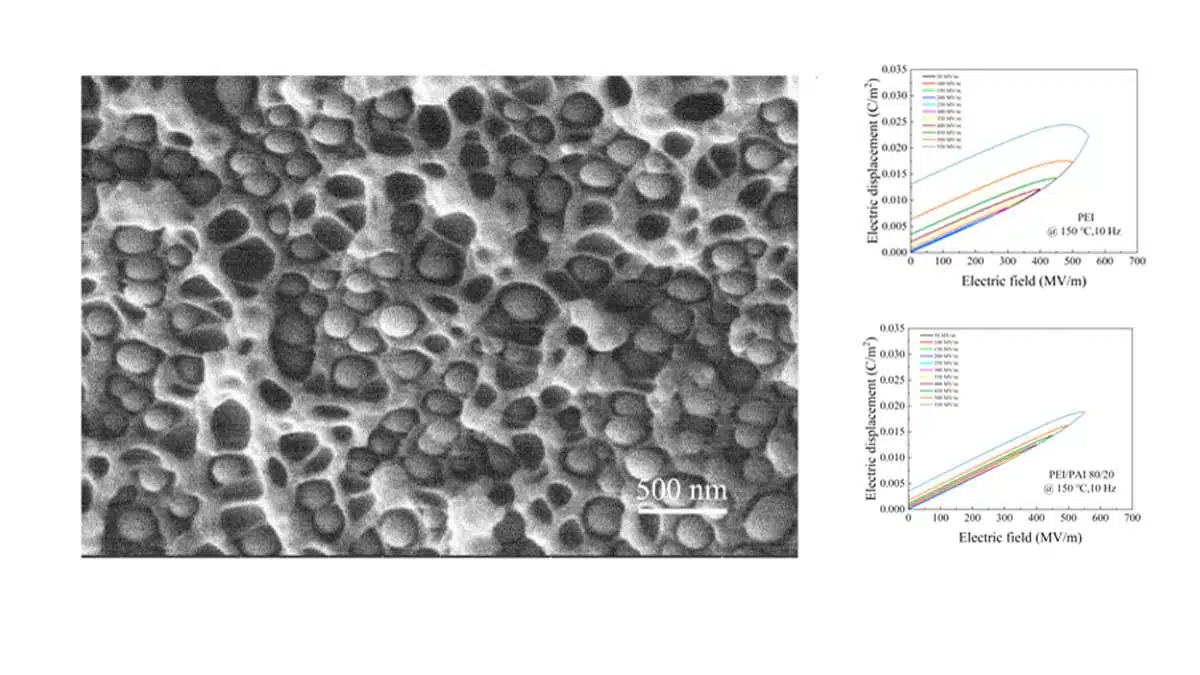
Polymer dielectric capacitors play a crucial role in modern electronics and power systems owing to their exceptional power density, high breakdown strength, excellent processability, and cost-effectiveness. Nevertheless, their practical deployment in harsh operating environments, particularly in electric vehicles and aerospace power electronics, remains challenging due to the inherent thermal instability of conventional polymer dielectrics. Herein, we report an all-polymer dielectric composite (APDC) material fabricated from partially miscible polyetherimide (PEI)/polyamide-imide (PAI) blends that exhibits significantly improved high-temperature capacitive energy storage properties, including breakdown strength (Eb), discharge energy density (Ud), and charge–discharge efficiency (η). The performance enhancement stems from the self-assembled nanoscale interfacial architectures comprising uniformly dispersed PAI domains within the PEI matrix, coupled with the intrinsic energy band structure mismatch between PEI and PAI (notably in electron affinity). These structural characteristics effectively create deep charge traps, resulting in a substantial reduction of leakage current density by more than one order of magnitude compared to pristine PEI under elevated temperatures and high-electric fields. Notably, the developed APDC materials feature a straightforward, efficient, and cost-effective fabrication process, rendering them highly promising for scalable production of high-performance dielectric films for high-temperature capacitors.

Introduction

Polymer dielectric film capacitors are essential in electronics due to their impressive energy storage properties and ease of manufacturing. However, their performance drops significantly in high-temperature environments, which limits their use in advanced applications like electric vehicles and aerospace power systems.

This article explores a novel approach to overcoming this limitation by designing all-polymer dielectric composites using microphase separation of polyetherimide (PEI) and polyamide-imide (PAI).

Key Points

  • All-polymer dielectric composites (APDCs) were fabricated using blends of PEI and PAI.
  • Microphase separation leads to nanoscale interfacial structures and deep charge traps.
  • These structures reduce leakage current and enhance high-temperature performance.
  • Significant improvements observed in breakdown strength, energy density, and efficiency.
  • Fabrication method is simple, scalable, and cost-effective.

Extended Summary

The researchers developed APDC materials by blending PEI and PAI polymers in various ratios to form thin dielectric films. Through a controlled solvent casting and thermal curing process, the blend achieved microphase separation, forming uniformly dispersed PAI domains within the PEI matrix. This nanoscale architecture created energetically favorable conditions—particularly due to mismatched electron affinities between the polymers—which induced deep charge traps at the interface.

These deep traps effectively suppressed leakage currents under high temperatures and strong electric fields, improving the overall capacitive performance. Specifically, the new composites demonstrated over a tenfold reduction in leakage current density compared to pure PEI, alongside notable enhancements in breakdown strength (Eb), discharge energy density (Ud), and efficiency (η).

To validate these improvements, the team conducted extensive characterizations using tools like FIB-SEM, TEM, FTIR, DSC, and broadband dielectric spectroscopy. The results confirmed that microphase-separated structures consistently deliver superior dielectric behavior across a wide temperature range—up to 200 °C—making them promising candidates for real-world high-temperature capacitor applications.

Notably, the fabrication process is straightforward and scalable, relying on common solvents and curing procedures, which paves the way for commercial application without added complexity or cost.

Conclusion

This study presents a compelling advance in dielectric material science by leveraging microphase separation in all-polymer composites. By strategically combining PEI and PAI, the researchers created a material that withstands high temperatures while maintaining excellent energy storage performance. Their work points to practical, scalable solutions for next-generation capacitors in demanding environments.

Read the full article:

Jinbao Chen, Ting Li, Ziyu Lv, Yongbiao Zhai, Wugang Liao, Qiyan Zhang; Enhancement of high-temperature capacitive energy storage performance in all-polymer dielectric composites via microphase separation. Appl. Phys. Lett. 7 July 2025; 127 (1): 012903. https://doi.org/10.1063/5.0280505

related link: What is a dielectric constant of polymer organic materials

Related

Source: Applied Physics Letters

Recent Posts

Samsung Releases Automotive Molded 2220 1kV C0G MLCC

23.10.2025
17

VINATech Offers Smallest 100µF Al-Hybrid Capacitor

23.10.2025
30

Vishay Unveils SMD 1200V PTC Thermistors in Compact Size

23.10.2025
4

Bourns Unveils Automotive 3 Watt Gate Driver Transformer

22.10.2025
7

Murata Opens EMC Test Lab in Nuremberg to Enhance Automotive Support

22.10.2025
12

Murata Integrates Component Models into Cadence EDA Tools

21.10.2025
38

Stackpole Introduces Automotive Thick Film Wide Termination Chip Resistors

20.10.2025
12

September 2025 ECIA US Components Sales Sentiment Continues in Optimism

20.10.2025
20

Bourns Release Automotive 4-Terminal Shunt Resistors

17.10.2025
22

Vishay Releases Automotive TO-220 Case 50W Thick Film Power Resistor

16.10.2025
16

Upcoming Events

Oct 28
8:00 - 15:00 CET

Power Up Your Design: SN6507 and the Ready-to-Use Development Kit

Oct 30
11:00 - 12:00 CET

Space Ceramic Capacitors with Flexible Testing

Nov 4
10:00 - 11:00 PST

Design and Stability Analysis of GaN Power Amplifiers using Advanced Simulation Tools

View Calendar

Popular Posts

  • Buck Converter Design and Calculation

    0 shares
    Share 0 Tweet 0
  • Boost Converter Design and Calculation

    0 shares
    Share 0 Tweet 0
  • Flyback Converter Design and Calculation

    0 shares
    Share 0 Tweet 0
  • LLC Resonant Converter Design and Calculation

    0 shares
    Share 0 Tweet 0
  • Ripple Current and its Effects on the Performance of Capacitors

    3 shares
    Share 3 Tweet 0
  • What is a Dielectric Constant and DF of Plastic Materials?

    4 shares
    Share 4 Tweet 0
  • SEPIC Converter Design and Calculation

    0 shares
    Share 0 Tweet 0
  • Dual Active Bridge (DAB) Topology

    0 shares
    Share 0 Tweet 0
  • MLCC and Ceramic Capacitors

    0 shares
    Share 0 Tweet 0
  • Flying Capacitors

    0 shares
    Share 0 Tweet 0

Newsletter Subscription


Passive Components Blog

© EPCI - Leading Passive Components Educational and Information Site

  • Home
  • Privacy Policy
  • EPCI Membership & Advertisement
  • About

No Result
View All Result
  • Home
  • Knowledge Blog
  • PCNS

© EPCI - Leading Passive Components Educational and Information Site

This website uses cookies. By continuing to use this website you are giving consent to cookies being used. Visit our Privacy and Cookie Policy.
Go to mobile version