









Passive Components Blog
No Result
View All Result
  • Home
  • NewsFilter
    • All
    • Aerospace & Defence
    • Antenna
    • Applications
    • Automotive
    • Capacitors
    • Circuit Protection Devices
    • electro-mechanical news
    • Filters
    • Fuses
    • Inductors
    • Industrial
    • Integrated Passives
    • inter-connect news
    • Market & Supply Chain
    • Market Insights
    • Medical
    • Modelling and Simulation
    • New Materials & Supply
    • New Technologies
    • Non-linear Passives
    • Oscillators
    • Passive Sensors News
    • Resistors
    • RF & Microwave
    • Telecommunication
    • Weekly Digest
    Credit: Institute of Science Tokyo

    Researchers Demonstrated 30nm Ferroelectric Capacitor for Compact Memory

    Towards Green and Sustainable Supercapacitors

    Mechano-Chemical Model of Sintered Tantalum Capacitor Pellets

    Bourns BTJ Thermal Jumper Chips for PCB Heat Management

    One‑Pulse Characterization of Nonlinear Power Inductors

    Wk 51 Electronics Supply Chain Digest

    Samsung Unveils World First CLLC Resonant 1kV 33nF C0G MLCC in 1210 Size

    Bourns Releases 500VDC 690VAC Fuse to Protect Power Semiconductors

    Samsung MLCC Replacing Aluminum Polymer Capacitors in AI Systems

    Trending Tags

    • Ripple Current
    • RF
    • Leakage Current
    • Tantalum vs Ceramic
    • Snubber
    • Low ESR
    • Feedthrough
    • Derating
    • Dielectric Constant
    • New Products
    • Market Reports
  • VideoFilter
    • All
    • Antenna videos
    • Capacitor videos
    • Circuit Protection Video
    • Filter videos
    • Fuse videos
    • Inductor videos
    • Inter-Connect Video
    • Non-linear passives videos
    • Oscillator videos
    • Passive sensors videos
    • Resistor videos

    One‑Pulse Characterization of Nonlinear Power Inductors

    Thermistor Linearization Challenges

    Coaxial Connectors and How to Connect with PCB

    PCB Manufacturing, Test Methods, Quality and Reliability

    Transformer Behavior – Current Transfer and Hidden Feedback

    Choosing the Right Capacitor: The Importance of Accurate Measurements

    RF Inductors: Selection and Design Challenges for High-Frequency Circuits

    Transformer Safety IEC 61558 Standard

    3-Phase EMI Filter Design, Simulation, Calculation and Test

    Trending Tags

    • Capacitors explained
    • Inductors explained
    • Resistors explained
    • Filters explained
    • Application Video Guidelines
    • EMC
    • New Products
    • Ripple Current
    • Simulation
    • Tantalum vs Ceramic
  • Knowledge Blog
  • Suppliers
    • Who is Who
  • PCNS
    • PCNS 2025
    • PCNS 2023
    • PCNS 2021
    • PCNS 2019
    • PCNS 2017
  • Events
  • Home
  • NewsFilter
    • All
    • Aerospace & Defence
    • Antenna
    • Applications
    • Automotive
    • Capacitors
    • Circuit Protection Devices
    • electro-mechanical news
    • Filters
    • Fuses
    • Inductors
    • Industrial
    • Integrated Passives
    • inter-connect news
    • Market & Supply Chain
    • Market Insights
    • Medical
    • Modelling and Simulation
    • New Materials & Supply
    • New Technologies
    • Non-linear Passives
    • Oscillators
    • Passive Sensors News
    • Resistors
    • RF & Microwave
    • Telecommunication
    • Weekly Digest
    Credit: Institute of Science Tokyo

    Researchers Demonstrated 30nm Ferroelectric Capacitor for Compact Memory

    Towards Green and Sustainable Supercapacitors

    Mechano-Chemical Model of Sintered Tantalum Capacitor Pellets

    Bourns BTJ Thermal Jumper Chips for PCB Heat Management

    One‑Pulse Characterization of Nonlinear Power Inductors

    Wk 51 Electronics Supply Chain Digest

    Samsung Unveils World First CLLC Resonant 1kV 33nF C0G MLCC in 1210 Size

    Bourns Releases 500VDC 690VAC Fuse to Protect Power Semiconductors

    Samsung MLCC Replacing Aluminum Polymer Capacitors in AI Systems

    Trending Tags

    • Ripple Current
    • RF
    • Leakage Current
    • Tantalum vs Ceramic
    • Snubber
    • Low ESR
    • Feedthrough
    • Derating
    • Dielectric Constant
    • New Products
    • Market Reports
  • VideoFilter
    • All
    • Antenna videos
    • Capacitor videos
    • Circuit Protection Video
    • Filter videos
    • Fuse videos
    • Inductor videos
    • Inter-Connect Video
    • Non-linear passives videos
    • Oscillator videos
    • Passive sensors videos
    • Resistor videos

    One‑Pulse Characterization of Nonlinear Power Inductors

    Thermistor Linearization Challenges

    Coaxial Connectors and How to Connect with PCB

    PCB Manufacturing, Test Methods, Quality and Reliability

    Transformer Behavior – Current Transfer and Hidden Feedback

    Choosing the Right Capacitor: The Importance of Accurate Measurements

    RF Inductors: Selection and Design Challenges for High-Frequency Circuits

    Transformer Safety IEC 61558 Standard

    3-Phase EMI Filter Design, Simulation, Calculation and Test

    Trending Tags

    • Capacitors explained
    • Inductors explained
    • Resistors explained
    • Filters explained
    • Application Video Guidelines
    • EMC
    • New Products
    • Ripple Current
    • Simulation
    • Tantalum vs Ceramic
  • Knowledge Blog
  • Suppliers
    • Who is Who
  • PCNS
    • PCNS 2025
    • PCNS 2023
    • PCNS 2021
    • PCNS 2019
    • PCNS 2017
  • Events
No Result
View All Result
Passive Components Blog
No Result
View All Result

Researchers Demonstrated 30nm Ferroelectric Capacitor for Compact Memory

2.1.2026
Reading Time: 6 mins read
A A
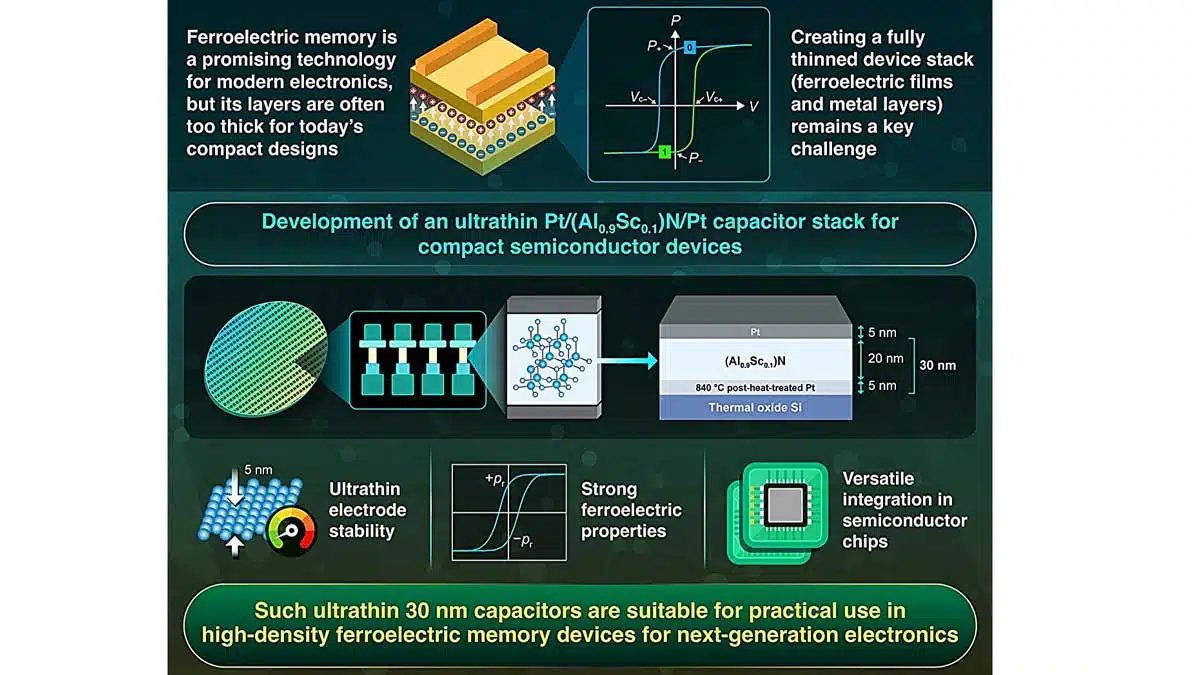
Credit: Institute of Science Tokyo

Credit: Institute of Science Tokyo

Researchers from the Institute of Science Tokyo demonstrated ultrathin ferroelectric capacitor stack with a total thickness of only 30 nm according to their published scientific paper in Advanced Electronic Materials.

Introduction

The article reports on the realization of an ultrathin ferroelectric capacitor stack with a total thickness of only 30 nm, including both top and bottom electrodes, while maintaining strong and stable electric polarization suitable for non-volatile memory applications. This work addresses the key challenge of scaling not only the ferroelectric film but the complete device structure for high-density embedded memory in advanced logic processes.​

RelatedPosts

Towards Green and Sustainable Supercapacitors

Mechano-Chemical Model of Sintered Tantalum Capacitor Pellets

Bourns BTJ Thermal Jumper Chips for PCB Heat Management

Ferroelectric capacitors are attractive for next-generation low-power memories because they store information in switchable polarization states that remain even when power is removed. However, conventional ferroelectric devices often lose performance as thickness is reduced, and previous research largely concentrated on thinning the ferroelectric layer alone rather than the integrated capacitor stack.​

In this study, researchers from the Institute of Science Tokyo and Canon ANELVA Corporation demonstrate a Pt/(Al,Sc)N/Pt capacitor stack using a scandium-substituted aluminum nitride film as the ferroelectric layer, optimized down to a 20 nm active layer with 5 nm electrodes on both sides. Their results highlight that careful control of stack design and electrode processing can preserve high remanent polarization and robust switching even under aggressive thickness scaling.​

Key points

  • Demonstration of an integrated Pt/(Al0.9_{0.9}0.9Sc0.1_{0.1}0.1)N/Pt ferroelectric capacitor stack with a total thickness of 30 nm, including 5 nm top and 5 nm bottom platinum electrodes.​
  • Use of scandium-substituted aluminum nitride ((Al,Sc)N) as the ferroelectric layer, leveraging its inherently high remanent polarization at nanometer-scale thicknesses.​
  • Focus on thickness scaling of the entire capacitor stack, not only the ferroelectric film, to better match real device integration requirements.​
  • Preservation of high ferroelectric performance and strong electric polarization despite the drastic reduction in total stack thickness.​
  • Post-deposition heat treatment of the bottom Pt electrode at 840 °C improves crystal orientation and enhances polarization switching behavior in the thin stacks.​
  • Fabricated capacitors exhibit characteristics compatible with direct embedding in semiconductor logic circuits for on-chip non-volatile memory.​
  • The results form a basis for scaling other ferroelectric device types, such as FeRAM and ferroelectric tunnel junctions (FTJs), which also depend on stable polarization switching and retention.​
  • Future directions include exploring alternative electrode materials with more favorable crystal orientations and reduced thermal budgets to improve device durability and manufacturability.​

Extended summary

The central problem addressed in the article is the challenge of achieving ultrathin ferroelectric capacitors that are not only functional at the material level but also realistic as integrated device stacks for embedded non-volatile memory in advanced electronics. As electronic systems continue to shrink, there is a strong demand for memory elements that occupy minimal area and thickness while maintaining reliable polarization switching and data retention without power. Prior work on ferroelectric memory scaling mainly pursued thinner ferroelectric layers, but frequently neglected the total stack thickness and the impact of electrodes and interfaces on device-level performance.​

To bridge this gap, the team led by Professor Hiroshi Funakubo at the Institute of Science Tokyo, working with Canon ANELVA, developed a three-layer metal–ferroelectric–metal capacitor stack using a (Al0.9_{0.9}0.9Sc0.1_{0.1}0.1)N thin film sandwiched between platinum electrodes. The chosen composition of scandium-substituted aluminum nitride is known to exhibit robust ferroelectric behavior, with high remanent polarization that can persist even when the film is reduced to nanometer dimensions. In the reported structure, the total thickness is limited to 30 nm, consisting of a 20 nm (Al0.9_{0.9}0.9Sc0.1_{0.1}0.1)N layer, a 5 nm bottom Pt electrode, and a 5 nm top Pt electrode.​

The fabrication strategy emphasizes not only ferroelectric layer deposition but also careful engineering of electrode properties and thermal processing. A critical step identified in the work is a post-heat treatment of the bottom Pt electrode at 840 °C, which enhances its crystal orientation. Improved electrode crystallinity in turn leads to better polarization switching in the ultrathin ferroelectric films, suggesting a strong coupling between electrode texture and ferroelectric domain behavior at these small dimensions.​

From a performance standpoint, the capacitors demonstrate strong electric polarization and high remanent polarization even with the severely reduced stack thickness. Remanent polarization—the polarization that remains after the external electric field is removed—is crucial for non-volatile memory, as it encodes the stored bit states. The study shows that the inherent ferroelectricity of (Al,Sc)N can be retained in a fully scaled stack and that the device-level configuration does not necessarily require thick electrodes or ferroelectric layers to ensure robust switching.​

The article emphasizes that scaling the full stack is essential for practical integration into logic circuits and semiconductor platforms. Ultra-thin, device-ready capacitors such as the reported Pt/(Al0.9_{0.9}0.9Sc0.1_{0.1}0.1)N/Pt stacks can be embedded alongside logic units, enabling compact on-chip memory with short interconnect distances and reduced parasitics. This integration pathway is especially relevant for Internet-of-Things (IoT) devices and mobile electronics, where space, power efficiency, and performance must be balanced carefully.​

Beyond the specific device reported, the study lays conceptual groundwork for thickness scaling in other ferroelectric memory architectures. For example, FeRAM and ferroelectric tunnel junctions (FTJs) also rely on stable, switchable polarization and would benefit from design principles that maintain ferroelectric performance at minimal thicknesses. Lessons from this work—such as the importance of electrode orientation, proper thermal treatments, and integrated stack optimization—could guide future designs in those related technologies.​

The authors also outline a path forward involving the exploration of alternative electrode materials with crystal orientations better matched to (Al,Sc)N and other ferroelectrics. Such materials might reduce the need for high-temperature processing, lowering the thermal budget and mitigating reliability concerns associated with aggressive annealing. Improved electrode–ferroelectric combinations could enhance durability and switching endurance, accelerating the adoption of ultrathin ferroelectric memories in industrial semiconductor lines.​

Conclusion

The reported 30 nm Pt/(Al0.9_{0.9}0.9Sc0.1_{0.1}0.1)N/Pt capacitor stack demonstrates that high ferroelectric performance can be retained even under aggressive thickness scaling of the complete device, not just the ferroelectric layer. This represents a meaningful advance toward realistic, ultrathin ferroelectric memory elements suitable for direct integration with logic circuits in compact, high-density electronics.​

At the same time, the work highlights limitations and open challenges, including the reliance on high-temperature treatments and the need to further optimize electrode materials and orientations for long-term device reliability. Future research aimed at lowering thermal requirements, improving endurance, and extending these design concepts to other ferroelectric architectures such as FeRAM and FTJs could further accelerate adoption in IoT and other miniaturized systems.​

References

  1. Institute of Science Tokyo, “New ultrathin ferroelectric capacitors show promise for compact memory devices,” TechXplore (Advanced Electronic Materials coverage). Available at: https://techxplore.com/news/2025-12-ultrathin-ferroelectric-capacitors-compact-memory.html
  2. S. Doko et al., “Thickness Scaling of Integrated Pt/(Al0.9_{0.9}0.9Sc0.1_{0.1}0.1)N/Pt Capacitor Stacks to 30 nm,” Advanced Electronic Materials (2025). DOI: 10.1002/aelm.202500451

Related

Recent Posts

Towards Green and Sustainable Supercapacitors

30.12.2025
15

Mechano-Chemical Model of Sintered Tantalum Capacitor Pellets

29.12.2025
33

Samsung Unveils World First CLLC Resonant 1kV 33nF C0G MLCC in 1210 Size

19.12.2025
57

Samsung MLCC Replacing Aluminum Polymer Capacitors in AI Systems

19.12.2025
84

Reliability Improvement in BaTiO3 MLCCs Using Ni–Sn and Ni–In Alloy Electrodes

19.12.2025
52

Mechanical Testing of Tantalum Anodes to Predict Tantalum Capacitor Quality

17.12.2025
42

Jianghai Offers Custom Bottom Cooled Screw Aluminum Capacitors

17.12.2025
46

TDK Unveils Vibration-Resistant Hybrid Polymer Aluminum Capacitors

15.12.2025
38

Samsungs Low ESL MLCCs to Power Next-Generation ADAS SoCs

10.12.2025
37

Upcoming Events

Jan 27
16:00 - 17:00 CET

Simplifying Vehicle Development with Automotive Ethernet and Zonal Smart Switch Technologies

Feb 24
16:00 - 17:00 CET

Designing Qi2 Wireless Power Systems: Practical Development and EMC Optimization

View Calendar

Popular Posts

  • Buck Converter Design and Calculation

    0 shares
    Share 0 Tweet 0
  • Boost Converter Design and Calculation

    0 shares
    Share 0 Tweet 0
  • LLC Resonant Converter Design and Calculation

    0 shares
    Share 0 Tweet 0
  • Flyback Converter Design and Calculation

    0 shares
    Share 0 Tweet 0
  • What Electronics Engineer Needs to Know About Passive Low Pass Filters

    0 shares
    Share 0 Tweet 0
  • Ripple Current and its Effects on the Performance of Capacitors

    3 shares
    Share 3 Tweet 0
  • Dual Active Bridge (DAB) Topology

    0 shares
    Share 0 Tweet 0
  • MLCC and Ceramic Capacitors

    0 shares
    Share 0 Tweet 0
  • SEPIC Converter Design and Calculation

    0 shares
    Share 0 Tweet 0
  • What is a Dielectric Constant and DF of Plastic Materials?

    4 shares
    Share 4 Tweet 0

Newsletter Subscription


Passive Components Blog

© EPCI - Leading Passive Components Educational and Information Site

  • Home
  • Privacy Policy
  • EPCI Membership & Advertisement
  • About

No Result
View All Result
  • Home
  • Knowledge Blog
  • PCNS

© EPCI - Leading Passive Components Educational and Information Site

This website uses cookies. By continuing to use this website you are giving consent to cookies being used. Visit our Privacy and Cookie Policy.
Go to mobile version