




Passive Components Blog
No Result
View All Result
  • Home
  • NewsFilter
    • All
    • Aerospace & Defence
    • Antenna
    • Applications
    • Automotive
    • Capacitors
    • Circuit Protection Devices
    • electro-mechanical news
    • Filters
    • Fuses
    • Inductors
    • Industrial
    • Integrated Passives
    • inter-connect news
    • Market & Supply Chain
    • Market Insights
    • Medical
    • Modelling and Simulation
    • New Materials & Supply
    • New Technologies
    • Non-linear Passives
    • Oscillators
    • Passive Sensors News
    • Resistors
    • RF & Microwave
    • Telecommunication
    • Weekly Digest

    Bourns Completes Rakon Acquisition, Enters Timing Market

    Knowles Releases 3825 X1/Y2 Safety MLCCs for High‑Voltage Applications

    Knowles Expands High Q Ceramic Core Inductors

    TAIYO YUDEN Releases 220uF 1210 Automotive MLCC

    HEICO’s Exxelia Expands High-Voltage Ceramic Capacitor Portfolio with CalRamic Acquisition

    Vishay Extends Automotive Ferrite Beads for High‑Current EMC Noise Filtering

    CapXon Earns EcoVadis Bronze Medal for Sustainability Performance

    All‑Water Supercapacitor Based on 1‑nm Clay Channels and Nanoconfined Water Electrolyte

    Littelfuse Unveils High‑Current 48V SMD Fuse for AI Data Center Protection

    Trending Tags

    • Ripple Current
    • RF
    • Leakage Current
    • Tantalum vs Ceramic
    • Snubber
    • Low ESR
    • Feedthrough
    • Derating
    • Dielectric Constant
    • New Products
    • Market Reports
  • VideoFilter
    • All
    • Antenna videos
    • Capacitor videos
    • Circuit Protection Video
    • Filter videos
    • Fuse videos
    • Inductor videos
    • Inter-Connect Video
    • Non-linear passives videos
    • Oscillator videos
    • Passive sensors videos
    • Resistor videos

    Why Isolated DC/DC Power Supplies Fail Late, Würth Elektronik Podcast

    Designing 800 V DC EMC Filters: Calculation, Simulation and Measurement

    Current Sense Transformer Datasheet and Design‑in Guide

    Designing a USB Type‑C Flyback Planar Transformer with Frenetic’s Planar Tool

    Magnetics Design in High‑Frequency GaN Converters

    Qi2 Wireless Charging: Inductors, Capacitors and EMC Filters

    Two‑capacitor paradox explained for engineers

    Capacitances of Nonlinear MLCCs: What Datasheets Don’t Tell You

    Tapped Inductor Buck Converter Fundamentals

    Trending Tags

    • Capacitors explained
    • Inductors explained
    • Resistors explained
    • Filters explained
    • Application Video Guidelines
    • EMC
    • New Products
    • Ripple Current
    • Simulation
    • Tantalum vs Ceramic
  • Knowledge Blog
  • DossiersNew
  • Suppliers
    • Who is Who
  • PCNS
    • PCNS 2025
    • PCNS 2023
    • PCNS 2021
    • PCNS 2019
    • PCNS 2017
  • Events
  • Home
  • NewsFilter
    • All
    • Aerospace & Defence
    • Antenna
    • Applications
    • Automotive
    • Capacitors
    • Circuit Protection Devices
    • electro-mechanical news
    • Filters
    • Fuses
    • Inductors
    • Industrial
    • Integrated Passives
    • inter-connect news
    • Market & Supply Chain
    • Market Insights
    • Medical
    • Modelling and Simulation
    • New Materials & Supply
    • New Technologies
    • Non-linear Passives
    • Oscillators
    • Passive Sensors News
    • Resistors
    • RF & Microwave
    • Telecommunication
    • Weekly Digest

    Bourns Completes Rakon Acquisition, Enters Timing Market

    Knowles Releases 3825 X1/Y2 Safety MLCCs for High‑Voltage Applications

    Knowles Expands High Q Ceramic Core Inductors

    TAIYO YUDEN Releases 220uF 1210 Automotive MLCC

    HEICO’s Exxelia Expands High-Voltage Ceramic Capacitor Portfolio with CalRamic Acquisition

    Vishay Extends Automotive Ferrite Beads for High‑Current EMC Noise Filtering

    CapXon Earns EcoVadis Bronze Medal for Sustainability Performance

    All‑Water Supercapacitor Based on 1‑nm Clay Channels and Nanoconfined Water Electrolyte

    Littelfuse Unveils High‑Current 48V SMD Fuse for AI Data Center Protection

    Trending Tags

    • Ripple Current
    • RF
    • Leakage Current
    • Tantalum vs Ceramic
    • Snubber
    • Low ESR
    • Feedthrough
    • Derating
    • Dielectric Constant
    • New Products
    • Market Reports
  • VideoFilter
    • All
    • Antenna videos
    • Capacitor videos
    • Circuit Protection Video
    • Filter videos
    • Fuse videos
    • Inductor videos
    • Inter-Connect Video
    • Non-linear passives videos
    • Oscillator videos
    • Passive sensors videos
    • Resistor videos

    Why Isolated DC/DC Power Supplies Fail Late, Würth Elektronik Podcast

    Designing 800 V DC EMC Filters: Calculation, Simulation and Measurement

    Current Sense Transformer Datasheet and Design‑in Guide

    Designing a USB Type‑C Flyback Planar Transformer with Frenetic’s Planar Tool

    Magnetics Design in High‑Frequency GaN Converters

    Qi2 Wireless Charging: Inductors, Capacitors and EMC Filters

    Two‑capacitor paradox explained for engineers

    Capacitances of Nonlinear MLCCs: What Datasheets Don’t Tell You

    Tapped Inductor Buck Converter Fundamentals

    Trending Tags

    • Capacitors explained
    • Inductors explained
    • Resistors explained
    • Filters explained
    • Application Video Guidelines
    • EMC
    • New Products
    • Ripple Current
    • Simulation
    • Tantalum vs Ceramic
  • Knowledge Blog
  • DossiersNew
  • Suppliers
    • Who is Who
  • PCNS
    • PCNS 2025
    • PCNS 2023
    • PCNS 2021
    • PCNS 2019
    • PCNS 2017
  • Events
No Result
View All Result
Passive Components Blog
No Result
View All Result

SCHURTER Releases Coin Cell Supercapacitors for Backup Power

10.2.2026
Reading Time: 6 mins read
A A

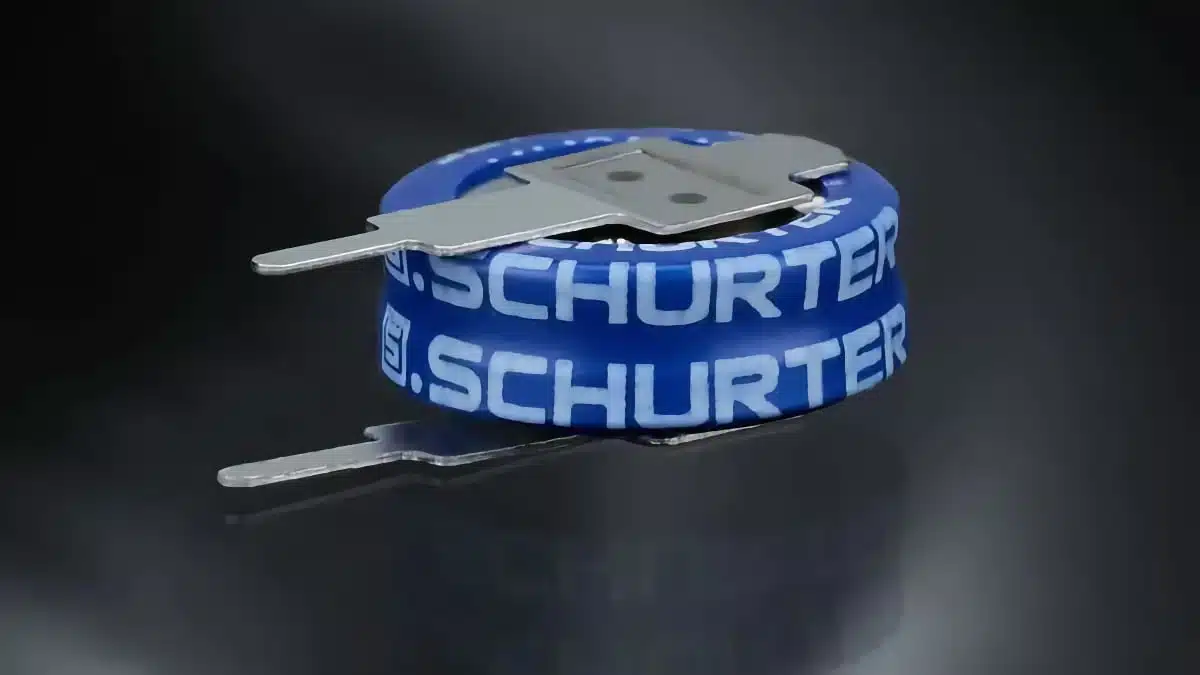
SCHURTER has introduced a new series of 5.5V coin cell supercapacitors designed as compact energy storage elements for low‑voltage electronics.

These SCHURTER supercapacitor devices target engineers who need fast charge/discharge capability and long cycle life for backup, ride‑through, and peak‑power support in space‑constrained designs.

RelatedPosts

SCHURTER Buys Biaodi to Boost High-Voltage Protection Portfolio

SCHURTER Releases SMT Micro Switch for Compact HMIs

SCHURTER Releases Compact SMT DIP Switches

Key features and benefits

Coin cell supercapacitors bridge the gap between conventional capacitors and rechargeable batteries in terms of energy and power handling.

Key characteristics of SCHURTER’s new coin cell supercapacitors include:

  • Form factor options:
    • SCCA series for horizontal mounting
    • SCCC series for vertical mounting
  • Operating in systems up to 5.5 V according to the manufacturer datasheet.
  • Capacitance range from 100 mF up to 1,500 mF according to the manufacturer datasheet.
  • Coin‑cell style package for compact board‑level integration.

From a circuit design perspective, these parts behave like high‑value capacitors with:

  • High power density, enabling very rapid charge and discharge.
  • Long cycle life, tolerating many more charge/discharge cycles than typical rechargeable batteries.
  • Fast response to load transients, making them suitable to support short, high current peaks and to buffer brief supply interruptions.

In practical terms, the lower energy density versus batteries means they will not replace a primary energy source for long‑duration supply, but they can excel wherever quick bursts of energy or reliable short‑term backup are needed.

Typical applications

SCHURTER positions the coin cell supercapacitors as a solution for a broad range of low‑voltage electronics that require short‑term energy storage.

Typical use cases include:

  • Real‑time clock (RTC) backup in microcontroller‑based systems.
  • Memory backup to retain volatile data during brief power outages.
  • Battery swap ride‑through, keeping logic and configuration alive while the main battery is replaced.
  • LED or audible alarm drivers that must operate briefly without the main supply.
  • Backup power supplies in small electronic devices, including portable or handheld equipment.
  • Support in renewable energy systems and medical devices where short‑term buffering and high cycle life are important.

For many of these applications, the coin cell supercapacitor can either replace a small rechargeable backup battery or be used alongside it to improve peak power capability and extend battery lifetime.

Technical highlights

The core technical parameters defined by SCHURTER for these coin cell supercapacitors are:

  • System voltage: up to 5.5 V (refer to series‑specific datasheet for exact ratings).
  • Capacitance: from 100 mF to 1,500 mF depending on variant.
  • Mounting style:
    • SCCA: horizontal mount coin cell supercapacitor.
    • SCCC: vertical mount coin cell supercapacitor.

From a system point of view:

  • The relatively high capacitance in a coin‑cell footprint allows sufficient stored charge for seconds‑level backup or ride‑through at low currents.
  • The high power density supports pulses of current where a conventional small electrolytic or ceramic might not provide enough energy without significant voltage droop.
  • The supercapacitor technology supports a large number of charge/discharge cycles, which is beneficial in designs that frequently switch between active, sleep, and backup modes.

Engineers should refer to the SCCA and SCCC datasheets for detailed electrical characteristics, leakage, ESR, temperature behavior, and lifetime data when finalizing their design.

Design‑in notes for engineers

When designing in coin cell supercapacitors such as SCHURTER’s SCCA and SCCC series, engineers should consider:

  • Energy budget:
    • Calculate the energy requirement of the load during backup or ride‑through using the expected current, time, and minimum acceptable voltage.
    • Select the capacitance and operating voltage so that the stored energy covers this budget with margin.
  • Voltage rating and derating:
    • Keep the working voltage below the maximum 5.5 V rating, with appropriate derating to enhance reliability and lifetime according to the datasheet guidance.
  • ESR and pulse current:
    • Check ESR values to ensure that voltage droop at peak current remains within acceptable limits for the load.
  • Mounting orientation and footprint:
    • Choose SCCA (horizontal) or SCCC (vertical) depending on board height constraints and mechanical design.
    • Verify footprint, keep‑out area, and any mechanical support needed under shock or vibration.
  • Charging and protection:
    • Implement controlled charging, current limiting, and any required protection circuitry recommended by the manufacturer to avoid overstress.
  • System‑level reliability:
    • Consider the impact of temperature, cycling frequency, and storage conditions on long‑term performance, and confirm lifetime figures in the datasheet.

For purchasing and component engineering teams, the presence of both horizontal and vertical versions in the same technology family can simplify AVL management while allowing mechanical flexibility across multiple designs.

Source

This article is based on information provided in SCHURTER’s official press release on the introduction of their SCCA and SCCC coin cell supercapacitors, complemented with general engineering context for design‑in and application use.


References

  1. SCHURTER press release: New coin cell supercapacitors
  2. SCHURTER SCCA coin cell supercapacitor datasheet
  3. SCHURTER SCCC coin cell supercapacitor datasheet

Related

Recent Posts

Bourns Completes Rakon Acquisition, Enters Timing Market

12.6.2026
3

Knowles Releases 3825 X1/Y2 Safety MLCCs for High‑Voltage Applications

11.6.2026
19

Knowles Expands High Q Ceramic Core Inductors

11.6.2026
16

TAIYO YUDEN Releases 220uF 1210 Automotive MLCC

11.6.2026
28

HEICO’s Exxelia Expands High-Voltage Ceramic Capacitor Portfolio with CalRamic Acquisition

10.6.2026
35

Vishay Extends Automotive Ferrite Beads for High‑Current EMC Noise Filtering

10.6.2026
22

CapXon Earns EcoVadis Bronze Medal for Sustainability Performance

10.6.2026
22

All‑Water Supercapacitor Based on 1‑nm Clay Channels and Nanoconfined Water Electrolyte

10.6.2026
31

Littelfuse Unveils High‑Current 48V SMD Fuse for AI Data Center Protection

9.6.2026
15

Upcoming Events

Jun 16
16:00 - 17:00 CEST

EMC with EMC – EMC‑compliant design with electromechanical connectors

Jul 14
16:00 - 17:00 CEST

EMC Design Essentials: Mastering Varistors and Common Mode Chokes

Jul 21
16:00 - 17:00 CEST

Safety by design: X and Y Interference suppression capacitors for power line filters

View Calendar

Popular Posts

  • Buck Converter Design and Calculation

    0 shares
    Share 0 Tweet 0
  • Boost Converter Design and Calculation

    0 shares
    Share 0 Tweet 0
  • MLCC and Ceramic Capacitors

    0 shares
    Share 0 Tweet 0
  • LLC Resonant Converter Design and Calculation

    0 shares
    Share 0 Tweet 0
  • Flyback Converter Design and Calculation

    0 shares
    Share 0 Tweet 0
  • SEPIC Converter Design and Calculation

    0 shares
    Share 0 Tweet 0
  • Dual Active Bridge (DAB) Topology

    0 shares
    Share 0 Tweet 0
  • What Electronics Engineer Needs to Know About Passive Low Pass Filters

    0 shares
    Share 0 Tweet 0
  • Earthing Systems and IEC Classification Explained

    0 shares
    Share 0 Tweet 0
  • Capacitor Charging and Discharging

    0 shares
    Share 0 Tweet 0

Newsletter Subscription


Passive Components Blog

© EPCI - Leading Passive Components Educational and Information Site

  • Home
  • Privacy Policy
  • EPCI Membership & Advertisement
  • About

No Result
View All Result
  • Home
  • Knowledge Blog
  • Dossiers
  • PCNS

© EPCI - Leading Passive Components Educational and Information Site

This website uses cookies. By continuing to use this website you are giving consent to cookies being used. Visit our Privacy and Cookie Policy.
Go to mobile version