








Passive Components Blog
No Result
View All Result
  • Home
  • NewsFilter
    • All
    • Aerospace & Defence
    • Antenna
    • Applications
    • Automotive
    • Capacitors
    • Circuit Protection Devices
    • electro-mechanical news
    • Filters
    • Fuses
    • Inductors
    • Industrial
    • Integrated Passives
    • inter-connect news
    • Market & Supply Chain
    • Market Insights
    • Medical
    • Modelling and Simulation
    • New Materials & Supply
    • New Technologies
    • Non-linear Passives
    • Oscillators
    • Passive Sensors News
    • Resistors
    • RF & Microwave
    • Telecommunication
    • Weekly Digest

    Modelithics COMPLETE Library v25.8 for Keysight ADS

    Taiyo Yuden Releases 165C Automotive Multilayer Metal Power Inductor in 1608 Size

    Energy-Controlled Structural Evolution of Amorphous Ta₂O₅ in Tantalum Anodes

    Jianghai Vibration‑Resistant Aluminum Capacitors Guidelines for Industrial Electronics

    2025 Top Passive Components Blog Articles

    Exxelia Releases Custom Smart Integrated Magnetics for Space Applications

    Credit: Institute of Science Tokyo

    Researchers Demonstrated 30nm Ferroelectric Capacitor for Compact Memory

    Towards Green and Sustainable Supercapacitors

    Mechano-Chemical Model of Sintered Tantalum Capacitor Pellets

    Trending Tags

    • Ripple Current
    • RF
    • Leakage Current
    • Tantalum vs Ceramic
    • Snubber
    • Low ESR
    • Feedthrough
    • Derating
    • Dielectric Constant
    • New Products
    • Market Reports
  • VideoFilter
    • All
    • Antenna videos
    • Capacitor videos
    • Circuit Protection Video
    • Filter videos
    • Fuse videos
    • Inductor videos
    • Inter-Connect Video
    • Non-linear passives videos
    • Oscillator videos
    • Passive sensors videos
    • Resistor videos

    One‑Pulse Characterization of Nonlinear Power Inductors

    Thermistor Linearization Challenges

    Coaxial Connectors and How to Connect with PCB

    PCB Manufacturing, Test Methods, Quality and Reliability

    Transformer Behavior – Current Transfer and Hidden Feedback

    Choosing the Right Capacitor: The Importance of Accurate Measurements

    RF Inductors: Selection and Design Challenges for High-Frequency Circuits

    Transformer Safety IEC 61558 Standard

    3-Phase EMI Filter Design, Simulation, Calculation and Test

    Trending Tags

    • Capacitors explained
    • Inductors explained
    • Resistors explained
    • Filters explained
    • Application Video Guidelines
    • EMC
    • New Products
    • Ripple Current
    • Simulation
    • Tantalum vs Ceramic
  • Knowledge Blog
  • Suppliers
    • Who is Who
  • PCNS
    • PCNS 2025
    • PCNS 2023
    • PCNS 2021
    • PCNS 2019
    • PCNS 2017
  • Events
  • Home
  • NewsFilter
    • All
    • Aerospace & Defence
    • Antenna
    • Applications
    • Automotive
    • Capacitors
    • Circuit Protection Devices
    • electro-mechanical news
    • Filters
    • Fuses
    • Inductors
    • Industrial
    • Integrated Passives
    • inter-connect news
    • Market & Supply Chain
    • Market Insights
    • Medical
    • Modelling and Simulation
    • New Materials & Supply
    • New Technologies
    • Non-linear Passives
    • Oscillators
    • Passive Sensors News
    • Resistors
    • RF & Microwave
    • Telecommunication
    • Weekly Digest

    Modelithics COMPLETE Library v25.8 for Keysight ADS

    Taiyo Yuden Releases 165C Automotive Multilayer Metal Power Inductor in 1608 Size

    Energy-Controlled Structural Evolution of Amorphous Ta₂O₅ in Tantalum Anodes

    Jianghai Vibration‑Resistant Aluminum Capacitors Guidelines for Industrial Electronics

    2025 Top Passive Components Blog Articles

    Exxelia Releases Custom Smart Integrated Magnetics for Space Applications

    Credit: Institute of Science Tokyo

    Researchers Demonstrated 30nm Ferroelectric Capacitor for Compact Memory

    Towards Green and Sustainable Supercapacitors

    Mechano-Chemical Model of Sintered Tantalum Capacitor Pellets

    Trending Tags

    • Ripple Current
    • RF
    • Leakage Current
    • Tantalum vs Ceramic
    • Snubber
    • Low ESR
    • Feedthrough
    • Derating
    • Dielectric Constant
    • New Products
    • Market Reports
  • VideoFilter
    • All
    • Antenna videos
    • Capacitor videos
    • Circuit Protection Video
    • Filter videos
    • Fuse videos
    • Inductor videos
    • Inter-Connect Video
    • Non-linear passives videos
    • Oscillator videos
    • Passive sensors videos
    • Resistor videos

    One‑Pulse Characterization of Nonlinear Power Inductors

    Thermistor Linearization Challenges

    Coaxial Connectors and How to Connect with PCB

    PCB Manufacturing, Test Methods, Quality and Reliability

    Transformer Behavior – Current Transfer and Hidden Feedback

    Choosing the Right Capacitor: The Importance of Accurate Measurements

    RF Inductors: Selection and Design Challenges for High-Frequency Circuits

    Transformer Safety IEC 61558 Standard

    3-Phase EMI Filter Design, Simulation, Calculation and Test

    Trending Tags

    • Capacitors explained
    • Inductors explained
    • Resistors explained
    • Filters explained
    • Application Video Guidelines
    • EMC
    • New Products
    • Ripple Current
    • Simulation
    • Tantalum vs Ceramic
  • Knowledge Blog
  • Suppliers
    • Who is Who
  • PCNS
    • PCNS 2025
    • PCNS 2023
    • PCNS 2021
    • PCNS 2019
    • PCNS 2017
  • Events
No Result
View All Result
Passive Components Blog
No Result
View All Result

Researchers Demonstrated High Energy Ceramic Capacitors Stable in Wide Temperature Range

2.10.2025
Reading Time: 4 mins read
A A

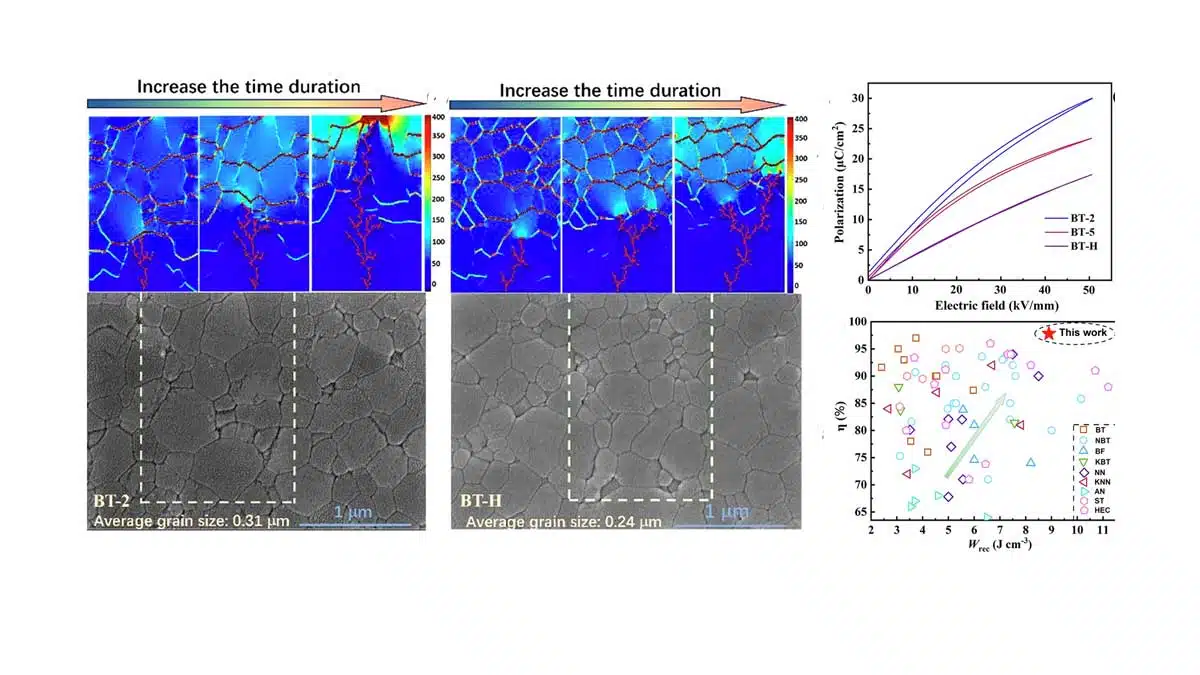
Researchers from Shanghai, China published paper in Nature Communications Journal that explores a high-entropy engineering strategy applied to relaxor ferroelectric ceramics, specifically transforming BT-Bi(Mg0.5Zr0.5)O3 into BT-H through dual-phase cationic disorder modulation.

The result is a material with exceptional energy storage performance and thermal resilience.

Introduction

Dielectric ceramic capacitors are vital components in modern electronics due to their high power density and rapid charge/discharge capabilities. However, achieving both high energy density and ultrawide temperature stability remains a challenge.

Key Points

  • High-entropy ceramics (BT-H) achieve 8.9 J/cm³ recoverable energy density.
  • Conversion efficiency reaches 97.8% with minimal hysteresis.
  • Stable performance across −85°C to 220°C with ±9% energy variation.
  • Atomic-scale disorder and multiphase coexistence enhance dielectric properties.

1. High-Entropy Strategy and Material Design

The BT-H system is derived by substituting the B-site cations in BT-BM with a cocktail of five elements (Mg, Zn, Al, Sn, Zr) and introducing NaTaO3. This increases the configurational entropy (Sconfig) and promotes atomic-scale polar inhomogeneity. The coexistence of multiple perovskite phases (orthorhombic, rhombohedral, tetragonal, cubic) facilitates smoother energy transitions and reduces hysteresis.

2. Microstructure and Breakdown Strength

SEM analysis reveals compact grain structures with reduced grain size from 0.31 μm to 0.23 μm. This refinement enhances breakdown strength (Eb) due to suppressed grain boundary migration. UV-vis spectroscopy shows an increased bandgap (Eg = 3.38 eV), indicating improved intrinsic breakdown resistance.

SampleGrain Size (μm)Bandgap (eV)
BT-20.313.12
BT-H0.233.38

3. Dielectric and Relaxor Behavior

BT-H ceramics exhibit relaxor ferroelectric behavior with a modified Curie–Weiss slope γ > 1.5. The transition temperature Tm shifts below room temperature, indicating a superparaelectric (SPE) state. This state minimizes dipolar interactions and hysteresis, enhancing energy efficiency.

4. Energy Storage Performance

Unipolar P-E loops show needle-like shapes with near-zero remanent polarization (Pr < 0.4 μC/cm³). Under 83.3 kV/mm, BT-H achieves:

SampleWrec (J/cm³)η (%)
BT-26.092.1
BT-H8.997.8

The energy density increases linearly with electric field, while Pr remains low, confirming entropy-induced suppression of long-range polar domains.

5. Temperature Stability and Raman Analysis

BT-H maintains stable polarization and efficiency across −85°C to 220°C. Raman spectra show minimal shifts in Ti-O bond modes, indicating robust thermal stability of polar configurations.

Temperature (°C)ΔWrec (%)Δη (%)
−85 to 220±9±4.8

6. Atomic-Scale Structure and Phase Coexistence

HAADF-STEM imaging reveals disordered oxygen octahedral tilts and multiphase coexistence. The polarization vector mapping shows a predominance of tetragonal phase (61.7%), with rhombohedral and orthorhombic phases contributing to local heterogeneity.

7. Phase-Field Simulation and Theoretical Validation

Simulations confirm that domain sizes remain below 5 nm and exhibit minimal temperature dependence. The Ginzburg–Landau equation governs polarization evolution:

\[ \dot{P}_i = -\alpha \left[ \frac{\partial H}{\partial P_i} – \left( \frac{\partial H}{\partial P_{i,j}} \right)_{,j} \right] \]

This supports the observed near-zero hysteresis and stable energy storage behavior across extreme conditions.

Conclusion

The BT-H high-entropy relaxor ferroelectric ceramics represent a breakthrough in dielectric energy storage. Through entropy engineering, they achieve high energy density, ultrahigh efficiency, and exceptional temperature stability. These properties make BT-H a promising candidate for capacitors in electric vehicles, aerospace, and high-precision electronics operating under extreme conditions.

RelatedPosts

Modelithics COMPLETE Library v25.8 for Keysight ADS

Taiyo Yuden Releases 165C Automotive Multilayer Metal Power Inductor in 1608 Size

Energy-Controlled Structural Evolution of Amorphous Ta₂O₅ in Tantalum Anodes

Read the complete paper:

Zhou, S., Zhou, Y., Li, L. et al. Ultrawide-temperature-stable high-entropy relaxor ferroelectrics for energy-efficient capacitors. Nat Commun 16, 8456 (2025). https://doi.org/10.1038/s41467-025-63173-z

Related

Source: Nature Communications

Recent Posts

Modelithics COMPLETE Library v25.8 for Keysight ADS

7.1.2026
9

Taiyo Yuden Releases 165C Automotive Multilayer Metal Power Inductor in 1608 Size

7.1.2026
8

Energy-Controlled Structural Evolution of Amorphous Ta₂O₅ in Tantalum Anodes

6.1.2026
20

Jianghai Vibration‑Resistant Aluminum Capacitors Guidelines for Industrial Electronics

6.1.2026
10

2025 Top Passive Components Blog Articles

5.1.2026
47

Exxelia Releases Custom Smart Integrated Magnetics for Space Applications

5.1.2026
25
Credit: Institute of Science Tokyo

Researchers Demonstrated 30nm Ferroelectric Capacitor for Compact Memory

2.1.2026
23

Towards Green and Sustainable Supercapacitors

30.12.2025
36

Mechano-Chemical Model of Sintered Tantalum Capacitor Pellets

29.12.2025
44

Upcoming Events

Jan 27
16:00 - 17:00 CET

Simplifying Vehicle Development with Automotive Ethernet and Zonal Smart Switch Technologies

Feb 24
16:00 - 17:00 CET

Designing Qi2 Wireless Power Systems: Practical Development and EMC Optimization

View Calendar

Popular Posts

  • Buck Converter Design and Calculation

    0 shares
    Share 0 Tweet 0
  • Boost Converter Design and Calculation

    0 shares
    Share 0 Tweet 0
  • LLC Resonant Converter Design and Calculation

    0 shares
    Share 0 Tweet 0
  • Flyback Converter Design and Calculation

    0 shares
    Share 0 Tweet 0
  • What Electronics Engineer Needs to Know About Passive Low Pass Filters

    0 shares
    Share 0 Tweet 0
  • Ripple Current and its Effects on the Performance of Capacitors

    3 shares
    Share 3 Tweet 0
  • MLCC and Ceramic Capacitors

    0 shares
    Share 0 Tweet 0
  • Dual Active Bridge (DAB) Topology

    0 shares
    Share 0 Tweet 0
  • What is a Dielectric Constant and DF of Plastic Materials?

    4 shares
    Share 4 Tweet 0
  • SEPIC Converter Design and Calculation

    0 shares
    Share 0 Tweet 0

Newsletter Subscription


Passive Components Blog

© EPCI - Leading Passive Components Educational and Information Site

  • Home
  • Privacy Policy
  • EPCI Membership & Advertisement
  • About

No Result
View All Result
  • Home
  • Knowledge Blog
  • PCNS

© EPCI - Leading Passive Components Educational and Information Site

This website uses cookies. By continuing to use this website you are giving consent to cookies being used. Visit our Privacy and Cookie Policy.
Go to mobile version