



Passive Components Blog
No Result
View All Result
  • Home
  • NewsFilter
    • All
    • Aerospace & Defence
    • Antenna
    • Applications
    • Automotive
    • Capacitors
    • Circuit Protection Devices
    • electro-mechanical news
    • Filters
    • Fuses
    • Inductors
    • Industrial
    • Integrated Passives
    • inter-connect news
    • Market & Supply Chain
    • Market Insights
    • Medical
    • Modelling and Simulation
    • New Materials & Supply
    • New Technologies
    • Non-linear Passives
    • Oscillators
    • Passive Sensors News
    • Resistors
    • RF & Microwave
    • Telecommunication
    • Weekly Digest

    Skeleton Supercapacitor Achieves UL‑certified 3,500 A Peak Current for AI Data Centers

    Bourns Planar Transformers for SiC and GaN Gate Driver Isolation

    100 V Hybrid Polymer Capacitor from VINA Enesol Targets 48–72 V Power Platforms

    Panasonic Releases Relays for IEC 62955 Compliant Single‑Phase EV Wallboxes

    KYOCERA AVX Releases NTN Antenna Selection Guide Brochure

    Coilcraft Releases 0402 Ferrite-Core Wirewound Chip Inductors for RF and EMI Control

    DigiKey Releases Season Two of Sustainable Futures Series

    Using a Virtual Anode Thermal Model to Evaluate Miniaturization Risk in Tantalum Capacitors

    Bourns Introduced High-Current Coupled Inductor for 48 V Hybrid and IBC Converters

    Trending Tags

    • Ripple Current
    • RF
    • Leakage Current
    • Tantalum vs Ceramic
    • Snubber
    • Low ESR
    • Feedthrough
    • Derating
    • Dielectric Constant
    • New Products
    • Market Reports
  • VideoFilter
    • All
    • Antenna videos
    • Capacitor videos
    • Circuit Protection Video
    • Filter videos
    • Fuse videos
    • Inductor videos
    • Inter-Connect Video
    • Non-linear passives videos
    • Oscillator videos
    • Passive sensors videos
    • Resistor videos

    EMC‑Compliant PCB and Connector Design Guidelines

    Why Isolated DC/DC Power Supplies Fail Late, Würth Elektronik Podcast

    Designing 800 V DC EMC Filters: Calculation, Simulation and Measurement

    Current Sense Transformer Datasheet and Design‑in Guide

    Designing a USB Type‑C Flyback Planar Transformer with Frenetic’s Planar Tool

    Magnetics Design in High‑Frequency GaN Converters

    Qi2 Wireless Charging: Inductors, Capacitors and EMC Filters

    Two‑capacitor paradox explained for engineers

    Capacitances of Nonlinear MLCCs: What Datasheets Don’t Tell You

    Trending Tags

    • Capacitors explained
    • Inductors explained
    • Resistors explained
    • Filters explained
    • Application Video Guidelines
    • EMC
    • New Products
    • Ripple Current
    • Simulation
    • Tantalum vs Ceramic
  • Knowledge Blog
  • DossiersNew
  • Suppliers
    • Who is Who
  • PCNS
    • PCNS 2025
    • PCNS 2023
    • PCNS 2021
    • PCNS 2019
    • PCNS 2017
  • Events
  • Home
  • NewsFilter
    • All
    • Aerospace & Defence
    • Antenna
    • Applications
    • Automotive
    • Capacitors
    • Circuit Protection Devices
    • electro-mechanical news
    • Filters
    • Fuses
    • Inductors
    • Industrial
    • Integrated Passives
    • inter-connect news
    • Market & Supply Chain
    • Market Insights
    • Medical
    • Modelling and Simulation
    • New Materials & Supply
    • New Technologies
    • Non-linear Passives
    • Oscillators
    • Passive Sensors News
    • Resistors
    • RF & Microwave
    • Telecommunication
    • Weekly Digest

    Skeleton Supercapacitor Achieves UL‑certified 3,500 A Peak Current for AI Data Centers

    Bourns Planar Transformers for SiC and GaN Gate Driver Isolation

    100 V Hybrid Polymer Capacitor from VINA Enesol Targets 48–72 V Power Platforms

    Panasonic Releases Relays for IEC 62955 Compliant Single‑Phase EV Wallboxes

    KYOCERA AVX Releases NTN Antenna Selection Guide Brochure

    Coilcraft Releases 0402 Ferrite-Core Wirewound Chip Inductors for RF and EMI Control

    DigiKey Releases Season Two of Sustainable Futures Series

    Using a Virtual Anode Thermal Model to Evaluate Miniaturization Risk in Tantalum Capacitors

    Bourns Introduced High-Current Coupled Inductor for 48 V Hybrid and IBC Converters

    Trending Tags

    • Ripple Current
    • RF
    • Leakage Current
    • Tantalum vs Ceramic
    • Snubber
    • Low ESR
    • Feedthrough
    • Derating
    • Dielectric Constant
    • New Products
    • Market Reports
  • VideoFilter
    • All
    • Antenna videos
    • Capacitor videos
    • Circuit Protection Video
    • Filter videos
    • Fuse videos
    • Inductor videos
    • Inter-Connect Video
    • Non-linear passives videos
    • Oscillator videos
    • Passive sensors videos
    • Resistor videos

    EMC‑Compliant PCB and Connector Design Guidelines

    Why Isolated DC/DC Power Supplies Fail Late, Würth Elektronik Podcast

    Designing 800 V DC EMC Filters: Calculation, Simulation and Measurement

    Current Sense Transformer Datasheet and Design‑in Guide

    Designing a USB Type‑C Flyback Planar Transformer with Frenetic’s Planar Tool

    Magnetics Design in High‑Frequency GaN Converters

    Qi2 Wireless Charging: Inductors, Capacitors and EMC Filters

    Two‑capacitor paradox explained for engineers

    Capacitances of Nonlinear MLCCs: What Datasheets Don’t Tell You

    Trending Tags

    • Capacitors explained
    • Inductors explained
    • Resistors explained
    • Filters explained
    • Application Video Guidelines
    • EMC
    • New Products
    • Ripple Current
    • Simulation
    • Tantalum vs Ceramic
  • Knowledge Blog
  • DossiersNew
  • Suppliers
    • Who is Who
  • PCNS
    • PCNS 2025
    • PCNS 2023
    • PCNS 2021
    • PCNS 2019
    • PCNS 2017
  • Events
No Result
View All Result
Passive Components Blog
No Result
View All Result

Overvoltage and Transient Protection for DC/DC Power Modules

13.11.2025
Reading Time: 12 mins read
A A

This presentation from Würth Elektronik by Timur Uludag delves into overvoltage protection for safe operation-transient protection for non-isolated DC/DC Power Modules in a practical case study of advanced input transient protection for 24V non-isolated DC/DC power module.

Key Takeaways

  • This article discusses advanced overvoltage protection for non-isolated DC/DC Power Module applications.
  • Unmitigated voltage transients can damage sensitive components, causing operational downtime.
  • Implementing a two-stage protection system with a TVS diode and passive LC filter enhances reliability.
  • Designing robust filters requires careful selection of components and consideration of temperature effects.
  • Merging immunity and emission filters can optimize space, but thorough validation is essential for effectiveness.

Introduction

Industrial systems utilizing non-isolated DC/DC power modules are increasingly exposed to disruptive voltage transients that can induce catastrophic failures and operational downtime.

Effective overvoltage and transient suppression is crucial for ensuring reliability and compliance with EMC regulations. This white paper explores advanced filter concepts for transient protection, focusing on a two-stage approach suited to typical 24V bus applications found in industrial environments.

1. Understanding Voltage Transients and Their Effects

1.1 What Are Voltage Transients?

Transients are short-term deviations in voltage which exceed the nominal operational range of a system. In a regulated 24V bus, any spike above the design limit is termed a transient, often triggered by external events (e.g., lightning) or internally by switching loads.

1.2 Impact of Transients in Industrial Applications

Unmitigated transients can:

  • Destroy sensitive input stages of DC/DC modules
  • Propagate across the system causing multi-point damage
  • Lead to costly downtimes and increased maintenance
Source TypeExampleEffect
ExternalLightning strike entering mainsHigh-energy system-wide surge
InternalMotor load dump, frequency converter cross-couplingLocalized voltage spikes

2. Core Protection Concepts for 24V DC/DC Power Modules

2.1 Structure of the Protection System

The recommended input protection system relies on a two-stage configuration:

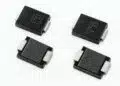
  1. TVS Diode Stage (Immunity Filter): Rapidly clamps high overvoltages during surge events.
  2. Passive LC Filter Stage: Attenuates residual voltages above the safe operating threshold of the module.

2.2 Why Two Stages?

Relying solely on a TVS diode is insufficient due to its temperature dependence and finite clamping capability. The LC filter manages transients not fully suppressed by the TVS, ensuring complete system protection.

3. Designing a Robust Input Filter: Parameters and Equations

3.1 Key Parameters for TVS Selection

Select a TVS diode using:

  • System supply voltage (VDC)
  • Breakdown voltage (VBR)
  • Peak pulse current and power dissipation
  • Maximum clamping voltage at given peak current (VClamp,max)

A properly chosen TVS diode has VBR above the maximum operating bus voltage but below the absolute maximum rating of connected modules.

3.2 Temperature Effects on TVS Diode Behavior

Clamping voltage rises with temperature, requiring de-rating: VClamp,max(T) = VClamp,25°C × (1 + α × ΔT) Where α is the temperature coefficient, and ΔT is temperature rise from 25°C.

For example, a laboratory value of 48.4V at 25°C could increase to 49.8V at 55°C (approx. 3% rise).

3.3 LC Filter Dimensioning and Trade-offs

The LC filter must ensure that VPM,max (absolute max allowable input voltage from module datasheet) is not exceeded.

Required attenuation (in decibels) is found by: AdB = 20 × log₁₀(VClamp,max / VPM,max)

For a real world example:

  • VDC = 30V (max on 24V bus)
  • TVS VClamp,max = 49.8V (at 55°C)
  • Module VPM,max = 44V
  • Calculated attenuation ≈ 1.08 dB
Inductor (μH)Capacitor (μF)Description
12280Typical configuration @ 55°C
20110If higher inductor used, lower capacitor value possible
5600If lower inductor used, larger capacitor needed

4. Advanced Considerations and Practical Tips

4.1 The Consequence of Temperature Neglect

If temperature effect on VClamp,max is ignored, the chosen capacitor may be undervalued by >20%, leading to inadequate attenuation and potential system failure.

4.2 Merging Immunity and Emission Filters

It is possible to combine the immunity (protection) and emission (EMC) filter into a single LC structure, but this requires thorough validation under real measurement conditions to balance both functions effectively.

4.3 Data Sheet Use and Practical Selection

Always refer to module and TVS manufacturer datasheets for:

  • Input capacitance (CIN)
  • Clamping voltages across temperature
  • Recommended filter layouts

4.4 Special Applications: Wide Temperature and Input Voltage Ranges

For extended application requirements (e.g., -40°C to 85°C, 18–36V buses), consult the supplier’s tools or application notes for suitable TVS and filters.

Conclusion

Robust transient protection in 24V DC/DC power module applications requires a two-stage input filter approach: a correctly specified TVS diode for high-speed surge suppression and a dimensioned LC filter for residual transient attenuation.

Temperature, worst-case input scenarios, and careful reference to datasheets and application notes are vital for safe, EMC-compliant system design. For combined immunity and emission filtering or extended application conditions, seek further application guidance and empirically validate filter designs.

FAQ: Overvoltage and Transient Protection for Non-Isolated DC/DC Power Modules

What are voltage transients?

Voltage transients are short-term deviations from the nominal value of a bus voltage, often caused by lightning strikes or internal switching events such as motor operations. These spikes can exceed defined tolerance ranges and lead to destructive effects within electrical systems.

Why do DC/DC power modules need input filter protection?

ithout adequate input filtering, destructive transients can damage the module’s input stage and propagate through the entire industrial system, causing downtime and costly repairs.

How does the two-stage filter concept work?

The first stage uses a TVS diode to clamp high-energy spikes. The second stage employs a passive LC filter to attenuate remaining voltages and ensure they do not exceed the maximum ratings of DC/DC modules.

Why can’t a TVS diode alone guarantee safe operation?

TVS diodes are temperature-dependent and have limited clamping capabilities. High-temperature environments can increase clamping voltage, making a supplementary LC filter necessary for comprehensive protection.

What is the risk of incorrect filter dimensioning?

Choosing capacitor and inductor values without considering temperature or worst-case transient voltages leads to insufficient damping. This can result in permanent damage to the power module and further propagation of transients.

Can immunity and emission filters be merged?

It is possible but requires careful measurement and validation to ensure both EMC and transient protection. Exact values depend on system configuration and target compliance standards.

How-to: Design a Two-Stage Input Filter for Transient Protection

  1. Define Your Bus Specifications

    Identify the nominal and maximum DC bus voltage (e.g. 24 V nominal, 30 V max for industrial buses).

  2. Select an Appropriate TVS Diode

    Choose a TVS diode with:
    – Breakdown voltage (VBR) higher than the maximum operating voltage but lower than the absolute max rating.
    – Adequate peak current and power dissipation for your application.
    – Maximum clamping voltage at relevant temperature (e.g. consider 55°C instead of only 25°C).

  3. Calculate Required LC Filter Attenuation

    Use attenuation formula:

    Attenuation (dB) = 20 × log₁₀(VClamp,max / VModule,max)

    Example: If VClamp,max = 49.8 V (at 55°C) and VModule,max = 44 V, attenuation ≈ 1.08 dB.

  4. Determine Filter Component Values

    Based on attenuation, select a suitable combination of inductor and capacitor, such as:
    – 12 μH inductor and 280 μF capacitor for typical industrial setups.
    Adjust these based on available components and temperature coefficients.

  5. Validate With Real World Conditions

    Check the filter’s behavior under full operating temperature range and worst-case transients. Use manufacturer datasheets and simulation if available.

    RelatedPosts

    Würth Elektronik Expands Nanocrystalline Cable Cores for Broadband EMI Suppression

    EMC‑Compliant PCB and Connector Design Guidelines

    Würth Elektroniks Flexible EMI Shielding Sheets Provides Quick and Easy Schielding Solution

  6. Optionally Merge Immunity and Emission Filters

    For space or cost optimization, consider merging the stages, but test thoroughly to maintain both EMC and transient suppression.

Related

Source: Würth Elektronik

Recent Posts

Bourns Introduced Automotive TVS Diodes for Compact ESD Protection

23.6.2026
18

SCHURTER Introduces PPTC Resettable Overcurrent Protection for Compact Electronics

18.6.2026
34

Würth Elektroniks Flexible EMI Shielding Sheets Provides Quick and Easy Schielding Solution

17.6.2026
49

Why Isolated DC/DC Power Supplies Fail Late, Würth Elektronik Podcast

8.6.2026
96

Power Converter Dossier: Passive Components Design and Selection Guide 2026

5.6.2026
76

Designing 800 V DC EMC Filters: Calculation, Simulation and Measurement

4.6.2026
157

GDT Gas Discharge Tubes: Surge Protection Fundamentals, Selection, and Design‑in Tips

25.5.2026
160

Automotive Passive Components Technology Dossier

5.6.2026
111

Murata Expands Thermistor Production Capacity at Yokaichi Plant

21.5.2026
63

Upcoming Events

Jun 30
17:00 - 18:00 CEST

PSMA Capacitor Committee Webinar: High Voltage Pulse Capacitors

Jul 14
16:00 - 17:00 CEST

EMC Design Essentials: Mastering Varistors and Common Mode Chokes

Jul 21
16:00 - 17:00 CEST

Safety by design: X and Y Interference suppression capacitors for power line filters

View Calendar

Popular Posts

  • Boost Converter Design and Calculation

    0 shares
    Share 0 Tweet 0
  • Buck Converter Design and Calculation

    0 shares
    Share 0 Tweet 0
  • LLC Resonant Converter Design and Calculation

    0 shares
    Share 0 Tweet 0
  • Flyback Converter Design and Calculation

    0 shares
    Share 0 Tweet 0
  • MLCC and Ceramic Capacitors

    0 shares
    Share 0 Tweet 0
  • Nvidia Vera Rubin: Why One AI Rack Needs So Many More MLCC Capacitors

    0 shares
    Share 0 Tweet 0
  • Earthing Systems and IEC Classification Explained

    0 shares
    Share 0 Tweet 0
  • Dual Active Bridge (DAB) Topology

    0 shares
    Share 0 Tweet 0
  • SEPIC Converter Design and Calculation

    0 shares
    Share 0 Tweet 0
  • MLCC Case Sizes Standards Explained

    0 shares
    Share 0 Tweet 0

Newsletter Subscription


Passive Components Blog

© EPCI - Leading Passive Components Educational and Information Site

  • Home
  • Privacy Policy
  • EPCI Membership & Advertisement
  • About

No Result
View All Result
  • Home
  • Knowledge Blog
  • Dossiers
  • PCNS

© EPCI - Leading Passive Components Educational and Information Site

This website uses cookies. By continuing to use this website you are giving consent to cookies being used. Visit our Privacy and Cookie Policy.
Go to mobile version