












Passive Components Blog
No Result
View All Result
  • Home
  • NewsFilter
    • All
    • Aerospace & Defence
    • Antenna
    • Applications
    • Automotive
    • Capacitors
    • Circuit Protection Devices
    • electro-mechanical news
    • Filters
    • Fuses
    • Inductors
    • Industrial
    • Integrated Passives
    • inter-connect news
    • Market & Supply Chain
    • Market Insights
    • Medical
    • Modelling and Simulation
    • New Materials & Supply
    • New Technologies
    • Non-linear Passives
    • Oscillators
    • Passive Sensors News
    • Resistors
    • RF & Microwave
    • Telecommunication
    • Weekly Digest

    Bourns BTJ Thermal Jumper Chips for PCB Heat Management

    One‑Pulse Characterization of Nonlinear Power Inductors

    Wk 51 Electronics Supply Chain Digest

    Samsung Unveils World First CLLC Resonant 1kV 33nF C0G MLCC in 1210 Size

    Bourns Releases 500VDC 690VAC Fuse to Protect Power Semiconductors

    Samsung MLCC Replacing Aluminum Polymer Capacitors in AI Systems

    Reliability Improvement in BaTiO3 MLCCs Using Ni–Sn and Ni–In Alloy Electrodes

    Littelfuse Introduces Automotive Current Sensors for EV Battery, Motor, and Safety Systems

    Vishay Releases Fast Acting Thin Film Chip Fuses

    Trending Tags

    • Ripple Current
    • RF
    • Leakage Current
    • Tantalum vs Ceramic
    • Snubber
    • Low ESR
    • Feedthrough
    • Derating
    • Dielectric Constant
    • New Products
    • Market Reports
  • VideoFilter
    • All
    • Antenna videos
    • Capacitor videos
    • Circuit Protection Video
    • Filter videos
    • Fuse videos
    • Inductor videos
    • Inter-Connect Video
    • Non-linear passives videos
    • Oscillator videos
    • Passive sensors videos
    • Resistor videos

    One‑Pulse Characterization of Nonlinear Power Inductors

    Thermistor Linearization Challenges

    Coaxial Connectors and How to Connect with PCB

    PCB Manufacturing, Test Methods, Quality and Reliability

    Transformer Behavior – Current Transfer and Hidden Feedback

    Choosing the Right Capacitor: The Importance of Accurate Measurements

    RF Inductors: Selection and Design Challenges for High-Frequency Circuits

    Transformer Safety IEC 61558 Standard

    3-Phase EMI Filter Design, Simulation, Calculation and Test

    Trending Tags

    • Capacitors explained
    • Inductors explained
    • Resistors explained
    • Filters explained
    • Application Video Guidelines
    • EMC
    • New Products
    • Ripple Current
    • Simulation
    • Tantalum vs Ceramic
  • Knowledge Blog
  • Suppliers
    • Who is Who
  • PCNS
    • PCNS 2025
    • PCNS 2023
    • PCNS 2021
    • PCNS 2019
    • PCNS 2017
  • Events
  • Home
  • NewsFilter
    • All
    • Aerospace & Defence
    • Antenna
    • Applications
    • Automotive
    • Capacitors
    • Circuit Protection Devices
    • electro-mechanical news
    • Filters
    • Fuses
    • Inductors
    • Industrial
    • Integrated Passives
    • inter-connect news
    • Market & Supply Chain
    • Market Insights
    • Medical
    • Modelling and Simulation
    • New Materials & Supply
    • New Technologies
    • Non-linear Passives
    • Oscillators
    • Passive Sensors News
    • Resistors
    • RF & Microwave
    • Telecommunication
    • Weekly Digest

    Bourns BTJ Thermal Jumper Chips for PCB Heat Management

    One‑Pulse Characterization of Nonlinear Power Inductors

    Wk 51 Electronics Supply Chain Digest

    Samsung Unveils World First CLLC Resonant 1kV 33nF C0G MLCC in 1210 Size

    Bourns Releases 500VDC 690VAC Fuse to Protect Power Semiconductors

    Samsung MLCC Replacing Aluminum Polymer Capacitors in AI Systems

    Reliability Improvement in BaTiO3 MLCCs Using Ni–Sn and Ni–In Alloy Electrodes

    Littelfuse Introduces Automotive Current Sensors for EV Battery, Motor, and Safety Systems

    Vishay Releases Fast Acting Thin Film Chip Fuses

    Trending Tags

    • Ripple Current
    • RF
    • Leakage Current
    • Tantalum vs Ceramic
    • Snubber
    • Low ESR
    • Feedthrough
    • Derating
    • Dielectric Constant
    • New Products
    • Market Reports
  • VideoFilter
    • All
    • Antenna videos
    • Capacitor videos
    • Circuit Protection Video
    • Filter videos
    • Fuse videos
    • Inductor videos
    • Inter-Connect Video
    • Non-linear passives videos
    • Oscillator videos
    • Passive sensors videos
    • Resistor videos

    One‑Pulse Characterization of Nonlinear Power Inductors

    Thermistor Linearization Challenges

    Coaxial Connectors and How to Connect with PCB

    PCB Manufacturing, Test Methods, Quality and Reliability

    Transformer Behavior – Current Transfer and Hidden Feedback

    Choosing the Right Capacitor: The Importance of Accurate Measurements

    RF Inductors: Selection and Design Challenges for High-Frequency Circuits

    Transformer Safety IEC 61558 Standard

    3-Phase EMI Filter Design, Simulation, Calculation and Test

    Trending Tags

    • Capacitors explained
    • Inductors explained
    • Resistors explained
    • Filters explained
    • Application Video Guidelines
    • EMC
    • New Products
    • Ripple Current
    • Simulation
    • Tantalum vs Ceramic
  • Knowledge Blog
  • Suppliers
    • Who is Who
  • PCNS
    • PCNS 2025
    • PCNS 2023
    • PCNS 2021
    • PCNS 2019
    • PCNS 2017
  • Events
No Result
View All Result
Passive Components Blog
No Result
View All Result

Key Interconnect Technologies for 2025

5.12.2025
Reading Time: 3 mins read
A A

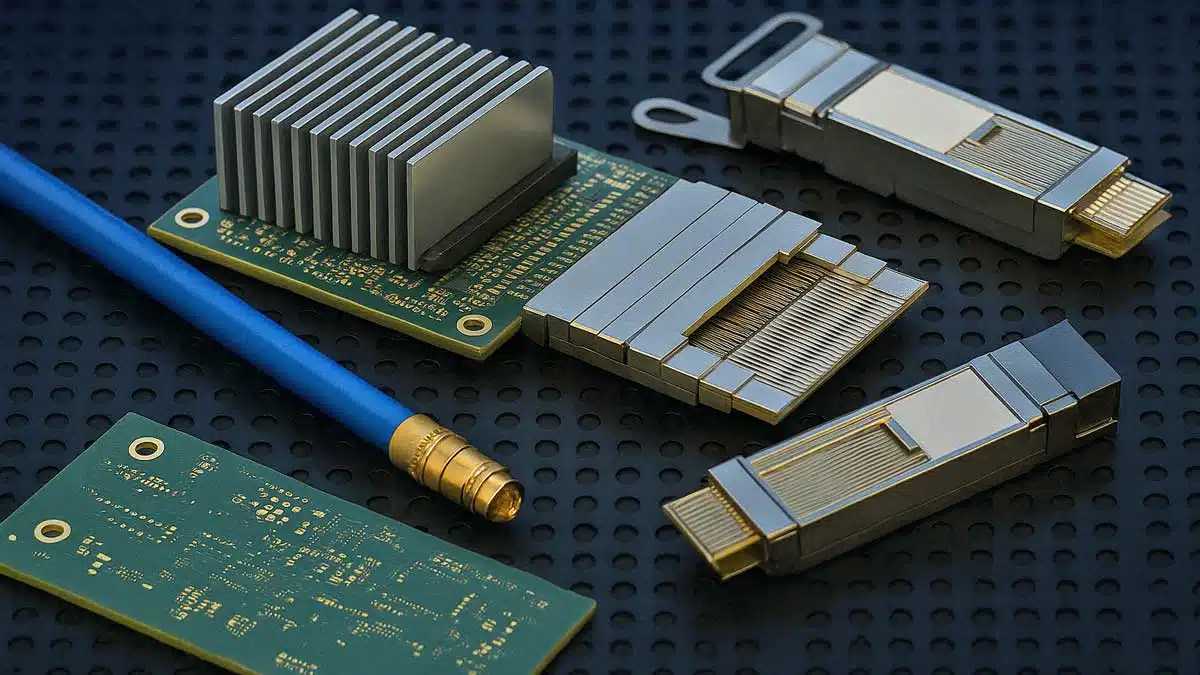
This article provides technical insights into four innovations shaping next‑generation high‑speed systems that was presented by Samtec in its blog.

Introduction

As signaling rates push beyond 100 Gbps per lane and approach 448 Gbps, system designers face challenges in electrical loss, thermal management, and reproducible validation. Four complementary technologies — Glass Core Technology (GCT), Nitrowave cable assemblies, optical transceivers, and co‑packaged connectivity — provide a toolkit for addressing these hurdles. Each targets a different segment of the signal path, collectively improving signal integrity, reliability, and manufacturability.

RelatedPosts

Samtec Releases Rugged Multi-Port SMPM Interconnects with Threaded Coupling

How to Match the Right Connector with Protocol Requirements

Samtec Expands Offering of Slim, High-Density HD Array Connectors

Glass Core Technology (GCT)

Glass substrates are transitioning from experimental to production‑ready. Their low dielectric constant reduces insertion loss, while thermal expansion closely matches silicon, improving reliability in die‑to‑package connections. Through‑glass vias and redistribution layers enable high‑density fan‑out, critical for advanced packaging and co‑packaged optics.

Engineering insight: At 448 Gbps, even picosecond mismatches matter. Using glass substrates can reduce equalization complexity, simplify channel design, and stabilize manufacturing tolerances.

Nitrowave Cable Assemblies

High‑frequency test environments demand cables that maintain predictable propagation delay under flexure. Nitrowave assemblies deliver phase stability, low insertion loss, and tight tolerance up to 110 GHz. Their construction ensures consistent results across labs, eliminating variability that can obscure true device performance.

Engineering insight: Two labs testing the same SerDes may see divergent results if cables differ. Phase‑stable designs remove this variable, saving time and reducing troubleshooting cycles.

Optical Advancements

Electrical channels are reaching practical limits, making optics essential for extending bandwidth. Halo optical transceivers achieve extremely low bit error rates at 112 Gbps PAM4, while supporting pluggable integration with interchangeable copper options.

Engineering insight: Optics should offload long‑reach, high‑loss paths, allowing equalization to remain within the ASIC or short‑channel package. This reduces power consumption and complexity while maintaining low BER at higher symbol rates.

Co‑Packaged Connectivity

Co‑packaging redefines where electrical‑to‑optical conversion occurs. By placing transceivers or short copper channels closer to the ASIC, designers reduce electrical path lengths, improving eye height and simplifying routing. These designs demand careful thermal management and mechanical alignment but enable higher per‑lane rates and tighter integration.

Engineering insight: Co‑packaging shifts complexity rather than eliminating it. Designers must consider serviceability, substrate integration, and long‑term thermal paths to ensure reliability.

Complementary Ecosystem

TechnologyContribution
Glass Core TechnologyReduces loss, improves thermal match, supports dense redistribution layers
Nitrowave cablesProvides stable, reproducible measurement paths across labs
Optical transceiversExtends bandwidth beyond electrical limits, reduces equalization load
Co‑packaged connectivityShortens electrical paths, enables higher lane rates and tighter integration

Forward‑Looking Notes

These technologies are not isolated solutions but part of a broader ecosystem. Material innovation, cable engineering, optics, and packaging converge to deliver measurable improvements in system performance. As designs scale from 224 Gbps to 448 Gbps per lane, lessons learned in test environments and pilot deployments will inform mainstream adoption.

Conclusion

These four technologies illustrate how material innovation, cable engineering, optics, and packaging converge to address challenges in high‑speed system design. Their combined use improves signal integrity, reliability, and overall system performance.

Source: Samtec Blog – “Top Samtec Technologies for 2025”

Related

Source: Samtec

Recent Posts

Coaxial Connectors and How to Connect with PCB

17.12.2025
46

PCB Manufacturing, Test Methods, Quality and Reliability

17.12.2025
46

Littelfuse Completes Acquisition of Basler Electric

12.12.2025
30

Molex Introduces Modular Wire-to-Wire Automotive Connectors

11.12.2025
13

YAGEO Achieved a Record Revenue in November on Strong AI Demand

10.12.2025
47

Murata Releases World’s First Inner Cavity-Structure Ultra-Low-Loss LCP Flexible Substrate

10.12.2025
62

Bishop Reveals Top 10 Connector Manufacturers

5.12.2025
100

November 2025 Interconnect, Passives and Electromechanical Components Market Insights

4.12.2025
105

DigiKey Launches 2025 DigiWish Holiday Giveaway for Global Engineering Community

3.12.2025
25

Upcoming Events

Jan 27
16:00 - 17:00 CET

Simplifying Vehicle Development with Automotive Ethernet and Zonal Smart Switch Technologies

Feb 24
16:00 - 17:00 CET

Designing Qi2 Wireless Power Systems: Practical Development and EMC Optimization

View Calendar

Popular Posts

  • Buck Converter Design and Calculation

    0 shares
    Share 0 Tweet 0
  • Boost Converter Design and Calculation

    0 shares
    Share 0 Tweet 0
  • LLC Resonant Converter Design and Calculation

    0 shares
    Share 0 Tweet 0
  • Flyback Converter Design and Calculation

    0 shares
    Share 0 Tweet 0
  • What Electronics Engineer Needs to Know About Passive Low Pass Filters

    0 shares
    Share 0 Tweet 0
  • Dual Active Bridge (DAB) Topology

    0 shares
    Share 0 Tweet 0
  • Ripple Current and its Effects on the Performance of Capacitors

    3 shares
    Share 3 Tweet 0
  • MLCC and Ceramic Capacitors

    0 shares
    Share 0 Tweet 0
  • What is a Dielectric Constant and DF of Plastic Materials?

    4 shares
    Share 4 Tweet 0
  • SEPIC Converter Design and Calculation

    0 shares
    Share 0 Tweet 0

Newsletter Subscription


Passive Components Blog

© EPCI - Leading Passive Components Educational and Information Site

  • Home
  • Privacy Policy
  • EPCI Membership & Advertisement
  • About

No Result
View All Result
  • Home
  • Knowledge Blog
  • PCNS

© EPCI - Leading Passive Components Educational and Information Site

This website uses cookies. By continuing to use this website you are giving consent to cookies being used. Visit our Privacy and Cookie Policy.
Go to mobile version