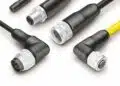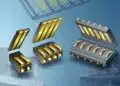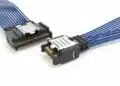












Molex has extended its Cardinal RF product family with new multi‑port high‑frequency coaxial assemblies supporting measurements up to 145 GHz.
The assemblies are aimed at demanding test and measurement setups in AI clusters, emerging 6G infrastructure, satellite and mmWave systems where dense multi‑channel, repeatable interconnects are critical for validation and characterization.
By combining phase‑matched, low‑loss performance with a compact, multi‑port PCB interface, the Cardinal 145 GHz assemblies give design and test engineers a way to push beyond the traditional 110 GHz ceiling while maintaining consistent measurement results and manageable test hardware complexity.
Key features and benefits
The new Cardinal multi‑port assemblies are designed as a higher‑frequency extension of the existing Cardinal test portfolio, preserving the same mechanical concept while upgrading the RF performance to cover the latest mmWave and sub‑THz bands.
Key product characteristics include:
- Frequency coverage from DC up to 145 GHz, extending the usable test range beyond the commonly used 110 GHz benchmark and addressing early 6G, advanced AI backhaul and terahertz‑adjacent work.
- Data characterization capability up to 448 Gbps, supporting verification of next‑generation high‑speed interfaces and complex multi‑lane links in AI and networking silicon.
- Phase‑matched, high‑precision coaxial connections optimized for low insertion loss and high return loss at very high frequencies, helping reduce measurement uncertainty and channel‑to‑channel skew.
- Multi‑port housing integrating several RF connectors into a single compact interface, supporting high‑density setups while reducing panel space and connector count.
- Compression‑mounted, solderless PCB attachment that simplifies installation and rework, allowing the same PCB interface to be reused across multiple boards and test fixtures.
- High‑cycle‑life construction rated for reliable performance over 500 mating cycles, supporting intensive lab and production test environments.
- High‑density PCB connector geometry designed to minimize test board real estate and allow smaller, lower‑cost evaluation boards.
For engineers, the combination of 145 GHz bandwidth and controlled phase matching means that both amplitude and time‑domain behavior of high‑speed links can be observed more accurately, which is especially important when validating equalization schemes, channel models or beamforming networks at mmWave frequencies.
Typical applications
The Cardinal 145 GHz multi‑port assemblies are positioned for high‑end RF and high‑speed digital test benches where multiple synchronized channels and repeatable performance are required.
Representative use cases include:
- AI compute clusters and high‑speed datacom links, where many high‑bandwidth lanes must be characterized in parallel at line rates up to 448 Gbps.
- 5G and emerging 6G radio development, including access, backhaul and fronthaul, where operation in higher mmWave and sub‑THz bands is under active investigation.
- Satellite communications terminals and payload RF chains, which demand precise RF characterization across wide bandwidths and at elevated frequencies.
- mmWave radar systems for automotive, industrial or imaging, where phase‑coherent multi‑channel measurements are needed to validate antenna arrays and signal processing algorithms.
- Terahertz imaging and research setups that currently push up against the top end of conventional coaxial test interfaces.
- General RF/mmWave test and measurement environments requiring dense, multi‑port PCB launches and frequent reconnection without sacrificing repeatability.
Because the assemblies are part of a broader Cardinal portfolio, they can be used alongside 67 GHz and 110 GHz precision assemblies to create tiered test strategies, for example using lower‑frequency assemblies during early bring‑up and reserving 145 GHz channels for stress margin or advanced characterization.
Technical highlights
Frequency and signal integrity
- Operating frequency: DC to 145 GHz, allowing characterization into frequency regions used for advanced 6G research and early terahertz work.
- Signal integrity focus: low insertion loss and high return loss at high frequency, helping keep the test path contribution small relative to the device under test.
- Phase matching across ports: engineered to support multi‑channel, phase‑coherent measurements, which is valuable for MIMO, phased‑array and multi‑lane SERDES evaluation.
In practice, this means that when engineers run S‑parameter or time‑domain measurements across multiple channels, the channel‑to‑channel differences introduced by the interconnect can be minimized, improving correlation and repeatability between test runs.
Mechanical and interconnect structure
- Multi‑port housing: single‑row and dual‑row configurations support high‑density termination on the test board while keeping routing manageable.
- PCB interface: compression‑mounted, solderless attachment, avoiding repeated soldering/desoldering cycles on expensive RF evaluation boards.
- Mating endurance: rated for more than 500 mating cycles, important for fixtures that see daily use in validation labs or production test.
A solderless, compression‑style launch is particularly useful when the same connector pattern is reused across different DUT boards: the high‑frequency cable assembly can be moved between boards without degrading launch quality or risking pad damage.
Portfolio context and connector options
- Cardinal portfolio coverage: 145 GHz multi‑port assemblies complement existing Cardinal 67 GHz and 110 GHz precision coaxial assemblies, allowing consistent mechanics across different frequency tiers.
- Connector and configuration options: the family includes various cable connector types and port configurations such as 1×4, 1×8 and 2×8 multi‑port layouts, plus vertical, right‑angle and edge‑mount PCB terminations according to manufacturer documentation.
Exact connector interface sizes, dielectric materials and detailed RF parameters are specified in the Molex product pages and datasheets and should be consulted for final design‑in decisions.
Design‑in notes for engineers
Moving to 145 GHz‑capable coaxial assemblies has implications not only for the cable but also for the overall test fixture, PCB design and measurement practice. The following points can help streamline design‑in and procurement.
PCB and fixture design
- Treat the multi‑port launch as part of the RF channel: PCB stack‑up, via design and launch geometry must be co‑designed with the Cardinal interface to preserve the advertised high‑frequency performance.
- Reserve sufficient keep‑out around the multi‑port connector on the PCB to accommodate compression hardware and to avoid coupling into nearby traces or components.
- Smaller evaluation boards are feasible due to the high‑density interface, but care is needed to maintain adequate ground referencing, shielding and connector access in the mechanical design.
Where possible, reuse Molex‑recommended footprint and land pattern guidelines, as deviations at 145 GHz can significantly impact return loss and repeatability.
Channel modeling and de‑embedding
- Because the assemblies are phase‑matched and characterized to 145 GHz, they can be included explicitly in the channel model and de‑embedding flow.
- For SERDES and PAM‑x link work at up to 448 Gbps, treat each multi‑port connection as part of the full path, using manufacturer S‑parameters when available to separate fixture loss from DUT behavior.
This approach allows engineers to exploit the full bandwidth of the interconnect rather than treating it as an unknown parasitic contribution.
Operational considerations and lifetime
- The >500‑cycle mating rating supports intensive daily use, but labs should still adopt handling procedures similar to those used for precision 1.0 mm and 1.85 mm connectors: avoid side‑loading, contamination and over‑torque.
- The solderless compression PCB interface reduces risk to expensive test boards but does not eliminate the need for careful torque management and periodic inspection of contact surfaces.
From a cost‑of‑ownership perspective, the ability to consolidate multiple RF lines into a single multi‑port connector and reuse the same cable assemblies across different fixtures can offset the higher unit cost of precision 145 GHz interconnects.
Source
This article is based on information provided in the official Molex press release and associated Cardinal product documentation, with additional contextual interpretation for test and measurement engineers.