





Passive Components Blog
No Result
View All Result
  • Home
  • NewsFilter
    • All
    • Aerospace & Defence
    • Antenna
    • Applications
    • Automotive
    • Capacitors
    • Circuit Protection Devices
    • electro-mechanical news
    • Filters
    • Fuses
    • Inductors
    • Industrial
    • Integrated Passives
    • inter-connect news
    • Market & Supply Chain
    • Market Insights
    • Medical
    • Modelling and Simulation
    • New Materials & Supply
    • New Technologies
    • Non-linear Passives
    • Oscillators
    • Passive Sensors News
    • Resistors
    • RF & Microwave
    • Telecommunication
    • Weekly Digest

    Circuit Protection Technology Annual Dossier

    ESA SPCD 26 Registration Open

    Capacitances of Nonlinear MLCCs: What Datasheets Don’t Tell You

    Stackpole Releases Automotive Wide‑Termination Resistors

    How a Digital Structural Twin Can Predict Tantalum Capacitor Reliability

    SCHURTER Buys Biaodi to Boost High-Voltage Protection Portfolio

    Binder Hybrid Connector Simplifies One Cable Automation

    Tapped Inductor Buck Converter Fundamentals

    TAIYO YUDEN Releases Mini Metal Power Inductors

    Trending Tags

    • Ripple Current
    • RF
    • Leakage Current
    • Tantalum vs Ceramic
    • Snubber
    • Low ESR
    • Feedthrough
    • Derating
    • Dielectric Constant
    • New Products
    • Market Reports
  • VideoFilter
    • All
    • Antenna videos
    • Capacitor videos
    • Circuit Protection Video
    • Filter videos
    • Fuse videos
    • Inductor videos
    • Inter-Connect Video
    • Non-linear passives videos
    • Oscillator videos
    • Passive sensors videos
    • Resistor videos

    Capacitances of Nonlinear MLCCs: What Datasheets Don’t Tell You

    Tapped Inductor Buck Converter Fundamentals

    Planar vs Conventional Transformer: When it Make Sense

    Modeling Fringing Field Losses in Inductors & Transformers

    Why Power Inductors Use a Ferrite Core With an Air Gap

    Transformer-Based Power-Line Harvester Magnetic Design

    Thermal Modeling of Magnetics

    Standard vs Planar LLC transformers Comparison for Battery Chargers

    How Modern Tools Model Magnetic Components for Power Electronics

    Trending Tags

    • Capacitors explained
    • Inductors explained
    • Resistors explained
    • Filters explained
    • Application Video Guidelines
    • EMC
    • New Products
    • Ripple Current
    • Simulation
    • Tantalum vs Ceramic
  • Knowledge Blog
  • DossiersNew
  • Suppliers
    • Who is Who
  • PCNS
    • PCNS 2025
    • PCNS 2023
    • PCNS 2021
    • PCNS 2019
    • PCNS 2017
  • Events
  • Home
  • NewsFilter
    • All
    • Aerospace & Defence
    • Antenna
    • Applications
    • Automotive
    • Capacitors
    • Circuit Protection Devices
    • electro-mechanical news
    • Filters
    • Fuses
    • Inductors
    • Industrial
    • Integrated Passives
    • inter-connect news
    • Market & Supply Chain
    • Market Insights
    • Medical
    • Modelling and Simulation
    • New Materials & Supply
    • New Technologies
    • Non-linear Passives
    • Oscillators
    • Passive Sensors News
    • Resistors
    • RF & Microwave
    • Telecommunication
    • Weekly Digest

    Circuit Protection Technology Annual Dossier

    ESA SPCD 26 Registration Open

    Capacitances of Nonlinear MLCCs: What Datasheets Don’t Tell You

    Stackpole Releases Automotive Wide‑Termination Resistors

    How a Digital Structural Twin Can Predict Tantalum Capacitor Reliability

    SCHURTER Buys Biaodi to Boost High-Voltage Protection Portfolio

    Binder Hybrid Connector Simplifies One Cable Automation

    Tapped Inductor Buck Converter Fundamentals

    TAIYO YUDEN Releases Mini Metal Power Inductors

    Trending Tags

    • Ripple Current
    • RF
    • Leakage Current
    • Tantalum vs Ceramic
    • Snubber
    • Low ESR
    • Feedthrough
    • Derating
    • Dielectric Constant
    • New Products
    • Market Reports
  • VideoFilter
    • All
    • Antenna videos
    • Capacitor videos
    • Circuit Protection Video
    • Filter videos
    • Fuse videos
    • Inductor videos
    • Inter-Connect Video
    • Non-linear passives videos
    • Oscillator videos
    • Passive sensors videos
    • Resistor videos

    Capacitances of Nonlinear MLCCs: What Datasheets Don’t Tell You

    Tapped Inductor Buck Converter Fundamentals

    Planar vs Conventional Transformer: When it Make Sense

    Modeling Fringing Field Losses in Inductors & Transformers

    Why Power Inductors Use a Ferrite Core With an Air Gap

    Transformer-Based Power-Line Harvester Magnetic Design

    Thermal Modeling of Magnetics

    Standard vs Planar LLC transformers Comparison for Battery Chargers

    How Modern Tools Model Magnetic Components for Power Electronics

    Trending Tags

    • Capacitors explained
    • Inductors explained
    • Resistors explained
    • Filters explained
    • Application Video Guidelines
    • EMC
    • New Products
    • Ripple Current
    • Simulation
    • Tantalum vs Ceramic
  • Knowledge Blog
  • DossiersNew
  • Suppliers
    • Who is Who
  • PCNS
    • PCNS 2025
    • PCNS 2023
    • PCNS 2021
    • PCNS 2019
    • PCNS 2017
  • Events
No Result
View All Result
Passive Components Blog
No Result
View All Result

Molex Introduces Modular Wire-to-Wire Automotive Connectors

11.12.2025
Reading Time: 3 mins read
A A

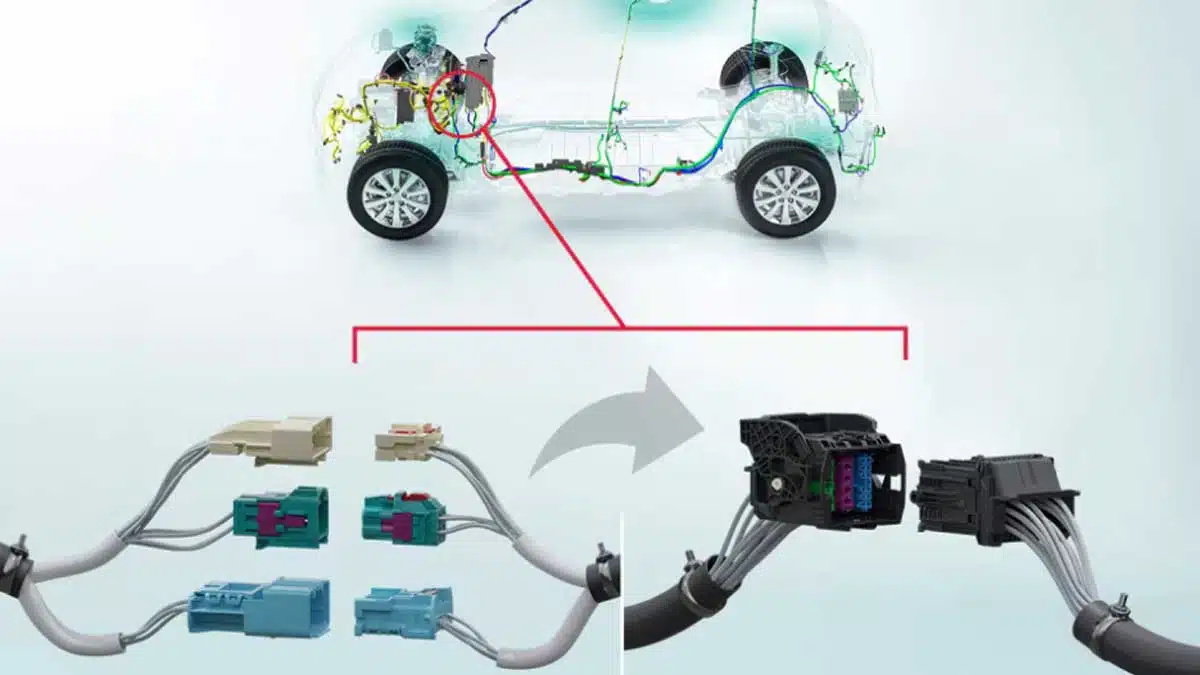
Molex introduces MX-DaSH Modular Wire-to-Wire Connectors, combining power and signal terminals in a single, modular system to reduce wiring harness weight and complexity for automotive zonal architectures. This solution enhances design flexibility and supports global OEMs. 

Molex, a global leader in electronics and connectivity innovation, proudly announces the launch of the MX-DaSH Modular Wire-to-Wire Connectors, the latest addition to its acclaimed MX-DaSH family.

RelatedPosts

Molex Completes Acquisition of Smiths Interconnect, Expanding Portfolio of High-Reliability Connectivity Solutions

Molex Extends Cardinal Multi‑Port Coax Assemblies to 145 GHz for AI and 6G Test

Molex Releases Industry-First Quad-Row Board-to-Board Connectors with EMI Shields

These state-of-the-art connectors integrate power, signal, and high-speed data connectivity into a single system, offering unparalleled flexibility and efficiency for automotive design.

The MX-DaSH Modular connectors feature a versatile cartridge-based design housed in a single system, simplifying wiring and harness architecture. This innovation enhances automotive design flexibility, adaptability, and scalability across various vehicle models and applications.

“MX-DaSH Modular Wire-to-Wire Connectors address critical challenges in today’s automotive design processes, driven by rapid changes in electrical and electronic requirements,” stated Scott Whicker, Senior Vice President and President of Transportation Innovative Solutions at Molex. “Our cartridge-based design facilitates easy function mixing and reconfiguration, enabling faster development cycles and cost reductions.”

Designed for Zonal Architectures

Each MX-DaSH Modular connector is built on an unsealed, cartridge-based hybrid connectivity platform, consolidating multiple connectors and connection types into one. This approach reduces the number of unique parts, offering unmatched freedom to tackle specific automotive design challenges, accelerate upgrades, and significantly cut design and tooling time.

The “building block” approach optimizes vehicle harnesses, leading to substantial weight, size, and cost savings. Tailored for zonal architectures, MX-DaSH Modular connectors are perfect for high-content connection points, such as instrument panel-to-body harness connections, seat power and signal connections, and electrical/electronic architecture components. Engineers can easily change cartridges within the housing, allowing for seamless feature additions or pin and cartridge swaps to meet evolving architecture needs.

Global Adoption and Chinese Market Impact

Localized manufacturing and compatibility with industry-standard terminals are driving global adoption of MX-DaSH Modular connectors, while mitigating global supply chain challenges. The connectors adhere to USCAR2 performance specifications for automotive electrical connector systems and USCAR49 specifications for miniature automotive coaxial connectors.

China, the largest automotive market and a hub for innovation in electric vehicles (EVs) and Advanced Driver-Assistance Systems (ADAS), is a key testing ground for next-generation automotive technologies, including Molex solutions. A regional version of the MX-DaSH Modular connector will be featured in MY26 cars in China, addressing the unique cost, packaging, and expedited time-to-market requirements of Chinese automotive OEMs.

Additionally, other automotive manufacturers in North America and Europe are deploying these new modular connectors, with MY28 vehicle designs expected to incorporate MX-DaSH Modular Wire-to-Wire and Wire-to-Board Connectors.

Automation-Friendly and Reliability-Focused

The MX-DaSH Modular connector’s automation-friendly design supports precise automated assembly operations, enhancing manufacturing efficiency and quality while reducing labor costs. Positive-locking features, blade stabilization, and vibration resistance further enhance reliability by preventing inadvertent disconnection in demanding automotive environments. Molex’s robust engineering support, extensive quality control, and range of versatile, customizable solutions solidify its role as a unique resource for improving vehicle wiring performance and reliability.

Product Availability

Molex MX-DaSH Modular Wire-to-Wire Connectors are now available, offering unprecedented design freedom and flexibility to meet the rapidly increasing data, power, and high-speed signal requirements in today’s vehicles. The connectors support a maximum pin count of 70 circuits, with the following maximum circuit counts per cartridge: 26 circuits for 0.50mm (CTX50) cartridges, 14 circuits for 1.20mm cartridges, 4 circuits for 2.80mm cartridges, and 3 circuits for 4.80 and 6.30mm cartridges.

Related

Source: Molex

Recent Posts

Binder Hybrid Connector Simplifies One Cable Automation

13.5.2026
16

binder Releases Tool‑Tightenable M12 Connectors for Improved Reliability

30.4.2026
13

Kyocera Developed Multilayer Ceramic Core Substrate for AI Packages

30.4.2026
56

Heatsink Design and Thermal Interface Materials for Reliable Electronics

27.4.2026
42

Amphenol Explanded Liquid Cooling Connectors for AI, ESS and EV Systems

17.4.2026
38

Hirose Introduced BGA connector for PCIe Gen6 for AI and Edge Computing

17.4.2026
32

Molex Completes Acquisition of Smiths Interconnect, Expanding Portfolio of High-Reliability Connectivity Solutions

1.4.2026
21

Binder Introduces Triangular Moulding for M16 and M12 Cable Connectors

31.3.2026
15

Bourns Expands its Modular Contacts for Power-Dense Systems

19.3.2026
23

Upcoming Events

May 19
16:00 - 17:00 CEST

Designing Qi2 Wireless Power Systems: Practical Development and EMC Optimization

Jun 2
16:00 - 17:00 CEST

Calculation, Simulation and Measurement of 800V EMC Filters

Jun 16
16:00 - 17:00 CEST

EMC with EMC – EMC‑compliant design with electromechanical connectors

View Calendar

Popular Posts

  • Buck Converter Design and Calculation

    0 shares
    Share 0 Tweet 0
  • Boost Converter Design and Calculation

    0 shares
    Share 0 Tweet 0
  • Flyback Converter Design and Calculation

    0 shares
    Share 0 Tweet 0
  • LLC Resonant Converter Design and Calculation

    0 shares
    Share 0 Tweet 0
  • MLCC and Ceramic Capacitors

    0 shares
    Share 0 Tweet 0
  • Capacitor Charging and Discharging

    0 shares
    Share 0 Tweet 0
  • What Electronics Engineer Needs to Know About Passive Low Pass Filters

    0 shares
    Share 0 Tweet 0
  • Dual Active Bridge (DAB) Topology

    0 shares
    Share 0 Tweet 0
  • Ripple Current and its Effects on the Performance of Capacitors

    3 shares
    Share 3 Tweet 0
  • Samsung Electro-Mechanics Releases High-Capacitance MLCCs for AI Server Applications

    0 shares
    Share 0 Tweet 0

Newsletter Subscription


Passive Components Blog

© EPCI - Leading Passive Components Educational and Information Site

  • Home
  • Privacy Policy
  • EPCI Membership & Advertisement
  • About

No Result
View All Result
  • Home
  • Knowledge Blog
  • PCNS

© EPCI - Leading Passive Components Educational and Information Site

This website uses cookies. By continuing to use this website you are giving consent to cookies being used. Visit our Privacy and Cookie Policy.
Go to mobile version