














Passive Components Blog
No Result
View All Result
  • Home
  • NewsFilter
    • All
    • Aerospace & Defence
    • Antenna
    • Applications
    • Automotive
    • Capacitors
    • Circuit Protection Devices
    • electro-mechanical news
    • Filters
    • Fuses
    • Inductors
    • Industrial
    • Integrated Passives
    • inter-connect news
    • Market & Supply Chain
    • Market Insights
    • Medical
    • Modelling and Simulation
    • New Materials & Supply
    • New Technologies
    • Non-linear Passives
    • Oscillators
    • Passive Sensors News
    • Resistors
    • RF & Microwave
    • Telecommunication
    • Weekly Digest

    2025 Annual Capacitor Technology Dossier

    Panasonic High Precision Chip Resistors Bridge Gap Between Thin and Thick Technology

    ROHM Extends 2012 Shunt Resistors Power Rating up to 1.25 W

    January 2026 Interconnect, Passives and Electromechanical Components Market Insights

    Passive Components in Quantum Computing

    0603 Automotive Chip Varistors as TVS Diode Replacements, TDK Tech Note

    Miniaturization of MLCCs and Electrolytics, KAVX Tech Chat

    Exxelia Offers Custom Naval Transformers and Inductors

    Researchers Demonstrated 32nm Aluminum Vacuum Gap Capacitor

    Trending Tags

    • Ripple Current
    • RF
    • Leakage Current
    • Tantalum vs Ceramic
    • Snubber
    • Low ESR
    • Feedthrough
    • Derating
    • Dielectric Constant
    • New Products
    • Market Reports
  • VideoFilter
    • All
    • Antenna videos
    • Capacitor videos
    • Circuit Protection Video
    • Filter videos
    • Fuse videos
    • Inductor videos
    • Inter-Connect Video
    • Non-linear passives videos
    • Oscillator videos
    • Passive sensors videos
    • Resistor videos

    One‑Pulse Characterization of Nonlinear Power Inductors

    Thermistor Linearization Challenges

    Coaxial Connectors and How to Connect with PCB

    PCB Manufacturing, Test Methods, Quality and Reliability

    Transformer Behavior – Current Transfer and Hidden Feedback

    Choosing the Right Capacitor: The Importance of Accurate Measurements

    RF Inductors: Selection and Design Challenges for High-Frequency Circuits

    Transformer Safety IEC 61558 Standard

    3-Phase EMI Filter Design, Simulation, Calculation and Test

    Trending Tags

    • Capacitors explained
    • Inductors explained
    • Resistors explained
    • Filters explained
    • Application Video Guidelines
    • EMC
    • New Products
    • Ripple Current
    • Simulation
    • Tantalum vs Ceramic
  • Knowledge Blog
  • DossiersNew
  • Suppliers
    • Who is Who
  • PCNS
    • PCNS 2025
    • PCNS 2023
    • PCNS 2021
    • PCNS 2019
    • PCNS 2017
  • Events
  • Home
  • NewsFilter
    • All
    • Aerospace & Defence
    • Antenna
    • Applications
    • Automotive
    • Capacitors
    • Circuit Protection Devices
    • electro-mechanical news
    • Filters
    • Fuses
    • Inductors
    • Industrial
    • Integrated Passives
    • inter-connect news
    • Market & Supply Chain
    • Market Insights
    • Medical
    • Modelling and Simulation
    • New Materials & Supply
    • New Technologies
    • Non-linear Passives
    • Oscillators
    • Passive Sensors News
    • Resistors
    • RF & Microwave
    • Telecommunication
    • Weekly Digest

    2025 Annual Capacitor Technology Dossier

    Panasonic High Precision Chip Resistors Bridge Gap Between Thin and Thick Technology

    ROHM Extends 2012 Shunt Resistors Power Rating up to 1.25 W

    January 2026 Interconnect, Passives and Electromechanical Components Market Insights

    Passive Components in Quantum Computing

    0603 Automotive Chip Varistors as TVS Diode Replacements, TDK Tech Note

    Miniaturization of MLCCs and Electrolytics, KAVX Tech Chat

    Exxelia Offers Custom Naval Transformers and Inductors

    Researchers Demonstrated 32nm Aluminum Vacuum Gap Capacitor

    Trending Tags

    • Ripple Current
    • RF
    • Leakage Current
    • Tantalum vs Ceramic
    • Snubber
    • Low ESR
    • Feedthrough
    • Derating
    • Dielectric Constant
    • New Products
    • Market Reports
  • VideoFilter
    • All
    • Antenna videos
    • Capacitor videos
    • Circuit Protection Video
    • Filter videos
    • Fuse videos
    • Inductor videos
    • Inter-Connect Video
    • Non-linear passives videos
    • Oscillator videos
    • Passive sensors videos
    • Resistor videos

    One‑Pulse Characterization of Nonlinear Power Inductors

    Thermistor Linearization Challenges

    Coaxial Connectors and How to Connect with PCB

    PCB Manufacturing, Test Methods, Quality and Reliability

    Transformer Behavior – Current Transfer and Hidden Feedback

    Choosing the Right Capacitor: The Importance of Accurate Measurements

    RF Inductors: Selection and Design Challenges for High-Frequency Circuits

    Transformer Safety IEC 61558 Standard

    3-Phase EMI Filter Design, Simulation, Calculation and Test

    Trending Tags

    • Capacitors explained
    • Inductors explained
    • Resistors explained
    • Filters explained
    • Application Video Guidelines
    • EMC
    • New Products
    • Ripple Current
    • Simulation
    • Tantalum vs Ceramic
  • Knowledge Blog
  • DossiersNew
  • Suppliers
    • Who is Who
  • PCNS
    • PCNS 2025
    • PCNS 2023
    • PCNS 2021
    • PCNS 2019
    • PCNS 2017
  • Events
No Result
View All Result
Passive Components Blog
No Result
View All Result

Panasonic Releases Small Robust Power Inductor for Automotive

15.7.2022
Reading Time: 5 mins read
A A

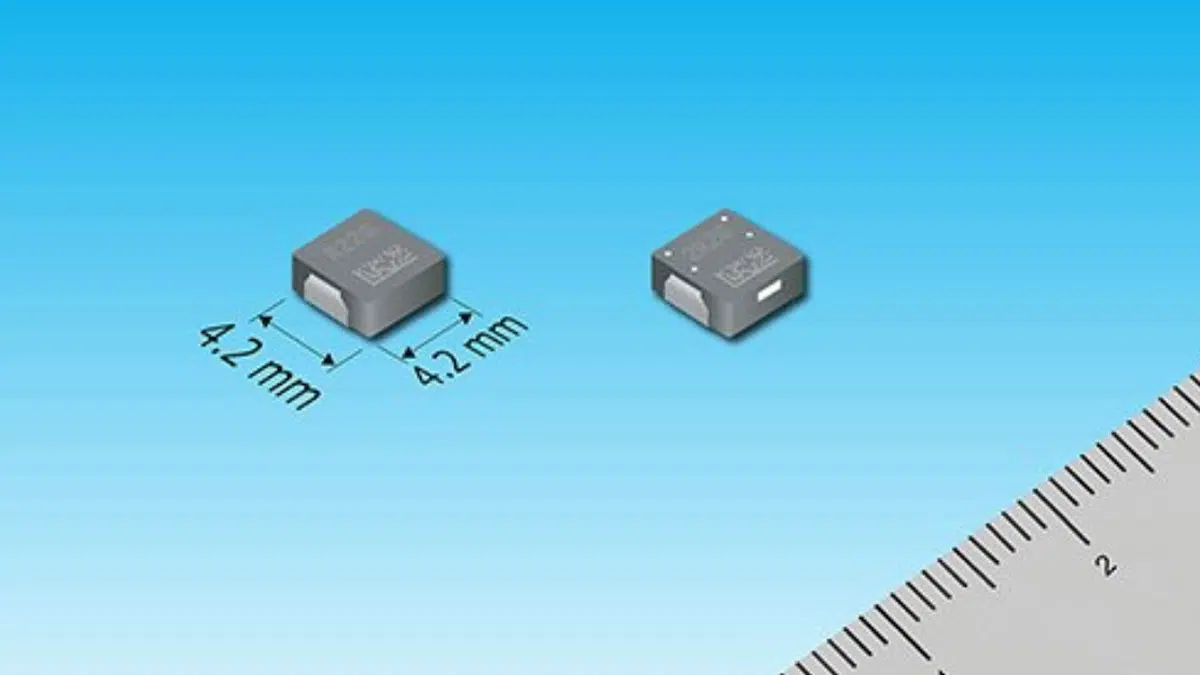
Panasonic Industry commercialize a small, robust power Inductor 4 mm by 4 mm size for automotive use. High resistance to vibrations and a redundant structure offer improved connection reliability.

Panasonic Corporation announced that its Industry Company has commercialized a small power inductor[1] (4 mm by 4 mm square) for automotive use that enables higher performance and downsizing of electronic control units (ECU) for advanced drive assistance systems (ADAS) and autonomous driving systems, with the ability to withstand harsh environment. Mass production of the power inductor will start in May 2022.

RelatedPosts

Panasonic High Precision Chip Resistors Bridge Gap Between Thin and Thick Technology

Conductive Polymer Capacitor Market and Design‑In Guide to 2035

Panasonic Passive Components for Reliable Robotic Arms

As the computerization of cars advances, ECUs are now incorporated in many cars. ADAS and autonomous driving require a number of ECUs capable of highly efficient control over cars, with such ECUs requiring small and high-performance power inductors free from connection failures.

The company has commercialized a small power inductor of 4 mm by 4 mm square for automotive use to address these needs. It is manufactured with a molding technology where the power inductor is completely filled with a melted metal composite material[2], and is highly resistant to vibrations, thereby preventing crack formation. Further, its leads have a redundant design[3] that improves the connection reliability of the coil. The improved manufacturing process has reduced CO2 emissions during the production of this product by 50% (CO2 emissions/unit).

Features:

  1. Suppress the bias of magnetic material density to prevent the formation of cracks inside the product.
  2. A connection with a redundant design between a built-in coil and a terminal improves the connection reliability.
  3. CO2 emissions during the manufacturing process are 50% less than in conventional cases (CO2 emissions/unit).

Applications:

ECU power circuits in cars equipped with ADAS/autonomous driving systems, radar ECUs, sensing camera ECUs, ECU power circuits in cars equipped with information communication systems, Telematics, gateways

Features Explained

1. Suppress the bias of magnetic material density to prevent the formation of cracks inside the product.

Sealing with a metal composite material requires that the metal composite material maintain a homogeneous density during molding to prevent crack formation in the product. However, downsizing a product makes it difficult to achieve a homogeneous density, and leads to a case where, after the molding, voids are formed between metal magnetic material particles, which cause a crack. To deal with this problem, the company has developed a metal composite material for insulating magnetic powder and sealing the metal magnetic material, by devising a special resin added to the metal. This metal composite material is melted and injected into the coil to fill it thoroughly. Therefore, the company has achieved a small power inductor that suppresses crack formation in the product.
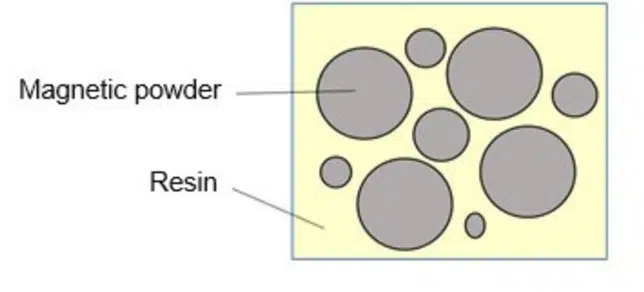
Metal composite material for a 4mm x 4mm power inductor

2. A connection with a redundant design between a built-in coil and a terminal improves the connection reliability.

A built-in coil has leads at both the start and end of windings, and these leads are electrically connected to a terminal inside the product. Currently, all leads have a redundant design that enables multiple connections, which prevents the occurrence of connection failures. In addition, each lead is welded to a part of the terminal in a structure where it is held in the terminal (caulking structure), which improves the connection reliability.

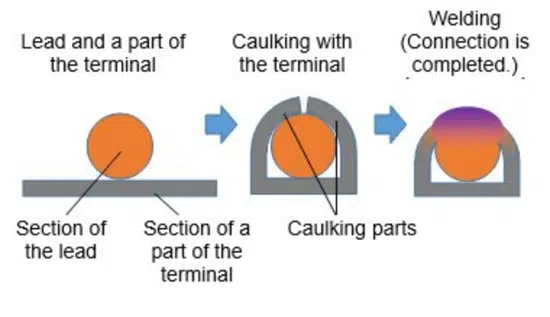
Small robust inductor redundant design and connection
Caulking and welding connection process, small robust inductor

3. CO2 emissions during the manufacturing process are 50% less than in conventional cases (CO2 emissions/piece)

Due to its smaller size than conventional ones, the product requires finer processing and assembly, resulting in a problem whereby the conventional manufacturing process needs a greater amount of power to manufacture the product. To deal with this problem, Panasonic has changed the processing method by reducing heat treatments, thereby allowing simultaneous microfabrication and high-speed processing. This has led to a significant improvement in the productivity of the production process. As a result, CO2 emissions during the manufacturing process are now 50% less than in conventional cases (CO2 emissions/unit).

Basic specifications:

  • (*1): Measured at 100 kHz. (*2): Current value that causes a temperature rise of 40degrees.

The company is planning to expand the inductance range of the power inductor to meet market needs.

Term Descriptions

[1] Power inductor. An electronic component used in DC/DC converters, etc. Functions as a filter that accumulates energy or eliminates noise.

[2] Metal composite material. A magnetic material made by insulating the powder of metal magnetic material (iron group) in which powder based on metallic magnetic material with resin.

[3] Redundant design. A design concept whereby backup means are provided for a part that must be highly reliable so that a problem with it does not develop into a major issue. A redundant design allows a product to maintain its normal functions and safety.

[4] Inductance. This is one of the indexes indicating the capability of a coil. A changing current flowing through a coil creates a voltage that generates a current flow for offsetting the changing current. The degree of creation of this voltage is referred to as inductance.

[5] DC resistance. DC resistance is a resistance component of winding (copper wire). The lower the DC resistance, the lower the power loss. Thereby yielding an improvement in power efficiency.


Related

Source: Panasonic Industry

Recent Posts

2025 Annual Capacitor Technology Dossier

23.1.2026
19

Panasonic High Precision Chip Resistors Bridge Gap Between Thin and Thick Technology

23.1.2026
16

ROHM Extends 2012 Shunt Resistors Power Rating up to 1.25 W

23.1.2026
11

Passive Components in Quantum Computing

22.1.2026
63

0603 Automotive Chip Varistors as TVS Diode Replacements, TDK Tech Note

21.1.2026
23

Exxelia Offers Custom Naval Transformers and Inductors

21.1.2026
15

Conductive Polymer Capacitor Market and Design‑In Guide to 2035

20.1.2026
106

YAGEO Offers Automotive MOVs for EV and AI power

19.1.2026
31

Würth Elektronik Introduces Product Navigator for Passive Components

14.1.2026
79

Upcoming Events

Jan 27
16:00 - 17:00 CET

Simplifying Vehicle Development with Automotive Ethernet and Zonal Smart Switch Technologies

Feb 24
16:00 - 17:00 CET

Designing Qi2 Wireless Power Systems: Practical Development and EMC Optimization

Mar 21
All day

PSMA Capacitor Workshop 2026

View Calendar

Popular Posts

  • Buck Converter Design and Calculation

    0 shares
    Share 0 Tweet 0
  • Boost Converter Design and Calculation

    0 shares
    Share 0 Tweet 0
  • LLC Resonant Converter Design and Calculation

    0 shares
    Share 0 Tweet 0
  • Flyback Converter Design and Calculation

    0 shares
    Share 0 Tweet 0
  • Ripple Current and its Effects on the Performance of Capacitors

    3 shares
    Share 3 Tweet 0
  • How Metal Prices Are Driving Passive Component Price Hikes

    0 shares
    Share 0 Tweet 0
  • MLCC and Ceramic Capacitors

    0 shares
    Share 0 Tweet 0
  • What is a Dielectric Constant and DF of Plastic Materials?

    4 shares
    Share 4 Tweet 0
  • Dual Active Bridge (DAB) Topology

    0 shares
    Share 0 Tweet 0
  • Degradation of Capacitors and its Failure Mechanisms

    0 shares
    Share 0 Tweet 0

Newsletter Subscription


Passive Components Blog

© EPCI - Leading Passive Components Educational and Information Site

  • Home
  • Privacy Policy
  • EPCI Membership & Advertisement
  • About

No Result
View All Result
  • Home
  • Knowledge Blog
  • PCNS

© EPCI - Leading Passive Components Educational and Information Site

This website uses cookies. By continuing to use this website you are giving consent to cookies being used. Visit our Privacy and Cookie Policy.
Go to mobile version