

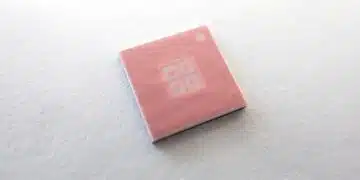
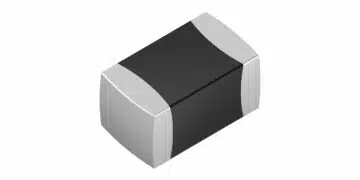

This Tech Chats episode from Mouser Electronics features a discussion between Daniel Bogdanoff and KYOCERA AVX’s Ron Demcko on why miniaturization is driving the current status and evolution of multilayer ceramic capacitors (MLCCs) and electrolytic capacitors.
The conversation focuses on how system requirements, power levels, and density targets force designers to rethink capacitor selection and placement in modern designs.
In this video Ron Demcko, KYOCERA AVX, explores why “more capacitance in less space” is now a core design constraint, how MLCC and electrolytic capacitor technologies are being pushed to their limits, and what this means for reliability, derating, and layout strategy. It also touches on practical placement methods and trade‑offs when mixing capacitor technologies on real boards.
Key Points
- Miniaturization is primarily driven by higher power density, smaller form factors, and tighter integration at both board and system level.
- MLCCs continue to displace electrolytics in many decoupling and bulk roles, but electrolytics remain essential in certain energy‑storage and low‑frequency applications.
- Voltage derating, DC bias effects, and temperature characteristics are critical parameters when selecting MLCCs for high‑density designs.
- Electrolytic capacitors must be evaluated for ripple current capability, lifetime, and thermal management when used in compact layouts.
- Designers increasingly need “more capacitance per square millimeter,” which changes how many capacitors are placed and how they are grouped.
- Typical designs use a mix of different capacitance values and dielectric types to cover a broad frequency spectrum for decoupling.
- Mechanical and reliability aspects, such as board flex cracking in MLCCs and electrolyte dry‑out in electrolytics, become more critical as components shrink.
- There are multiple capacitor placement strategies around ICs and power rails; the choice affects impedance, ESL/ESR distribution, and overall stability.
- Miniaturization amplifies layout‑dependent parasitics, making capacitor location, via design, and return paths as important as the component values themselves.
- Collaboration with capacitor vendors and use of up‑to‑date datasheets, application notes, and solution guides is essential to avoid over‑ or under‑design.
Extended Summary
Miniaturization in electronics is driven by user expectations for smaller, lighter devices with higher performance, along with industrial requirements for compact power conversion and control systems. As silicon integrates more functionality into single ICs or modules, the associated power rails and signal interfaces demand aggressive decoupling and energy storage within shrinking board areas. This pushes passive components, particularly capacitors, to deliver more capacitance in smaller packages, while maintaining reliability across complex operating profiles.
MLCCs have become the workhorse for decoupling and local energy storage because of their low equivalent series resistance (ESR), low equivalent series inductance (ESL), and high volumetric efficiency at lower voltages. They are widely used around digital ICs, high‑speed interfaces, and switching converters, where fast transient response and broadband impedance control are required. However, designers must account for DC bias derating, where the effective capacitance of a ceramic capacitor drops significantly when a DC voltage is applied, especially with high‑k dielectrics and small case sizes. This means a nominal MLCC at its rated voltage and room conditions may deliver far less capacitance under actual operating voltage and temperature, forcing engineers to overspecify parts or parallel multiple devices.
Electrolytic capacitors retain an important role in bulk energy storage, low‑frequency filtering, and applications that need relatively large capacitance values at higher voltages. Aluminum electrolytics provide high capacitance per cost but have higher ESR and limited lifetime due to electrolyte evaporation, which is accelerated by temperature and ripple current. Polymer electrolytics and hybrid constructions improve ESR and stability, offering better performance at higher frequencies and under ripple stress. In miniaturized systems, designers must carefully consider ripple current ratings, thermal paths, and lifetime calculations to ensure that electrolytic devices do not become premature failure points.
A central theme of the discussion is the relationship between capacitor placement and overall power integrity. Around high‑pin‑count digital ICs or power devices, designers often deploy a hierarchy of capacitors: small‑value MLCCs close to pins for high‑frequency decoupling, larger MLCCs slightly farther away for mid‑band support, and bulk capacitors (MLCC or electrolytic) at the rail entry point for low‑frequency stability and load transients. This multi‑value, multi‑technology approach helps shape the impedance profile of the rail across frequency, reducing resonances and maintaining a low impedance over the operating bandwidth. As layouts shrink, trace length, via inductance, and return path geometry significantly affect the effective ESL of the network, making physical placement as critical as the capacitance values selected.
Mechanical reliability is another factor impacted by miniaturization. MLCCs, especially larger case sizes, can crack from board flex, thermal cycling, or improper mounting, leading to latent or catastrophic failures. Techniques such as using smaller case sizes, flexible terminations, and careful placement away from board edges or mounting holes can mitigate this risk. Electrolytic capacitors, on the other hand, are sensitive to thermal and electrical overstress leading to increased leakage, capacitance loss, and rise in ESR over time. Design teams must consider not only the initial performance but also the expected drift of these parameters over the product’s operating life, especially in high‑temperature or high‑vibration environments.
The video outlines a spectrum of capacitor placement methods used in modern designs, ranging from minimum‑count strategies (using fewer, higher‑value capacitors) to distributed arrays of smaller MLCCs placed near individual loads. In dense boards, it is often more effective to use many smaller capacitors close to pins than a single large device at some distance, because of parasitic inductance and resistance in the connecting traces and vias. Designers also mix capacitor technologies—such as combining MLCCs with polymer electrolytics—so that each technology covers a different part of the frequency and load spectrum, improving overall rail stability and EMI performance.
Best practices highlighted include careful reading of datasheet curves for capacitance versus voltage and temperature, ESR/ESL versus frequency, and lifetime or ripple current derating. Engineers are encouraged to use vendor design tools, reference designs, and solution guides, particularly when operating near the limits of component ratings in highly miniaturized systems. Engaging with suppliers early in the design process helps in choosing the right dielectric, package size, and technology mix, which in turn reduces the risk of last‑minute redesigns due to thermal issues, noise problems, or reliability concerns.
Conclusion
After following this discussion, readers should understand why miniaturization drives a shift in how MLCCs and electrolytic capacitors are specified, placed, and combined in modern electronic designs. The key is not just achieving a target capacitance value, but managing derating, parasitics, thermal behavior, and lifetime in the context of tight board space and demanding power integrity requirements.
Typical next steps include reviewing existing designs for DC bias and temperature derating margins, evaluating whether capacitor placement and technology mix are appropriate for the target frequency spectrum, and consulting up‑to‑date vendor resources for optimized capacitor solutions in miniaturized systems.
References
- Why Miniaturization: Status of MLCCs & Electrolytics : Tech Chats – Mouser Electronics, YouTube. https://youtu.be/wvTtAm-4suM