












Passive Components Blog
No Result
View All Result
  • Home
  • NewsFilter
    • All
    • Aerospace & Defence
    • Antenna
    • Applications
    • Automotive
    • Capacitors
    • Circuit Protection Devices
    • electro-mechanical news
    • Filters
    • Fuses
    • Inductors
    • Industrial
    • Integrated Passives
    • inter-connect news
    • Market & Supply Chain
    • Market Insights
    • Medical
    • Modelling and Simulation
    • New Materials & Supply
    • New Technologies
    • Non-linear Passives
    • Oscillators
    • Passive Sensors News
    • Resistors
    • RF & Microwave
    • Telecommunication
    • Weekly Digest

    Schurter Releases EKO HV Fuses up to 1000 VDC, 1100 A

    Empower Releases High-Density Embedded Silicon Capacitors

    TDK Unveils 125C Compact DC Link Film Capacitors

    SCHURTER Releases Coin Cell Supercapacitors for Backup Power

    Skeleton Technologies Expands in U.S. to Power AI Data Centers

    TDK Releases Stackable µPOL 25A Power Modules

    Wk 6 Electronics Supply Chain Digest

    Smoltek CNF-MIM Capacitors Hit 1,000x Lower Leakage

    DigiKey Expands Line Card with 108K Stock Parts and 364 Suppliers

    Trending Tags

    • Ripple Current
    • RF
    • Leakage Current
    • Tantalum vs Ceramic
    • Snubber
    • Low ESR
    • Feedthrough
    • Derating
    • Dielectric Constant
    • New Products
    • Market Reports
  • VideoFilter
    • All
    • Antenna videos
    • Capacitor videos
    • Circuit Protection Video
    • Filter videos
    • Fuse videos
    • Inductor videos
    • Inter-Connect Video
    • Non-linear passives videos
    • Oscillator videos
    • Passive sensors videos
    • Resistor videos

    Enabling Software‑Defined Vehicle Architectures: Automotive Ethernet and Zonal Smart Power

    Calculating Resistance Value of a Flyback RC Snubber 

    One‑Pulse Characterization of Nonlinear Power Inductors

    Thermistor Linearization Challenges

    Coaxial Connectors and How to Connect with PCB

    PCB Manufacturing, Test Methods, Quality and Reliability

    Transformer Behavior – Current Transfer and Hidden Feedback

    Choosing the Right Capacitor: The Importance of Accurate Measurements

    RF Inductors: Selection and Design Challenges for High-Frequency Circuits

    Trending Tags

    • Capacitors explained
    • Inductors explained
    • Resistors explained
    • Filters explained
    • Application Video Guidelines
    • EMC
    • New Products
    • Ripple Current
    • Simulation
    • Tantalum vs Ceramic
  • Knowledge Blog
  • DossiersNew
  • Suppliers
    • Who is Who
  • PCNS
    • PCNS 2025
    • PCNS 2023
    • PCNS 2021
    • PCNS 2019
    • PCNS 2017
  • Events
  • Home
  • NewsFilter
    • All
    • Aerospace & Defence
    • Antenna
    • Applications
    • Automotive
    • Capacitors
    • Circuit Protection Devices
    • electro-mechanical news
    • Filters
    • Fuses
    • Inductors
    • Industrial
    • Integrated Passives
    • inter-connect news
    • Market & Supply Chain
    • Market Insights
    • Medical
    • Modelling and Simulation
    • New Materials & Supply
    • New Technologies
    • Non-linear Passives
    • Oscillators
    • Passive Sensors News
    • Resistors
    • RF & Microwave
    • Telecommunication
    • Weekly Digest

    Schurter Releases EKO HV Fuses up to 1000 VDC, 1100 A

    Empower Releases High-Density Embedded Silicon Capacitors

    TDK Unveils 125C Compact DC Link Film Capacitors

    SCHURTER Releases Coin Cell Supercapacitors for Backup Power

    Skeleton Technologies Expands in U.S. to Power AI Data Centers

    TDK Releases Stackable µPOL 25A Power Modules

    Wk 6 Electronics Supply Chain Digest

    Smoltek CNF-MIM Capacitors Hit 1,000x Lower Leakage

    DigiKey Expands Line Card with 108K Stock Parts and 364 Suppliers

    Trending Tags

    • Ripple Current
    • RF
    • Leakage Current
    • Tantalum vs Ceramic
    • Snubber
    • Low ESR
    • Feedthrough
    • Derating
    • Dielectric Constant
    • New Products
    • Market Reports
  • VideoFilter
    • All
    • Antenna videos
    • Capacitor videos
    • Circuit Protection Video
    • Filter videos
    • Fuse videos
    • Inductor videos
    • Inter-Connect Video
    • Non-linear passives videos
    • Oscillator videos
    • Passive sensors videos
    • Resistor videos

    Enabling Software‑Defined Vehicle Architectures: Automotive Ethernet and Zonal Smart Power

    Calculating Resistance Value of a Flyback RC Snubber 

    One‑Pulse Characterization of Nonlinear Power Inductors

    Thermistor Linearization Challenges

    Coaxial Connectors and How to Connect with PCB

    PCB Manufacturing, Test Methods, Quality and Reliability

    Transformer Behavior – Current Transfer and Hidden Feedback

    Choosing the Right Capacitor: The Importance of Accurate Measurements

    RF Inductors: Selection and Design Challenges for High-Frequency Circuits

    Trending Tags

    • Capacitors explained
    • Inductors explained
    • Resistors explained
    • Filters explained
    • Application Video Guidelines
    • EMC
    • New Products
    • Ripple Current
    • Simulation
    • Tantalum vs Ceramic
  • Knowledge Blog
  • DossiersNew
  • Suppliers
    • Who is Who
  • PCNS
    • PCNS 2025
    • PCNS 2023
    • PCNS 2021
    • PCNS 2019
    • PCNS 2017
  • Events
No Result
View All Result
Passive Components Blog
No Result
View All Result

TDK Unveils 125C Compact DC Link Film Capacitors

11.2.2026
Reading Time: 7 mins read
A A

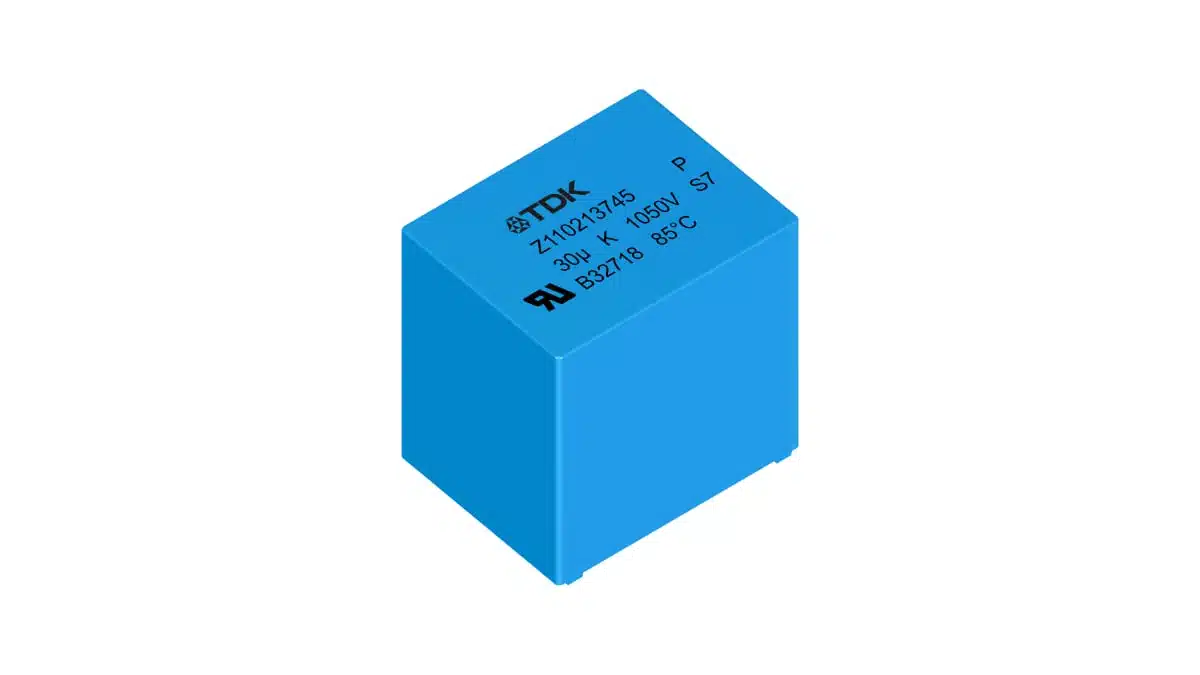
TDK has introduced the B3271xP series of DC link film capacitors aimed at demanding automotive and industrial power electronics operating up to 125 °C.

The series targets engineers who need high ripple current capability, compact dimensions, and long service life in thermally constrained inverter, converter, and power supply designs.

RelatedPosts

TDK Releases Stackable µPOL 25A Power Modules

0603 Automotive Chip Varistors as TVS Diode Replacements, TDK Tech Note

TDK Releases High Performance 105C DC Link Film Capacitors

Key features and benefits

The B3271xP series is a family of polypropylene (MKP) DC link capacitors designed for use on the DC bus of power conversion systems where elevated ambient temperature and continuous ripple loading are present. Its construction and ratings are optimized for xEV traction inverters, onboard chargers, DC‑DC converters, and industrial drives that operate close to the thermal limits of surrounding semiconductors and magnetics.

Main performance features include:

  • Maximum operating temperature of +125 °C with no power derating required up to +105 °C, supporting stable operation in hot inverter housings and under‑hood environments.
  • Polypropylene (MKP) dielectric with low dielectric losses, enabling high ripple current capability and reduced self‑heating compared with many alternative dielectric systems.
  • Capacitance range from 0.47 µF to 110 µF and rated DC voltages from 600 V to 1200 V, allowing scalable DC link designs across a wide power range.
  • Typical ESR in the single‑digit milliohm range at power frequencies such as 10 kHz, improving efficiency and reducing ripple voltage on the DC bus.
  • Over‑voltage capability and good self‑healing behavior, which helps limit the impact of partial dielectric breakdowns and contributes to long useful life.
  • High CV product and compact package sizes, supporting space‑constrained layouts where DC link volume is at a premium.

From a mechanical and safety perspective:

  • Flame‑retardant plastic case with epoxy sealing, qualified to UL 94 V‑0, suitable for applications requiring enhanced fire safety and robust environmental protection.
  • Availability in 2‑pin and, on request, 4‑pin versions, where 4‑pin options can reduce parasitic inductance and improve mechanical stability under vibration.
  • Compliance with UL 810 (construction) and AEC‑Q200E, making the series suitable for automotive platforms as well as industrial equipment with stringent reliability requirements.
  • RoHS‑compatible construction, supporting regulatory compliance in global markets.

Typical applications

The B3271xP film capacitor series is positioned as a DC link solution for both automotive and industrial power stages where high thermal robustness is essential. In automotive, the capacitors address powertrains and auxiliary power electronics that must operate reliably in compact enclosures with limited airflow.

Representative use cases include:

  • xEV traction inverters as the main DC link buffer between the traction battery and the inverter IGBT/MOSFET bridge.
  • Onboard chargers (OBC) for AC‑to‑DC conversion, providing energy storage and smoothing of rectified DC.
  • High‑voltage DC‑DC converters, such as those supplying 12 V or 48 V networks from a high‑voltage battery.
  • Industrial frequency converters for motor drives, where high ripple currents and elevated cabinet temperatures are common.
  • High‑end industrial power supplies and solar inverters, where low ESR and high ripple capability help achieve high efficiency and long lifetime.

In many of these applications, ambient and hot‑spot temperatures near the DC link capacitor can easily exceed 100 °C during normal operation. A maximum operating temperature of 125 °C with derating starting only at 105 °C allows more predictable lifetimes and can reduce the need to over‑dimension the capacitor bank.

Technical highlights

The series consists of three main ordering code families, differentiated primarily by lead spacing, capacitance range, and current capability. This structured portfolio helps designers select a suitable mechanical footprint while maintaining consistent electrical behavior at system level.

Key data by ordering code

  • B32714P
    • Rated voltage: 600 V to 1200 V DC
    • Capacitance range: 0.47 µF to 14.0 µF
    • Maximum RMS current at +85 °C, 10 kHz: 2.3 A to 11.0 A
    • Lead spacing: 27.5 mm
  • B32716P
    • Rated voltage: 600 V to 1200 V DC
    • Capacitance range: 1.5 µF to 65.0 µF
    • Maximum RMS current at +85 °C, 10 kHz: 4.0 A to 24.9 A
    • Lead spacing: 37.5 mm
  • B32718P
    • Rated voltage: 600 V to 1200 V DC
    • Capacitance range: 11 µF to 110 µF
    • Maximum RMS current at +85 °C, 10 kHz: 11.3 A to 25.8 A
    • Lead spacing: 52.5 mm

These values give a first indication of the achievable ripple current handling at a representative switching frequency; exact ratings and permissible operating points should be confirmed from the manufacturer datasheet for each specific part number. The combination of high RMS current, low ESR, and polypropylene dielectric enables the capacitors to maintain relatively low internal temperature rise, which directly impacts lifetime in DC link service.

The series adopts a plastic case and epoxy potting approach that provides environmental sealing and mechanical stiffness. In applications subject to shock and vibration, the optional 4‑pin versions can help distribute mechanical stress and reduce the risk of solder joint fatigue, while also lowering equivalent series inductance (ESL) for improved high‑frequency performance.

Design‑in notes for engineers

For design engineers, the key differentiator of the B3271xP series is the elevated maximum operating temperature combined with high ripple current capability. When dimensioning the DC link, it is important to evaluate not only the RMS ripple current at the fundamental switching frequency but also the harmonic spectrum and ambient temperature profile over the mission profile.

Practical design‑in considerations include:

  • Thermal design: Use the specified ripple current ratings (for example at 10 kHz and +85 °C) as a reference, then apply appropriate derating for higher ambient temperatures according to the datasheet curves. Ensure that the calculated core temperature stays within limits to achieve the desired lifetime.
  • Layout and inductance: When high di/dt currents flow through the DC link, parasitic inductance can lead to overshoot and EMI. Short trace lengths, wide copper planes, and, where appropriate, 4‑pin capacitor versions help reduce ESL and improve switching behavior.
  • Parallel connection: For higher energy storage or ripple capability, multiple capacitors can be paralleled. Careful layout symmetry and similar lead lengths help balance currents and temperatures between devices.
  • Coordination with electrolytics: In many designs, DC link film capacitors are combined with aluminum electrolytic capacitors. The film capacitors handle high‑frequency ripple and fast transients, while electrolytics provide bulk energy storage, so balancing their values and positions is a key optimization task.
  • Qualification and standards: For automotive projects, leveraging the AEC‑Q200E compliance simplifies component approval. The UL 810‑compliant construction and UL 94 V‑0 housing can also support safety case documentation and certification for industrial equipment.

For simulation‑driven design, TDK offers SPICE model libraries and the web‑based CLARA (Capacitor Life And Rating Application) tool. These resources allow engineers to estimate lifetime under specific electrical and thermal conditions and to validate voltage ripple and current distributions early in the design process.

Source

This article is based on an official press release and supporting information from TDK on the B3271xP series of DC link film capacitors for automotive and industrial power electronics.


References

  1. TDK presents DC link capacitors for up to +125 °C in demanding automotive and industrial applications
  2. TDK DC link film capacitors – product overview
  3. TDK SPICE model libraries for film capacitors
  4. TDK CLARA – Capacitor Life And Rating Application

Related

Recent Posts

Schurter Releases EKO HV Fuses up to 1000 VDC, 1100 A

11.2.2026
1

Empower Releases High-Density Embedded Silicon Capacitors

11.2.2026
3

SCHURTER Releases Coin Cell Supercapacitors for Backup Power

10.2.2026
6

Skeleton Technologies Expands in U.S. to Power AI Data Centers

9.2.2026
11

TDK Releases Stackable µPOL 25A Power Modules

9.2.2026
13

Smoltek CNF-MIM Capacitors Hit 1,000x Lower Leakage

6.2.2026
19

Vishay Releases Compact 0806 Low‑DCR Power Inductor

5.2.2026
31

Murata Opens New Ceramic Capacitor Manufacturing and R&D Center in Japan

5.2.2026
72

Murata Publishes Power Delivery Guide for AI Servers

4.2.2026
101

Upcoming Events

Feb 11
16:00 - 17:00 CET

What’s Next in Power Electronics Design

Feb 24
16:00 - 17:00 CET

Designing Qi2 Wireless Power Systems: Practical Development and EMC Optimization

Mar 3
16:00 - 17:00 CET

Cybersecurity at the Eleventh Hour – from RED to CRA – Information and Discussion

View Calendar

Popular Posts

  • Buck Converter Design and Calculation

    0 shares
    Share 0 Tweet 0
  • Boost Converter Design and Calculation

    0 shares
    Share 0 Tweet 0
  • LLC Resonant Converter Design and Calculation

    0 shares
    Share 0 Tweet 0
  • Flyback Converter Design and Calculation

    0 shares
    Share 0 Tweet 0
  • Ripple Current and its Effects on the Performance of Capacitors

    3 shares
    Share 3 Tweet 0
  • Dual Active Bridge (DAB) Topology

    0 shares
    Share 0 Tweet 0
  • MLCC and Ceramic Capacitors

    0 shares
    Share 0 Tweet 0
  • What is a Dielectric Constant and DF of Plastic Materials?

    4 shares
    Share 4 Tweet 0
  • How Metal Prices Are Driving Passive Component Price Hikes

    0 shares
    Share 0 Tweet 0
  • MLCC Case Sizes Standards Explained

    0 shares
    Share 0 Tweet 0

Newsletter Subscription


Passive Components Blog

© EPCI - Leading Passive Components Educational and Information Site

  • Home
  • Privacy Policy
  • EPCI Membership & Advertisement
  • About

No Result
View All Result
  • Home
  • Knowledge Blog
  • PCNS

© EPCI - Leading Passive Components Educational and Information Site

This website uses cookies. By continuing to use this website you are giving consent to cookies being used. Visit our Privacy and Cookie Policy.
Go to mobile version