












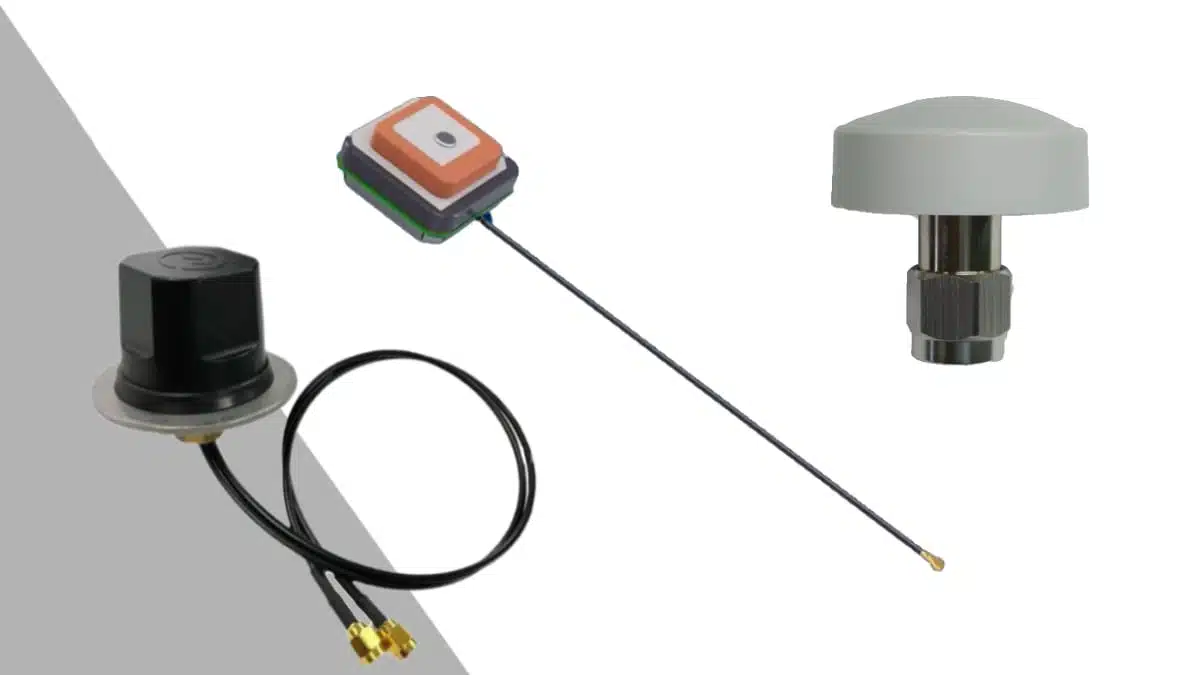
YAGEO Group has introduced three new antennas that target high‑reliability wireless connectivity and precision positioning: a compact 2×2 MiMo Wi‑Fi 6E/7 antenna and two tri‑band L1/L2/L5 GNSS antennas for timing and embedded applications.
These YAGEO group products are aimed at OEMs integrating next‑generation Wi‑Fi and high‑accuracy GNSS into industrial, infrastructure, and tracking systems where RF coexistence and mechanical constraints are critical.
Key features and benefits
LPTNG2471M2DMG0457 2×2 MiMo Wi‑Fi 6E/7 antenna

- 2×2 MiMo coverage across 2400–2500 MHz and 4900–7125 MHz, supporting Wi‑Fi 6E and Wi‑Fi 7 in a single low‑profile housing.
- Ground‑plane‑independent architecture using an integrated mounting washer, allowing stable performance on metallic and non‑metallic enclosures without relying on PCB ground planes.
- Rugged environmental construction with IP67 ingress protection, UV‑stabilized radome, and UL94‑V0 flame rating for outdoor and industrial use.
- Compact mechanical form factor with approximately 45.50 mm diameter and 34.5 mm installed height, suitable for crowded housings and mast‑mount installations.
- Two SMA‑male connectors with 457 mm (1.5 ft) RG316 cables for direct connection to 2×2 MiMo radios, routers, and gateways, with custom cable and connector options available on request.
From a design perspective, the ground‑plane‑independent approach reduces enclosure‑driven detuning and simplifies mechanical placement, which is often a pain point with conventional PCB or monopole antennas in metal cabinets.
GNSSL125DM26NM active GNSS L1/L2/L5 timing antenna

- Tri‑band GNSS operation across L1, L2, and L5, targeting modern timing receivers that leverage multi‑frequency signals for improved robustness and accuracy.
- Active stacked ceramic patch architecture with integrated low‑noise amplifier (typical 28–33 dB gain, band‑dependent) and filtering to improve signal‑to‑noise ratio and reject LTE/5G interference.
- Wide operating voltage range from 2.5 to 18 VDC and low current consumption, simplifying integration into diverse timing and network infrastructure platforms.
- IP67‑rated enclosure with operating temperature from –40 °C to +85 °C, UL 94 V0 flammability, and UL f1 UV resistance ratings for long‑term outdoor deployment.
- “N” male bulkhead mounting for direct installation on outdoor cabinets, timing enclosures, and panels without additional brackets or feedthroughs.
For timing and synchronization systems, multi‑band GNSS (L1/L2/L5) helps reduce ionospheric error and enhances resilience against jamming and spoofing compared to legacy L1‑only antennas.
GNSSL125182530S compact tri‑band GNSS patch antenna

- Tri‑band GNSS support for L1 (1561–1602 MHz), L2 (1215–1237 MHz), and L5 (1164–1189 MHz), enabling multi‑frequency positioning across GPS, GLONASS, Galileo, BeiDou, and IRNSS constellations.
- Stacked 25 × 25 mm ceramic patch footprint, providing a smaller form factor than typical 30 × 30 mm tri‑band patches while maintaining RHCP patterns across all three bands.
- Integrated 30 dB low‑noise amplifier with low noise figure (around 1.7 dB at L1 and 2.2 dB at L2/L5), plus strong internal filtering for RF coexistence with cellular and Wi‑Fi radios.
- Wide input voltage range from 2.5 to 18 VDC with internal LDO regulation and ESD protection, enabling direct connection to a variety of system power rails.
- Supplied with 100 mm Ø1.13 mm coaxial cable and I‑PEX MHF connector, with options for customized cable and connector configurations.
This integrated GNSS module saves PCB area and external BOM (LNA, LDO, biasing network), which is attractive for compact trackers and industrial IoT devices that still need multi‑band precision.
Typical applications
LPTNG2471M2DMG0457 MiMo Wi‑Fi antenna
- IoT gateways and edge devices mounted in metal or plastic enclosures.
- Enterprise access points, routers, and industrial Wi‑Fi bridges using Wi‑Fi 6E/7.
- Smart city infrastructure such as kiosks, environmental sensors, and public Wi‑Fi nodes.
- Smart utilities, metering systems, and control cabinets with limited antenna real estate.
- Remote monitoring, vending, and payment terminals where cable routing and environmental sealing are critical.
In practice, this antenna fits well into retrofit scenarios where the enclosure design is fixed and designers need predictable RF performance regardless of whether the mounting surface is sheet metal, fiberglass, or composite.
GNSSL125DM26NM timing antenna
- GNSS‑disciplined oscillators (GNSSDOs), network clocks, and precision timing modules.
- Cellular base stations and small‑cell infrastructure requiring accurate phase and frequency references.
- Outdoor timing cabinets, telecom shelters, and synchronization nodes in smart grid and utility networks.
- Transportation and transit timing systems, including roadside cabinets and depots.
For these applications, the wide supply range allows reuse of existing DC rails in cabinets (for example 5 V, 12 V, or 15 V), reducing the need for dedicated antenna power converters.
GNSSL125182530S embedded GNSS antenna
- Asset tracking and logistics devices where enclosure volume and PCB area are limited.
- Fleet management and telematics systems requiring higher integrity positioning.
- Surveying, mapping, and industrial positioning platforms in construction, mining, and agriculture.
- Compact GNSS‑enabled consumer and industrial devices such as handhelds, gateways, or geofencing units.
Because the antenna is supplied as an active patch with integrated LNA, LDO, and DC‑bias feed, it is particularly suitable for design teams that want to avoid RF front‑end design and focus on system‑level integration.
Availability and part numbers
- LPTNG2471M2DMG0457: 2×2 MiMo, ground‑plane‑independent Wi‑Fi 6E/7 antenna for 2.4 GHz and 4.9–7.125 GHz operation. Ordering and detailed specifications are provided in the manufacturer product brief and online product page.
- GNSSL125DM26NM: Active tri‑band L1/L2/L5 timing antenna with N‑type bulkhead mount for outdoor infrastructure timing systems. Key electrical and mechanical parameters are defined in the corresponding product brief and documentation.
- GNSSL125182530S: Compact tri‑band active GNSS patch antenna module with integrated LNA and cable/connector assembly. Detailed RF performance, gain, and matching information is available in the official product brief.
Exact parametric values beyond those described here (for example detailed gain curves, group delay, VSWR, axial ratio, or constellation‑specific performance) should be taken directly from the manufacturer datasheet and product brief when finalizing a design.
Design‑in notes for engineers
Wi‑Fi 6E/7 antenna: integration tips
- Treat the LPTNG2471M2DMG0457 as an external antenna module rather than a PCB element: focus on mechanical mounting, cable routing, and connector placement rather than ground‑plane design, since the antenna is ground‑plane‑independent by design.
- For metal enclosures, use the integrated mounting washer and follow the manufacturer’s recommended torque and sealing practices to maintain IP67 performance.
- Keep RF cables as short and straight as practical to minimize loss, and avoid routing parallel to noisy digital cables or switching regulators to preserve SNR at 6–7 GHz.
- When designing for Wi‑Fi 7, ensure that the radio front‑end and firmware are configured to utilize the full 4.9–7.125 GHz band capability offered by the antenna.
GNSS timing antenna: system considerations
- For GNSSL125DM26NM, verify that the GNSS receiver supports active antennas and that the DC feed and expected current draw are compatible with the 2.5–18 VDC active supply.
- The integrated LNA and filtering reduce the need for external amplification; additional gain stages should be added only after reviewing the system link budget and noise figure, as over‑amplification can degrade dynamic range.
- Use low‑loss coaxial cable between the timing equipment and the antenna, especially where cable runs are long or operate in harsh climates; consult the product brief for recommended maximum lengths based on gain and cable type.
- As with any timing antenna, ensure good sky visibility and avoid proximity to strong cellular or broadcast emitters; the integrated filtering helps, but placement still dominates overall performance.
Embedded GNSS patch: layout and mechanical
- For GNSSL125182530S, reserve a 25 × 25 mm clearance area on the PCB with a low‑loss dielectric underneath, and follow the manufacturer’s mechanical guidelines for distance to ground and housing.
- Because the module includes an integrated LNA and LDO, pay attention to input DC power quality and decoupling near the antenna connector, but RF matching work is largely handled inside the module.
- Place the antenna as far as practical from high‑speed digital interfaces, DC‑DC converters, and high‑power RF transmitters (LTE, Wi‑Fi), even though internal filtering is designed to improve coexistence.
- For custom cable lengths or alternate connectors, keep in mind that cable loss and changes in reference ground can slightly affect overall system noise figure and should be included in the design’s GNSS link budget.
In all three cases, early RF simulation or evaluation with the manufacturer’s recommended evaluation boards and test setups is advisable before locking down enclosure and PCB designs.
Source
The information in this article is based on official Yageo Group product brief press releases and associated documentation for the LPTNG2471M2DMG0457, GNSSL125DM26NM, and GNSSL125182530S antennas.