






Passive Components Blog
No Result
View All Result
  • Home
  • NewsFilter
    • All
    • Aerospace & Defence
    • Antenna
    • Applications
    • Automotive
    • Capacitors
    • Circuit Protection Devices
    • electro-mechanical news
    • Filters
    • Fuses
    • Inductors
    • Industrial
    • Integrated Passives
    • inter-connect news
    • Market & Supply Chain
    • Market Insights
    • Medical
    • Modelling and Simulation
    • New Materials & Supply
    • New Technologies
    • Non-linear Passives
    • Oscillators
    • Passive Sensors News
    • Resistors
    • RF & Microwave
    • Telecommunication
    • Weekly Digest

    Exxelia Miniaturized 400 MHz Inverted‑F Antenna

    Würth Elektronik Unveils High-Current Automotive Power Inductor

    Transformer-Based Power-Line Harvester Magnetic Design

    Tantalum Capacitor Anode Manufacturing Quality Management

    Middle East Conflict: The Potential Impact to Passive Components

    Wk 12 Electronics Supply Chain Digest

    Designing a 2 kW LLC Transformer with Integrated Resonant Inductor

    Inductor Technology Dossier

    Coilcraft Releases TLVR Inductors for High Density VRMs and PoL Converters

    Trending Tags

    • Ripple Current
    • RF
    • Leakage Current
    • Tantalum vs Ceramic
    • Snubber
    • Low ESR
    • Feedthrough
    • Derating
    • Dielectric Constant
    • New Products
    • Market Reports
  • VideoFilter
    • All
    • Antenna videos
    • Capacitor videos
    • Circuit Protection Video
    • Filter videos
    • Fuse videos
    • Inductor videos
    • Inter-Connect Video
    • Non-linear passives videos
    • Oscillator videos
    • Passive sensors videos
    • Resistor videos

    Transformer-Based Power-Line Harvester Magnetic Design

    Thermal Modeling of Magnetics

    Standard vs Planar LLC transformers Comparison for Battery Chargers

    How Modern Tools Model Magnetic Components for Power Electronics

    Advanced Loss Modeling for Planar Magnetics in the Frenetic Planar Tool

    2026 Power Magnetics Design Trends: Flyback, DAB and Planar

    Enabling Software‑Defined Vehicle Architectures: Automotive Ethernet and Zonal Smart Power

    Calculating Resistance Value of a Flyback RC Snubber 

    One‑Pulse Characterization of Nonlinear Power Inductors

    Trending Tags

    • Capacitors explained
    • Inductors explained
    • Resistors explained
    • Filters explained
    • Application Video Guidelines
    • EMC
    • New Products
    • Ripple Current
    • Simulation
    • Tantalum vs Ceramic
  • Knowledge Blog
  • DossiersNew
  • Suppliers
    • Who is Who
  • PCNS
    • PCNS 2025
    • PCNS 2023
    • PCNS 2021
    • PCNS 2019
    • PCNS 2017
  • Events
  • Home
  • NewsFilter
    • All
    • Aerospace & Defence
    • Antenna
    • Applications
    • Automotive
    • Capacitors
    • Circuit Protection Devices
    • electro-mechanical news
    • Filters
    • Fuses
    • Inductors
    • Industrial
    • Integrated Passives
    • inter-connect news
    • Market & Supply Chain
    • Market Insights
    • Medical
    • Modelling and Simulation
    • New Materials & Supply
    • New Technologies
    • Non-linear Passives
    • Oscillators
    • Passive Sensors News
    • Resistors
    • RF & Microwave
    • Telecommunication
    • Weekly Digest

    Exxelia Miniaturized 400 MHz Inverted‑F Antenna

    Würth Elektronik Unveils High-Current Automotive Power Inductor

    Transformer-Based Power-Line Harvester Magnetic Design

    Tantalum Capacitor Anode Manufacturing Quality Management

    Middle East Conflict: The Potential Impact to Passive Components

    Wk 12 Electronics Supply Chain Digest

    Designing a 2 kW LLC Transformer with Integrated Resonant Inductor

    Inductor Technology Dossier

    Coilcraft Releases TLVR Inductors for High Density VRMs and PoL Converters

    Trending Tags

    • Ripple Current
    • RF
    • Leakage Current
    • Tantalum vs Ceramic
    • Snubber
    • Low ESR
    • Feedthrough
    • Derating
    • Dielectric Constant
    • New Products
    • Market Reports
  • VideoFilter
    • All
    • Antenna videos
    • Capacitor videos
    • Circuit Protection Video
    • Filter videos
    • Fuse videos
    • Inductor videos
    • Inter-Connect Video
    • Non-linear passives videos
    • Oscillator videos
    • Passive sensors videos
    • Resistor videos

    Transformer-Based Power-Line Harvester Magnetic Design

    Thermal Modeling of Magnetics

    Standard vs Planar LLC transformers Comparison for Battery Chargers

    How Modern Tools Model Magnetic Components for Power Electronics

    Advanced Loss Modeling for Planar Magnetics in the Frenetic Planar Tool

    2026 Power Magnetics Design Trends: Flyback, DAB and Planar

    Enabling Software‑Defined Vehicle Architectures: Automotive Ethernet and Zonal Smart Power

    Calculating Resistance Value of a Flyback RC Snubber 

    One‑Pulse Characterization of Nonlinear Power Inductors

    Trending Tags

    • Capacitors explained
    • Inductors explained
    • Resistors explained
    • Filters explained
    • Application Video Guidelines
    • EMC
    • New Products
    • Ripple Current
    • Simulation
    • Tantalum vs Ceramic
  • Knowledge Blog
  • DossiersNew
  • Suppliers
    • Who is Who
  • PCNS
    • PCNS 2025
    • PCNS 2023
    • PCNS 2021
    • PCNS 2019
    • PCNS 2017
  • Events
No Result
View All Result
Passive Components Blog
No Result
View All Result

Capacitor Technology Dossier

4.3.2026
Reading Time: 4 mins read
A A

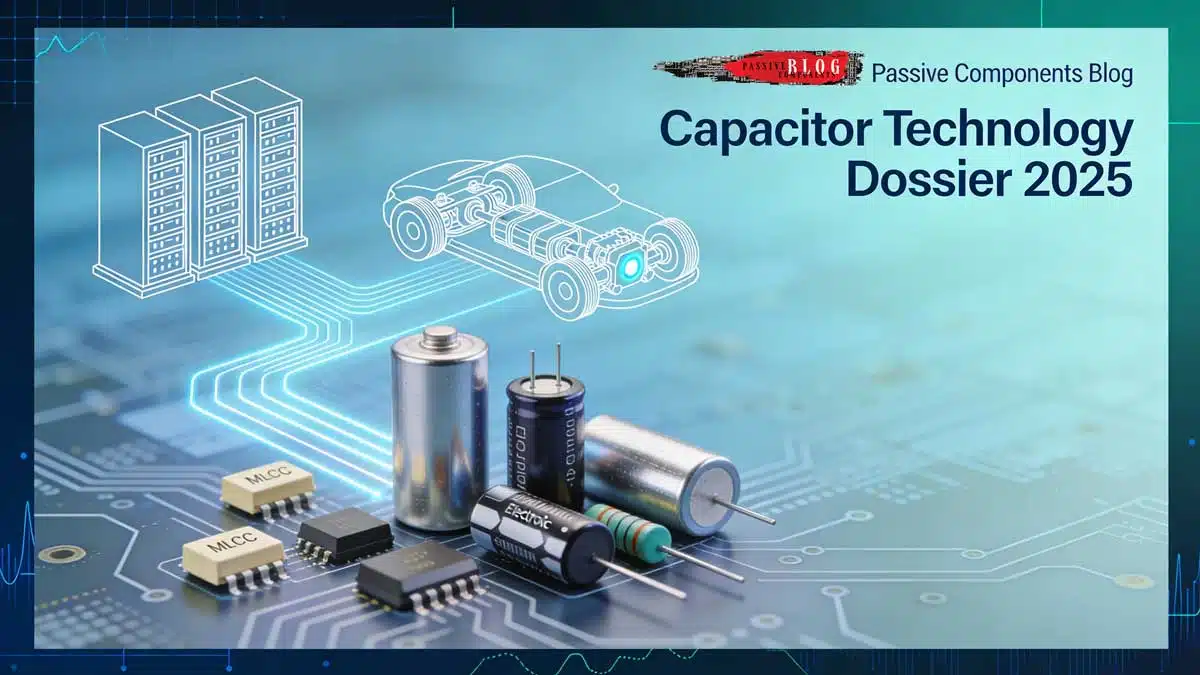
Passive Components Blog has released the 2025 Annual Capacitor Technology Dossier, a 33‑page deep dive into how capacitors moved from low-margin commodity parts to strategic enablers of AI, EV and 5G infrastructure in 2025.

The global capacitor market reached USD 41.23 billion in 2025, with strategic segments such as high‑voltage MLCCs, polymer/hybrid aluminum capacitors and DC‑link film capacitors growing at 12–17% CAGR, while general-purpose consumer MLCCs stagnated. The dossier explains why design-in decisions around capacitor technology, derating and qualification now drive system performance, reliability and total cost of ownership in mission‑critical applications.

RelatedPosts

Inductor Technology Dossier

Resistor Technology Dossier

What the dossier covers

  • Seven structural trends shaping 2025
    The report identifies seven forces that redefined the industry, including AI server power architectures, the 800 V EV tipping point, 5G‑Advanced RF front‑ends, regional supply chain reconfiguration, miniaturization limits, intensifying AEC‑Q200 qualification, and new sustainability mandates in the EU.
  • Hard numbers behind the shift
    Detailed tables quantify 2025 market size and 2035 projections by technology, from MLCC and high‑voltage MLCC to polymer/hybrid aluminum, DC‑link film, tantalum and supercapacitors. The dossier contrasts differing “total market” definitions among major research houses and shows how that changes the view of opportunity sizing.
  • AI, EV and other application chapters
    Application-focused sections dissect capacitor roles in AI data-center PDNs, 800 V EV powertrains and on‑board chargers, and Advanced base stations. Readers see which capacitor types win in each architecture – and why.
  • Technology landscape & roadmap
    A full technology map compares MLCC families, polymer and hybrid aluminum, film, tantalum/niobium and supercapacitors across capacitance, voltage, ESR, temperature and volumetric efficiency. A dedicated positioning diagram shows how each technology sits in the voltage–frequency space, from RF matching networks to DC‑link energy storage and grid‑level buffering.
  • Qualification, compliance and derating
    The dossier summarizes AEC‑Q200 Revision E implications for automotive capacitors, extended temperature and voltage stress regimes, and the resulting 12–18 month qualification cycles. It also covers updated RoHS/REACH and Digital Product Passport requirements, and provides concrete lead‑free derating guidelines that cut field failure rates for X7R, X5R and Y5V ceramics by ~86–94%.

Who should read it

This dossier is written for:

  • Component manufacturers and distributors refining 2026–2030 product roadmaps for MLCC, polymer/hybrid aluminum, film and supercapacitors.
  • OEM and Tier‑1 engineering teams designing AI servers, EV powertrains, OBC/BMS, industrial drives, solar inverters and other applications who need a consolidated view of capacitor options and trade‑offs.
  • Sourcing, category and product managers responsible for mitigating lead‑time and qualification risk in strategic capacitor categories.

Why it is different from generic market reports

Unlike broad passive-component reports that focus on high-level market sizing, the 2025 Annual Capacitor Technology Dossier combines:

  • Quantitative market and CAGR data across all major capacitor technologies.
  • Detailed technology benchmarking (capacitance, voltage, ESR, temperature, volumetric efficiency).
  • Application engineering guidance for AI, EV, 5G and grid-tied systems, including real power-rail and derating examples.

The result is a compact, high‑density reference that can be read in an afternoon and used throughout the year for strategy, design and sourcing decisions.

Availability

The Annual Capacitor Technology Dossier – “From Commodity to Strategic:Capacitors for AI, EV and other applications” is available now at 699EUR exclusively from passive-components.eu as a paid download.

To learn more and purchase your copy, visit the Technology Dossiers page on the passive-components.eu blog.
Technology Dossiers

Related

Recent Posts

Würth Elektronik Unveils High-Current Automotive Power Inductor

24.3.2026
11

Tantalum Capacitor Anode Manufacturing Quality Management

23.3.2026
14

Middle East Conflict: The Potential Impact to Passive Components

23.3.2026
72

Inductor Technology Dossier

19.3.2026
46

Coilcraft Releases TLVR Inductors for High Density VRMs and PoL Converters

19.3.2026
38

Rutheniums Critical Role in Passive Component Supply Chains

19.3.2026
30

Murata to Decouple China Rare Earth Supply in 3 Years

19.3.2026
156

Hirose Electric to Establish Automotive Connector Plant in India

19.3.2026
16
Schematic illustration of the electric double layer of porous carbon electrodes at elevated potentials in a a conventional electrolyte and b a weakly solvating electrolyte; source: authors

Researchers Presented Lignin-based Electrolyte for 4V Supercapacitors with Low Self‑Discharge

19.3.2026
25

Upcoming Events

Apr 21
16:00 - 17:00 CEST

Heatsink Solutions: Thermal Management in electronic devices

May 5
16:00 - 17:00 CEST

Understanding and Selecting Capacitors – Fundamentals, Technologies and Latest Trends

May 19
16:00 - 17:00 CEST

Designing Qi2 Wireless Power Systems: Practical Development and EMC Optimization

View Calendar

Popular Posts

  • Buck Converter Design and Calculation

    0 shares
    Share 0 Tweet 0
  • Boost Converter Design and Calculation

    0 shares
    Share 0 Tweet 0
  • Flyback Converter Design and Calculation

    0 shares
    Share 0 Tweet 0
  • LLC Resonant Converter Design and Calculation

    0 shares
    Share 0 Tweet 0
  • MLCC and Ceramic Capacitors

    0 shares
    Share 0 Tweet 0
  • MLCC Manufacturers Consider Price Increase as AI Demand Outpaces Supply

    0 shares
    Share 0 Tweet 0
  • Dual Active Bridge (DAB) Topology

    0 shares
    Share 0 Tweet 0
  • Ripple Current and its Effects on the Performance of Capacitors

    3 shares
    Share 3 Tweet 0
  • MLCC Case Sizes Standards Explained

    0 shares
    Share 0 Tweet 0
  • What is a Dielectric Constant and DF of Plastic Materials?

    4 shares
    Share 4 Tweet 0

Newsletter Subscription


Passive Components Blog

© EPCI - Leading Passive Components Educational and Information Site

  • Home
  • Privacy Policy
  • EPCI Membership & Advertisement
  • About

No Result
View All Result
  • Home
  • Knowledge Blog
  • PCNS

© EPCI - Leading Passive Components Educational and Information Site

This website uses cookies. By continuing to use this website you are giving consent to cookies being used. Visit our Privacy and Cookie Policy.
Go to mobile version