







Passive Components Blog
No Result
View All Result
  • Home
  • NewsFilter
    • All
    • Aerospace & Defence
    • Antenna
    • Applications
    • Automotive
    • Capacitors
    • Circuit Protection Devices
    • electro-mechanical news
    • Filters
    • Fuses
    • Inductors
    • Industrial
    • Integrated Passives
    • inter-connect news
    • Market & Supply Chain
    • Market Insights
    • Medical
    • Modelling and Simulation
    • New Materials & Supply
    • New Technologies
    • Non-linear Passives
    • Oscillators
    • Passive Sensors News
    • Resistors
    • RF & Microwave
    • Telecommunication
    • Weekly Digest

    Miniaturization of Tantalum Capacitors: Structural Limit Under Constant Rating

    Heatsink Design and Thermal Interface Materials for Reliable Electronics

    Murata New MLCC Bulk Case Packaging Cuts Packaging Material by 99%

    Wk 17 Electronics Supply Chain Digest

    Exxelia Introduces SMD High‑Voltage Mica Capacitors

    Modelithics Releases COMPLETE v26.1 for Keysight ADS

    April 2026 Interconnect, Passives and Electromechanical Components Market Insights

    SPICE Simulation of Non-Linear Resistors: Vishay’s Thermistor and PPTC Modelling Ecosystem

    KYOCERA AVX Introduces Traction‑Grade DC Link Film Capacitors

    Trending Tags

    • Ripple Current
    • RF
    • Leakage Current
    • Tantalum vs Ceramic
    • Snubber
    • Low ESR
    • Feedthrough
    • Derating
    • Dielectric Constant
    • New Products
    • Market Reports
  • VideoFilter
    • All
    • Antenna videos
    • Capacitor videos
    • Circuit Protection Video
    • Filter videos
    • Fuse videos
    • Inductor videos
    • Inter-Connect Video
    • Non-linear passives videos
    • Oscillator videos
    • Passive sensors videos
    • Resistor videos

    Why Power Inductors Use a Ferrite Core With an Air Gap

    Transformer-Based Power-Line Harvester Magnetic Design

    Thermal Modeling of Magnetics

    Standard vs Planar LLC transformers Comparison for Battery Chargers

    How Modern Tools Model Magnetic Components for Power Electronics

    Advanced Loss Modeling for Planar Magnetics in the Frenetic Planar Tool

    2026 Power Magnetics Design Trends: Flyback, DAB and Planar

    Enabling Software‑Defined Vehicle Architectures: Automotive Ethernet and Zonal Smart Power

    Calculating Resistance Value of a Flyback RC Snubber 

    Trending Tags

    • Capacitors explained
    • Inductors explained
    • Resistors explained
    • Filters explained
    • Application Video Guidelines
    • EMC
    • New Products
    • Ripple Current
    • Simulation
    • Tantalum vs Ceramic
  • Knowledge Blog
  • DossiersNew
  • Suppliers
    • Who is Who
  • PCNS
    • PCNS 2025
    • PCNS 2023
    • PCNS 2021
    • PCNS 2019
    • PCNS 2017
  • Events
  • Home
  • NewsFilter
    • All
    • Aerospace & Defence
    • Antenna
    • Applications
    • Automotive
    • Capacitors
    • Circuit Protection Devices
    • electro-mechanical news
    • Filters
    • Fuses
    • Inductors
    • Industrial
    • Integrated Passives
    • inter-connect news
    • Market & Supply Chain
    • Market Insights
    • Medical
    • Modelling and Simulation
    • New Materials & Supply
    • New Technologies
    • Non-linear Passives
    • Oscillators
    • Passive Sensors News
    • Resistors
    • RF & Microwave
    • Telecommunication
    • Weekly Digest

    Miniaturization of Tantalum Capacitors: Structural Limit Under Constant Rating

    Heatsink Design and Thermal Interface Materials for Reliable Electronics

    Murata New MLCC Bulk Case Packaging Cuts Packaging Material by 99%

    Wk 17 Electronics Supply Chain Digest

    Exxelia Introduces SMD High‑Voltage Mica Capacitors

    Modelithics Releases COMPLETE v26.1 for Keysight ADS

    April 2026 Interconnect, Passives and Electromechanical Components Market Insights

    SPICE Simulation of Non-Linear Resistors: Vishay’s Thermistor and PPTC Modelling Ecosystem

    KYOCERA AVX Introduces Traction‑Grade DC Link Film Capacitors

    Trending Tags

    • Ripple Current
    • RF
    • Leakage Current
    • Tantalum vs Ceramic
    • Snubber
    • Low ESR
    • Feedthrough
    • Derating
    • Dielectric Constant
    • New Products
    • Market Reports
  • VideoFilter
    • All
    • Antenna videos
    • Capacitor videos
    • Circuit Protection Video
    • Filter videos
    • Fuse videos
    • Inductor videos
    • Inter-Connect Video
    • Non-linear passives videos
    • Oscillator videos
    • Passive sensors videos
    • Resistor videos

    Why Power Inductors Use a Ferrite Core With an Air Gap

    Transformer-Based Power-Line Harvester Magnetic Design

    Thermal Modeling of Magnetics

    Standard vs Planar LLC transformers Comparison for Battery Chargers

    How Modern Tools Model Magnetic Components for Power Electronics

    Advanced Loss Modeling for Planar Magnetics in the Frenetic Planar Tool

    2026 Power Magnetics Design Trends: Flyback, DAB and Planar

    Enabling Software‑Defined Vehicle Architectures: Automotive Ethernet and Zonal Smart Power

    Calculating Resistance Value of a Flyback RC Snubber 

    Trending Tags

    • Capacitors explained
    • Inductors explained
    • Resistors explained
    • Filters explained
    • Application Video Guidelines
    • EMC
    • New Products
    • Ripple Current
    • Simulation
    • Tantalum vs Ceramic
  • Knowledge Blog
  • DossiersNew
  • Suppliers
    • Who is Who
  • PCNS
    • PCNS 2025
    • PCNS 2023
    • PCNS 2021
    • PCNS 2019
    • PCNS 2017
  • Events
No Result
View All Result
Passive Components Blog
No Result
View All Result

Murata to Decouple China Rare Earth Supply in 3 Years

19.3.2026
Reading Time: 5 mins read
A A

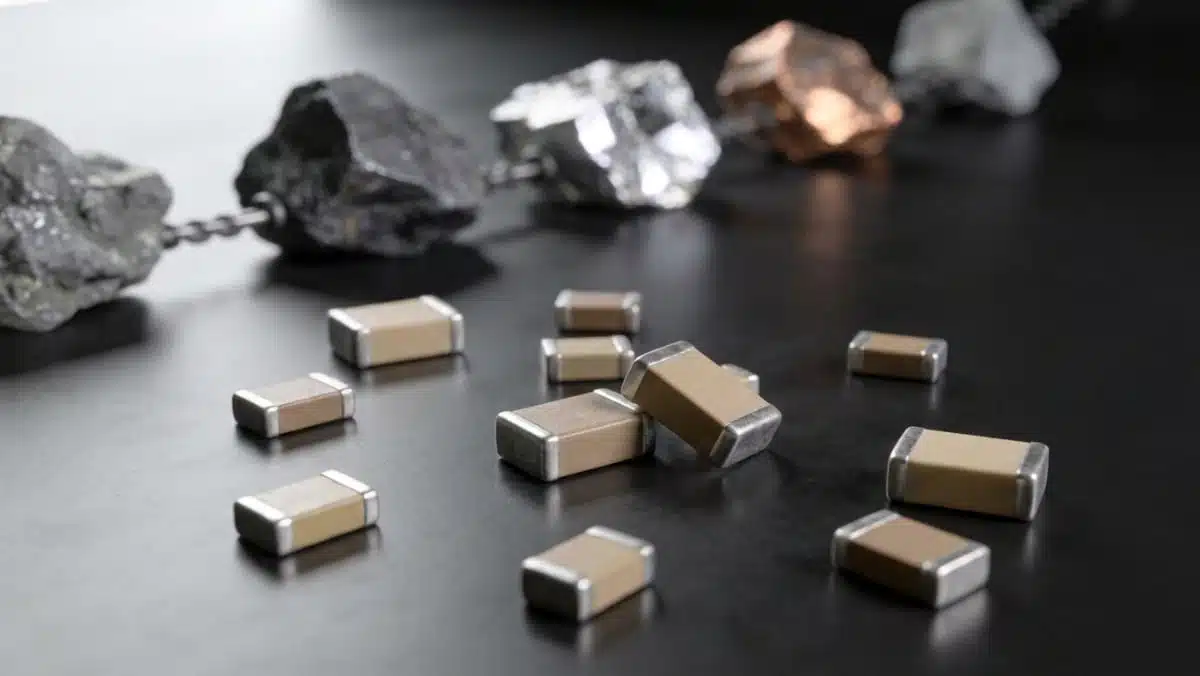
Japan-based Murata Manufacturing, the world’s leading supplier of multilayer ceramic capacitors, is moving to structurally separate its China-related rare earth supply chain from the rest of its global operations over the next three years.

This strategic shift comes amid rising geopolitical risks and tightening Chinese export controls on critical minerals and dual-use materials.

RelatedPosts

Murata New MLCC Bulk Case Packaging Cuts Packaging Material by 99%

Murata Automotive MLCCs Push Capacitance Limits for ADAS and Power Lines

Murata New Vibration Sensor Targets High‑Frequency Predictive Maintenance

Strategic Supply Chain Realignment

According to recent reports, Murata plans to establish distinct rare earth material supply chains for the U.S. and China, effectively ring‑fencing its China-based operations from its broader global business. The initiative aims to reduce exposure to regulatory and geopolitical shocks while maintaining stable component deliveries to key customers in smartphones, data centers, automotive, and industrial markets.

Murata has been working on this dual‑track strategy since around 2020, when President Norio Nakajima began steering the company toward supply chain structures better aligned with diverging U.S.–China policy environments. The current acceleration reflects heightened concern over China’s use of rare earth export controls as strategic leverage.

Qualification of Non‑Chinese Rare Earth Sources

As part of its decoupling plan, Murata is actively evaluating rare earth materials sourced outside China, including mining and refining routes controlled by non‑Chinese entities. This multi‑year process involves:

  • Identifying and auditing alternative mining projects and refining partners outside China
  • Verifying refining process stability, quality, and long‑term capacity commitments
  • Securing downstream customer approval for MLCCs made with new material sources

Murata expects this full qualification cycle to take roughly three years, though internal statements indicate the company is working to compress timelines where possible. At the same time, executives acknowledge that fully replacing Chinese-origin rare earths may not be technically or economically feasible in the near term, given China’s dominant position in refining and magnet‑grade material production.

Impact on Murata’s China Business and Competitive Landscape

Murata’s pivot comes as its revenue exposure to China is already trending downward. China’s share of the company’s total revenue has reportedly fallen from about 60% in 2021 to just under half in the latest fiscal year, partly due to smartphone and electronics production shifting to other Asian locations. Despite this decline, China remains a core manufacturing hub for iPhones and other high‑volume applications that depend heavily on Murata’s MLCC portfolio.

Competitive pressure from Chinese MLCC manufacturers is also intensifying. Murata continues to hold a leading position in high‑end MLCC technologies and maintains a technological lead estimated at around a decade versus key Chinese rivals, but management has warned that this gap could narrow. Contributing factors include active recruitment of experienced engineers from Japanese and Korean component makers by Chinese competitors, as well as strong domestic policy support for local supply chain build‑out.

Broader Japan–U.S. Critical Materials Cooperation

Murata’s actions are unfolding against a backdrop of wider Japanese and U.S. efforts to secure non‑Chinese sources of critical minerals, including rare earths, lithium, and copper. Reports indicate that the two governments are preparing joint initiatives to develop upstream mining and midstream refining capacity, with participation from major Japanese trading houses such as Mitsui & Co. and Mitsubishi Materials.

These programs build on over a decade of Japanese policy experience in diversifying rare earth supply, including partnerships with producers in Australia and Southeast Asia. For downstream component manufacturers like Murata, this emerging ecosystem of allied supply is expected to provide additional options as they redesign their material sourcing strategies away from single‑country dependence.

Implications for the MLCC and Electronics Industry

Murata currently supplies roughly 40% of the global MLCC market, making its supply chain decisions systemically important for electronics manufacturing. MLCCs are critical to power management and signal integrity in devices ranging from smartphones and notebooks to servers, EVs, and advanced driver‑assistance systems, so any disruption in rare earth inputs can have cascading effects across multiple end markets.

By proactively restructuring its rare earth supply chains and qualifying alternative sources, Murata is seeking to:

  • Reduce vulnerability to sudden export restrictions and licensing delays
  • Improve long‑term visibility on material costs and availability
  • Align more closely with customer and governmental requirements on supply chain resilience and national security

For OEMs and EMS providers, Murata’s three‑year roadmap provides a clearer planning horizon for product design, sourcing strategies, and inventory risk management in an era of persistent geopolitical uncertainty.

Source

This article is based on information from TrendForce News coverage of Murata Manufacturing’s rare earth supply chain strategy, which cites reporting from Financial Times and Nikkei, complemented by additional publicly available analysis on global rare earth supply dynamics and Japan–U.S. critical minerals cooperation.

References

  1. TrendForce – MLCC Giant Murata Reportedly to Decouple China Rare Earth Supply in 3 Years as Risks Rise
  2. Financial Times – Apple supplier Murata starts US–China rare earths decoupling
  3. Nikkei – Japan to provide rare-earth refining tech to Malaysia
  4. S&P Global / Platts – Rare earth supply bottlenecks set to persist in 2026
  5. EU Parliament Think Tank – China’s rare-earth export restrictions
  6. TrendForce – China’s Rare Earth Export Restrictions Sound Alarm for Global Tech Industry
Related

Recent Posts

Miniaturization of Tantalum Capacitors: Structural Limit Under Constant Rating

27.4.2026
19

Murata New MLCC Bulk Case Packaging Cuts Packaging Material by 99%

27.4.2026
27

Exxelia Introduces SMD High‑Voltage Mica Capacitors

28.4.2026
11

Modelithics Releases COMPLETE v26.1 for Keysight ADS

23.4.2026
11

April 2026 Interconnect, Passives and Electromechanical Components Market Insights

22.4.2026
57

KYOCERA AVX Introduces Traction‑Grade DC Link Film Capacitors

21.4.2026
41

When More Capacitance Hurts Reliability: The Role of the Metallic Skeleton in Tantalum Anodes

20.4.2026
43

YAGEO Introduces High‑Current Y2/X1 Film Capacitors for Wide-bandgap Power Systems

17.4.2026
34

YAGEO Introduces High Rel MLCCs Beyond MIL-Spec Limits

16.4.2026
55

Upcoming Events

Apr 29
10:00 - 11:00 CDT

SEPIC Design Done Right

Apr 30
10:00 - 11:00 CDT

Programming Embedded Systems

May 5
16:00 - 17:00 CEST

Understanding and Selecting Capacitors – Fundamentals, Technologies and Latest Trends

View Calendar

Popular Posts

  • Buck Converter Design and Calculation

    0 shares
    Share 0 Tweet 0
  • Boost Converter Design and Calculation

    0 shares
    Share 0 Tweet 0
  • Flyback Converter Design and Calculation

    0 shares
    Share 0 Tweet 0
  • LLC Resonant Converter Design and Calculation

    0 shares
    Share 0 Tweet 0
  • MLCC and Ceramic Capacitors

    0 shares
    Share 0 Tweet 0
  • Dual Active Bridge (DAB) Topology

    0 shares
    Share 0 Tweet 0
  • Capacitor Charging and Discharging

    0 shares
    Share 0 Tweet 0
  • What Electronics Engineer Needs to Know About Passive Low Pass Filters

    0 shares
    Share 0 Tweet 0
  • MLCC Case Sizes Standards Explained

    0 shares
    Share 0 Tweet 0
  • Ripple Current and its Effects on the Performance of Capacitors

    3 shares
    Share 3 Tweet 0

Newsletter Subscription


Passive Components Blog

© EPCI - Leading Passive Components Educational and Information Site

  • Home
  • Privacy Policy
  • EPCI Membership & Advertisement
  • About

No Result
View All Result
  • Home
  • Knowledge Blog
  • PCNS

© EPCI - Leading Passive Components Educational and Information Site

This website uses cookies. By continuing to use this website you are giving consent to cookies being used. Visit our Privacy and Cookie Policy.
Go to mobile version