














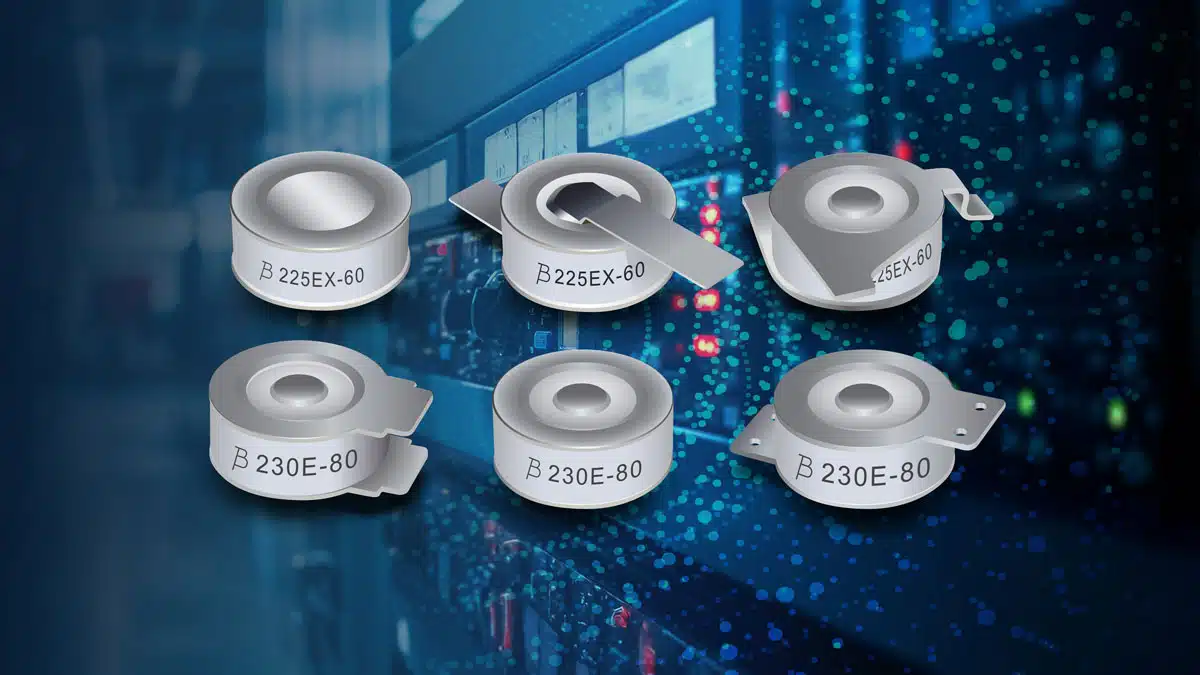
Bourns has introduced the GDT225HE Series, a new family of high voltage, high energy gas discharge tubes (GDTs) designed for demanding surge protection in power and energy systems.
These GDT circuit protection components target lightning‑prone, high energy environments where conventional protection elements alone may not provide sufficient robustness. The series combines high surge current ratings with a broad breakdown voltage range in a compact form factor suitable for high density designs.
Key features and benefits
The GDT225HE Series is a UL Recognized family of high voltage, high energy gas discharge tubes intended for primary surge protection in power and infrastructure applications. According to the manufacturer, the series is tested per ITU‑T K.12 methods, which is widely used as a reference for telecom and surge protective devices.
Key electrical features include:
- DC breakdown voltage (DCBV) range from 1000 V to 2000 V (nominal), allowing coordinated protection on medium to high voltage lines according to the manufacturer datasheet.
- DC breakdown voltage tolerance of ±20%, typical for GDT technology and relevant for coordination with downstream MOVs or TVS components.
- Maximum impulse breakdown voltage specified at 6 kV (1.2/50 µs, two operations) according to the featured product bulletin.
- Impulse discharge current capability on an 8/20 µs surge waveform with:
- Nominal impulse discharge current In of 40 kA.
- Maximum impulse discharge current Imax of 60 kA.
- High energy handling on a 10/350 µs surge waveform with a maximum impulse discharge current rating of 12.5 kA for the GDT225HE‑100 version.
These ratings position the GDT225HE as a primary surge element for systems exposed to high lightning currents or switching surges.
From a practical design perspective, the series offers:
- Compact, space‑saving construction suitable for high density and space‑restricted PCB layouts.
- A variety of lead shapes to fit different mechanical configurations and assembly preferences.
- Low capacitance and low insertion loss, helping to minimize impact on signal integrity and power system performance.
- Fast response time (specified breakdown time < 100 ns for 100–2000 V/s ramp rates), supporting rapid clamp of fast transients.
- Stable performance throughout life, with insulation resistance limits after life ratings still above 100 MΩ according to the manufacturer.
- RoHS compliance as per the referenced directive.
For designers, the combination of high surge capability, low parasitics and compact size simplifies protection design in high energy environments where board space and long‑term reliability are both critical.
Typical applications
The GDT225HE Series is targeted at surge protection in high energy systems where lightning or switching surges are expected on power lines and DC buses. Typical application domains called out by the manufacturer include:
- Surge protective devices (SPDs) used as primary or intermediate protection stages in power distribution and equipment‑level surge protection.
- Power systems, including AC distribution panels, power conversion equipment and upstream protection at equipment inputs.
- Industrial equipment with long cable runs, exposed outdoor interfaces, or high power switching elements.
- Renewable energy systems such as solar and wind installations, where long DC strings and outdoor exposure increase lightning susceptibility.
- Energy storage systems, including battery energy storage, where high energy surge events may couple into DC busbars and system interfaces.
In many of these applications, the GDT225HE would be used in combination with other protection components (for example, a suitable MOV in series as noted by the manufacturer) to achieve a coordinated protection scheme that can both withstand high surge currents and limit residual voltage to safe levels for downstream electronics.
Technical highlights
The featured product bulletin provides a key parameter overview for the GDT225HE‑100 part number, which is representative of the series:
- Part number: GDT225HE‑100.
- Nominal DC breakdown voltage: 1000 V.
- Maximum impulse breakdown voltage: 1800 V.
- Maximum impulse discharge current (8/20 µs): 60 kA.
- Nominal impulse discharge current (8/20 µs, 15 operations): 40 kA.
- Maximum impulse discharge current (10/350 µs, 1 operation): 12.5 kA.
- Temporary overvoltage (TOV) withstand at 1200 V for 0.2 s as defined by the manufacturer.
- Maximum follow‑on current at 50/60 Hz: 300 A.
- Maximum continuous operating voltage (MCOV) at 50/60 Hz: 255 V (when used with a suitable MOV in series as noted in the bulletin).
- Minimum insulation resistance: 1 GΩ (test voltage 500 V).
- Breakdown time: < 100 ns at 100–2000 V/s.
Other voltage variants in the family are listed as:
- GDT225HE‑120 – nominal 1200 V DC breakdown.
- GDT225HE‑140 – nominal 1400 V DC breakdown.
- GDT225HE‑160 – nominal 1600 V DC breakdown.
- GDT225HE‑180 – nominal 1800 V DC breakdown.
- GDT225HE‑200 – nominal 2000 V DC breakdown.
For these variants, maximum impulse breakdown voltages are given up to 3000 V at 1.2/50 µs according to the manufacturer’s table. Exact surge current capability for each variant should be confirmed against the detailed datasheet, but the series in general is positioned as a high surge current GDT family.
The manufacturer notes that:
- DC and impulse sparkover values are specified in ionized mode at 25 °C, which is important when comparing to other GDTs or setting protection coordination margins.
- Impulse sparkover voltage is expressed as a maximum value with a 99% probability that measured values will be within the stated limit.
- DC sparkover voltage limits after life testing may exceed +20%, but devices are designed to continue providing protection without venting, referencing ITU‑T K.12 Edition 9.0.
- Surface mount versions (where applicable) are intended to be reflowed according to IPC/JEDEC J‑STD‑020 rev. D.
These details are relevant for long‑term reliability, compliance, and for accurately modeling worst‑case behavior in surge protection design.
Design‑in notes for engineers
When integrating the GDT225HE Series into a surge protection design, engineers should consider the following practical aspects:
- Coordination with MOVs and downstream protection
The bulletin notes that certain specifications, such as MCOV, are defined when the GDT is used with a suitable MOV in series. This is typical in AC mains and DC bus protection where the GDT handles the highest energy surge while the MOV clamps the residual voltage. Engineers should select MOV ratings and clamping levels consistent with the chosen GDT breakdown voltage and with the equipment insulation coordination requirements. - Selection of breakdown voltage
The choice between 1000 V, 1200 V, 1400 V, 1600 V, 1800 V or 2000 V versions depends on:- System nominal voltage and overvoltage profile.
- Required insulation coordination and creepage/clearance design.
- Coordination with other surge protection stages (line‑side SPDs, downstream TVS diodes, etc.).
Higher breakdown versions can reduce nuisance operation under normal overvoltage, at the cost of higher residual voltages during surge events.
- Surge rating versus expected threat level
The 40 kA/60 kA ratings on 8/20 µs waveforms and 12.5 kA on 10/350 µs provide significant headroom for systems where direct or nearby lightning currents are expected. Designers should map these ratings to local SPD class requirements, test classes and installation conditions, paying attention to the number of operations specified in the bulletin (for example, 15 operations at nominal 8/20 µs current). - Thermal and mechanical considerations
Although GDTs dissipate most surge energy in a short pulse, PCB layout should allow adequate thermal spreading and robust solder joints for the lead style selected. Keeping current paths short and minimizing loop inductance will help achieve the intended protection performance. - Testing and verification
Because impulse sparkover voltages are given as maximum values with 99% probability, prototypes should be evaluated under realistic surge and TOV conditions. This includes:- Verifying coordination with upstream and downstream SPDs.
- Confirming that follow‑on current remains within system limits given the specified 300 A maximum follow‑on current rating at 50/60 Hz for the GDT225HE‑100.
- Checking post‑surge insulation resistance against system safety and leakage requirements.
- Standards context
The references to ITU‑T K.12 test methods and to specific notes on life ratings and DC sparkover voltage drift are helpful when positioning the GDT225HE within telecom and power SPD standards. Designers working under IEC or UL frameworks can use these references as a starting point for mapping to the applicable surge test classes and safety requirements.
Overall, the GDT225HE Series gives designers a high energy primary protection element for modern power, renewable and storage systems where high surge currents, high operating voltages and limited board space must be balanced.
Source
The information in this article is based on the official Bourns new product release for the GDT225HE Series high voltage, high energy gas discharge tubes and associated featured product bulletin, combined with general surge protection design practice.