






Passive Components Blog
No Result
View All Result
  • Home
  • NewsFilter
    • All
    • Aerospace & Defence
    • Antenna
    • Applications
    • Automotive
    • Capacitors
    • Circuit Protection Devices
    • electro-mechanical news
    • Filters
    • Fuses
    • Inductors
    • Industrial
    • Integrated Passives
    • inter-connect news
    • Market & Supply Chain
    • Market Insights
    • Medical
    • Modelling and Simulation
    • New Materials & Supply
    • New Technologies
    • Non-linear Passives
    • Oscillators
    • Passive Sensors News
    • Resistors
    • RF & Microwave
    • Telecommunication
    • Weekly Digest

    Modelithics Library for MATLAB: Measurement-Based Models for Microwave and RF Passive Components

    Bourns Extends Multilayer Chip Inductors Offer for RF and Wireless Designs

    Researchers developed a polymer capacitor by combining two cheap, commercially available plastics. The new polymer capacitor makes use of the transparent material — pictured here, with vintage Penn State athletic marks visible through it — to store four times the energy and withstand significantly more heat.  Credit: Penn State

    Penn State Demonstrated Polymer Alloy Capacitor Film with 4× Energy Density up to 250C

    ECIA January 2026 Reports Strong Sales Confidence

    Vishay Unveils Ultra-Compact 0201 Thick Film Chip Resistors

    Würth Elektronik Component Data Live in Accuris

    Coilcraft Releases Automotive Common Mode Chokes

    MLCC Manufacturers Consider Price Increase as AI Demand Outpaces Supply

    YAGEO Extends Antenna Portfolio with Wi‑Fi 6E/7 and Tri‑band GNSS Solutions

    Trending Tags

    • Ripple Current
    • RF
    • Leakage Current
    • Tantalum vs Ceramic
    • Snubber
    • Low ESR
    • Feedthrough
    • Derating
    • Dielectric Constant
    • New Products
    • Market Reports
  • VideoFilter
    • All
    • Antenna videos
    • Capacitor videos
    • Circuit Protection Video
    • Filter videos
    • Fuse videos
    • Inductor videos
    • Inter-Connect Video
    • Non-linear passives videos
    • Oscillator videos
    • Passive sensors videos
    • Resistor videos

    2026 Power Magnetics Design Trends: Flyback, DAB and Planar

    Enabling Software‑Defined Vehicle Architectures: Automotive Ethernet and Zonal Smart Power

    Calculating Resistance Value of a Flyback RC Snubber 

    One‑Pulse Characterization of Nonlinear Power Inductors

    Thermistor Linearization Challenges

    Coaxial Connectors and How to Connect with PCB

    PCB Manufacturing, Test Methods, Quality and Reliability

    Transformer Behavior – Current Transfer and Hidden Feedback

    Choosing the Right Capacitor: The Importance of Accurate Measurements

    Trending Tags

    • Capacitors explained
    • Inductors explained
    • Resistors explained
    • Filters explained
    • Application Video Guidelines
    • EMC
    • New Products
    • Ripple Current
    • Simulation
    • Tantalum vs Ceramic
  • Knowledge Blog
  • DossiersNew
  • Suppliers
    • Who is Who
  • PCNS
    • PCNS 2025
    • PCNS 2023
    • PCNS 2021
    • PCNS 2019
    • PCNS 2017
  • Events
  • Home
  • NewsFilter
    • All
    • Aerospace & Defence
    • Antenna
    • Applications
    • Automotive
    • Capacitors
    • Circuit Protection Devices
    • electro-mechanical news
    • Filters
    • Fuses
    • Inductors
    • Industrial
    • Integrated Passives
    • inter-connect news
    • Market & Supply Chain
    • Market Insights
    • Medical
    • Modelling and Simulation
    • New Materials & Supply
    • New Technologies
    • Non-linear Passives
    • Oscillators
    • Passive Sensors News
    • Resistors
    • RF & Microwave
    • Telecommunication
    • Weekly Digest

    Modelithics Library for MATLAB: Measurement-Based Models for Microwave and RF Passive Components

    Bourns Extends Multilayer Chip Inductors Offer for RF and Wireless Designs

    Researchers developed a polymer capacitor by combining two cheap, commercially available plastics. The new polymer capacitor makes use of the transparent material — pictured here, with vintage Penn State athletic marks visible through it — to store four times the energy and withstand significantly more heat.  Credit: Penn State

    Penn State Demonstrated Polymer Alloy Capacitor Film with 4× Energy Density up to 250C

    ECIA January 2026 Reports Strong Sales Confidence

    Vishay Unveils Ultra-Compact 0201 Thick Film Chip Resistors

    Würth Elektronik Component Data Live in Accuris

    Coilcraft Releases Automotive Common Mode Chokes

    MLCC Manufacturers Consider Price Increase as AI Demand Outpaces Supply

    YAGEO Extends Antenna Portfolio with Wi‑Fi 6E/7 and Tri‑band GNSS Solutions

    Trending Tags

    • Ripple Current
    • RF
    • Leakage Current
    • Tantalum vs Ceramic
    • Snubber
    • Low ESR
    • Feedthrough
    • Derating
    • Dielectric Constant
    • New Products
    • Market Reports
  • VideoFilter
    • All
    • Antenna videos
    • Capacitor videos
    • Circuit Protection Video
    • Filter videos
    • Fuse videos
    • Inductor videos
    • Inter-Connect Video
    • Non-linear passives videos
    • Oscillator videos
    • Passive sensors videos
    • Resistor videos

    2026 Power Magnetics Design Trends: Flyback, DAB and Planar

    Enabling Software‑Defined Vehicle Architectures: Automotive Ethernet and Zonal Smart Power

    Calculating Resistance Value of a Flyback RC Snubber 

    One‑Pulse Characterization of Nonlinear Power Inductors

    Thermistor Linearization Challenges

    Coaxial Connectors and How to Connect with PCB

    PCB Manufacturing, Test Methods, Quality and Reliability

    Transformer Behavior – Current Transfer and Hidden Feedback

    Choosing the Right Capacitor: The Importance of Accurate Measurements

    Trending Tags

    • Capacitors explained
    • Inductors explained
    • Resistors explained
    • Filters explained
    • Application Video Guidelines
    • EMC
    • New Products
    • Ripple Current
    • Simulation
    • Tantalum vs Ceramic
  • Knowledge Blog
  • DossiersNew
  • Suppliers
    • Who is Who
  • PCNS
    • PCNS 2025
    • PCNS 2023
    • PCNS 2021
    • PCNS 2019
    • PCNS 2017
  • Events
No Result
View All Result
Passive Components Blog
No Result
View All Result

Check Who from passive components is on Elektra Awards 2019 shortlist

30.9.2019
Reading Time: 3 mins read
A A

Source: Electronics Weekly news

Electronics Weekly just revealed the shortlists for this year’s Elektra Awards, the industry’s largest technology and business awards. Check who is nominated from passive components.

RelatedPosts

Modelithics Library for MATLAB: Measurement-Based Models for Microwave and RF Passive Components

Bourns Extends Multilayer Chip Inductors Offer for RF and Wireless Designs

Penn State Demonstrated Polymer Alloy Capacitor Film with 4× Energy Density up to 250C

Now in their 17th year, the Elektra Awards recognise technical, personal and business achievements within electronics. The winners will be announced at a prestigious Gala Dinner at the Grosvenor House Hotel on London’s Park Lane, on Wednesday December 4th.

Passive & Electromechanical Product of the Year Elektra Awards Nomination List

  • CUI Inc – AMT33 Commutation Encoder Series
  • HARTING Ltd – The HARTING T1 Industrial
  • Murata – HPHF series transformer
  • Peratech – Peratech QTC® based EDGE Solution

Passive Components:

1) Murata – HPHF series transformer
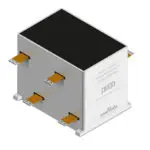
Murata has announced a new transformer technology for high power, high frequency applications that uses a novel winding technique to allow designers to efficiently reach power and frequency levels that were never possible with conventional winding methods.

Murata’s innovative and patented pdqb winding technology makes it possible to construct high frequency transformers of up to and over 400 kW that can operate at frequencies as high as 50 kHz. The pdqb winding technique overcomes the skin and proximity effects as well as other high frequency losses associated with conventional construction methods, delivering an efficient (>99.5 %) solution in a compact footprint.

Electromechanical Components:

1) CUI Inc – AMT33 Commutation Encoder Series

AMT33 SeriesCUI’s AMT33 series is a rugged, high accuracy commutation encoder that generates standard U/V/W communication signals for commutating brushless dc motors. Thanks to its innovative capacitive platform, the series is not susceptible to contaminants such as dirt, dust, and oil that typically plague encoders in industrial environments. The AMT33’s design also simplifies the assembly process, reducing the time-consuming tasks of mounting and alignment to mere seconds with the One Touch Zero™ feature. Combined with an operating temperature range of -40°C to +125°C, high accuracy, a compact package, and low current draw, the AMT33 provides a compelling solution for a range of industrial, automation, robotics, and renewable energy

2) HARTING Ltd – The HARTING T1 IndustrialHARTING T1 Industrial IP20 Steckverbinder und Gerätebuchse
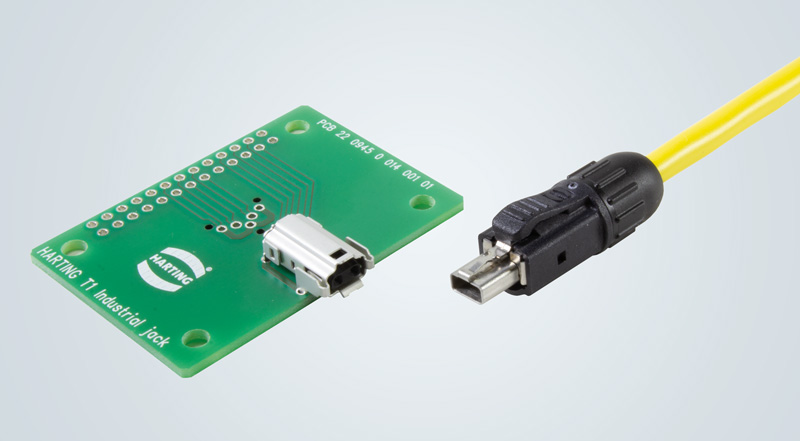
Harting T1 Industrial brings data and power on one pair of wires to previously unattainable locations, thus challenging existing bus systems. HARTING relies on an alliance of research, industry and standardisation for single pair Ethernet. As part of this alliance, international standardisation committees have completed a multi-stage selection process in favour of the HARTING Technology Group’s SPE mating face. This also ensures planning security for the designers of new devices or sensor/actuator technology, permitting them to actively commence the implementation of SPE in the respective device technology.

3) Peratech – Peratech QTC® based EDGE Solution

Force sensing solution from Peratech.Peratech launched its QTC®-based EDGE force-sensing solution that delivers User Experience (UX) differentiation and functionality for smartphones, wearables, and tablets. Peratech’s latest HMI solution uses the edges of a device to provide what Peratech believes is a fundamentally better user experience. Thin sensors with Peratech’s patented QTC technology are mechanically integrated in key areas of the smartphone to capture a user’s natural single-handed grip, ergonomic finger movements, intuitive presses and squeezes to control key functions. EDGE can be used to simplify mute, sleep, volume, zoom, scroll, and emergency-call functions while improving one-handed usability. This means fewer dropped phones, less distraction, and fewer false touches while typing. EDGE works even while the user has wet hands or is wearing gloves.

Related

Recent Posts

Bourns Extends Multilayer Chip Inductors Offer for RF and Wireless Designs

20.2.2026
7

ECIA January 2026 Reports Strong Sales Confidence

19.2.2026
24

Würth Elektronik Component Data Live in Accuris

19.2.2026
14

Coilcraft Releases Automotive Common Mode Chokes

19.2.2026
10

MLCC Manufacturers Consider Price Increase as AI Demand Outpaces Supply

18.2.2026
167

2026 Power Magnetics Design Trends: Flyback, DAB and Planar

13.2.2026
46

Skeleton Technologies Expands in U.S. to Power AI Data Centers

9.2.2026
34

DigiKey Expands Line Card with 108K Stock Parts and 364 Suppliers

6.2.2026
18

Würth Elektronik Announces Partner Program

6.2.2026
43

Upcoming Events

Feb 24
16:00 - 17:00 CET

Mastering Galvanic Isolation: Ensuring Safety in Power Electronics

Mar 3
16:00 - 17:00 CET

Cybersecurity at the Eleventh Hour – from RED to CRA – Information and Discussion

Mar 21
All day

PSMA Capacitor Workshop 2026

View Calendar

Popular Posts

  • Buck Converter Design and Calculation

    0 shares
    Share 0 Tweet 0
  • Boost Converter Design and Calculation

    0 shares
    Share 0 Tweet 0
  • LLC Resonant Converter Design and Calculation

    0 shares
    Share 0 Tweet 0
  • Flyback Converter Design and Calculation

    0 shares
    Share 0 Tweet 0
  • Ripple Current and its Effects on the Performance of Capacitors

    3 shares
    Share 3 Tweet 0
  • Dual Active Bridge (DAB) Topology

    0 shares
    Share 0 Tweet 0
  • What is a Dielectric Constant and DF of Plastic Materials?

    4 shares
    Share 4 Tweet 0
  • MLCC and Ceramic Capacitors

    0 shares
    Share 0 Tweet 0
  • MLCC Case Sizes Standards Explained

    0 shares
    Share 0 Tweet 0
  • SEPIC Converter Design and Calculation

    0 shares
    Share 0 Tweet 0

Newsletter Subscription


Passive Components Blog

© EPCI - Leading Passive Components Educational and Information Site

  • Home
  • Privacy Policy
  • EPCI Membership & Advertisement
  • About

No Result
View All Result
  • Home
  • Knowledge Blog
  • PCNS

© EPCI - Leading Passive Components Educational and Information Site

This website uses cookies. By continuing to use this website you are giving consent to cookies being used. Visit our Privacy and Cookie Policy.
Go to mobile version