



In a study published in Nature Communications, researchers from Monash University have introduced a new graphene-based material that promises to revolutionize energy storage.
This innovative material enables supercapacitors to store energy comparable to traditional lead-acid batteries while delivering power at speeds far surpassing conventional batteries.
Supercapacitors, known for storing charge electrostatically rather than through chemical reactions, have faced limitations due to the limited accessibility of their carbon material’s surface area. However, the Monash team, led by Professor Mainak Majumder, Director of the ARC Research Hub for Advanced Manufacturing with 2D Materials (AM2D), has unlocked significant potential by altering the material’s heat-treatment process.
“Our team has shown how to unlock much more of that surface area by simply changing the way the material is heat-treated,” said Professor Majumder. “This discovery could allow us to build fast-charging supercapacitors that store enough energy to replace batteries in many applications, and deliver it far more quickly.”
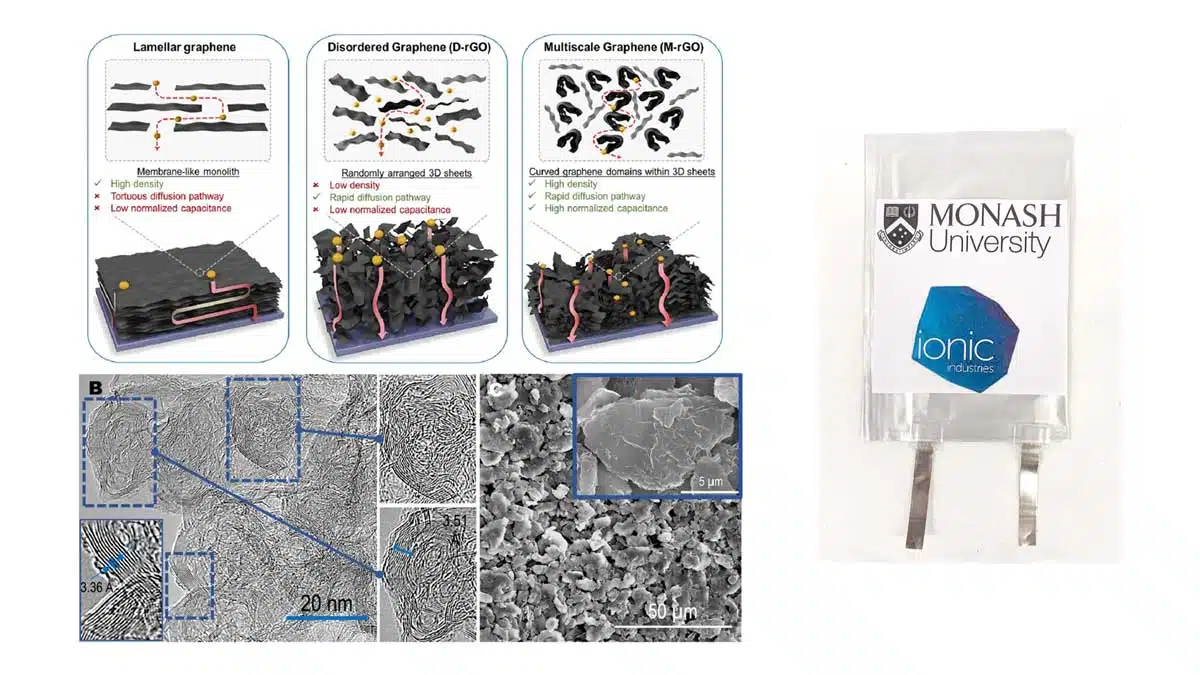
The breakthrough lies in the development of multiscale reduced graphene oxide (M-rGO), synthesized from natural graphite, an abundant Australian resource. Through a rapid thermal annealing process, the researchers crafted a highly curved graphene structure with precise pathways for ion movement, achieving a rare combination of high energy density and high power density.
Dr. Petar Jovanović, a research fellow in the ARC AM2D Hub and co-author of the study, highlighted the impressive performance metrics of the Monash supercapacitors, which delivered volumetric energy densities of up to 99.5 Wh/L in ionic liquid electrolytes, power densities as high as 69.2 kW/L, and rapid charging capabilities with excellent cycle stability. “These performance metrics are among the best ever reported for carbon-based supercapacitors, and crucially, the process is scalable and compatible with Australian raw materials,” Dr. Jovanović stated.
Dr. Phillip Aitchison, CTO of Monash University spinout Ionic Industries and a co-author of the study, announced that the technology is now being commercialized. “Ionic Industries was established to commercialise innovations such as these and we are now making commercial quantities of these graphene materials,” said Dr. Aitchison. “We’re working with energy storage partners to bring this breakthrough to market-led applications – where both high energy and fast power delivery are essential.”
This research, supported by the Australian Research Council and the US Air Force Office of Sponsored Research, underscores Monash University’s commitment to developing advanced materials for a low-carbon energy future.
Nature Communications: Operando interlayer expansion of multiscale curved graphene for volumetrically-efficient supercapacitors.
Key points
- Multiscale design: Curved turbostratic graphene crystallites interwoven with disordered domains enable dense electrodes with rapid ion transport and high capacitive site accessibility.
- Operando interlayer expansion (e‑IE): Stepwise widening of the voltage window drives ion insertion into graphene interlayers, tripling capacitance without excessive electrode swelling.
- High volumetric metrics: Pouch cells deliver 99.5 Wh/L in EMIMBF4 and 49.2 Wh/L in organic TEABF4/SBPBF4, with power density up to 69.2 kW/L at 9.6 Wh/L.
- Fast kinetics: Low ESR, improved Warburg response, and near-rectangular CVs up to high scan rates demonstrate rapid ion transport and excellent rate capability (up to 200 A/g).
- Stability mechanisms: e‑IE forms a thin, stabilizing SEI‑like interphase and reduces ongoing electrolyte degradation, sustaining >90% capacitance over 50,000 cycles and 10‑day voltage float tests.
- Practical fabrication: Two-step rapid thermal treatment at 700 °C, aqueous ink processing with minimal binder, calendering to ~1.42 g/cm³, and scalable pouch-cell assembly with thin separators.
Extended summary
The work addresses a central limitation in supercapacitors: achieving high volumetric energy density in compact form factors while maintaining fast kinetics. Traditional high-surface-area carbons suffer from low packing densities, and lamellar graphene stacks restrict ion access, depressing volumetric performance. The authors design “multiscale graphene” by creating abundant curved turbostratic crystallites embedded in disordered domains. Disordered regions act as reservoirs and transport highways, while curved crystalline galleries serve as high-capacitance active sites, together enabling dense electrodes with fast ion transport and high volumetric performance.
Synthesis involves a two-step rapid thermal process of graphite oxide (GtO): flash exfoliation (~2 s residence at 700 °C) produces disordered rGO (D‑rGO), then a second rapid thermal step (700 °C, N2, up to 12 min) promotes sp² restoration and crystallite growth. HR‑TEM reveals tangled, curved turbostratic crystallites with varied interlayer spacing (~0.336–≥0.351 nm). XRD peak deconvolution confirms coexisting disordered, turbostratic, and graphitic domains; Raman shows reduced ID/IG and narrower G‑band FWHM. BET indicates mesopore narrowing while maintaining micropore volume. Gentle roll‑milling improves processability, and tape‑cast electrodes are calendered to densities approaching graphite (~1.42 g/cm³).
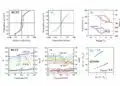
To activate the latent interlayer galleries, the team applies an operando e‑IE protocol by progressively expanding the voltage window (in TEABF4/ACN, up to 3.8 V during conditioning). Capacitance surges nonlinearly beyond ~2.7 V, rising from ~44 F/g to ~231 F/g at 3.8 V, and stabilizes to ~153 F/g upon returning to 2.7 V—producing ~3× hysteresis gains. Ex‑situ XRD at intervals reveals broadening and shifting of the (002) reflection and emergence of an intercalation peak (~16.6°), corroborating ion insertion and interlayer expansion. Operando dilatometry shows modest electrode swelling (~11%) relative to the capacitance gains.
Electrochemical impedance spectroscopy highlights low ESR (~0.6–0.8 Ω·cm²) and improved diffusion reflected by a ~3× drop in the Warburg coefficient after e‑IE. Frequency-resolved analysis shows growth of low-frequency capacitance (<1 Hz), indicating activation of deeper, more confined storage sites without compromising meso‑macro transport. Rate tests maintain near-rectangular CVs up to high scan rates, with capacitance sustained at extreme specific currents (e.g., ~119 F/g at 200 A/g). Ion-size studies across ammonium cations reveal an inverse relation between cation diameter and pre‑e‑IE capacitance, but larger cations induce more dilation and, beyond a threshold, exfoliation; thus electrolyte selection must balance accessibility and structural integrity.
The multiscale architecture yields exceptionally high surface‑area‑normalized capacitance (e.g., ~85.5 μF/cm² in organic electrolytes), exceeding typical EDLC limits. Dunn’s method suggests a significant partial Faradaic‑like contribution (~27–32%) arising from ion insertion into size‑matching curved galleries under nanoconfinement, while disordered domains sustain rapid EDL formation. Curvature effects and nanosizing shorten diffusion paths and reduce activation barriers, supporting the high rate capability. Optimized devices at ~6.1 mg/cm² areal loading, thin separators, and high active material volume fraction demonstrate industrially relevant configurations.
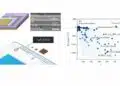
Device‑level metrics are compelling across electrolytes: in neat EMIMBF4 at 4 V, volumetric capacitance reaches ~280 F/cm³ and energy density ~99.5 Wh/L (power ~17.7 kW/L at ~9.8 Wh/L), with modest gains at elevated temperature (45 °C). In organic electrolytes, the devices achieve ~49.2 Wh/L with power density up to ~69.2 kW/L at ~9.6 Wh/L—among the highest reported for carbon-based EDLCs under practical stacks. Long‑term cycling at 10 A/g shows >90% retention over 50,000 cycles in TEABF4 and SBPBF4, while 10‑day voltage float tests exhibit low ESR rise (<12%) and >90% capacitance retention, rivalling commercial benchmarks.
Post‑mortem analysis indicates that e‑IE drives formation of a thin, stabilizing SEI‑like interphase that curbs ongoing electrolyte polymerization and deposition, preventing transport‑inhibiting films seen in controls without e‑IE. Separator surfaces and XPS confirm reduced filming and stabilized surface chemistry in e‑IE-treated M‑rGO. Under restricted electrolyte volumes, e‑IE cells maintain high retention (~96% over 3000 cycles), whereas non‑e‑IE cells degrade rapidly (~78%). The stabilized interphase, combined with reduced effective contact area from multiscale curved crystallites embedded in micron-scale particles, underpins durability under harsh operational regimes.
Conclusion
By pairing a multiscale curved graphene microstructure with operando interlayer expansion, this work unlocks dense, fast, and durable supercapacitors that close the volumetric performance gap. The architecture activates confined high-capacitance galleries while preserving rapid transport pathways, and e‑IE establishes a protective interphase that sustains performance across electrolytes, loadings, and stress tests. The methods, metrics, and stability mechanisms together chart a practical path to volumetrically efficient, high‑power carbon EDLCs.
Read the full paper:
Jovanović, P., Sharifzadeh Mirshekarloo, M., Aitchison, P. et al. Operando interlayer expansion of multiscale curved graphene for volumetrically-efficient supercapacitors.Nat Commun 16, 8271 (2025). https://doi.org/10.1038/s41467-025-63485-0